Tag Archives: echo chamber

What Michael Henson Doesn’t Want You To Read

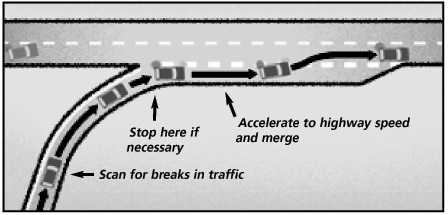
Awareness of the Minnesota Orchestra lockout grows daily. However, if you’re just tuning in, I imagine it’s tough to know where to start. So to make things easier, I tagged some entries “merge lane.” These are entries that don’t require any background knowledge about what’s been going on. Pick a few merge lane entries to read, and soon you’ll be up to speed!

merge

Welcome to the Minnesota Orchestra lockout information highway!

However, if you prefer to tackle things chronologically, I do keep an extensive “table of contents” here. And you can always explore topics using the tags in the right-hand column of the blog.

For this particular “merge lane” entry, I gathered 25 quotes that contradict the narrative Minnesota Orchestra CEO Michael Henson has been selling the last couple of years…in other words,”What Michael Henson Doesn’t Want You To Read.” Enjoy!

***

An orchestra does not recover easily, from such drastic cuts, if ever. – former Minnesota Orchestra music directors Edo de Waart, Stanislaw Skrowaczewski, Neville Marriner, Star Tribune editorial, 6 October 2012

Continue reading

Leave a comment

Filed under Labor Disputes, Minnesota Orchestra

Save Our SPCO’s Presentation to SPCO Management

While we await news from St. Paul…

Here’s a link to the PDF presentation that Save Our SPCO gave to St. Paul Chamber Orchestra Interim CEO Dobson West and various SPCO board members yesterday. I don’t really have much to say about it besides it’s absolutely fabulous, and I hope that eventually Minnesota management will agree to a similar kind of meeting with Orchestrate Excellence.

This should be a watershed moment in both these conflicts. Are Dobson West and Michael Henson more interested in actual problem-solving…or pouring gas onto the fires of their own ideologies? For too long, too many of us have feared they’re really more interested in the latter. But their responses to these passionate well-educated audience advocacy groups should let us know for certain.

Click to access SOSPCO-Presentation-2013-02-11.pdf

2 Comments

Filed under Labor Disputes

My MPR Commentary

I’m a contributor to Minnesota Public Radio now!

Minnesota Orchestra’s ‘fresh start’ needs to go beyond talks with musicians

So – yeah! A big thanks to everyone at MPR who helped to make this happen. It’s an exciting opportunity, and I’m grateful for it.

If you feel moved to, please share my article via the social network of your choice. Facebook, Twitter, Google+, email, or printing it out and actually sharing it with someone when you speak to them face to face.

And if you want to get news and links like this RIGHT AS THEY HAPPEN, feel free to like SOTL on Facebook.

And Mr. Henson, or Mr. Campbell, or Mr. Davis…any time you want to contact me, feel free… We’re waiting… *checks watch* *smiles politely*

Once again, I reiterate: I am not a scary individual. I am ninety pounds, 5’5″, and disabled. You would win in a fight. What are you afraid of?

8 Comments

Filed under Labor Disputes, Minnesota Orchestra

Woods Bowman’s Amazing Article on Non-Profit Ethics

Here’s an article called “Nonprofit Accountability and Ethics: Rotting From the Head Down,” by Woods Bowman. I’ve heard snippets here and there since it was posted in October but didn’t actually sit down to read the whole thing until yesterday. This was a mistake on my part. Go read it now – go, go, go.

Here are selected passages and my reactions.

The article starts off:

Arguably, the public holds nonprofits to higher ethical standards than government or businesses. Over 25 percent of Americans report having “a lot” of confidence in charitable organizations compared to 9 percent for government and 7 percent for major corporations,1 but do nonprofits deserve that confidence?

Interest: piqued.

Continue reading

6 Comments

Filed under Labor Disputes, Minnesota Orchestra, The Orchestra Business

Minnesota Orchestra Sibelius Grammy Concert

Was not expecting this…

From Mayor Rybak’s office:

Mayor R.T. Rybak and Minnesota Orchestra benefactor Judy Dayton today invited the public to a community celebration that they are hosting on Friday evening, February 1 to mark the Minnesota Orchestra’s nomination for a Grammy Award. The celebration will take place at the Minneapolis Convention Center.

The Minnesota Orchestra has been nominated for Best Orchestral Performance at the 55th Annual GRAMMY Awards for its recording of Jean Sibelius’ Symphonies Nos. 2 and 5, conducted by Osmo Vänskä and released by the Swedish label BIS Records. The winner in the category will be announced on February 10.

Mayor Rybak and Ms. Dayton invited Minnesota Orchestra musicians and Music Director Osmo Vänskä to perform these nominated works at the February 1 community celebration. If the musicians and Music Director Vänskä accept the invitation, ticketing information will be announced to the public soon thereafter.

“The difficult labor dispute has taken its toll, but for this one night, we ask everyone to set negotiations aside and come together as a community to celebrate the Orchestra’s extraordinary achievement and listen to their beautiful, Grammy-worthy performance,” Mayor Rybak said.

“The Minnesota Orchestra is one of our premier civic treasures,” said Ms. Dayton. “We must not miss the opportunity to honor their nomination for this prestigious award, regardless of the circumstances.”

From the Star Tribune:

Minneapolis Mayor R.T. Rybak and Judy Dayton, a longtime arts benefactor, are hoping that both sides in the Minnesota Orchestra labor dispute will set down their arms for one night and celebrate the ensemble’s Grammy nomination.

Rybak and Dayton have invited the players and music director Osmo Vanska to perform the Sibelius Symphonies No. 2 and 5 on Feb. 1 at the Minneapolis Convention Center. The orchestra’s recording of those two pieces have been nominated for Best Orchestral Performance. The Grammy winner will be announced Feb. 10.

“We are obviously in a complicated labor issue right now,” Rybak said in an interview Wednesday afternoon. “But it would be a tragedy in my mind if the dispute prevented this community from celebrating the fact that we have an institution that is up for a Grammy.” …

From the musicians:

The Musicians of the Minnesota Orchestra are honored to be invited by Mayor R.T. Rybak and Orchestra benefactor Judy Dayton to perform at a Grammy celebration concert on February 1st, 2013.

The Musicians recognize the significance this Grammy nomination holds for our community and the Orchestra’s reputation, as well as the importance of joining Osmo in performing these Sibelius works for our audience.

“This is a tremendous gesture by the Mayor and Ms. Dayton,” Principal Trombonist Doug Wright said. “It will be the Musicians’ distinct honor to accept their invitation and join our Music Director on stage for a performance of these Grammy-nominated works for our community. It should be a concert to remember.”

So.

Will you be there?

You could go to this.

17 Comments

Filed under Labor Disputes, Minnesota Orchestra

SOTL on MPR

SOTL on MPR…

Many patrons, like Emily Hogstad, were left wondering how it will all play out.

“I have no idea yet,” she said. “I think it is way too early for anybody to know, as crazy as that sounds because it’s been going on for a while.”

Hogstad writes The Song of the Lark, a detailed and deeply researched blog that has explored the intricacies of the Minnesota Orchestra dispute. She supports the musicians’ cause and is frustrated by the lack of progress.

“I think if there are changes, they are happening behind the scenes,” Hogstad said, “and we have to do all we can to pressure those who we disagree with to maybe come around to our point of view.”

Hop down a couple of paragraphs and we hear from Michael Henson…

In Minneapolis, Minnesota Orchestra President Michael Henson agreed that the issues will take time to resolve. Musicians have not made a counteroffer to a contract proposal first put on the table in April.

When asked directly if his negotiating team might make a new offer to break the logjam, he said: “We’ll continue to evaluate the most appropriate solutions to find a resolution to this.”

However, he returned time and again to the board’s belief that the orchestra needs to reduce its annual budget to $26 million in order to survive.

So helloooooo, Michael Henson! Any time you want to stop pretending you don’t know who I am, feel free! I promise not to hold your silence against you. All I want is to hear from you and have you answer a few questions. That’s all. I promise.

Maybe if I greet you with some British GIFs gleaned from the Internet, you’d be more likely to return my greeting…? Well, it’s worth a shot. Here goes.

tumblr_lq10nswdMs1qklp22o1_500


tumblr_inline_mfpksbk0551rv1jfr


tumblr_memf54Jcol1r1b3rxo1_500


6 Comments

Filed under Labor Disputes, Minnesota Orchestra

Analysis of the MOA’s 12/21 Letter to the Legislature

Well. When it rains, it pours.

On December 21st, the MOA sent a six-page letter to the state representatives who contacted them on December 6th, asking the MOA for information about their finances. The first page of the reply consists of addresses; the second and third, standard boilerplate taken verbatim from the MOA’s website. I’m not going to bother rebutting the boilerplate here, because I’ve already done so in previous entries, but if anyone from the government is reading this and wants an informed outsider’s perspective about the letter, please contact me at the following email address: songofthelarkblog[at]gmail[dot]com. I will gladly explain to you sentence-by-sentence how and why this letter is misleading. It only tells part of the story, and as lawmakers, I think you deserve to hear a broader perspective. I’ve been covering this story since late August, and I’d be delighted to help you gain that broader perspective, and answer any questions you may have.

The fourth page of the MOA’s letter starts getting more specific…so let’s start our analysis there.

In your December 6th correspondence, you make the following specific requests of the Orchestra:

a. Provide the musicians the current financial documents that they have repeatedly requested.

The Orchestral Association has been transparent with its financial information. Since this negotiation began in April, the Orchestral Association has shared over 1200 pages of information, including the following:

  • Audited Financial Statements (2011 and 2012) (The 2012 Audited Financial Statement was released on December 6, the date on which the Board approved it);
  • Monthly Finance Committee Meeting Minutes (2009 through 2012);
  • Monthly Financial Updates to the Board of Directors and Committees (2009-2012);
  • Profit and Loss Reports;
  • Contribution Reports (2009-2012);
  • Building for the Future Reports (2009-2012);
  • Investment Policies and Objectives;
  • Information Related to the annual draw from the endowment for fiscal years 2010-2013; and
  • Actuarial Report for the defined benefit pension plan

Looks impressive…at first glance. The only problem? These are not the financial documents that the musicians have requested. According to the musicians, this is what they want:

  • The 2012-2013 budget
  • The FY2012 audit. This may very well have been released to musicians on December 6, but according to them, for months beforehand, the MOA refused to release reports they gave to the auditors. Hopefully a copy of the audit is indeed now in their hands. But the only reason it is is because it was released to the public at the same time. It wasn’t because they were interested in clarifying the situation for musicians.
  • An answer to the question “if the ‘substantial decline’ ($15.25m) in contributions and pledges from key staff, Board members, and Board-member influenced organizations between fiscal years 2010 and 2011, was related to these contract negotiations.”
  • Oakleaf Trust meeting minutes
  • Answers to “a series of questions related to Endowment Fund policies, practices, and projections.”
  • A joint independent financial analysis, which, according to the musicians, would “cover an institution’s viability, stability, business plan, strategic plan, the quality of its management, comparative performance, [and] present and future prospects…” It would also “assess current and future trends, opportunities and risks.”

And of course the MOA knows this. They’re just hoping that legislators won’t have the time to dig to find what the musicians really want.

b. Return to the bargaining table in good faith with the musicians and resolve the contract negotiations expeditiously in a way that preserves the public interest and investments in the Orchestra

The Orchestral Association is ready and willing to engage in negotiation discussions. As a matter of fact, we specifically put forward our contract proposal in April, five months before the end of the contract, to allow ample time for discussion.

I think it’s worth reminding people here that way back in September, the MOA released that proposal to the public weeks before the old one expired, without telling the musicians they were going to do so. Needless to say, that’s not acting in “good faith.”

Keep in mind as well that during all these months, the MOA has not moved, or given the musicians the financial information they’ve requested. They might tell legislators that they’ve proposed two contracts, and that’s true…technically. But the second proposal still included about 97% of what they originally wanted. Not much negotiation or compromise happening there.

So no matter what the MOA says, nothing they’ve done over the course of this negotiation has been done in good faith, or with respect. Accordingly, they will need to do much more than send a letter to the legislature to regain the trust not just of the musicians, but of the taxpaying public.

More than eight months later, the musicians have not yet put forward a single counterproposal to allow for discussion at the table. We were very pleased to accept an offer from the federal mediator’s office to get involved: the federal mediator has not yet been successful in encouraging the musicians to come back to the table with a counterproposal either.

First of all, the main reason that the musicians have not submitted a counterproposal is because they don’t have a clear idea of what is happening with the MOA’s finances. (As we’ve already seen.)

Second, a counterproposal is simply not necessary for discussion. It never has been; it never will be. Read what orchestra expert Drew McManus says here. Mr. McManus, a respected consultant and a consummate professional, goes so far as to say that what Mr. Campbell and Mr. Henson are proposing is “a trap.” Once a counterproposal is on the table, it’s possible that could turn the conflict from a lockout into a strike, and that has ramifications, shall we say. Even more irritatingly, until December 21, the MOA was clear that they were not interested in even coming back to the table until a counterproposal was made. (Mr. Campbell and Mr. Davis, on November 28 in the Strib: “The musicians’ negotiating team appears to be avoiding at all costs our request to come back to the table with a substantive counterproposal.”) Now, of course, the MOA has changed their tune, saying there will be “no preconditions” on their proposed January talks. It’s still unclear whether this is a kind of publicity stunt, or if pressure from donors, patrons, and government officials is finally encouraging them to be more transparent. Based on their past actions, I’m going to guess the former…but we simply can’t know yet for sure. Let’s hope the MOA provides all information the musicians request, and that I’m proven wrong.

c. Provide the necessary financial documentation that assures the public that they have not been funding the lockout of the musicians and that no public funds were used to pay costs associated with the management discussion to shutter this premier cultural attraction in our state

The Orchestral Association has not used any public funds to fund administrative expenses of the lockout.

The Orchestral Association has received a total of $641,677 in the State’s current fiscal year in grants from the Minnesota State Arts Board, which in turn came from the general fund and the Legacy fund. These grants are for general operating support. We are extremely appreciative of this funding, as it goes to support a portion of the general operations of the Orchestra, including musician salaries and benefits paid.

Let’s stop right there and get a little clarification as to what the phrase “administrative expenses” means. From WiseGeek:

Administrative expenses are costs that are associated with the management and general functions of an organization and are not directly related to a specific department. Sometimes considered part of general business expenses, these costs can be for basic needs such as rental space for the business, utilities or office supplies. Administrative costs also can include the salaries of people who are not involved in sales, production or other departments within the company, such as senior executives, secretaries and receptionists.

Then, later on the page:

For charities and other [non]profit organizations, administrative costs are often defined differently from the way for-profit businesses define them. In many cases, any money that is brought into the charity organization and spent by the organization instead of being turned into charitable efforts or donations is counted as an administrative cost. Therefore, all of the costs of running the organization, such as for salaries, marketing, rent and utilities, would be called administrative expenses.

And here’s the definition of general operating expenses from the Foundation Center:

grants for the day- to-day operating costs of an existing program or organization or to further the general purpose or work of an organization; also called unrestricted grants

So if I’m understanding correctly, the funds given to the MOA from the State of Minnesota went to general operating support, but not to administrative expenses related to the lockout. So…where exactly is that place? Would it be out of bounds to ask for further clarification? Did all of the public money go to musicians’ salaries? Mr. Henson’s salary? Rent for temporary offices? Did it go into the endowment? If so, where in the endowment? Did any of the money go to the hall renovation? If so, how much? Why? And what is “security” mentioned by the WCCO report? Is “security” an administrative expense? (What does “security” even mean in the context of an orchestra?) As you can see, the definitions get slippery quickly, especially since non-profit definitions can differ from for-profit ones. Some of our non-profit buffs may want to jump into this discussion in the comments. What do you think the MOA could be talking about here? (And as always, MOA, you’re more than welcome to get in touch with me directly… You know how much I’d love to hear from you. I’ve lost track of the number of times I’ve asked for you to respond to my questions over the months…)

d. A full accounting of what funds have been used for marketing the Building for the Future Fund, public relations related to the Fund of the lockout.

The Orchestral Association has relied on distributions from the endowment for costs associated with marketing, public relations and fundraising related to the Building for the Future Campaign and, as noted above, for costs associated with administration expenses related to the contract negotiation. We have worked hard to keep our campaign expenses low. These costs average about 1.5 of our annual fundraising total, compared to an industry standard that is between two and five percent.

I sure hope you’re right. I’m so hesitant to take anything the MOA says at face value. I always feel like there’s a trick behind everything they say, and many patrons feel the same. Needless to say, this isn’t a great position for a non-profit to be in.

e. A transparent representation of how endowment funds have been accounted for in loans and distributions to give the public perception of a balanced budget as Orchestra.

I’m not going to re-type everything that the MOA said in answer to this point, as they went into quite a bit of meandering detail. (It’s quite amazing how much they can say without saying anything at all…) Once again, you can read what they say here. But suffice it to say, not once does the MOA address why, back in 2009, they were planning to run deficits in 2011 and 2012.

From the MOA’s letter:

The Orchestra’s new strategic plan [adopted in 2011] calls for reductions in the rate of endowment distributions and continuing to show a balanced budget from operations would not accurately portray the financial condition of the Orchestra.

No…………..kidding, Sherlock. But isn’t this a tacit admission that showing a balanced budget from operations in 2009 and 2010 also didn’t accurately portray the financial condition of the Orchestra? The MOA can try to pussyfoot around this – cloak this in euphemism – write things on official-looking letterheads – but there’s really no getting around the fact they misled everyone.

This is what the MOA wants you to believe happened: throughout 2009 and 2010, while the economy was in freefall, the MOA was trying to figure out if bad things were happening to their finances (or, in their words, seeking “to better evaluate the depth and likely length of the recession and its effects on all sources of revenue”). As they were evaluating, they increased their draws from the endowment to meet expenses, but didn’t publicize the fact. And not only that, they trumpeted their extraordinary financial health to their patrons, the legislature, and the international press. (If you haven’t already, read this article from 2010: “With orchestras across the US hard hit by the recession – and management strategies the number-one talking point at the League of American Orchestras’ conference in June – the Minnesota Orchestra stands out as a beacon institution among the bad news.” That sentence was on their website until October of 2012, when I called them out on it and they pulled it from their website, without explanation.) But after the request for the $14 million from the State was approved, and after they’d gotten the additional private money they wanted for the Building for the Future Campaign, they finally decided to attack the problem by adapting a new strategy (“a restructured business plan”). Keep in mind that this plan had zero – zeroZERO – public input…and it’s a strategy that experts from around the country have said will completely decimate the artistic quality of the orchestra. It also was the MOA’s first public acknowledgment that they had a financial problem. Do you really think they were so stupid that they didn’t know there was a problem in 2009 and 2010? Really? No. They knew. There was no reason they couldn’t have been honest with us. And they weren’t. And they don’t even acknowledge the dishonesty in this letter.

They continue:

As noted above, public funds have not been used in this way. For avoidance of any doubt and to give you the assurance you are seeking, the Orchestral Association will immediately sequester in a separate account the funds that have been received from the Minnesota State Arts Board thus far in this fiscal year and will sequester any payments that are scheduled to be made going forward, until the contract negotiation is completed.

What does this do? Who, if anyone, will be overseeing this process? Have any funds already been spent? If so, on what? So many questions…

From yesterday’s MPR article: MN Orchestra re-opens negotiation talks, cancels concerts:

St. Paul DFL Rep. Alice Hausman, chair of the House Capital Improvement Committee, was one of the lawmakers who signed the letter. She supported giving the money for Orchestra Hall, but said it is important that musicians be treated fairly, as without them there would be no orchestra.

Hausman said she was pleased to hear about the sequestering of the Legacy funds.

“Having made that assurance, I personally would say, OK, I would take your word for it, you are going to put it in a separate account,” Hausman said. “And in that case I would probably say no legislative hearing would probably be necessary.”

However, Hausman said upcoming hearings on more Legacy funds for the orchestra will be problematic if the lock out continues.

“If the orchestra isn’t playing, ensuring we can’t send checks there, unless we have some sense that that is only going to be held for salaries for musicians,” Hausman said.

My dear Rep. Hausman, you are so awesome for looking into this, and I’m so so so deeply appreciative, but please, I beg you, don’t make that mistake! This problem goes way beyond if Legacy funds were used to fund the lockout. This is about a CEO misleading the state legislature, saying that his organization has “announced” balanced budgets, and that it is “facing the current economic downturn with stability,” when in fact it was doing no such thing. This is about a major non-profit believing it is okay to pre-plan deficits three to four years ahead of time, in order to be better positioned to get money from the government and wring concessions out of workers. (From the Star Tribune, November 26: ““Balances in 2009 and 2010 would support our state bonding aspirations,’ Bryan Ebensteiner, vice president of finance, told the orchestra’s executive committee in September 2009, ‘while the deficits in 2011 and 2012 would demonstrate the need to reset the business model.'” A “reset business model” is, of course, code for slashed salary and benefits.)

If Michael Henson and the Minnesota Orchestra management can get away with this, then other leaders will be emboldened. A disease of distrust will start to spread. We must not allow these individuals to set a precedent: this is not the way to do business in Minnesota. A sequestered account, while it may be a step forward, is not adequate. We still need that hearing. We need additional pressure from our elected officials. The public has too many unanswered questions, which the MOA refuses to answer. Keep in mind, not a single representative from the MOA has given an in-depth public interview about what is going on. Not one. This despite the fact that many writers have outstanding requests for interviews, including me, Matt Peiken from MNuet, and Drew McManus. If the only way we can get accountability is through the legislature, well, then so be it: let’s go through the legislature.

On the plus side, I’ve heard that Rep. Jim Davnie (the legislator in the WCCO video) is really fired up about this. A reader showed me a non-auto-reply email she got within a couple of hours of writing him…on Saturday. He said that he will “continue to work on this until the lock out is ended and the musicians return to work.” That’s comforting.

And also, here’s another tiny victory from the MPR article:

Henson said management is also prepared to respond to the musicians’ concerns about recent changes in the orchestra’s mission statement. He said the statement will revert to its original form except for three changes to expand the orchestra’s activities in the community.

So, we’ve restored “orchestra” to the mission statement. That’s…not nothing.

But one does wonder why exactly it was taken out in the first place. And I’m not going to express wholehearted approval until I see the precise wording of the new version of the old mission statement. But it’s…something, I guess. It’s one tiny little bit of movement toward accountability. I’m going to assume it’s a sign of pressure being applied behind the scenes.

So. Anyway. I think the moral of the story is: keep writing legislators. Keep a (polite) drumbeat pounding. They’re obviously looking into this. The pressure is on. But we need to keep encouraging them. A slap on the wrist is simply not enough: we need, and we deserve, accountability. This can’t be allowed to happen again.

Once again, I encourage anyone from the legislature to contact me at songofthelarkblog[at]gmail[dot]com if you want to speak privately about any of this. I’ve written about this conflict since late August, and gotten international attention for doing so. If I don’t know the answer to something, I will know exactly the person to direct you to. Trust me, I have lots of questions for Mr. Henson and Mr. Campbell. I’d be delighted to pass them along to you.

8 Comments

Filed under Labor Disputes, Minnesota Orchestra

BREAKING: Lawmakers Call For Hearing Into Minn. Orchestra Finances

I wanted to be the first blogger to break it:

http://minnesota.cbslocal.com/2012/12/20/lawmakers-call-for-hearing-into-minn-orchestra-finances/

More information as it develops…

30 Comments

Filed under Labor Disputes, Minnesota Orchestra

Analyzing the Almanac Interview

On today’s docket: analyzing Doug Kelley and Tony Ross’s November 30 appearance on Almanac. Please watch it or read the transcript before continuing.

I believe this is the longest live interview that a Minnesota Orchestral Association (MOA) representative has given. Over the months, the musicians have been much more interested in speaking to the public than the MOA has been. Musicians spoke with us individually after their convention center concert. In late October, Ellen Dinwiddie Smith gave an in-depth interview with Matt Peiken. (This proved to be one of the more clarifying media events of the lockout so far.) The musicians also have provided an email address on their website that you can use to get in contact with them, and their Facebook page is thriving. Contrast that with the MOA’s relative silence. We’re still waiting on Mr. Henson to accept Mr. Peiken’s request for an interview, and for Mr. Campbell and Mr. Davis to accept Drew McManus’. The only reciprocal contact we have with management is via its Facebook page…and that’s marginally reciprocal, at best; the responses there consist of little more than regurgitated talking points. (Go ahead and check it out for yourself.) Also, the MOA’s recent annual meeting was closed to the public, and no announcements of any kind of open meeting have been made. So I’m going to assume that this Almanac segment is about as lengthy and in-depth a live discussion as the MOA is willing to risk. What else am I supposed to think?

As you can imagine, this frustrates me to no end. Rightly or wrongly, it makes me feel as though the MOA is hiding things and is afraid, contrary to what they keep asserting. If they don’t have anything to hide, and if they aren’t afraid of anything, then why aren’t they answering as many questions as possible? Why aren’t they giving more live interviews? Anyone can write an editorial or say a few sentences to the Pioneer Press without making a fool of themselves. Those are not difficult things to do, and I can say that with authority, because I’ve done both. The tricky part is engaging with another person in front of an audience – thinking on your feet – being able to defend and articulate your vision in a fair, respectful, factually accurate manner. It becomes increasingly obvious that Mr. Henson, Mr. Campbell, and Mr. Davis don’t feel up to the task of defending their position. Prove me wrong, gentlemen. Please.

Anyway. Here’s my point: the longest interview they’ve given has only lasted ten minutes, and that’s with both sides involved, so it’s probably actually closer to five, and that’s really sad and ridiculous, and it pisses me off. Consequently I’m going to hold Mr. Kelley to a very very very high standard of truth tonight. If this is the longest live interview the MOA is willing to give, then they’d better make it as accurate as possible.

***

Erik Eskola: Well, Mr. Ross, let me start with you. The independent audit that has been sort of at the center of this is due out next week. Will that get things off the dime here, or – ?

Tony Ross: No, we’re really looking for an independent financial analysis, not an audit that is produced by their side. There’s so many fuzzy numbers, numbers we don’t understand, that we need an independent joint analysis to be able to go further at all. And an audit just simply doesn’t do it. It looks backward. The analysis looks forward, looks at all kinds of things, as far as you know, management’s – the atmosphere of management, the workplace, the mission statement, the future of the band.

The interview began with Tony Ross articulating what musicians want to see in addition to an independent audit. There are more details about what they want on the musicians’ website:

Audits do not cover an institution’s viability, stability, business plan, strategic plan, the quality of its management, comparative performance, or present and future prospects. A joint, independent financial analysis would review all of these things, and would assess current and future trends, opportunities and risks.

Before the musicians even revealed that they were seeking such things, resident guest-blogger Mary Schaefle was thinking along similar lines in her two entries here on SOTL:

Do management and the Board have a new set of projections for future years? A review by an investment analyst, which is typically not part of an audit, is needed…

As I pointed out in the comments section of Emily’s earlier post on the endowment, the draw amounts released by Minnesota Orchestra do not match their tax forms. That means percentages are off as well. Yes, we once again need that accountant…

You may remember my suggestion in the last article for an independent financial analysis. The questions I’m raising here wouldn’t be answered by that kind of oversight. A respected leader in performing arts management, preferably orchestra management, would be the best person to review the strategic plan to ensure it is sound…

Of course I don’t know if the musicians are seeking exactly what Mary is suggesting or would suggest. But we do seem to be coalescing around the same general idea: we want a team of outside specialists to come in to provide additional perspective on many subjects, such as the feasibility of the strategic plan, future investment projections, comparisons of the Orchestra with other similar organizations, etc., etc., etc. And I wonder what we should be calling this…review? inspection? examination? scrutiny? study? I don’t know what word to use, and for a writer like me, that’s frustrating! The phrase “joint independent financial analysis” may cover part of what we want to see happen, but I’m not sure that it covers all of it. For instance, I don’t think that someone just tuning in would necessarily understand from the phrase “joint independent financial analysis” that we’re also discussing things like having someone review the strategic plan, or quality of management, etc. On the other hand, I have no idea what to actually call what we want. Hmm.

Sorry; that was a bit of a tangent. But it was a thought I wanted to throw out there before I forgot.

Back to the interview.

Cathy Wurzer: You’re still dealing with a structural budget problem, no matter how you slice it, correct? According to information from the Star Tribune, minutes of board meetings and that kind of thing, you’ve had the structural budget problem for a while. And from 2009 to 2011, there was no public mention of any trouble. So I’m wondering here. You opened the door to accusations that you misled the public, your donors, and lawmakers during that time.

Doug Kelley: Well, I’m glad you asked, because I’d like to put that to rest.

As you’re reading the rest of Mr. Kelley’s response, look for where he puts it to rest.

We, like every other organization, we have income, and we have expenses. And they are certified by an outside accounting firm every year. And those numbers are given to the musicians. We file a tax return. Everybody knows you don’t lie on your tax return. And that’s given to the musicians every year. I think the dispute this week is about the budget and how that works. Let’s say we budget $8 million to come from the endowment, and at the end of the year the expenses are greater and we draw $10 million from the endowment. That number – every penny – is accounted for. It goes down, put on all the income tax return and everything else. It’s as transparent as you can be, and we have done that every year, and those numbers are public. The musicians have them. If they want to do a forward-thinking analysis, the first place they’d go would be to a certified financial statement or tax returns. Those are sort of the gold standard documents in financial analysis. And I think that the musicians should really kind of back off the accusation that we misled the legislature. We gave them every number and were totally transparent with them.

Did you catch the part where he explains why the MOA didn’t mislead the public? Where he explains why there were no mentions of trouble from 2009 to 2011? If so, you’re seeing something I’m not. I didn’t realize how blatantly he avoided the question until I worked up the transcript. I shouldn’t have been, but frankly I was shocked. And at this point I have a pretty high shock threshold.

Since I’m an obsessive detail-oriented freak, let’s break his words down even further.

We file a tax return. Everybody knows you don’t lie on your tax return.

Yes, apparently Doug Kelley believes it’s impossible to lie on your tax return…? (Not that I’m saying the MOA has. But to give as proof that they haven’t the sentence “everybody knows you don’t lie on your tax return”? That’s weak.)

 I think the dispute this week is about the budget and how that works

The dispute “this week”? Wow, way to treat us like teenagers whining because we can’t get the latest iPhone. This kind of dismissive attitude will work well to regain our trust. *thumbs up*

If they want to do a forward-thinking analysis, the first place they’d go would be to a certified financial statement or tax returns.

Notice he says “the first place”…insinuating that it wouldn’t be “the only place.” Is Doug Kelley making our argument for us?

And I think that the musicians should really kind of back off the accusation that we misled the legislature.

Welllllll, unfortunately for management, lots of other people are going to keep beating on that drum, even if the musicians would for whatever reason stop. I for one am not backing off my personal belief that Michael Henson straight-out lied to the legislature. I know that many of you agree with me. The Minnesota AFL-CIO is promising to “urge Legislators to look into the situation in January.” At least one legislator is feeling betrayed, and going so far as to urge her colleagues to “think critically before voting on any legislation that would further direct public dollars into the Minnesota Orchestra (or the St. Paul Chamber Orchestra).” In future I think Mr. Kelley would do well to acknowledge that the MOA has, rightly or wrongly, lost the trust of a large segment of the public, as well as musicians.

Okay, onto the next chunk…

CW: However, Mr. Henson in January 2010, talking about bonding money in front of the committee said, “On the financial front, we have announced balanced budgets over the last three consecutive years. We are facing the current economic downturn with stability.” But that wasn’t the case.

DK: The orchestra’s 110 years old. It’ll be on for a long time after this dispute is over.

Around in here I almost start feeling pity for Doug Kelley, and for the impossible argument he’s being asked to sell. Because in order to make his case semi-convincingly, he’s forced to resort to the following logic: if something is 110 years old…it is immortal.

This is a 110-year-old woman named Mary Brown. She attributes her cenetenarian status to “having an inquiring mind, not driving and sprinkling all of food with plenty of salt.” She is also, if I’m following Doug Kelley’s logic correctly, immortal.

Here’s a question for Mr. Kelley. It sounds stupid, but bear with me. What is the Minnesota Orchestra? Is it any old group of orchestral musicians with the label “the Minnesota Orchestra” slapped onto it? Or is the Minnesota Orchestra these specific musicians – this specific ensemble? If we use the former definition, then yes, the Minnesota Orchestra will likely continue to exist after this dispute is over. However, I believe that most of us would prefer to employ the latter definition. And we know that it’s very possible – if not probable – that this Minnesota Orchestra will not exist after the lockout ends. There are too many fabulous players taking too many attractive auditions. Trust me.

But. So when you take that $10 million out of the endowment and you cover your expenses, you match income with expenses. That’s a balanced budget by anybody’s definition.

Oh, for…crap’s sake.

Does this mean that if I get a cash advance from my credit card, and buy a wicked expensive viola, and therefore match my income with expenses for the month, that I’m facing my fiscal future with stability? Really?

Look, I’ll be extremely generous and grant Mr. Henson the “we have announced balanced budgets” bit, on the technicality of the verb. But the “facing the current economic downturn with stability” part…? I mean. Come. On. Cathy Wurzer is absolutely right: that was not the case.

And the other thing I think that’s a little exasperating is the musicians knew we were trying to figure out how to put the best face on it. We talked to the musicians about that. We shared those numbers with them as early as 2010.

…Maybe you did, but why didn’t you share them with us? And remember, not only was the MOA not sharing those numbers with the public, they were actively misleading the public about those numbers. But of course nobody from management ever mentions that. Talk about exasperating.

DK: Yeah, let me just say, what happened in between the time before and now in how we report these numbers is the recession. The musicians have been shielded from the recession.

Yes, musicians apparently…have no realization that a recession has occurred. Those self-absorbed dunderheads! So busy playing…and making the Orchestra the greatest in the world…they didn’t notice the global fiscal apocalypse. For shame, musicians. Get out from under your rock once in a while. Geez.

You had a 25% increase from 2007 to 2012.

Now this I found interesting, because the MOA website says, “The musicians still received a 19.2 percent increase over the five years of the contract.” (If you want to verify that figure, it’s under Have musicians offered concessions in response to the Orchestra’s financial challenges?“) As Tony Ross said in the interview: these are “fuzzy numbers.” Is anyone else amused by the irony that Doug Kelley refutes claims of fuzzy numbers…by citing fuzzy numbers?

And you remember that first big meeting – I think you were just referring to it – Richard Davis and Michael Henson came in front of you and told you exactly what they were doing. They said, you know, we have reported that we have balanced the budget and we have announced that publicly. And we’re also telling you that we’re about a million five short and we’ve done that because of donors. And you guys knew every bit about that, and that’s why I think it’s so disingenuous to go to the legislature.

?

In the words of Bill O’ Reilly:

Honestly, Doug Kelley might as well be speaking Greek here. He lost me completely, totally, utterly. After I transcribed it, I sat on that paragraph for a while, waiting for an epiphany as to what it meant, but it never came. So a few days ago I went to Drew McManus in the hopes that he could translate the management-ese.

Here’s what I wrote in the comment section of Drew’s blog:

Is Mr. Kelley admitting that they announced the balanced budget only for the donors, thereby reinforcing the idea that the donors were manipulated, even though Mr. Kelley heavily implied earlier in the interview this was not the case? Is this admission as big a deal as I think it is? Aside from the MOA being better positioned to get what they wanted from the state legislature in January 2010, and from the musicians’ union in 2012, what would be the strategic advantage of announcing balanced budgets if you’re going to reveal in a couple years that the financial position wasn’t as rosy as you once said it was? Wouldn’t that be – in Mr. Kelley’s parlance – kicking the can down the road? Or have I totally misinterpreted this? I’m also curious what he meant by “that’s why I think it’s so disingenuous to go to the legislature.” I couldn’t understand if he was talking from the musicians’ POV, or if he was missing a word or two, or what was going on. Am I just being dense here? Does it make any sense to you?

He wrote back:

In the excerpt you quoted, I believe Kelly’s phrasing is such that there’s no way to definitively determine what he is saying here without added clarity.

So um, apparently nobody has any idea what Doug Kelley was actually trying to say. So, hey! Doug Kelley! Feel free to clarify. Comment section’s open. I have absolutely no idea what you were trying to get at. I’d be delighted to listen to a fuller explanation. (If you as a reader think you’ve cracked the code and know what he’s saying, let me know.)

CW: The musicians say, Doug Kelly, that they do not have confidence in Mr. Henson. Has the board voted – has the board discussed Mr. Henson? Do you have full confidence in him?

DK: Yes, we do. Absolutely. And we just – we had a committee meeting to discuss Mr. Henson. Mr. Henson has the unanimous full support of the board.

I know I wasn’t the only one whose ears pricked up at this. Doug Kelley saying “Mr. Henson has the unanimous full support of the board” is something very different from the entire board holding a unanimous vote of confidence in Mr. Henson…or even the entire board discussing Mr. Henson.

I brought this up with Drew McManus, since he’s blogged about the subject:

I know you had mentioned in a previous entry about how we’re not sure what is going on with the Board re: their opinion on Mr. Henson. When asked if the board had full confidence in Mr. Henson, Mr. Kelley said, “Yes, we do. Absolutely. And we just – we had a committee meeting to discuss Mr. Henson. Mr. Henson has the unanimous full support of the board.” Do you think that that’s any indication that a full vote has occurred? Is it likely? Or is it impossible to know based on those words?

Here’s what he had to say in response:

Regarding the board confidence point, I noticed Kelly’s phrasing here too in that he said the committee met to discuss Henson. Although it would be worth confirming, I believe Kelly was referring to the executive committee. If that’s accurate then no, that is not the same thing as a full board vote and/or discussion on the topic.

I’m guessing it was this appearance on Almanac, combined with Jon Campbell’s 11/27 quote, “Michael Henson is a perfect leader at this challenging time and has the full confidence of our board”, that led some bystanders to believe that a full vote had taken place. In fact, MPR actually ran an article that included the phrase “With the board’s recent unanimous vote in support of Henson“, but I (and probably others) contacted them to check if this was actually the case. It turns out it wasn’t. It is official: there has not been a vote of confidence in Mr. Henson, much less a unanimous one. Accordingly, MPR later edited the article.

So. Suddenly, any trust I may have once had in Doug Kelley has vanished. Completely. I feel extremely uncomfortable that he deigned to speak for everyone on the board, without having an actual vote or discussion to back his words up. Is it possible that every single one of the eighty-odd members of the MOA board have total confidence in Michael Henson? Absolutely! But do we have any objective evidence to back that assertion up, like we do with the musicians’ vote of no-confidence? No, we do not.

As Drew McManus wrote, “Although this point may seem heavy on semantics, it is perhaps useful to remember that as tensions rise, words carry greater meaning; even if they are, at times, delivered through the filter of intense emotion.”

I think the reason the musicians have been unhappy with Mr. Henson is because when he first came, he said you have this structural deficit, it is here, you need to address it, and he started to address it, and that makes everybody nervous when you start doing that, and to put it on a sustainable basis, is going to take some real changes.

Question: If the main problem with Michael Henson is his courageous leadership, then why are so many well-informed patrons also angry with him? Is there any chance that we have anger for the same reasons the musicians do? Look, I’ve devoted the last three months of my life to trying to understand Michael Henson and what he’s done with the Minnesota Orchestra. I’ve read literally hundreds of articles and blog entries and press releases about this situation, from both sides. I’ve written over two dozen in-depth articles. I’d be delighted to debate Michael Henson, live and on-the-record, in front of the entire music world. I’m confident I know as much as anyone in the public knows about this situation. And I can guarantee you, my problem with Michael Henson is not his addressing a structural deficit.

EE: How’s this going to get settled?

DK: You know what? I hope that instead of going off on these frolic and detours, we just come back to the table and help us settle and solve this problem.

TR: We made counters, and if you want us to make a more detailed counter, we need that financial analysis. And I’d like to ask you, Doug: what are you afraid of?

DK: We’re not afraid of anything –

TR: Well, let’s have it!

I don’t really have anything to say about this exchange besides it was dramatic and riveting and popcorn GIF worthy. So:

TR: For once in the minutes it says, and there’s very few times they speak of this, there’s a gift of half a million dollars. And the board says, what should we do with it? It was given to the orchestra. Well, ten percent of it goes to operations. And ninety percent of it goes to the building fund – the lobby part of the building fund.

Weary sigh. I’d love to hear more details about this. Honestly, I’d love to hear any details about anything having to do with the MOA’s finances. I wish we had more, but I’m so glad that we have Mary aboard to help us try make sense of the numbers we do have. *waves to Mary* (By the way, she’s working on part three of her Minnesota Orchestra Financials Series! No rush, Mary, darling, but we can’t wait to read it!)

So. With that, I come unceremoniously to the end of the longest live interview a representative from MOA management has yet given. And it wasn’t even that long: ten minutes and six seconds, according to the Almanac website. And about half of that was Tony Ross speaking. And within the space of those five minutes, I had to sort through Doug Kelley’s misrepresentations, weak excuses, non-answers, logical fallacies, a paragraph of complete gibberish…and I was even forced to email MPR to fact-check one of Mr. Kelley’s statements. That’s…not good.

If Doug Kelley is the most eloquent and persuasive communicator the MOA can field, then clearly the MOA is having trouble fielding eloquent and persuasive communicators.

Either that, or not even a lawyer can defend the MOA’s position.

6 Comments

Filed under My Writing

On Cheap Publicity Stunts

Eons ago (as in, a week ago), there were two editorials published in the Strib, one from musicians, one from management. Sorry I haven’t gotten to analyzing management’s yet. Been busy assembling board member addresses and writing for Norman Lebrecht, among other things. And too I have a thing known as a “real life” that I occasionally indulge in.

Anyway, as the saying goes, better late than never. So let’s settle down, pop some corn, and analyze!

On Oct. 11, our commentary on the Minnesota Orchestra’s financial position appeared in the Star Tribune (“Orchestra makes a stand: Even in the arts, we can spend only what we earn”).

We were then six months into contract negotiations. The orchestra’s musicians had not offered a single counterproposal.

NO, THEY HAVEN’T. AND YOU WANT TO KNOW ONE REASON WHY??? BECAUSE. THE NUMBERS. YOU’VE GIVEN. CONTRADICT. THEMSELVES. How many times have I said that here? How many times have the musicians said that? And yet we’ve heard no explanation or clarification…not even a denial that the numbers contradict themselves. It’s like being at a family dinner, and asking your uncle if he could please pass the chicken, and your uncle not only refuses to pass the chicken, but starts talking pointedly about the salad, and you say, yes, I understand that the salad is delicious, but I’d like some chicken now please, but your uncle keeps yammering about how fresh and crisp the lettuce is. Stop – it! We’re not talking about salad! For Pete’s sake! Could you at least acknowledge there’s chicken on the table?

But they never do, so… I advise the Minnesota business community to take note. Either A) Jon Campbell and Richard Davis would happily approve of millions upon millions of dollars of investments even if the numbers within the deals contradict themselves, or B) Jon Campbell and Richard Davis are shameless hypocrites. Until they explain themselves, there’s not much middle ground there. This information may prove useful to you as you’re deciding whether or not you want to do business with them.

The orchestra board had planned for the possibility of a lockout in case the musicians decided to run out the clock on their contract.

Yes, just in case the musicians decided they didn’t want pesky things like salaries, health insurance, or jobs weighing them down…

At midnight on Oct. 1, we were obligated to make the decision to hold musicians accountable for a counterproposal rather than continuing to “pay and play” — an option that would incur losses to the orchestra of at least $500,000 per month.

Or “play and talk”, as it’s known on Earth. (And by the way, technically speaking, the MOA never “played and talked.” That practice is typically – if not always – done after the contract expires. Before September 30, the musicians were contractually obligated to play. We’ve discussed this before, but clearly they need a little reminder.)

Since then, the musicians have been busy with publicity stunts and attempts to discredit their greatest supporters and most generous donors.

So. For those of you keeping track at home…

Holding a vote of no confidence in a CEO after information comes to light that he misled the state legislature about the state of his organization’s finances = publicity stunt.

Releasing the entirety of a draconian proposed contract without letting the musicians know =/= publicity stunt.

Got that?

Also, as a corollary to that equation, if you donate a lot of money to an organization (even if this is a relatively small percentage of your overall income), you are above approach. This is what Campbell and Davis are saying: having a lot of money = automatic competence in all fields of endeavor, always, no exceptions, ever.

Here’s a little news flash for the MOA: the musicians aren’t the only ones who have been…”stunting.” (Or whatever.) What about we devoted patrons who have been following every twist and turn of this crazy saga? Who have been reading and parsing their press releases and editorials? Who have been combing through Strib articles dating back years? Who are at this moment analyzing their 990s from the past decade? Who had to figure out what percentage draw rates they were taking from their endowment because they wouldn’t tell us? Who have been begging the MOA, pleading with the MOA, to engage with us for months? What about us? Are we stunting? If so, why??? What the hell are we getting out of this, besides bad cases of carpal tunnel?

What if I would start a petition asking Michael Henson to resign? What if thousands sign it (as certainly seems possible, judging from the musicians’ Facebook page, which is nearing 6000 fans)? Would that be a publicity stunt? Listen to us! This isn’t just about the musicians. The musicians are secondary now. This is about a much larger group of people: your patrons – and, more importantly, the taxpaying citizens of Minnesota.

You’re having a meeting with your board on Thursday. How about a meeting with us?

Consider the motives of the volunteer members of this board. Why would we link our personal reputations to an institution that we didn’t care for greatly? Why would we seek harm for any member of this iconic organization? Why would we have any goal but to protect the future of this great orchestra?

Why would they link their personal reputations to an institution that they don’t care for greatly? Because it’s good PR! Especially in an era when a large percentage of the population, rightly or wrongly, believes that the ultra-wealthy frequently avoid their moral obligations to society. Exhibit A: Jim Ulland’s editorial, Enough with the big-bank bashing, from November 2011, where he uses Jon Campbell and Richard Davis’s seats on the Minnesota Orchestra board as evidence of their fundamental respectability and decency and goodness, and as a reason to not criticize the business practices of Wells Fargo and US Bancorp.

Mr. Campbell and Mr. Davis shouldn’t pretend that being on a board with other wealthy people isn’t a powerful networking tool. There’s absolutely no shame in admitting that. Wealthy individuals and institutions have always used music and musicians as tools to express their power and social status. That’s Music History 101 for you. Am I saying that none of you care for orchestral music? Of course not. Am I saying that there are other reasons besides love of the orchestra that might lead a powerful individual to want to be on the Minnesota Orchestra’s board of directors? Yes. So don’t even try to play such an easily refuted card. Your doing so suggests you have no case, and know it.

Another question… If you don’t seek harm, then why are you not following – or even acknowledging – the dire pronouncements of orchestra experts, who are tossing about the following phrases: “the Minnesota Orchestra’s reputation has been wrecked for years amongst musicians by recent events”, “The cure stands a high degree of probability for killing the patient”, and “An orchestra does not recover easily, from such drastic cuts, if ever”? Are you saying you know more about how orchestras work than Drew McManus, Robert Levine, Edo de Waart, Stanislaw Skrowaczewski, and Neville Marriner combined? If you are, then I have one thing to say to you: ha ha ha. It would be better for the Minnesota Orchestra to be dissolved completely than to be led by the likes of you.

Good intentions mean nothing; knowledge, competence, and experience in the field are everything. I could become chair of a major bank, have the best intentions in the world, and still be completely capable of turning the international financial system upside down. (If the bankers in power haven’t done so already…)

Recently, orchestra musicians shared board meeting minutes with the Star Tribune in an effort to criticize financial decisions made by our board — decisions that had been made expressly to protect the Minnesota Orchestra.

Their sharing this knowledge is “an effort to criticize financial decisions”? Uh, I don’t think so. It was more like an attempt to drag some accountability out of Orchestra leadership after they manipulated numbers so they could get a better crack at $14 million in tax dollars.

We shared those board minutes, amid 1,200 pages of documents, with musicians in our negotiations last summer as part of the orchestra’s longstanding commitment to transparency with our players.

Yes, a longstanding commitment to transparency that includes not giving players important documents and analyses they request. That longstanding commitment to transparency also extends to members of the public, who have asked for a longer version of the Strategic Plan, a fuller explanation of where endowment draws are going, answers to literally hundreds of questions, extended interviews with leadership, etc., etc., etc…none of which have ever been acknowledged or granted. Transparent transparent transparent. Totally transparent.

Transparent

That musicians chose to give these documents to a reporter is not our issue;

Mmm, Dontcha love the smell of passive-aggressive non-accusations in the morning?

rather, it is that they feigned surprise at the revelation of our financial situation. Contrary to a quote from musician Tim Zavadil (“I’m not sure we were ever told how big this cliff was going to be”), the musicians were fully aware that we could no longer manage our deficit with precarious endowment draws. Mr. Zavadil, and all his colleagues in the orchestra, participated in three meetings — on May 28, 2010, March 18, 2011 and Nov. 21, 2011 — in which we plainly articulated a $5 million gap that would only grow each year.

Oh! So you’re climbing aboard the “We Were Facing A Fiscal Apocalypse At The Same Time We Were Asking For $14 Million In State Money And Telling Our Patrons And The Legislature We Were In A Golden Period” train? Sure, hop right on! I’m sure Mr. Henson would be glad to welcome you! The public will wave a fond good-bye to you at the station.

So long, farewell, auf Wiedersehen, good-bye...

So long, farewell, auf Wiedersehen, good-bye…

Question: why would 90 musicians want to deplete the organization’s endowment by 2018? Are you really suggesting that ninety of the best-educated people in the country are too stupid to do basic math? Really?

In 2010, we asked our musicians to help alleviate growing deficits by taking a 22 percent wage reduction. We told them that even this sizable reduction would not resolve our financial problems. It would, however, make the cliff less steep in 2012. The musicians chose not to participate in those reductions. That was their legal right, and so we must grapple with even bigger financial issues today.

Haven’t heard this allegation yet, and consequently, I’m a little suspicious. I imagine there’s more to this story than what fits in a Strib editorial. (Also, there’s the little fact that in the past, just about everything provable that management has said was obfuscation and/or lie.) However, even if a new standard for transparency is being set here, and Mr. Campbell and Mr. Davis are being completely honest, as Robert Levine noted in his blog:

Notice what wasn’t mentioned: the contract re-opener of 2009. And yet the minutes demonstrated pretty clearly that the Board was planning on running deficits even in advance of that re-opener. What did they ask for in that negotiation? If they needed “a 22 percent wage reduction” in 2010, why not in 2009? And why not mention that the musicians had already given back  wage increases in 2009? It’s not even clear why a 22% giveback in 2010 would have changed management’s demands this year. If the issue is really “sustainability,” whatever deficits were run in previous years were not going to have a big impact on what sustainable fundraising goals and endowment draws would be going forward.

As I’ve said before, what we need here is more clarification… Which apparently nobody wants to give us! Ever! So we’re forced to assume the worst! Fun! Yay!

The musicians also knew that the rest of the organization had taken salary, benefit and staff cuts and that we had trimmed other expenses as much as we could without destroying this institution.

Question: What are you doing now, exactly? Have you heard what the experts are saying these proposals will do to this orchestra? Go to Google Blog Search. Type in “Minnesota Orchestra.” Press Enter. And read.

They knew of and were thrilled with our plans to secure the Minnesota Orchestra’s future through a capital campaign that began in 2005.

Yeah, I was thrilled, too… Until I heard what terrible shape the Orchestra’s finances were in. And then I wondered if fundraising for the building might be taking money away from donations for operating expenses. And then Mary Schaefle came along and said, “Unrestricted gifts decreased by close to $750,000 in three years, or almost 25%. I wondered whether focusing on the campaign would have a dampening effect on general, or annual, contributions. We can’t say for certain, but it’s tempting to think that the same effort for the Orchestra as a whole would have eased or erased the deficit.” And then I started worrying that something somewhere had gone terribly terribly wrong.

And why not? That $110 million (scaled back by nearly 50 percent postrecession) would provide for a badly needed renovation of Orchestra Hall and would help cover additional musician, touring and recording expenses in the future. The successful completion of that campaign is in sight, thanks to generous donors who believe in the Minnesota Orchestra’s future.

So now Campbell and Davis are claiming that the Building for the Future campaign was originally slated at nearly $220 million. That’s a new exciting number to add to our ever-lengthening list of Contradictory Numbers The MOA Has Provided. I’d heard that the hall renovation was possibly going to go up in cost to $90 million as late as 2010, but nothing about management seeking $110 million for musician, touring, and recording expenses in future, as is implied here. Gentlemen, would you mind pointing me to the news articles where this major campaign was announced? I’d love to read all the details.

We understand that peering into one of this region’s most venerable arts organizations through excerpted meeting minutes might make for scintillating news coverage. That’s often part of the job when leaders must make tough calls. The leaders of the Minnesota Orchestra have nothing to hide.

Yes…there’s nothing that people love more than…scintillating news coverage of…orchestral endowment draw percentages. You remember the autumn tabloids. I think it went something like LiLo stars in Liz and Dick, the fallout from the Robsten cheating scandal, and the Strib coverage of the Minnesota Orchestra’s minutes. Who can resist the sex appeal of a large endowment draw? Yes, Graydon Royce is our Mary Hart; the Strib is the National Enquirer. They do nothing but facilitate the public’s filthy, filthy, filthy habit of finding fault with brave leaders making tough calls. Shame on us for being shocked by that article, and wanting answers, and being taken in by flashy news coverage. For shame, Minnesota. (And entire music world.) For shame.

Now, bringing the sarcasm down a notch or two… Question: Does the MOA honestly believe that if we think they’re hiding something, their telling us they’re not is going to convince us?

Nixon: I have nothing to hide.

Public: OK! Glad that’s settled!

*presidency continues*

Yeah. From what I remember, Watergate didn’t go that way. People who have something to hide don’t tell people they’re hiding something. Otherwise it wouldn’t be called “hiding something.” Do I think the MOA is hiding something? I don’t know. Would they be telling us if they were? No.

Our minutes in their entirety reflect the deliberations of a board that takes its fiduciary responsibility very seriously.

Do you want to know how seriously the MOA takes their fiduciary responsibility? They misled (or lied to; take your pick) the State legislature to get $14 million. You’re taking something awfully seriously if you mislead the state legislature to get it.

They reveal a methodical coming-to-terms with the structural deficits that threaten the stability of orchestras around the country. They show a board wrestling with how to continue to offset a mounting deficit during the recession through expense reductions and precarious endowment draws in order to preserve the 25 percent pay raise contained in the 2007 contract with musicians. They show it carefully considering the impact of the 2008 recession on a fundraising campaign that began three years before the “new normal” of 2008 turned the orchestral world on its ear. And they reflect the board’s absolute commitment to ensure every musician was fully aware of the pending budget problem and the need for contract change in 2012.

And unfortunately, they never ever show a board who is open and accountable to the public about this process.

The musicians’ negotiating team appears to be avoiding at all costs our request to come back to the table with a substantive counterproposal. While we have been clear that we seek savings of $5 million annually, the approach we use to reduce these costs can be adjusted through the course of good-faith negotiations. But we need our musicians to participate for this to happen.

Sorry; I think you got that backward. We need you to participate for this to happen.

Maybe I’m unspeakably stupid, but…what would be the downside to an independent financial analysis? The cost? By your own admission, you’ve just raised $110 million. Surely it wouldn’t be too difficult to raise a few thousand more specifically for this purpose. The time it would take to analyze the books? The musicians asked for an analysis back in early September, so the time it would take should be on your dime, not theirs. The fact that you’re hiding something? Surely not; you just said you had nothing to hide, and of course those who are hiding something never lie to the public about it…

So. Once again, behold! Yet another useless major editorial from Mr. Campbell and Mr. Davis! (Once again, notice how Michael Henson is…totally, completely, and utterly absent. Let’s hear it for bold, engaged leadership, guys!) No answers to the dozens of questions we patrons have raised. No answers to the experts in the field who are warning about the dire results of the MOA’s proposals. No explanation of why a financial analysis is off-limits (an omission made even more perplexing by the musicians’ Strib editorial which ran the same day). No explanation of why they manipulated the numbers to get the balanced budgets when they thought it would be convenient for them. No explanation of why Mr. Royce’s article isn’t under Industry News. No explanation of the changed mission statement. I’m assuming they have no answers for these questions. I’m assuming they know their case is on life support.

In other words:

Good thing so many members of the Orchestra have perfect pitch. At least some people in this mess aren’t tone-deaf.

22 Comments

Filed under My Writing