Article: Woman’s Position in the Violin World, 1901

Every once and a while I come across historic articles that speak about the trend of women playing the violin in general. At least in my online research, they’re not as common as you might think. I just came across a fantastic website of digitized Etude magazines. Particularly awesome is a women’s issue from September 1901. I haven’t read the whole thing yet, but I just had to share this article, entitled “Woman’s Position in the Violin World”…which includes a much-coveted discussion about women playing the violin. Hurrah! Speaking from a modern perspective, it’s interesting to see how male violinists were perceived. This is a bit scandalous to say, but more than once the thought has crossed my mind that Victorians were often sexist…against men. In this article alone they are assumed to lack tenaciousness, steadfastness, and morality, among other things. Is it fair to say the sexism sometimes went both ways? … I think it is.

As an aside, it’s interesting to go through the covers, keeping an eye out for what roles women are playing. In the early years, they start out solely as passive listeners listening to men performing, or as accompanists for men, or as pianists in a domestic setting. Then in August 1910 Maud Powell and Cecile Chaminade and some other women are on the cover…with men. Jenny Lind makes an appearance in December 1913. In February 1920 a woman finally appears with a violin in a full-cover image (and it’s about time). In March 1921, a professional piano student appears in “the Master’s Studio.” In December 1922, there’s a really striking image of a woman in a fancy gown playing a violin concerto; it’s captioned “Her Hour of Triumph.” (You go, girl!) A liberated flapper who is terrorizing her old teacher with jazz makes an appearance in August 1926 in a cover entitled “The Jazzo-Maniac And Her Victim.” Because that jazz is seriously frightening stuff. Have you heard what Gershwin’s writing nowadays? … And then there’s October 1931‘s cover, which consists of a man and a woman, he playing piano and she playing violin. Apparently it is set in a fantasy decade in which women wore dresses from the Civil War and wore flapper bobs, and men wore outfits from the Regency period (and lipstick, apparently). But the sentiment of the image is nice, leastways; it’s captioned “Perfect Harmony.” It’s a pretty shocking transition to see in the space of twenty years, to say the least. (For additional images of women on the cover of Etude, check out November 1932, October 1933, September 1936, August 1939, January 1940, January 1946, September 1948, and August 1954.)

Anyway, here’s the article I was talking about. Expect to see more Etude articles as I get the chance to scout around the website more.

***

About sixty years ago two young Italian girls, Teresa and Maria Milanolla, astounded European audiences with their beautiful violin-playing. They had been trained by the best virtuosi of their day, and their instrumental abilities, coupled with their youth and their charming personality, easily won the hearts of all music-lovers who had the privilege of hearing them play. Teresa, the elder of the gifted sisters, was born August 18, 1827; Maria was born June 18, 1832, and received her earliest instruction from her sister. Marvelous as it may seem to those who, in mature years, are still struggling with comparatively simple problems of violin-playing, these two Italian children were, in 1840, so far advanced in their art that they were enabled to appear with uncommon success on the concert-platforms of Germany, England, Belgium, Holland, and France. Maria’s untimely death (at Paris, October 21, 1848) greatly affected her sister’s artistic career; and though, after a long period of retirement, Teresa resumed her work as a concert-violinist, she was not heard in public later than 1857.

It may come as a surprise to those who associate woman and the violin with the “innovations” of quite recent years, that two young girls should have achieved success as violinists so long ago as did the Milanolla sisters, for it is hardly more than thirty years ago that the girl, more especially the American girl, who appeared in the street with a violin under her arm was generally regarded as a new, if not ridiculous, species of feminity. Little more than a quarter of a century ago violin-playing was hardly considered an “elegant” accomplishment for any young lady. Indeed, most parents had very decided views on this question, and they did everything in their power to discourage, rather than encourage, their daughters in a field of art which seemed to them to promise only social degradation. The ignominy attached to the ancient usuage of “fiddler” had not yet entirely lost its force. It was surely bad enough for a man to be a fiddler; but the mere thought of a refined young gentlewoman playing the violin, either in private or in public, was, indeed, intolerable.

Nowadays all this is changed. Narrow prejudices of earlier days have given place to common-sense appreciation. Ignorance of art-matters in general (in this country), and of the high position in musical art occupied by violin-playing, is wholly a condition of the past. Musical knowledge and a wider general culture have superseded ignorance and the most puerile conceptions of feminine refinement and social dignity. Briefly, society’s attitude toward the woman violinist is so completely metamorphosed that a young girl, possessed of neither wealth nor great physical or mental charms, but capable of playing the violin tolerably well, is strongly fortified for social and even material success. And for the young violiniste who is possessed of marked artistic ability in conjunction with pleasing personal attributes, there are absolutely no limitations to social conquest. For her the fiddle opens many a door which remains obdurately closed even to the wealthy. Her fiddle does not plead for her; it commands.

But, it will be asked, what is the woman violinist’s true position in the world of musical art? Ah, that is an entirely different question. Many stern, unyielding critics of to-day refuse to believe that a woman is capable of achieving greatness as a player of the violin. These critics, both professional and amateur, concede woman’s fitness to accomplish agreeable things as players of the king of instruments, but they are unwilling to believe that she possesses either the mental qualifications or the physical strength and endurance to enable her successfully to compete with man in the mastery of violin-technics. Time alone will decide whether these critics are right. But something may be said, even now, both for and against their opinion.

Experience has taught us that woman is, at least in many respects, peculiarly fitted to play the violin, and to play it exceedingly well. The gifted girl has infinitely more tenacity than the average gifted boy. When she is in earnest, her art is an all-governing passion. She applies herself to study with the devotion that characterizes her sex. Her zeal and ambition are steadfast: no petty pleasures could make her unfaithful to her work and her art.

But what shall we say of the average gifted young man? His progress is impeded, his development endangered by a thousand and one unprofitable divertisements. He is not blessed with a fine moral sense of his obligations to himself and his art. Harsh or unjust as such an accusation may seem, a glimpse into the lives of the talented young men who either are studying or have studied at the various European music-schools more than verifies such an unflattering estimate. The whole manner of life and thought of the gifted young woman, her sense of responsibility, her firm purpose and her nobility of character,—all are in fine agreement with an art which demands from its devotees what is good and true and beautiful.

On the other hand, it cannot be denied that, where the higher art of violin-playing is concerned, the average gifted woman labors under certain great disadvantages which too often prove fatal, insurmountable barriers to success. How many are blessed with the physical strength which is necessary to carry them through the long hard years of musical servitude? The limit of their physical endurance is not often commensurate with the demands of their art; and just when the greatest effort is required of them—when their highest musical and instrumental possibilities are dependent upon a continuance, if not an increase, of energy and vitality—they fail to put forth the requisite strength, and stop far short of their aspirations.

Then, again (and here we touch on delicate and dangerous ground), in the art of violin-playing, as in all the other arts, woman is, according to her critics, deficient in originality, and weak in her intellectual grasp of the greater compositions. Whatever there may be of truth or injustice in such an estimate of woman, this is assuredly not the place to attempt to verify or disprove our critics’ conclusion. It is true that many women violinists now before the public prove themselves to be clever imitators rather than original players. They shun all compositions which make serious demands on the intellect, and their repertoire may be said to consist of superficial nothings. But it is equally true that we have had, and still have, violinistes who play such concertos as the Beethoven and the Brahms with as little hesitancy as could be expected of any man. How well or ill they succeed in such bold attempts, however, is a question which elsewhere may be discussed with greater profit than here. Let us rather view the work and personality of a few of the best women violinists of the present day and the latter half of the nineteenth century.

Lady Halle.

Few violinists have had a more brilliant career than Lady Hallé, better known in the musical world as Wilhelmina Normann-Neruda. Few have better merited success than this distinguished artiste; few have retained their powers as concert-players throughout so great a number of years. Born at Brünn, March 21, 1839, Lady Hallé must look backward fully half a century to recall her earliest triumphs. Hardly more than two years have elapsed, however, since she visited the United States and demonstrated to thousands of intelligent admirers how well deserved was her European reputation. The freshness and purity of her style were as delightful as of yore, her technical equipment was most admirable and never betrayed her years. Indeed, her listeners found it no easy matter to believe that she was not in the first flush of womanhood and artistic strength.

It is more than twenty years ago since I first had the pleasure of hearing Lady Hallé play. Though possessed of only a boy’s imperfect musical judgment, I remember well how deeply her beautiful qualities impressed me. More especially do I remember her staccato work in the last movement of Vieuxtemps’s E-major concerto. Its wonderful crispness and rapidity were a revelation to me.

Lady Hallé is a highly-polished, exceedingly brilliant player, thoroughly at ease in all compositions of the virtuoso school; but to designate her as a virtuoso, implying thereby that her gifts and attainments are of an instrumental rather than musical order, would be a serious belittlement of her knowledge and her art. She has always been an earnest player, fortunate in her ability to play bravura pieces and compositions which demand intellectuality equally well. Her teacher, Leopold Jansa, who was far greater skilled as a quartet player than a soloist, early inspired in her a love for chamber-music, with the result that Lady Halle’s musical development kept pace with her budding virtuosity. Though the reputation she has earned is that of soloist, she has frequently appeared in public in London in conjunction with the quartet concerts given in that city for many years by Joachim.

Lady Hallé’s career as a soloist is necessarily approaching its termination; but that her musical and instrumental vitality have not yet departed, and that her abilities justify a continuance of her public work, her comparatively recent visit to the United States proved beyond a doubt. When Lady Hallé returned to Europe from this trip, she took up her residence in Berlin, where she has since been engaged in teaching the art she so nobly represents.

Camilla Urso.

In what may be termed New York’s premusical days, when Alboni and Sontag thrilled American audiences with their vocal art, there appeared in New York a young girl, a mere child of ten, who astounded musicians and music-lovers with her remarkable violin-playing. That Camilla Urso, the prodigy, gradually developed into the serious-minded and highly-accomplished artiste is a fact of which no one familiar with our musical history of the past forty years requires reminder, for since those early days, when the little wonder-girl achieved her first American triumphs at the concerts of Alboni and Sontag, her name has been closely associated with many of our most noteworthy musical ventures.

Camilla Urso was born at Nantes, France, in 1842. She had the good fortune to receive her instrumental training under Massart, that wonderful pedagogue to whom so many brilliant violinists are indebted for their artistry. As early as 1852 she came to the United States, accompanied by her father, practically making in this country the beginning of her artistic career. Shortly after this first successful trip she returned with her father to Europe, and devoted the next ten years or more to conscientious study and the achievement of a European reputation. Then she revisited the United States, and finally concluded to make this country her future home.

It is a much-to-be-regretted fact that the work of so accomplished an artiste as Camilla Urso has not had commensurate material reward. In this respect, at least, the gods have certainly been less kind to her than she deserved, and when, but a few years since, an enterprizing proprietor of vaudeville theaters made to her what seemed a brilliant offer, she was severely criticised in many quarters for accepting this opportunity of redeeming her broken fortunes. Without attempting to set up a logical defense of the position which she took in this unfortunate affair, it should be said, in all fairness, that she deserved the widest sympathy rather than the condemnation of her thoughtless critics.

Camilla Urso’s playing has always been characterized by uncommon digital ability, an exceedingly dexterous wrist, and that fine finish which is almost invariably the product of the school in which she was trained. About ten years ago she met with a mishap in New York, and for a time it seemed as though she would not recover sufficiently to resume professional work. As it was, her wrist remained affected, and certain bowings, particularly staccato, remain constant reminders of her accident.

 Teresina Tua.

It would be difficult to imagine a more charming and captivating violiniste than was Teresina Tua in the early eighties. It is hardly an exaggeration to say that both her personality and her art entranced all Europe. Her exceeding loveliness of face and form bewitched her audiences before they heard her play, and it was not long before she was known throughout Europe as “Die Geigenfee” (the violin fairy).

Surely it will always be deplored by all who heard her play in those days—myself among the number—that Teresina Tua’s career was so metorically brief. Comparatively few people are familiar with the unfortunate circumstances which, in reality, had the effect of abruptly terminating her public work. Her sudden retirement from public life, at a time when she gave such splendid promise of future greatness, will always remain an enigma to the majority of her admirers.

Teresina Tua was born in Turin, Italy, May 22, 1867. When only thirteen years of age she received the first prize at the Paris Conservatory. Like so many other players, she owed the development of her remarkable gifts to the genius and faithful guidance of Massart. Under this master her talents ripened so rapidly that, in 1880, she played an ample repertoire of concertos and solo pieces with an artistic perfection which almost defied criticism. Everywhere she played she was the idol of the day. In 1882 she made her first concert-trip through Germany; and in orthodox old Leipzig, as well as in the home of Joseph Joachim, the beautiful Italian girl’s playing created nothing less than a sensation.

Teresina Tua’s visit to the United States, in 1887, proved the first in a series of misfortunes which resulted in her retirement to private life. Feeble health, combined with wretched mismanagement, destroyed all possibilities of success in the United States. What should have been a most brilliant and profitable season proved only a dismal fiasco. She appeared at few concerts, and the critics, as well as the public, withheld from her the homage to which she had grown accustomed. She returned to Europe quite disheartened, if not embittered, with her experience in America, and not long after she decided to abandon the concert-stage altogether. Leaving the scenes of her many triumphs, she returned to Italy, where, several years later, she married an Italian nobleman. Several times it has been rumored that she would re-enter public life, but she has doubtless preferred domestic peace and happiness to the trials and tribulations incident to a public career.

 Maud Powell.

It seems as though it were but yesterday that a little American girl came soberly walking toward the old conservatory, a fiddle tucked under her arm, and resolution plainly written on her comely face. Yet twenty years and more have passed away since then, and the little girl has grown to womanhood and accomplished laudable things. She has more than fulfilled the promise of her childhood, for she has outstripped all her American sisters in the art of violin-playing, and stands to-day the representative woman violinist of the United States.

Miss Powell’s success was not so easily won as that of many of our gifted players. Her career is a striking illustration of the possibilities of earnest endeavor and unfaltering resolution. When she returned to the United States, in 1885, she did not meet with that immediate success which sets all doubts aside; but step by step, year after year, she has risen in the public’s esteem, till her position is at last firmly established and her future success assured.

After a year or more of study at the Leipzig Conservatory Miss Powell decided to go to Paris, feeling that the training of the purely French school was best suited to her needs. But the experiment proved less satisfactory than she had hoped it would; and, after lingering in the French capital for a period of about two years, she betook herself to Berlin, hoping to find in Joachim her ideal of a great pedagogue. But there, too, she was doomed to disappointment. The methods of training pursued at the Berlin Hochschule failed to enlist her sympathies. She did not find at the Hochschule what she had long sought in vain. Nevertheless she decided to remain in Berlin, and during her comparatively brief stay she remained true to her purpose to succeed, and continued her work under Joachim as a painstaking and industrious student.

It must be confessed that when Miss Powell left the Hochschule her playing was crude and immature, revealing none of the admirable qualities which now strongly characterize her work. She had, it is true, a certain degree of technical ability which enabled her to play important compositions with reasonable accuracy; but beyond this there was little in her performances that was truly interesting to the intelligent and exacting musician. In those days, however, girl violinists were not as numerous in the United States as they are to-day, and Miss Powell experienced little or no difficulty in obtaining lucrative engagements.

It was just at this period of her career, during the first few years of success in her native land, that Miss Powell began to reveal those qualities which have since elevated her art. Not content with financial reward and meaningless successes, she applied herself each year more seriously and vigorously to study. The results which she has achieved prove not only a justification of her early self-confidence, but they prove also how important a factor in success is dogged perseverance.

Miss Powell’s abilities are sure to command respect wherever she may play. Her reappearance in the United States last season, after an absence in Europe of several years, materially assisted in strengthening her position both at home and abroad. She has again returned to Europe, where, it is hoped, she will repeat her successes of recent years.
Leave a comment

Filed under Not My Writing, Women Violinists

ISGOT: The d’Aranyi Sisters

The violin-playing d’Aranyi sisters were fascinating women, and their lives are practically begging for a contemporary biographical treatment. To the best of my knowledge, only one book has been written about them, called (surprise!) The Sisters d’Aranyi, by Joseph MacLeod…this despite the fact that Jelly inspired some of the greatest violin masterworks of the twentieth century. Oh, biographers. Sigh. I’ve wanted to get my hands on a copy of the book for a long time, but just haven’t had the cash. Once I do, and once I buy a copy, expect to see some research here about these two extraordinary women.

The d’Aranyi sisters – Jelly and Adila – were born in Budapest, studied under Jeno Hubay, and knew Bartók as girls (just like Stefi Geyer). They were grand-nieces of arguably the greatest violinist of the late nineteenth century, Joseph Joachim, who was great friends with Brahms. The two inspired works from many of the major composers of the day – Bartók (his two violin and piano sonatas), Vaughan Williams (Concerto Academico), Ravel (Tzigane), Holst (Double Concerto). Jelly was friends with Elgar, as well; their relationship was dramatized in the admittedly rather Lifetime-y-looking (is that an adjective? well, it is now) movie Elgar’s Tenth Muse. (This article says “After Alice Elgar died, he conceived a brief passion for the dynamic young Hungarian violinist Jelly d’Aranyi, whom he treated to expensive dinners, a trip to the British Museum and an unfortunate scene over tea and a book at his Hampstead home that left the girl ‘cursing old men’ “… Hmm.) Bartók too was attracted to her; she actually ended up refusing to work with him outside of rehearsals because she was so uncomfortable with his obvious interest in her. Jelly herself had a tragic love affair with Frederick Septimus Kelly, an Australian Olympic athlete, pianist, and composer, who died in World War I. (His sonata for Jelly has recently been re-discovered.) And that’s not even touching the sisters’ fascination with spiritualism, which resulted in the uncovering of the mostly forgotten Schumann violin concerto. Adila actually wrote or co-wrote a book on spiritualism called Widening Horizons, and apparently she “possessed the rare gift of transmitting spiritual waves in a waking state and fully conscious, never falling into a trance.”

Here’s Jelly playing Brahms. She was a gutsy firebrand on that fiddle!

And Adila playing Beethoven –

I’m more keen on Jelly’s playing than Adila’s, but perhaps it’s just the quality of the recording. Adila’s is heavy on the piano, to put it mildly!

Here is a treasure trove of recordings of the two. They were two larger-than-life personalities who deserve a full biographical treatment pronto. Until then, I hope this little entry encourages some people to seek out what they can about the sisters and their fascinating lives. If you have any information on Jelly d’Aranyi or Adila Fachiri…or a used copy of The Sisters d’Aranyi…contact me! In the meantime I’ll keep digging online.

4 Comments

Filed under My Writing, Women Violinists

ISGOT: The Kubelík Girls

I was reading the Wikipedia entry on Jan Kubelík and came upon this peculiar sentence…

In his personal life, in 1903 he married Countess Marianne Czáky-Szell, with whom he had eight children, five violinist daughters and three sons

Bold mine.

Really? Five violinist daughters?

Additional Googling has yet to uncover any more details.

(By the way, not trying to start a competition here, but I found I prefer Marie Hall’s recording of the Ries Perpetuum Mobile to Kubelik’s. What do you think?)

5 Comments

Filed under Not My Writing, Women Violinists

Images: Lillian Shattuck’s Scrapbook

The first professional string quartet made up of women was called the Eichberg String Quartet; it was based in Boston and active in the late Victorian era. One of the ladies in the group was a woman named Lillian Shattuck. Someone at Harvard scanned her scrapbook and it is now being hosted at the Harvard University Library website. Take a look if you’re interested in seeing some beautiful portraits of women violinists from the turn of the century.

Here’s a link.

Edit (27 May): The link doesn’t work. It worked yesterday. It’s as if the Harvard University Library website doesn’t want anyone to see their collection. Well…try googling “Lillian Shattuck” Harvard. And a big thumbs down to the Harvard University Library website. I applaud your digitization of this important collection, but next time it would be nice if you’d include, you know, a link so that people, you know, can go visit it.

Edit (30 May): Try the comment section for a working link.

5 Comments

Filed under Not My Writing, Women Violinists

Audio: Maud Powell playing Vieuxtemps

This is a fantastic performance from one of the great Victorian violin virtuosas, American Maud Powell (1867-1920). I still haven’t bought Karen Shaffer’s biography on her…it’s on my (ever-expanding) wish-list, though! I love the verve that Powell brings to this performance! What a stylish player.

Leave a comment

Filed under Not My Writing, Women Violinists

ISGOT: Maya Stuart-King

If you’re a violin nerd, you’re probably familiar with the name of Baron Johann Knoop, who was very possibly the greatest violin collector the world has ever seen. But I’d wager you know nothing about his wife, the mysterious Maya Stuart-King.

From a great article on Cozio.com – (forgive any funky formatting) –

This new focus on literary guests was due to the influence of Johann’s second wife, whom he married in 1899. Maya Stuart-King (1875-1945) was a young violinist who had run away from home at the age of 18 to search for her godmother, a German princess. She never did find her godmother, but she did find a Baron. She met Baron Knoop while playing at a salon in Vienna. The Baron fell in love with her and eventually convinced her to marry him, despite the fact that he was 30 years her senior.

There are a couple different versions to how this marriage came about. According to Mike Ashley, the author of a biography about the writer Algernon Blackwood, Knoop first hired Maya as a governess for his son and only married her some years later when Ludwig turned 18. On the other hand, the author Stephen Graham, who knew both Maya and Algernon quite well, remembered Maya relating events differently:

‘It was in Vienna. I was a violinist and I lived for music. I had my own Stradivarius and was one of a string quartet enjoying high social patronage. One evening a guest at a musical entertainment saw me. It was the Baron and he became infatuated. At first he tried to make me his mistress, but I was elusive and drove him to what was an unwise decision. I was a poor girl of no family; he was a nobleman of great wealth and he was sixty. But he made me a formal proposal of marriage. For me that made his courtship serious. I consulted my friends. They all said it was a golden opportunity for me because the man was fabulously rich. So I accepted him. The wedding itself, in the Russian Orthodox Church with crowns on our heads, was most impressive, and I felt at the time we were achieving something magnificent.

Whatever the case, the marriage was not a happy one for Maya. As Graham recalled, Maya continued with the story as follows:

But once married I soon realized I had lost my freedom. Courtship ceased and the Baron showed himself fanatically possessive. He stopped my playing and deposited my Stradivarius in a bank. It is still there for all I know. He cut me off from my acquaintances and friends and the patrons of my music. I was switched away to Russia, to Paris, to Egypt, and finally to England, and all the while I was his private – almost his secret – personal property. He affected to despise music and would never go to a concert. When he came to live here he had no guests beyond a few members of his family.’

At first Maya obeyed the Baron and did completely as he wished. But eventually, according to Graham’s account, she broke free, thanks in part to a certain German philosopher:

‘He stinted me for money and I was dressed always in black, like one of his German maids. Whatever he told me to do I did. I had no resistance. But one day I discovered Nietzsche and his philosophy was an inspiration. The sloppy faith I had been brought up in was no good; turning the other cheek had made me a slave. The German philosopher said, “Be hard as a diamond”. I could not get as hard as that, but hard enough to begin to live my own life and defy the restrictions which my husband put upon it. Then his power over me dissolved as if I had wrought a spell.”

Once Maya gained some independence from the Baron, she quickly became a favorite in literary circles and befriended many authors, including Graham and Ranier Rilke. But her closest friend – in fact they were almost inseparable from about 1911-1918 – was Algernon Blackwood, a journalist and novelist whom Maya met on a Nile steamer which belonged to the Baron. Blackwood specialized in books about the supernatural and occult. As Graham describes the relationship, Blackwood became her “Slave of the Ring.”  “A love affair began,” writes Graham, “and lasted the rest of his life, though without physical expression. For him Maya became a wonder-child, and then a mystical being with an awareness of invisible things.” Blackwood dedicated virtually all of his books to Maya. 

What the Baron thought of this relationship is not recorded but if he objected to it he was also resigned to the fact that there was little he could do about it, short of divorcing Maya. It seems that the couple had a devil’s pact. The broody Baron needed Maya’s presence – her lightness and gaiety. For her part, Maya enjoyed the Baron’s money and the freedom of being married in letter only. Though undoubtedly not the ideal union that each wished, the marriage nevertheless survived 19 years, and ended only with the Baron’s death.

The story about Maya’s Strad being locked in a bank vault is one I have not been able to confirm. Indeed, it’s not clear which of the many Strads owned by Baron Knoop was actually Maya’s. Interestingly, the accounts of Graham and Ashley conflict with what Doring has written. According to Doring, Baron Knoop actually purchased a Strad as a gift for his wife.  This instrument was the de Barrou’ Strad, previously owned by C.G. Meier. “After Meier’s death,” writes Doring, “this violin of 1714 was acquired by Baron Knoop as a gift for his wife.” But as Meier was still alive at least as late as 1911, and the Baron and Maya married in 1899, this cannot be the same Strad to which Maya referred.

By the early 1900s, Knoop and Maya were more-or-less permanent residents of England, living first in a mansion in Tunbridge Wells. It was here that Graham had his first and only encounter with the Baron. Graham described the castle as “an immense structure, a castellated aggregation of brickwork.  . . The music room, in which no music was allowed, was as big as a church.”

Graham had travelled widely in Russia and had written many articles and books about Russia, including a biography of Alexander II, so one might have assumed that he and Baron Knoop would have much to discuss. But this was not the case. Graham and his wife were not invited to stay at the castle itself “because the Baron would not allow any guests to stay the night.” During the entire weekend they were there, Graham saw the Baron only once, for about 5 minutes.

The Baron had apparently been traumatized by the death of his first wife and child, and the near-death of his son. “He lived in a draught-proof little room,” wrote Graham,“where the temperature was not allowed to vary from 60 degrees Fahrenheit. The rest of his spacious domain he ignored.”

“The Baron was not stricken by disease,” continues Graham, “but was mortally afraid of ill-health. “

Graham summed up his opinion of the Baron thus:  Knoop was a “jealous and morose Russian baron. . . His idea when he saw anything beautiful was to take it for himself and hide it from the rest of the world.”

In 1903 Knoop purchased a large mansion in Wadhurst overlooking Kent and Sussex Weald, “with one of the most beautiful views in the south-east.” And although he himself remained in seclusion, he apparently allowed Maya to invite houseguests. Algernon stayed there frequently and even gave South Park as his forwarding address during the summer of 1911.

Algernon’s biographer, Mike Ashley, believes that Knoop and Maya were the models for characters in several of Algernon’s books and stories. In The Damned, for example, one of the main characters is Samuel Franklyn, a rich but gloomy man. But whereas the fictional Franklyn was grudgingly respected for his philanthropic works, the real-life Knoop seems to have kept his wealth mostly to himself. Aside from a Ruggeri violin that Knoop loaned to the Russian violinist, Carol Gregorowitch, in the 1880s, there is no evidence that he ever loaned any of his instruments to musicians, and the only record of philanthropy he left was a 75 pound scholarship at the Guildhall School of Music awarded each year, starting in 1899, to a promising violinist… [snip]

Meanwhile, the Knoops were being similarly persecuted in their Prussian homeland of Bremen. In 1915, the Prussian government took control of their Muhlenthal estate, justifying this seizure with the fact that one of the owners, namely Baron Johann Knoop, had permanent residence in England, and that his wife, “Baroness May Knoop,” was German-American by birth. By this time, the Baron had anyway abandoned the castle, with his last visit there believed to have been in 1910.

In 1916, probably to give their company a more Russian flavor, the Russian Knoops reorganized their enterprise and renamed the resulting company ‘Volokno’. But as Russia was increasingly hostile to any successful companies, and especially those with German roots, the Knoop family transferred as much of their assets as possible into the Manchester de Jersey company, whose chairman was Baron Johann Knoop.

After June, 1918, all of the Knoops’ Russian enterprises were nationalized (with the exception of the Kraenholm cotton mill in Estonia), and the Knoops – Johann’s two brothers and their families – were forced to flee Russia. 

A few months after the Knoop’s Russian empire was nationalized during the Russian revolution, Baron Johann Knoop died at his castle in Tunbridge Wells. The cause of death was not reported, but it was most likely the influenza pandemic, which killed an estimated 50 million people 1918. In his will he had left most of his estate to his son Ludwig, but Maya received a generous annual stipend, with the provision that she would lose the income should she re-marry. This may have put Maya in quite a quandary in relation to Algernon Blackwood. While she undoubtedly loved him as a friend, it’s not clear that their relationship was romantic, and she had become accustomed to a life that his book royalties could not support.  Graham writes that“Maya might have taken a chance and married him for love, but Blackwood would not.”

Graham continues that “Maya recovered her Stradivarius from the bank where the Baron had stored it, and organized a string quartet and gave music parties.” She belonged to a group called ‘Higher Thought’ which believed that thought more than actions worked miracles. Another member of this group was a coal magnate named Ralph Hilton Philipson, whose first wife had died in 1873. Once again, Maya was courted by a wealthy, elderly widower, and once again she accepted the marriage proposal. But where the Baron had been a dour, possessive personality, Philipson was his opposite – affable and generous, and a patron of many artists, authors and musicians. By all accounts, her marriage with Philipson was happier than her life with Baron Knoop, but the marriage was a short one. Philipson died of food poisoning in December, 1928. Maya herself continued to live in London until her death in 1945. What became of her Stradivari is not known.

Obviously I write non-fiction, and I absolutely love doing so, but fiction will always be the genre that I love the best and feel the most comfortable in. So as soon as I read this post on Cozio, I headed to the library to get a book by Algernon Blackwood in an attempt to discover more about Maya. His stories are spooky, unique, and ridiculously atmospheric; they’re highly recommended. The first one I read was Chinese Magic, which is the story of an older academic man who becomes entranced with a striking young woman. Turns out, there are shades of the Maya/Algernon relationship in just about every story.

I’ve looked around for more information on the Baroness and found little else. I’m writing a novel now (that has nothing to do with music), and I’m committed to finishing that, and I’m going to be busy with it for the foreseeable future, but…I have to confess, I’m totally inspired by the idea of somehow fictionalizing this strange love triangle between a reclusive violin collector, a spiritualist writer, and an independent musical young woman…

Leave a comment

Filed under Not My Writing, Women Violinists

A Blessing

Here’s an essay that I published on violinist.com in April 2011. I was extremely touched by the reaction it garnered there, and so I’d like to reproduce it here.

***

My violin has laid in the corner of the room for weeks now. I haven’t picked it up at all, save for the ninety minutes I spend every Thursday night at orchestra rehearsal. But I’ve decided to cut myself some slack because my life is currently spinning out of control.

In the last six weeks alone, I have started seriously contemplating moving from the small town in which I’ve lived all my life to Minneapolis; I decided for sure that I am going to try my very best to become a music writer and musicologist; I saw the Minnesota Orchestra play one of my favorite pieces of all time, Ravel’s La Valse; I spent a thrilling day with a musician and writer I admire very, very much; I made contact with a professional string-player who has the same ridiculously rare health problems I have; my beloved 15-year-old cat was diagnosed with cancer; she died a few days later; I made an inadvertent discovery of a truly devastating secret that I was never meant to uncover; family tensions simmered; unbearably tight financial pressures grew even tighter; and yesterday my other teenage cat was diagnosed with a life-threatening uterine infection. Not to mention all of the horrors happening all around the world. And we’ve had the strangest spring weather, to boot. We’ve emerged from one of the snowiest, most brutal winters we’ve ever had directly into what could easily pass as late autumn. There has been no sunlight or warmth or light or any of the lovely spring things traditionally associated with April: daffodils, maybe, but to be honest, at this point, they’re growing in spite of themselves.

In any case, whatever the reason, whatever the reasons, I’ve got a bad case of emotional whiplash. This morning I was so numb from yesterday’s diagnosis that I didn’t feel like getting out of bed. It took me almost half an hour to drag myself out, eat a bagel for breakfast, feed my ailing cat…and stuff my music into my neglected violin case. This noon my little string orchestra had a concert at a local organization called the Community Table, which serves a free meal every day of the year to whoever wants one. This organization does hugely important work. And trust me, you don’t know how important it is unless you’ve been food insecure yourself. So I got there at eleven, feeling a little disheveled from yesterday’s day of trauma, but still excited and resolved to play. I’d been sick for the last rehearsal, and all of the musicians asked how I was feeling. Their love and concern was touching, and the memory of yesterday’s tears began to fade, a little.

We started with a G-major scale to warm up, then played our way through a set of relatively simple pieces, with a chunk of the first movement of Brandenburg 3 for good measure. Every once in a while came a round of applause from the diners. We smiled and grinned at them. The organizer came up beaming in the middle of our set and said, “I think you should know that one of our guests just said, I’m so thankful for the angels who are playing here today.” We all blinked quickly a few times and moved onto the next piece as fast as we could. There was a comic interlude, during which we had a group picture taken against one wall. First we blocked the door to the restroom. Then we scooted over. Then we had to scrunch so closely together that we were practically cheek to cheek. We all got a fit of the giggles. Then we had a ten minute break where we had some coffee and shot the breeze and talked about how much we were enjoying ourselves. Then back to the set. The last few pieces had to go at a quicker pace so we’d finish up by one – “’Swing Low, Sweet Chariots’ should be taken faster, like the chariots at the royal wedding,” our conductor advised. As we were packing up, a gentleman came up and told us, “Thank you so much for the best fifteen minutes of my week. If I had known you were coming, I would have gotten here earlier.” And at that moment I felt a great thankfulness for him, and a great kinship with him, and a great thankfulness for that great kinship…as it was the best fifteen minutes of my week, too.

This is a cliché, but – I am so blessed. And musicians? We’re even blessed-er. Even if absolutely everything feels as if it’s going wrong in our lives – even if we have been pounded into the pavement again and again and again, until we are convinced we can’t take another day of it – even if we’re chronically dizzy from the dull stuffy headaches that come after long bouts of crying late into the night, and even if our eyelashes are stained with the salt of our tears, and even if our hearts and ribs and throats feel as if they are loaded heavy with lead – the fact remains: we are so blessed. We are so powerful. We have a precious, precious talent that we will be able to employ for as long as we want to groom it: we have the ability to bring joy and beauty into other people’s darkened lives…and in turn, into our own. It doesn’t matter if we can’t play the Caprices, if we can’t get into Juilliard, if we haven’t made a world-class orchestra, if we will never play the Sibelius, or the Bruch, or Mozart 3, or more than a handful of Suzuki books. If we can draw a semi-decent tone, and hit some of the notes some of the time…really, honestly, that’s all it takes to brighten and beautify a day and a life. I’m not saying that we shouldn’t care about being the best musicians we can be. It’s hugely important to always want to excel (says the woman who hasn’t practiced for weeks; remember, kids, do as I say, not as I do). But we severely underestimate our own capacity to illuminate the world. Today I realized it is in our most trying hours as musicians that we need to remember that the most.

***
A few people have emailed me wondering what happened to my second cat. Sadly, she too passed away after surgery on May 4. I’d like to dedicate this entry to my two extraordinary kitties – Demi (1996-2011) and Winks (1997-2011), who brought so much light and joy into my life.

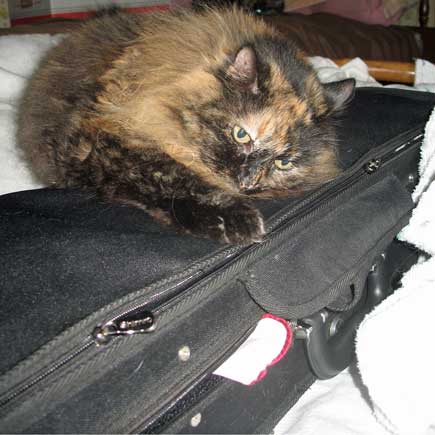
Demi on my violin case, 2009

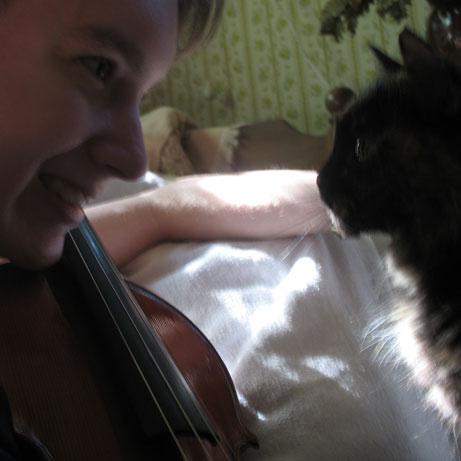
Me, my violin, and Winks, 2009

1 Comment

Filed under My Writing

Coming Attractions: Vivien Chartres

EDIT (5/28/2012): This essay has now been posted here.

***

I thought I would start a series of blog entries describing upcoming projects (FYI, I’m going to tag them “Coming Attractions”), so everyone is encouraged to check back as often as possible. There may be relatively long stretches of silence on this blog as I do research and write rough drafts, etc., so I want everyone to stay tuned even if it seems like I’ve abandoned the blog.

Recently I became interested in the life story of violin prodigy Vivien Chartres (1893-1941). Chartres was a musical phenomenon in the early years of the twentieth century, and in the contemporary press her name was often mentioned in the same sentence as Elman and Huberman. Her story is truly fit for a novel…and unlike most life stories, it actually became one: Vivien’s mother, Annie Vivanti Chartres, was a professional writer who wrote a book about Vivien in 1910 called The Devourers. As you can imagine, since the fictional Devourers is a major primary source, it occasionally gets a bit sticky trying to separate fact from fiction, and the challenge has been a fascinating one that has made me ask a lot of questions… What roles do parents play in raising musical children? What roles should they play? How far should a gifted child be pushed? How do writers fictionalize their own experiences, and how can historians untangle the truth? I’ve been in touch with some people who have helped me uncover some really interesting, thought-provoking things about Vivien and Vivanti, and I’m super excited to be able to share my findings. To the best of my knowledge, this will be the first biography of Chartres available to the general public. So if you’re interested, be sure to check back in the coming weeks. The subjects are extraordinary and I promise that their contemporary relevance will surprise you.

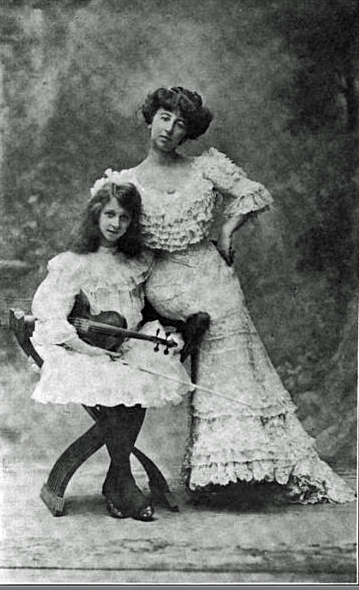
Vivien Chartres and her mother Annie Vivanti

4 Comments

Filed under My Writing, Women Violinists

Link: The Kôda Sisters

Through violinist.com I’ve found a fascinating series of essays written by Margaret Mehl about early female violinists in Japan and the Kôda sisters..

Earthquakes and Pioneering Sisters in Japan

Kôda Shimai: the Pioneering Sisters (2): Kôda Kô

The Kôda Sisters 3

If anyone knows of any online resources about female violinists, or if you have essays like this one to share, contact me! I’d be glad to read them and publicize it here. Er, not that being featured on a tiny blog like this one is going to increase your hits very much, but it certainly can’t hurt, right?

Leave a comment

Filed under Not My Writing, Women Violinists

ISGOT: Lady Anne Blunt

I’m introducing a new series of blog entries called “I Should Get On That.” These are little snippets of information I’ve heard of here and there that I want to dig into deeper but can’t at the moment, for whatever reason.

So, drumroll please.

Today’s ISGOT… Lady Anne Blunt.

According to Wikipedia, she was a writer, a polygot, a breeder of horses, and a fantastic violinist. I’m curious how fantastic a violinist. She studied under Leopold Jansa, who was Wilma Norman-Neruda’s (Lady Hallé’s) teacher. When did she start? Did she ever think of becoming a professional, or did she just study for her own pleasure? When did she start playing? Did she study abroad, or did Jansa come to her? She was born in 1837, so she was Lady Hallé’s near-exact contemporary, and before Lady Hallé came along, there were not many English women violinists at all. How did she start playing an instrument that was so unusual for her era and gender? I’d love to know, but sadly at the moment there doesn’t seem to be much information about her online… And I’m nowhere near a reputable library, so I’ll have to sit tight on this one. Unless, of course, one of my readers emails me some info…

You may have heard of her fiddle, the impeccable 1721 Lady Blunt Strad. It’s currently for sale. So if anyone has a spare….ten or twenty million, call me.

Leave a comment

Filed under My Writing, Women Violinists