Category Archives: Women In Music

Dead Women Are Dead To American Orchestras

If you spend any time in the online orchestra world, you’ve probably seen the Baltimore Symphony Orchestra’s infographic about American orchestras’ 2014/15 seasons. A few days ago, the BSO released figures tracking the 15/16 season, and this year, the data net has been cast even wider. Writer Ricky O’Bannon describes the methodology:

This season we collected programming data for both major American symphonies as well as smaller regional orchestras — 89 in total — to give a more holistic view of symphonic repertoire in the United States.

My thoughts after reading that:

Oh, cool! With so many more orchestras included in the data-gathering this year, surely the proportion of living and historic women composers has skyrocketed, or at least inched upward gradually!

Hahahaha. Hahahahahahahaha.

Last season, the works of female composers accounted for 14.3% of the performances of living composers (and a mere 1.8% of the performances overall). This year, even with the wider field? 14% and 1.7%, respectively.

And then there’s this little asterisk at the bottom of the graph.

every composer

*deep breath*

giphy.gif

Look, I know it’s hard for orchestras to program works outside The Canon. And at this point, pretty much every orchestral work by women is outside The Canon. But no one in the bunch of eighty-nine orchestras wanted to program a single work by a female composer once? No one thought that would be musically or historically or politically or culturally interesting? No one thought that would be unique or exciting? No one thought that would be fantastic press release material? No one thought that would excite donors? No one thought that would advance orchestras’ missions to broaden audiences or educate communities? No one saw this as The Easiest Way Ever to outperform peer organizations? For crap’s sake, a random orchestra could program a dead lady’s ten-minute overture once, and wow, suddenly they’re playing 100% more historic women than any other orchestra in America! Congratulations, random orchestra! Your commitment to underrepresented demographics is palpable.

download (1)

The 2015 Song of the Lark Award for Demographically Diverse Orchestral Programming

And hell, it’s not like I’m asking every orchestra to throw an annual month-long Vagina Festival. It just would have been nice to see one orchestra play one work by one woman at one point. I thought that someone, somewhere, would throw us a pity Gaelic Symphony or Farrenc third or Clara Schumann concerto. But, nope.

Anyway. I would love to offer probing analysis. But it’s pretty f***ing hard to analyze the number zero.
25 Comments

Filed under Women In Music

Can American Orchestras Do Better At Including Women Composers?

This is a follow-up to the recent widely-read entry In Which I Learn Why There Are No Great Women Composers. Liane Curtis got in touch with me during the hullabaloo, wondering if I would be interested in covering the grants made available by Women’s Philharmonic Advocacy. I didn’t have time to write anything this week, so I invited her to post a guest entry. According to her bio:

Liane Curtis is a musicologist and the founder and President of both The Rebecca Clarke Society, and Women’s Philharmonic Advocacy, non-profit organizations which are based at the WSRC [Women’s Studies Research Center at Brandeis University]. A former Fulbright Scholar, Liane has taught at a wide range of colleges and universities, including Wellesley, Ohio State, and (in 2011 and 2007) at Brandeis University. She has written for the San Francisco Examiner, Bay Windows, The Musical Times, The New Grove Dictionary of Music, the National Women’s Studies Association Journal, Women’s Enews, The Gay and Lesbian Review, and other publications. In October 2006, Liane was a Fellow in the National Endowment for the Arts Journalism Institute in Classical Music and Opera.

An impressive resume, but for me the thing that stands out about Liane is that she Cares Deeply About This Stuff. About a year ago, when I was beginning my study of the Clarke viola sonata, I sent her an email asking where the manuscript was. She sent me a link to a PDF of it right away. Never mind I was a largely self-taught violist based out of Eau Claire, Wisconsin, who had no plans to perform the piece publicly. (The manuscript, by the way, is fascinating – a must-read for any violist – and can be perused here.) She cares, and she was excited that I care, and that generous and free exchange of knowledge is hugely meaningful and exciting and awesome. Agree or disagree with any of her premises, she is a woman on a mission, and I appreciate that.

So here is her guest entry. If you’re connected with an organization that is looking for grants, take note! – Emily

*

Can American orchestras do better at including – rather than excluding – women composers???

And can the grants offered by Women’s Philharmonic Advocacy help?

by Guest Blogger Liane Curtis

The recent inflammatory article in the Spectator (by Damian Thompson – no link here so you don’t encourage the clickbait), squashed so deftly by Emily E. Hogstad in this blog, and on New Music Box, reveals an overt instance of how deep-seated, hostile bias against women composers continues to survive. While overtly sexist statements such as those in the Spectator article are not as common as they were in the past, these same values are played out routinely in the current practice of dismissing and ignoring music by women. In short, when we see many orchestras routinely programming NOT ONE  SINGLE work composed by a female in their entire season of classical orchestral programming, it is agreeing with Damian Thompson’s ignorant opinion that “there are no great women composers, [and] that’s because creative geniuses are rare and, in the past, so few women wrote music. There may be some in the future…” The orchestras that are in this group this season (2015-2016) include: the Cleveland Orchestra, National Symphony Orchestra, New York Philharmonic, Philadelphia Orchestra, Pittsburgh Symphony Orchestra, San Francisco Symphony, Seattle Symphony Orchestra, St. Louis Symphony and Utah Symphony. Just to point out one grievous case, the San Francisco Symphony is based in the city that was the home of The Women’s Philharmonic for all of its 20-plus years. Much of their past extensive fan base is there and would be eager to hear works by women. But one of our WPA supporters tells me that the SFS has excluded women composers in 17 of its past 20 seasons. The SFS prides itself for its creative, inventive programming, but to be so emphatic in ignoring women makes one wonder if there is some deep-set misogyny there.

Continue reading

2 Comments

Filed under Guest Blogs, Women In Music

Five Takeaways From The Conversation on Female Composers (Link)

Hey, y’all! I just wrote a follow-up to my last blog entry for NewMusicBox:

“Five Takeaways From The Conversation on Female Composers”

Many thanks to the fine folks over there. Feel free to continue the conversation! The places where I’d most like you to continue the conversation would be at local artistic committee meetings, at music stores, at your private teachers’, and anywhere else where repertoire is decided and debated.

It's been fun, Spectator!

It’s been fun, Spectator!

5 Comments

Filed under Women In Music

In Which I Learn Why There Are No Great Women Composers

Lots of people have hobbies like knitting, jogging, or stamp collecting. Because I am the nerdiest nerd to ever nerd, the closest thing I have to a hobby is learning about the history of women in music. It’s a topic that doesn’t get as much press as the old chestnuts like “classical music is dying” or “Stradivari’s secret varnish” or “lockouts.” Nonetheless, once in a while the mainstream media will run articles about women composers, and when they do, I enjoy reading what other people have to say on the topic.

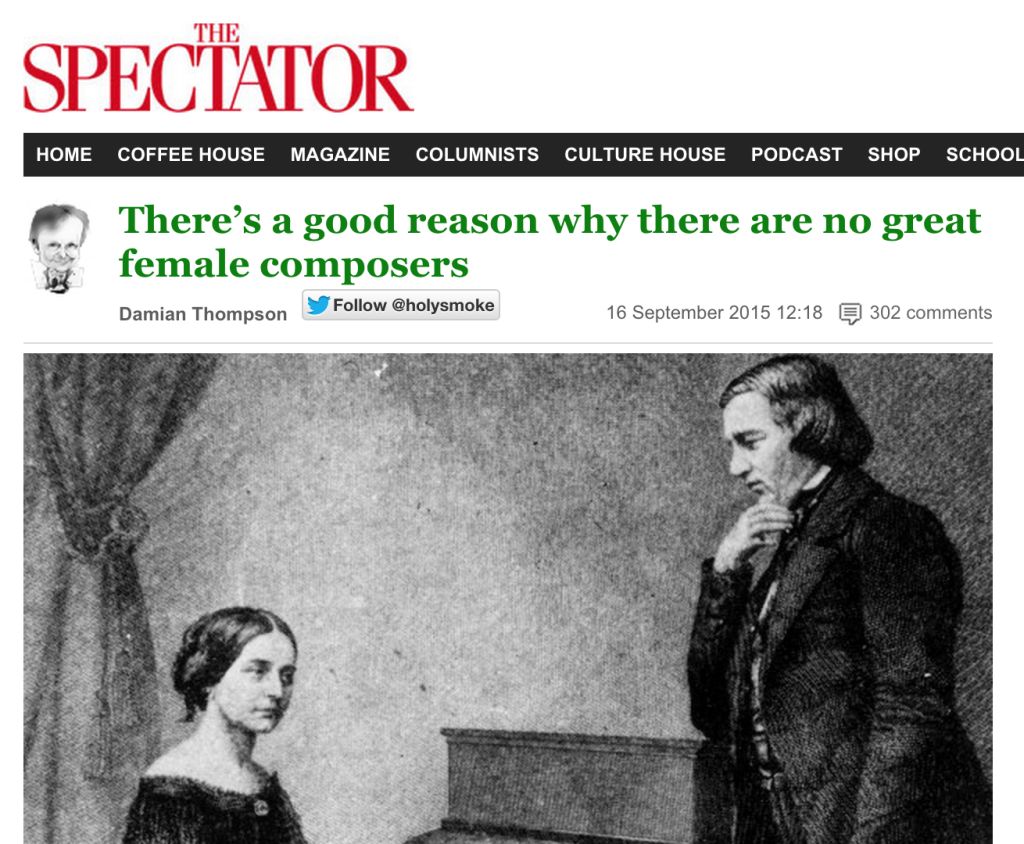
Today a very special article ran in the conservative British magazine The Spectator. It’s called “There’s A Good Reason Why There Are No Great Women Composers.” I’m not going to link to it for reasons that will gradually become obvious to you.

It begins:

Last week a 17-year-old girl forced the Edexcel exam board to change its A-level music syllabus to include the work of women composers.

Wow. A 17-year-old girl forced the Edexcel exam board to change its A-level music syllabus? How did she do this? Did she hack an extensive computer network? Did she threaten the board and then hold it hostage? Did she storm their office with firearms and issue terrifying proclamations with her foot resting upon the skulls of her enemies?

The truth is actually far more frightening: she began a change.org petition.

Continue reading

183 Comments

Filed under Women In Music

Maddalena, Musicology, & Me: Prologue

There is an elephant in the room, and that elephant is the fallout from the Minnesota Orchestra lockout.

Unfortunately, I can’t do much about that elephant right now. Crucial portions of the future of the elephant, which will determine how I ultimately react to the elephant, are being decided in closed door meetings. My poking the elephant could easily turn counterproductive. And rest assured, I work with friends behind the scenes every – single – day to do what I can to help the elephant; and I imagine many of you do, too. So until there is more concrete information about the state of the elephant, or the state of elephants in general, I want to move onto another topic that brings me joy, namely:

Discovering the work of a forgotten composer – resurrecting one of her compositions – musing on the (dangerous?) nature of our Sacred Canon of Western Art Music – learning what I can about period performance practice of the 1770s – taking up a new violin concerto – and writing about the journey for anyone who cares to read.

***

9606094

Meet Maddalena Laura Lombardini Sirmen. According to Wikipedia, she was born in 1745 (roughly a decade before Mozart) and she died in 1818 (roughly a decade before Beethoven). We don’t know a lot about her. What we do know, though, is fascinating. She was a violinist, composer, harpsichordist, singer, and businesswoman. When she was 21, she married another violinist and composer named Ludovico Sirmen. Ludovico eventually became involved with a countess, while Maddalena traveled across Europe with a priest. She performed in many of the cultural centers of her day and her work was widely praised. But unfortunately, if predictably, her extraordinary career was largely forgotten in the intervening centuries. In fact, if her name is ever mentioned today, it is invariably because her teacher Tartini (he of Devil’s Trill fame) once wrote her a famous letter about violin technique. But Maddalena Lombardini Sirmen was so much more than a Tartini student. In later blog entries, I’ll try to fill in some more of the details. But it’ll take some time and detective work. Continue reading

2 Comments

Filed under Women In Music, Women Violinists

The Schumanns, Symphonies, and Brahms, Part 3

Here’s the last part of the November Lark Notes, the third part of an essay called The Schumanns, Symphonies, and Brahms. Part I here; Part II here. Buy tickets to the Minnesota Orchestra Musicians’ show here.

III.

It took many years, and many pieces, for Brahms to come to term with the Schumann prophecy.

His first piano concerto, dating from 1859, was his first large-scale work featuring an orchestra. Portions of it had come from the sonata for two pianos in d-minor. Many historians have noted that the initial theme of the first movement bears a resemblance to a fall: Schumann’s leap into the Rhine, perhaps? He admitted openly to Clara that the glowing second movement was a portrait of her. As for the last movement, he was so conflicted about what to do, he unabashedly copied the form of Beethoven’s third piano concerto.

When he finally got around to writing his first published work for orchestra alone, he tried calling the piece a symphony, but couldn’t bring himself to do it. So he hedged his bets: he labeled the D-major serenade a “Symphony-Serenade.” But he soon realized he was kidding himself, and he so he scratched out the word Symphony entirely. He wrote to Joachim: “I had such a beautiful, big conception of my first symphony, and now! – ” The dash said it all.

He was getting nowhere with the highly anticipated Big Work. During this frustrating time he circled back to Clara for intellectual and emotional companionship. In January 1861 he wrote to her, “I sometimes wish to see [you] for the first time again, so that I might be able to fall in love with you all over again. But all the same things are well as they are. Don’t you feel the same?” Practical as ever, she returned, “I by no means wish you to see me again for the first time in order that you may be able to ‘fall in love with me’ (if indeed that can ever have happened); rather love me dearly, truly, and for ever and ever – that is the best of all.”

In 1862, she received a packet of music from Brahms: “imagine the surprise!” she wrote Joachim, “the first movement of a symphony.” It was indeed. Unfortunately, she’d have to wait over a decade for the music to be finished and performed. Once again, Brahms had gotten stuck. He began to look like a horse in quicksand.

Continue reading

5 Comments

Filed under Women In Music

The Schumanns, Symphonies, and Brahms, Part 2

Here’s the second part of the November Lark Notes, an essay called The Schumanns, Symphonies, and Brahms. If you want to see a Brahms symphony in the flesh, buy tickets to the Minnesota Orchestra Musicians’ concert here. Part I is here.

II.

In 1850 Robert Schumann had accepted a music directorship in Düsseldorf. His time there was unfulfilling. Bluntly, he wasn’t suited for the job. Worse, ill health led him to become increasingly withdrawn. In rehearsals with the local chorus, Clara provided piano accompaniment and made suggestions to the singers when Robert was uncommunicative. Although Clara didn’t – or couldn’t – acknowledge it, his career was in decline. Robert, his energy waning, saw Brahms as someone who could take up his cause and bring it further: a Joshua to his Moses.

Accordingly, both Schumanns immediately began encouraging Johannes to write on a larger scale. In his famous article, Robert wrote, “If he will sink his magic staff in the region where the capacity of masses in chorus and orchestra can lend him its powers, still more wonderful glimpses into the mysteries of the spirit-world will be before us…” In her journal Clara wrote, “A great future lies before him, for when he comes to the point of writing for orchestra, then he will have found the true medium for his imagination.” There was something to that assessment. The piano works that Johannes had played for the Schumanns were big and bold, and it was tempting to imagine what such genius might produce for orchestra.

Maybe given time and health, Robert could have helped Brahms give voice to a symphony. But Robert had neither time nor health. On 27 February 1854, while Clara was consulting with a doctor, Robert slipped away and jumped into the Rhine. He was saved by fishermen. Clara only caught a glimpse of him before he was taken to an asylum. The next time she’d see him would be two years later on his deathbed.

Continue reading

2 Comments

Filed under Women In Music

The Schumanns, Symphonies, and Brahms, Part 1

The November Lark Notes consist largely of this three part essay, The Schumanns, Symphonies, and Brahms. Stay tuned for the rest. Enjoy, and remember you can buy your tickets to the Minnesota Orchestra Musicians’ performance of Brahms 2 here.

I.

In early November 1853, a twenty-year-old Johannes Brahms read the latest issue of the music journal Neue Zeitschrift für Musik. On the front page was an article by Robert Schumann hailing him as the savior of music.

I have thought…someone must and would suddenly appear, destined to give ideal presentation to the highest expression of the time, who would bring us his mastership not in the process of development, but springing forth like Minerva fully armed from the head of Jove. And he is come, a young blood by whose cradle graces and heroes kept watch. He is called Johannes Brahms…

It had only been six months since Brahms had left his home in commercial Hamburg to tour Germany as an unknown accompanist. Only five weeks had elapsed since Brahms had met Robert Schumann for the first time, along with his wife, the radiant sad-eyed Clara, one of the greatest pianists of the nineteenth century.

Schumann’s article sent Brahms reeling.

The article that changed Brahms’s life

A few months later, in the wintry depths of February 1854, Robert Schumann threw himself into the Rhine. His effusions had been the precursor to a horrific mental breakdown. Robert himself asked that he be sent to an asylum for treatment; Clara was left behind pregnant and alone. In a rush of gallantry, Brahms came to her side. Suddenly he found himself de facto master of the house, stepfather to his idols’ children. Robert’s madness, and his extended stay in institutional purgatory, made possible arrangements that might otherwise have been looked upon askance. In the evenings, Clara and Johannes mourned their mentor by playing music, often Robert’s. To minds like theirs, sharing music is more intimate than sex.

This is the environment in which Johannes Brahms first seriously wrestled with the idea of writing a symphony. And people wonder why it took him so long to finish it.

Continue reading

3 Comments

Filed under Women In Music