Tag Archives: Minnesota Orchestra

What We Know About Minnesota Orchestra’s Finances – And What We Don’t, Part II

Once again I’m turning the floor over to Minneapolis non-profit professional Mary Schaefle… You can read Part I of her series on the Minnesota Orchestra’s finances here.

***

I’m back with another installment on Minnesota Orchestra finances. If you haven’t seen my first guest post, head on over to learn about the Minnesota Orchestra’s endowment.

The last post focused on the endowment. According to the Orchestra’s strategic plan, endowment/trust proceeds are one-third of their annual income. It’s time to turn to the other two legs of the stool, ticket sales and contributions.

Ticket Sales and Other Earned Income

Management lists declining ticket sales as a significant financial challenge. It’s true ticket revenue declined 8.3% when you compare the season ending in 2009 with 2011 (990, page 9 available on Guidestar).

Let’s turn to the words of Orchestra management to learn why that happened. In 2011, the change was “due primarily to a reduction in the number of concerts”. This refrain was repeated in the 2010 report, when a reduction in ticket revenue was attributed to “16 fewer concerts, a dropoff of 9 percent.” Mr. Henson went on to say decreasing the number of concerts was part of their financial strategy to control costs. Sure, decreasing the number of concerts means lower costs for ushers, box office staff, concession staff and many other things. But it also means lower revenue. If your financial strategy is to decrease costs through fewer concerts, but that same strategy also means decreasing revenue, do you really come out ahead?

Orchestra concerts are not the only events at Orchestra Hall. Decreases in other earned revenue, things like the Jazz series and hall rentals, were more than double the drop in classical tickets, by more than $1.3 million or 18%. We don’t know why those things decreased (interestingly, concessions showed an increase). But it makes me nervous that the new business strategy plans to broaden “program offerings to respond to customer interest.” If the plan does rely on income that has been dropping more rapidly than concert sales, major revisions are required.

You may remember my suggestion in the last article for an independent financial analysis. The questions I’m raising here wouldn’t be answered by that kind of oversight. A respected leader in performing arts management, preferably orchestra management, would be the best person to review the strategic plan to ensure it is sound.

Contributions and Grants

If you go to the Orchestra’s tax forms (after all, I have been harping on them), you’d see huge dollar amounts in contributions. Those figures are a combination of all donations, including the Hall renovation, the endowment, and other restricted funds. The Orchestra’s management is correct that they can’t divert money from the endowment or any other restricted fund to pay for this year’s season.

We see a steady increase in government grants (990, Part VIII). My guess is this is due in part to the Clean Water, Land and Legacy Amendment, though we should give credit where it’s due to the grant writing staff at the Orchestra. Competition for those funds has been fierce.

If we turn to the financial statements, we get more details about what is contributed for operating activities (translation- things such as musicians’ salaries and concert expenses). Again, grant income is strong. Current year grants double from 2009 to 2011 – impressive. Grants released from restriction ($$ received last year for programs this year) increased to a lesser degree. Grant writing staff deserve kudos for the $1.75 million they brought in. Before anyone starts questioning or speculating, no I don’t know the individuals doing the work. I don’t even know if the Orchestra has staff grant writers or if they hire a consultant as some nonprofits do. But I think we should give credit where it is due.

Contributions, on the other hand, didn’t fare as well. Remember we are focused on unrestricted donations for current operations, not any of the $$ for the Hall or the endowment. Unrestricted gifts decreased by close to $750,000 in three years, or almost 25%. I wondered whether focusing on the campaign would have a dampening effect on general, or annual, contributions. We can’t say for certain, but it’s tempting to think that the same effort for the Orchestra as a whole would have eased or erased the deficit.

Wrapping Up the Income Side of Things

We know that ticket sales have declined as a whole, but aren’t sure how much of that is due to the decrease in concerts. There could have been other factors. We know that hall rentals and non-classical concerts fell by even larger amounts.

Grant writing is a bright spot, but annual or unrestricted donations have decreased while the Orchestra was focused on the endowment and Hall renovation campaign. Again we don’t know if there were additional influences causing the decline.

I’ll be posting a #1A in the ”Minnesota Orchestra Financials Series” (never thought I’d see those words together). I asked a colleague who works as a nonprofit investment analyst to review my previous post. The one thing I can share now is the 5 year return on the endowment is within a reasonable range. That is reassuring. But it doesn’t answer what I consider the most significant question – why did the Board use only half of the 2011 draw for current operations, and how was the remaining $6.1 million spent? After I look at the Notes with my colleague’s help (did you know they have such a thing in Financial Statements?), I’ll provide an updated and/or corrected view on investments and my questions about the 2008 stock sales and the Orchestra’s portfolio.

After all these words about income and revenue, what do we know? Management’s statement that revenue has decreased is true. But I believe there are enough questions posed here that the Board needs to take another look at ways to increase revenue in addition to considering cuts. They need to take a good hard look at the Strategic Business Plan. Is it a “Vision for a Sound Future”? We all want the Minnesota Orchestra back on stage and performing. We need a plan that will get us there and keep us there.

***

Here is Part 3

Thank you, Mary! Mary will be in the comment section to answer any questions or comments you may have.

14 Comments

Filed under Not My Writing

Your Daily Dose of Cognitive Dissonance

Here’s the full Strib article about Osmo’s letter.

Campbell said he was not surprised that Vänskä’s letter was released to news media in a labor dispute that has become increasingly public. “But I’m certainly disappointed that we’re not sitting down in private trying to find a solution,” he said.

In case you forgot, Mr. Campbell was the man who said OK to releasing the entirety of the proposed contract online on September 5, weeks before the deadline of September 30. (It came a day after the SPCO released their proposed contract. Coincidence? ….) In their open letter, the MOA Negotiations Committee said, “For nearly five months, we have held our negotiations behind closed doors to foster a respectful process. With the deadline for contract expiration less than a month away, we feel that now is the time to update all who have a stake in the outcome on the proposals that we have put forth to musicians.”

So, to recap:

Management going public with a draconian proposed contract behind musicians’ backs weeks before the old contract expired = helpful and necessary

Musicians (presumably) going public with a letter their music director wrote to them discussing the future of their orchestra = disappointing

Private negotiations in September = bad

Private negotiations in November = good

Got that?

Interestingly, it’s possible to read between the lines and realize management is not completely comfortable with what has just transpired. Despite their ridiculous email response, they obviously understand that Osmo’s letter is a PR loss for them…because otherwise they would have wanted to be the ones to release it to the press. Correct? And they acknowledge here they didn’t. So aha, Mr. Campbell. You’ve inadvertently shown your hand. If this letter was such a great bolster to your cause, why weren’t you running to the Star Tribune office with it? (Not to mention…there was no link to Osmo’s full letter in their email response. It’s almost as if they don’t want us to read the whole thing.)

It must be tough to live under the weight of such cognitive dissonance.

Dissonance.

8 Comments

Filed under My Writing

Response to Management’s Response to Osmo’s Letter

I’m no expert in orchestral management, but… If you’re the CEO of a world-renowned orchestra, and your conductor sends you this letter…wouldn’t you maybe want to change tack?

November 12, 2012

Dear Members of the Minnesota Orchestra Board and the Musicians of the Orchestra:

In the last few years, the Minnesota Orchestra has truly established itself as a world-class orchestra. Critics and audiences around the world praise what we have achieved together. The national and international attention we have attracted through our Beethoven and Sibelius recordings, our Carnegie Hall and BBC Proms engagements, as well as our crucial work at home is the result of the invested talent, energy and commitment of an exceptional group of artists, not merely competent professionals.

The Board is justifiably proud of the results which the Minnesota Orchestra has achieved; many other Boards would be delighted if their own orchestras achieved anything like the level of the Minnesota Orchestra. This is all the more gratifying when you compare our costs with our peers in Chicago, New York, San Francisco or Los Angeles.

The Twin Cities area is such a special place. No metropolitan area our size can boast the award-winning cultural offerings that we do. We are the home of several Fortune 500 companies as well as many other innovative businesses. Our downtown is thriving, our unemployment low. Smart, creative people choose to live here because of all the Twin Cities has to offer. No other market our size has an orchestra such as ours, playing at the same level as the greatest orchestras in the world. A metropolitan leader as cultured as this must protect, preserve and cultivate such an asset.

But now I fear we may be on a path to diminishing greatly, if not destroying, the Minnesota Orchestra as an artistic and cultural leader. While there is no progress in the contract negotiations; while players are unable to rehearse and perform together; while some are obliged to seek jobs elsewhere – I am desperately anxious about the risk posed to the quality and spirit of the orchestra for the future. I become deeply emotional when I listen to our latest Sibelius recording edit of the 1st and 4th Symphonies, first because the music is so moving and superbly played in the hands of our musicians, and second because I fear that to preserve our reputations I may need to consider letting go of the remaining recording projects we have planned. I will also be in a position to think seriously about the viability of bringing a diminished or compromised orchestra to Carnegie Hall for our four concerts in the 2013-14 season, plus international touring thereafter, including a re-invitation to the BBC Proms.

It is difficult to imagine that the current negotiation process will sustain the orchestra’s future. Rather, the process may rob us of the chance of having a world class ensemble for years to come. When the lockout is over, the Twin Cities may have a “professional orchestra” but inevitably not the same one, nor a highly regarded one. Will anyone – either the Board or the Musicians – be able to reflect back with pride at what was accomplished during this season? The Association and the Musicians must come together to mitigate any more damage.

It is clear that the orchestra’s finances are deeply troubled and finding a solution must balance business and art. I urge the Board and the players of the MO, from the bottom of my heart, to seek new and creative ways – without insulting or demeaning – to pursue these negotiations, to re-establish a common vision, to identify a path forward, in partnership, to a financially and artistically sustainable future. There must be some way to re-establish trust and bring both parties to negotiate once again.

The Twin Cities is a unique and great place to live. The 109-year-old Minnesota Orchestra is a great orchestra. We are all proud of what we have achieved here. The world-class Orchestra Hall this orchestra needs and deserves is only months from completion. Once again, many other orchestras envy our significant accomplishments.

Nine years ago, you brought me here and entrusted me to lead a world-class orchestra, which I have enthusiastically and faithfully done. It is my responsibility as Music Director, and one that I take extremely seriously, to maintain and develop the artistic level of this great orchestra. If the orchestra does not play, its quality will most definitely diminish. Please, do what it takes, find a way, talk together, listen to each other and come to a resolution of this dreadful situation.

Sincerely,

Osmo Vänskä

That letter speaks for itself. I have nothing to add to it.

For some reason, I don’t get emails from the Minnesota Orchestra management any more. (I stopped receiving them after I started being critical of them on this blog. I logged in tonight to make sure that all my contact information is current and up-to-date, and it is. Sigh. Whatever.)

But! Lucky for me, a brave friend rode to the rescue and forwarded me management’s official response, so that I wouldn’t have to toss and turn tonight wondering what Mr. Henson and Mr. Campbell are thinking of this terrible blow to their cause.

Dear Patron,

We want to make you aware that we recently received a letter from Music Director Osmo Vänskä expressing his hope that the Board and musicians will come together to resolve our negotiations. He wrote, “It is clear that the orchestra’s finances are deeply troubled and finding a solution must balance business and art. I urge the Board and the players of the Minnesota Orchestra…to pursue these negotiations, in partnership, to a financially and artistically sustainable future.”

Holy…crap. You…think that letter was written in support of you and your methods? What – ? Just – what?

What?

Is this some Rorschach test?

What do you see? Is Osmo Vänskä praising management’s handling of the situation? Or is he desperately begging them to sit down and talk and compromise? Don’t worry; your answer will remain confidential between you and your therapist.

We agree. It has been a great partnership – between musicians, Music Director, Board and community – that has led the Minnesota Orchestra to great artistic heights; no one entity could have done it without the other. Similarly, in the end, the way forward for our contract negotiations will also be through partnership.

*drinks*

*spews water across keyboard*

Quick question. Can you please share with me one aspect of this negotiation that has been done with the word “partnership” in mind? Just one…

It is for this reason that we confused by the musicians’ unwillingness to return to the negotiations with a contract proposal. How can a negotiation take place if one side refuses to participate? It has now been 31 weeks since the Board put forward its proposal and we have yet to receive a counterproposal from the musicians.

In the Star Tribune on November 8, Labor relations expert John Budd, of the University of Minnesota’s Carlson School of Management, agreed that the musicians’ positions are “structural requests around the parameters of the negotiations and not formal counterproposals.”

Yeah, I actually have that article here, and quoted from it on the blog. Did you take a quick moment to glance at what people – the public you are purportedly serving – in the comment sections said? If you haven’t, here’s a little sample…

Why is management collecting their salary if no concerts are being performed? We certainly don’t blame the musicians (those who actually make the money) for the current situation. Management is supposed to plan and raise money. They are the ones who failed and the ones who need to be replaced.

How much damage is management willing to do to the orchestra? Appparently, quite a bit. It’s disgusting.

There are two lockouts by management and the Board: the musicians and the public. Both are victims of an arrogant disregard for the interests of either.

This is so sad, and reflects utter failure and incompetence at the top. Is there not one courageous board member, or group of prominent donors, who will stand up, and demand another approach ? The Founders are spinning in their graves. Shame on you board, and admin. You are ruining one of the great institutions of the nation, and not one of you speaks out ? Your little social club is disgusting. Replace the board with those capable of leading, with the understanding of negotiating difficult situations, and creating consensus. Someone need to step-up here, and do some reconciliation, and bridge building. This is disgusting in so many ways, and betrays a vastly sick organization, rotten to the core.

I have been reading article after article in a variety of sources – newspapers, MPR, blogs . . . not ONE commenter who self-identifies as an audience member supports management. Not ONE. As a subscriber and donor to one orchestra and a ticket-purchaser to the other, I am furious that we are not being included here. The arrogance of management is astounding.

Yeah. Suddenly the stuff I’ve said on this blog doesn’t seem so bad, does it?? While you’re at it, do you want to hear some input from your Facebook page?

The musicians ARE the orchestra. Pay up.

I LOVE the Arts, please show respect and pay the musicians. This post is truly a shame.

Very disappointed that you have not been able to work out an agreement which is more fair to the musicians.

Shame on management and the Board for getting into this situation and for their unwillingness to go to arbitration.

Management and the Board needs to STOP acting like the victim here, and take responsibility. You are the steward of OUR orchestra, entrusted with ensuring that it maintains its place in the world as a top-tier orchestra. You should be answering to the musicians and the patrons, not some imaginary stockholders! You are holding this community hostage, and we WILL NOT stand for it.

Yeah. That tone actually continues…unanimously…and unambiguously…throughout the entire comment section. I think you might want to check it out, because, if this email is any indication, you haven’t.

We can only reach a resolution if we meet at the table, share proposals and begin earnest conversations, something which we are eager to do.

Oh, yes. You’re so totally eager to come to a settlement that you refuse to submit to an independent financial analysis, even when just about all the numbers you’ve released publicly contradict themselves.

Come on, guys. My sarcasm muscle is getting weak from overuse.

And by the way, since you’re apparently suffering from a major attack of amnesia, the musicians offered to meet at a table less than two weeks ago. And you turned them down.

We have great empathy for our musicians—and our audiences—right now;

BWAHAHAHAHA. You have great empathy for me?

Really?

And you have –

Great empathy –

For the people whose salaries and health insurance you cut off?

Empathy?

What the – ?

*goes to find dictionary*

*looks to see if “empathy” means the same thing in 2012 as it did in 1997 when I was in grade school and first learned the definition of the word*

the intellectual identification with or vicarious experiencing of the feelings, thoughts, or attitudes of another.

*slams book shut*

*checks calendar to see if it’s Opposites Day*

Hey, Opposites Day is actually November 13th.

Um….did I just decode the entire meaning of this email?

*checks date on email*

Oh, shoot. It’s dated November 14th. I didn’t.

So as best I know, empathy does, in fact, still mean today what it meant in 1997.

I have no idea what they’re talking about.

however, we cannot continue performing on borrowed time. Last year our organization posted a $2.9 million deficit, and we anticipate this year’s shortfall to be $6 million. In order to protect the Minnesota Orchestra for the long term, we must address our financial challenges now, rather than push them down the road and allow them to multiply. We believe it is not only possible to combine great artistry and financial viability; it is absolutely essential.

THEN.

ANSWER.

OUR.

QUESTIONS.

ABOUT.

HOW.

YOU.

ARE.

PLANNING.

ON.

DOING.

SO.

It is our greatest desire to find a meaningful resolution to this labor impasse quickly so that the music can resume again for our community – and continue for many, many decades. We are grateful for your support.

Hahahaha. Hey, FYI, absolutely nobody supports you. Just a little head’s up there. If you don’t realize this, things might get a little awkward next time you show up to a concert and various patrons recognize you. Judging by the Strib comments, and the furious comments on your orchestra’s Facebook page, I’d advise wearing a mask next time you go to a show.

May I recommend this stylish accessory for your next outing to the symphony?

So.

Where do we go from here?

No clue. Absolutely none at all.

I literally don’t know what could cause management to give a single inch, or submit to the public’s call for transparency, or cause Mr. Henson to say “yes, I made some mistakes along the way, and I’m sorry.” An internationally renowned conductor practically begging the two sides to sit down and talk to one another? (Doesn’t seem to have swayed Henson or Campbell.) Big donors withdrawing their support en masse? (I don’t know; there’s one hugely important one who has been very public in her support of musicians, and I’m assuming words have been exchanged with her behind the scenes. I’m guessing if she’s annoyed, then others are, too. Still hasn’t changed anything, at least publicly.) A counter-proposal from musicians halfway between what management is suggesting and what the musicians had in September? Say, totally theoretically, a 10% pay cut, with benefits and working conditions remaining unchanged? (No, management would reject that, and just start harping on how out-of-touch the musicians are with fiscal realities.) Maybe Mr. Henson could come work for my state’s governor? They’d get along splendidly, I’d think. (No, my governor would never pay anyone $400,000 to work in arts management…) Intervention from Governor Dayton or Mayor Rybak? I have no idea what they could do to help, if anything (?). Members of the board who disagree with Mr. Henson, and Mr. Campbell, and Mr. Davis, and Mr. Cutler, speaking up and going rogue? A civil war within the board? Who knows if even that would help. A criminal investigation? Highly doubt there are any grounds for that…

So… I… don’t know.

I don’t know.

The only comforting thing here? I’m just a patron, and nothing more. I’m not privy to inside information. I don’t know what insiders might be having heated conversations behind closed doors. I don’t know what board members might be tossing and turning tonight and wondering what they might say or do in the coming weeks. I don’t know where the governor or the mayor are, or what power or influence they could wield. I can’t see the whole picture. I’m not omniscient, by any means. And tonight? That’s a blessing. I can go to bed tonight hoping and praying that Osmo’s beautiful letter will have some positive effect on this horrifying situation.

That being said, my heart breaks for all of us tonight.

Because we were all betrayed.

And betrayed mightily.

9 Comments

Filed under My Writing

Response to Ken Cutler’s 11/11 Strib Editorial

MINNESOTA ORCHESTRA

The musicians must make a counteroffer

I have been a season-ticket holder for the Minnesota Wild since their first game and a Minnesota Orchestra subscriber since 1975, and I serve on the orchestra board. I am frustrated that my two favorite winter activities are in the midst of lockouts. But at least in hockey I can take heart that the sides are talking about contract terms and that each side has presented proposals and counterproposals. In the case of the orchestra, however, two proposals have been presented to the musicians, as long ago as April, yet no counterproposal has been made.

The hockey players never demanded an independent financial analysis before making a counterproposal. They did their own work after examining the league’s finances, yet had even less insight than do the musicians, who have audited financials and 1,200 pages of documents. Unless the musicians offer a counterproposal, no progress can be made. And they must recognize that the orchestra cannot survive if concert revenues only cover 22 percent of operating expenses, a significant portion of which is musician salaries.

I truly love the orchestra and its fine musicians, but if this continues I will think seriously about canceling my season tickets, ending my annual contributions and eliminating the bequest to the orchestra in my will.

KEN CUTLER, EDINA

Well then feel free to resign, I guess

I know dozens of people from all around the world who would be delighted to take the awful inconvenience of being on the Minnesota Orchestra board off your hands. Contact me ASAP and we can discuss options.

If you do resign or withdraw your contributions, take solace in the fact that if the current proposed contract is ratified, many more people will cancel their season tickets, end their annual contributions, and eliminate their bequests. So we may lose you, but we will retain many others who we otherwise would not have. So it will probably be, as the Star Tribune said about the Minnesota Orchestra’s holiday season, a “net” “wash.”

Also, I hope that as a corporate lawyer you don’t endorse the business practices you seem to be recommending here. I highly doubt that when you represented AmCom Software, Inc., in its sale to US Mobility, Inc., for $163,000,000 that you would have willingly overseen a transaction that included such egregiously misleading and confusing numbers, no matter how many thousands of pages of information you had in your possession. And since over the months nobody in management has addressed the musicians’ allegation that there are conflicting numbers at play, and since we’ve caught Mr. Henson blatantly lying about the fiscal health of the orchestra at least once before, and since Mr. Davis has been cheerfully deceptive about numbers in the past, and since the draw amounts released by the Orchestra do not match those listed on their tax forms, I’m sure you’ll forgive me for assuming that there are misleading numbers at play within those 1200 pages. You’d agree, it would be naive to assume otherwise.

While I have you here, you mind answering some of these hundred questions? Also: do you know why the orchestra was trumpeting its financial health so loudly in 2010? I’ve been asking for weeks now and nobody from the Orchestra has addressed the discrepancy. Hey, maybe we could set up an in-depth interview to discuss the conflict from your perspective. I’ve got a whole group of well-informed people who would love to talk to you. We could have a conference call. A Google Hangout! You can record those and upload them onto Youtube for the whole world to see. It could be awesome. Contact me! Seriously!

Sorry about your favorite winter activities being canceled. That sucks. Not as bad as, say, losing your job and health insurance over Christmas. But it still sucks.

EMILY HOGSTAD, EAU CLAIRE

Edit, later – Oh, and by the way, take a look at the differences between the two proposals. They’re basically identical. It’s completely disingenuous – nay, irresponsible – to insinuate there are any substantive differences between them.

12 Comments

Filed under My Writing

Lame

I’m just going to leave this here. It speaks for itself. From the Star Tribune

Thursday’s cancellations will have consequences beyond the orchestra.

The Minneapolis Convention Center had projected income of $274,000 from the fall and holiday orchestra seasons, said spokeswoman Kirsten Montag. And the Minnesota Chorale, which had been scheduled for dates with the orchestra in October, November and December, will lose nearly all of its earned income for the fiscal year, said executive director Bob Peskin.

“We’ll have to make up the lost income with further expense cuts and increased donations,” Peskin said.

Orchestra president and CEO Michael Henson said the December dates — which include classical, jazz and presentations in addition to the holiday fare — were projected to make up 19.3 percent of annual ticket revenue. However, the net impact is a wash because the orchestra won’t have to pay rent at the Convention Center or musician salaries and benefits.

4 Comments

Filed under Not My Writing

What We Know About Minnesota Orchestra’s Finances – and What We Don’t, Part I

There is an old stereotype that artists are terrible with numbers. Many enforce the stereotype (me, for instance), while others defy it. Happily, Mary Schaefle defies it, and she is today’s guest blogger!

Mary is a Twin Cities nonprofit professional and community violinist. You may have seen her name in the comment section here at SOTL, on Facebook, or on the Musicians of the Minnesota Orchestra’s website. I highly recommend reading the two letters she sent to Minnesota Orchestra management; you can find those here and here. I’ve been staying away from too much in-depth analysis of numbers, because I obviously don’t know much about non-profit nitty-gritty. Happily, however, Mary does, and she offered to take a look at some of the public documents discussing the Orchestra’s finances, so that we might at least try to figure some of this stuff out on our own. Hey, if management isn’t going to answer our questions, what else are we supposed to do?

You can take a look at some of the forms she refers to online. Unfortunately I can’t link directly to them, but if you sign up for a free account with Guidestar, and look up the Minnesota Orchestral Association, you can download some of the documents she mentions. If you have any questions or refutations to make, the comment section is open, and Mary will answer you directly, and I will edit the original article as needed. How’s that for service? I’d be so delighted if management would do the same for us, but for some reason that’s too much to ask… Anyway. Many thanks to Mary for contributing such an interesting piece. I hope we get some answers to the questions she raises, and soon.

***

Minnesota Orchestra’s management has told us they are making “difficult and necessary decisions” and can only spend what they earn. So what do we know about the Minnesota Orchestra’s finances? Tax returns and audited financial statements give us some answers, but unfortunately more questions. There will be plenty of numbers in this post, but I’ll try my best to explain terms.

Remember that I’m not an accountant and certainly not a CPA. I am a person who cares deeply about the Minnesota Orchestra, and who likes to dig through nonprofit tax returns and financials. They can tell you a lot about the organization as long as you have a lot of time and either a translator or a basic understanding of nonprofit finance.

Endowment Income – Is That the Problem?

Management has pointed to the 2008 recession and the resulting decrease in endowment revenue as a key problem. The Orchestra’s endowment lost $12.9 million that year (reported on the 2008-2009 tax forms which are available at Guidestar). They’ve since experienced modest gains of $6.3 and $5.6 million (990, Schedule D, Part V).

But endowment challenges are much larger than a one-time decrease in size. Organizations assume they will receive a certain amount of income from the endowment each year. Those estimates can be conservative, assuming smaller returns, or they can be wildly optimistic. Looking at the Orchestra’s strategic plan, those 2008-09 investments were projected to be $201.4 million. The actual assets were $135.3 million, a difference of $52.2 million before the market tanked. The $12.9 million loss was piled on top of that. The 2007 projections are somewhere between overly optimistic, flawed, and just plain wrong. Perhaps this was the genesis of the financial problems.

Let’s get to how that impacts us today. Back in 2009, our endowment “paycheck” was lowered by 13% compared to our projections. Then things got even worse and our 2012 “paycheck” is expected to be 45% lower. They know the 2007 projections are wrong, but just keep using them. Why do they appear in the 2011 Strategic Plan? Do management and the Board have a new set of projections for future years? A review by an investment analyst, which is typically not part of an audit, is needed.

The Endowment Draw and Two More Questions

Comparing tax returns to media statements and the Minnesota Orchestra website raises two more questions. The draw on the endowment (the income or “paycheck” I mentioned above) has been excessive according to management. They are correct that a 19% draw could deplete the endowment in just over five years. That one is simple math.

According to our friend the 990, the endowment distributions (read “draw”) were 16.3%, 9.4% and 7.8% from 2008-09 through 2010-11 (Schedule D, Part V). As I pointed out in the comments section of Emily’s earlier post on the endowment, the draw amounts released by Minnesota Orchestra do not match their tax forms. That means percentages are off as well. Yes, we once again need that accountant.

Now onto an item that – at least for me – is really troubling. Audited financial statements list “Board Designated Draws from Investments” in the Statement of Operating Activities. Think of this as the amount taken from the endowment (draw) to support concerts, education programs and the day-to-day business of an orchestra (operating activities). In 2008-09 and 2009-10, amounts reported on the financial statements are fairly close to those on tax forms.

But the difference in 2010-11 is just over $6 million. You read that right. The Board withdrew $12.1 million from the endowment, but only $6 million was used to run the Orchestra. I’ve scoured the financial statements and don’t know where the remaining $6.1 million was spent. The money was used somewhere – but where? Financing long-term debt? Expenses related to the Hall renovation? Why did the Board and management decide to withdraw such a large amount in 2011 and only use half for the operations of the Orchestra?

Now is a great time to reiterate that I’m not a CPA. A clarification from an accountant would be wonderful. Perhaps closer to necessary.

For those who like to verify my figures, unfortunately the audited financial statements are not available on the Orchestra’s website or on Guidestar. I’d suggest requesting a copy from the Minnesota Orchestra.

Turning To Investments

Minnesota Orchestra owns plenty of stock. In the 2010-11 and 2009-10 years, Minnesota Orchestra reported gains (or income) of $7.8 million and $2.8 million when they sold securities (Form 990, part VIII). We don’t exactly know how that income was used, but I think we can all agree that bringing in more money is a good thing.

Unfortunately, 2008-09 is again the spoiler. The Orchestra sold a large amount of stock at a $13.9 million loss. It is well known advice to buy stocks low and sell high, and the 2008 market was low as a contrabassoon. It’s possible the stock was on its way to becoming a penny stock. But why would they own such a volatile, risky stock? It could be a bad decision or bad investment advice – to the tune of almost $14 million. I know you’re ready with my next line. A review by an investment analyst would certainly help explain some things.

The Wrap-Up…And More Numbers Coming

For those who’ve stuck with me through this post, you might wonder why I spent so much time and effort on the endowment. It’s because the Orchestra’s management emphasized the shrinking endowment as a key factor in sending their books into the red. So far we’ve confirmed the endowment decreased during the recession. But we’ve also looked at faulty estimates, endowment draws not matching tax returns, some bad investment advice, and an endowment draw where only half the funds go to the work of the Orchestra. If you came here for answers…well hopefully the title gave you a hint.

There are other problems cited by management, including declining ticket revenue, musicians’ salaries, and donors’ restrictions on their gifts. But that means digging into the financials, tax forms and media statements again. Trying to digest too many numbers at once jumbles everything for me, so I’m going with manageable chunks. Check in later for the current state of Orchestral Apocalypse (thank you, Emily, for what you’ve been doing!) and for a few more facts and figures.

***

You’re welcome, Mary, and thank you!

So…what do you think? I’m in absolutely no position to judge; this kind of stuff is way beyond my personal sphere of expertise. (I do, however, trust Mary.) Are there any experts out there who can help to shed some light on what’s going on? Have any other patrons been looking at the documents that Mary references? If so, what did you find? Now would certainly be an excellent time to hear directly from the MOA…

You can read Part II of Mary’s series here.

16 Comments

Filed under Not My Writing

Misrepresentation, Reality…Misrepresentation of Reality

~ Preface ~

If you’re a first-time reader, I highly highly highly recommend that you mosey over to this post, If you’re just joining us…, to get all the relevant details about who I am, what I’m doing, and where the Minnesota Orchestra negotiations are at right now. Otherwise big chunks of the following won’t make much sense.

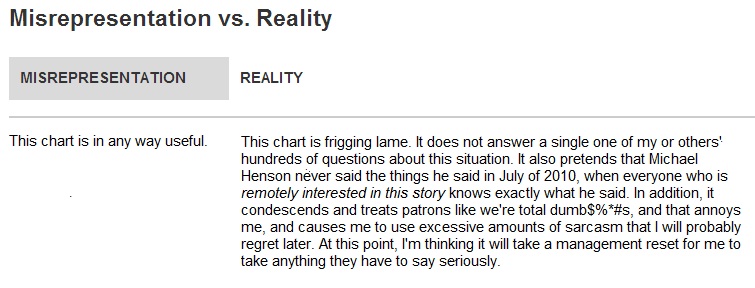
This blog has been criticized – and occasionally rightly so – for overuse of sarcasm. Well, if sarcasm isn’t your thing, then you’ll want to look away now, because this entry is loaded with it.  That being said, until Minnesota management gets serious, I’m not particularly interested in being serious, either. The time for joke charts like this one is over. It’s time for some real answers. And if you don’t give them to me, then I’m going to Release The Snark! What else am I supposed to do? Reason calmly and politely and rationally? I – and many other patrons – have already tried that. And it didn’t work. Like, at all. So I dunno. Might as well turn up the sarcasm?

I’d also like to say – once again – that I do not speak for the musicians of the Minnesota Orchestra. I have never spoken for the musicians of the Minnesota Orchestra and I will never speak for the musicians of the Minnesota Orchestra. I speak solely for myself. If we often share perspectives, then so be it, but keep in mind that’s incidental. We are totally separate entities. They never pressure me to say anything, and even if they did, I wouldn’t listen to them. I say what I say how I want to say it when I want to say it. So if you’re going to criticize this entry, or the tone of this entry, then remember the criticism belongs squarely at my feet. Not an ounce of it should go to them. Because they’re better wiser human beings than I am, and they consistently take the high road, while I routinely veer off into the brambles of angry, cranky, frustrated snark.

Now for our feature presentation…

***

What’s that, you say? Minnesota Orchestra management has some new information up on their website?

*heart rate spikes*

*face flushes*

*do you think they’ll answer any of my questions???*

*omg*

*gallops along to read, excited to finally get some answers!*

*reads document*

*heart rate slows*

*becomes ridiculously disappointed*

*resists urge to get drunk*

*pounds wall in frustration*

*searches Google Images for “FRUSTRATION”*

ARRRRRRRRRRRRRRRRRRRRRRRGH

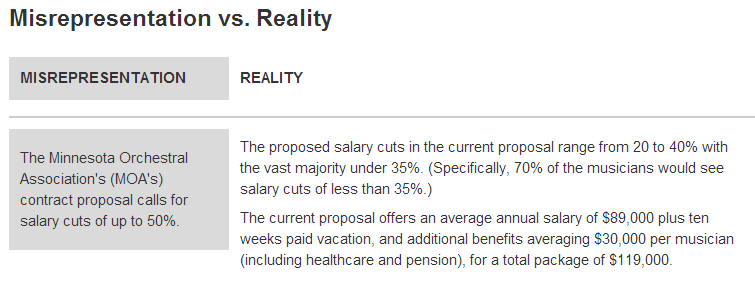
Here it is, in all its irrelevant, completely unhelpful glory. It’s a two-column chart called “Misrepresentation vs. Reality.”

Deep, man. Cuz I mean…what is reality, really? Do we really know? Like, really?

I love how we’re all tip-toeing over the word everyone’s thinking but nobody’s actually saying. I say obfuscation; you say misrepresentation; we both mean another word entirely…am I right? Anyway. Let’s get to analyzing. I’ll copy/paste the Misrepresentation and Reality, and then counter with my own Misrepresentation of Reality. Then management (assuming they ever acknowledge I exist) can come back with a “No, That Misrepresentation of Reality Is Really A Misrepresentation of Reality.” Or, whatever.

Here goes:

Misrepresentation: The Minnesota Orchestral Association’s (MOA’s) contract proposal calls for salary cuts of up to 50%.

Reality: The proposed salary cuts in the current proposal range from 20 to 40% with the vast majority under 35%. (Specifically, 70% of the musicians would see salary cuts of less than 35%.)

The current proposal offers an average annual salary of $89,000 plus ten weeks paid vacation, and additional benefits averaging $30,000 per musician (including healthcare and pension), for a total package of $119,000.

Misrepresentation of Reality: “The vast majority” are “under 35%”? Oh, well, that’s not so bad, then! I guess I’ll put away my picket sign. Twenty to forty percent of someone’s paycheck is chump change. So chump-ish, in fact, that, if Michael Henson took that pay cut, he’d only lose out on a mere $80,000 to $160,000 a year. I’m sure he’d swallow such a cut easily, without any resistance whatsoever. Especially since there are so few orchestra CEO positions available in the world today, and since he’d have such difficulty finding work elsewhere.

I’m going to sound a bit like a broken record here. As I’ve said before, keep in mind the difference in base versus average salaries (the proposed base is $78,000); both numbers should be considered. As I’ve said before, musicians don’t have vacation weeks, ever; only weeks in which they do not perform with the orchestra. As I’ve said before, take everything from both sides with not just a grain of salt, but a salt mine.

The more I read about this topic, the more I realize I can’t state with any certainty what numbers are accurate. Especially not when we’re talking about the massive fiscal infrastructure of a major American symphony orchestra. And especially especially not when the numbers come from management, since they have a long – and apparently proud – history of obfuscation. However, I am well aware that just like Bible verses, numbers can be massaged to say whatever the crap you want them to. (Exhibit A.) And since management routinely obfuscates about the things I do understand, like musician “vacation time”, then that makes me feel as if they’re also obfuscating about the things I don’t understand, like their financial status. That’s just common sense. If someone obfuscates about one thing, what’s to keep them from obfuscating about another? So they’ll really need to step up their game to get me to believe them.

So let’s keep reading and see if they do that…

Misrepresentation: The MOA turned down three musician contract proposals.

Reality: Musicians have not presented a single contract proposal since negotiations began in April.

The three “proposals” provided by musicians—to play and talk, to submit to binding arbitration and to conduct an independent financial analysis—are not contract proposals.

Misrepresentation of Reality: But…binding arbitration would have resulted in a new contract, right? If I offer to do something that’s guaranteed to end in a contract, then that’s basically a contract proposal. IMHO. If I tie a ring box around the neck of my boyfriend’s dog and push the dog into the room where my boyfriend is sitting, I’m not saying out loud “please marry me,” but the intent is obvious: I’m making a proposal of marriage. If an orchestra offers to go through binding arbitration, then their intent is obvious. Correct?

Misrepresentation: The MOA is refusing to share specifics on the Orchestra’s finances with musicians.

Reality: Board and management have been communicating the financial position of the Orchestra with musicians for three years.

In addition, the Orchestra’s Negotiating Committee has provided more than 1,200 pages of information to the Musician Negotiating Committee in the past six months, including the independently audited financial statements.

Misrepresentation of Reality: Oh, I see. So the board and management have been communicating the financial position of the Orchestra with the musicians for three whole years…just not with the public or with the press. *thumbs up* My confidence in you is soaring…like the Hindenburg! (To borrow a famous quote from Colbert.)

There is nothing in the “reality” spiel about incomplete and misleading numbers, which, to the best of my understanding, is the crux of the issue. Number of pages tells me nothing. Nada. Zilch. I could easily print out 1200 pages of documents about the sorry state of my finances and still not reveal to you how much is actually in my savings account ($5, if you’re interested). Also, notice: no word about the already approved budget that they are apparently refusing to release. And no word about the mysterious vanished article from 2010 that says how well they’re doing. No word, no word, no word. The rest is silence, et cetera.

Misrepresentation: The audited financial information shared was from Fiscal 2011 and is out of date.

Reality: The Fiscal 2011 financials are the most current audited figures available.

Our most recent fiscal year ended in August and our 2012 independent audit is now underway. Those figures, too, will be shared with musicians when the audit is complete.

Misrepresentation of Reality: Dunno the exact truth here (and if you do know anything, please don’t tell me – unless you want to go on the record; I really really don’t want to get stuck in the middle of discussions about numbers I can’t verify), but this is what Ellen Dinwiddie Smith said in the Matt Peiken MNuet interview… (5:29 in)

MP: Ellen, you also told me, and I want you to talk about this a little more, you mentioned that to date, you have not seen…as an orchestra, you have not been shown the books, let alone your request to have an independent auditor look at them. Is that true, that the musicians have not seen the books?

EDS: This is true. We have repeatedly called for a joint independent financial analysis, and they have refused to do that. We have given the papers that we were given to people who have looked at them and basically told us that everything they’ve given us is so contradictory to each other that it doesn’t make sense.

So…take from that exchange what you will. Pretty impossible for those of us on the outside to understand all the subtleties of what’s going on here, I think. Nonetheless, management doesn’t once address the musicians’ central allegation: that there are contradictory numbers at play.

Misrepresentation: MOA’s refusal to “play and talk” signals an intention to create a second-rate orchestra.

Reality: After six months of playing and talking without a single counter-proposal from the musicians, Orchestra management concluded that continuing to repeat that activity would only result in more unproductive discussions and costly delays. A “play and talk” agreement incurs monthly operating losses for our organization of $500,000.

Preserving the future of an exceptional Orchestra for generations of music lovers is our highest priority. We await a counter-proposal from the musicians so we can resume negotiations and reach a settlement as quickly as possible.

Misrepresentation of Reality: Hey, guys. I know it’s hard for you, but let’s get real for a brief moment. The idea of the “playing and talking” period being while the musicians were still legally obligated to play…that’s just such a ridiculously ludicrous notion, and so far outside the definition of the phrase “playing and talking” in the orchestral world, that I don’t even know what to say. Barney Frank said it best: “On what planet do you spend most of your time? Trying to have a conversation with you would be like trying to argue with a dining room table; I have no interest in doing it.” And you know what? He’s right. To be perfectly honest, I have no idea why I’m giving this chart the time of day. It’s ridiculous and useless and irrelevant. This is the Dick Morris of charts. At a certain point, you stop reading for information and start reading for the sheer entertainment value.

But we’ve gotten this far. So let’s keep going… Maybe we’ll be surprised by a flash of insight…

Misrepresentation: Most of the musicians will leave if this contract is approved.

Reality: We believe our musicians remain committed to this organization and community, and hope they will choose to remain.

Other major orchestras across the country who have undergone a market reset have not seen significant departures from their players.

These orchestras still report a high number of qualified candidates applying for positions that do become available.

Misrepresentation of Reality: That Kool-Aid must taste awfully delicious. While you’re drinking, you might be interested in checking out what happened to the principals in Detroit after their own orchestral apocalypse. Here’s a little taste.

Also, clever clever clever use of the word “most.” No, “most” probably won’t leave…but “a lot” certainly could. Especially our principals. Who are some of the very best in the business. Heck, one could easily argue that we’ve already lost Sarah Kwak over this. She and her husband – also an Orchestra violinist – saw this coming. I wouldn’t be surprised if that knowledge factored heavily in their decision to leave for Oregon.

Also also…”undergoing a market reset.” Ha. Hey, while we’re throwing around chilling Orwellian phrases, here are some of my personal favorites: “Ministry of Plenty” – “Newspeak” – “Ignorance is Strength” – and “no animal shall sleep in a bed with sheets.”

Note that once again, there is no concern at all, whatsoever, for THESE particular musicians, for these individuals, for these hearts and souls, and for the relationships the community has with them. The callousness verges on entertaining…if it wasn’t so cruel. The relationships they’ve built with community members – particularly, with children and young people – are not easily replaceable. I know this will come as a shock to some of you, but there are other consequences to this conflict besides economic ones. And you’ve yet to address those.

Orchestra member Manny Laureano is a co-artistic director and conductor at the Minnesota Youth Symphonies. If he’s anything like my youth symphony conductors, he is hugely influential, and his example brightens hundreds of kids’ lives. When he announces his departure for greener pastures, I defy you to walk up to every single student that he has led and inspired over the years in the Twin Cities, and reassure them that “well, a high number of qualified candidates are applying for Mr. Laureano’s now-vacant seat, so don’t worry, kids! That’s just what happens during market resets!” I dare you to do this. Orch dorks may not look threatening, but I think you’d be surprised by the reaction you’d get. Repeat a scene like this for every single individual who leaves the orchestra due to the behavior of management. Behind every single departed musician, I guarantee you will find a wake of depressed fans, students, friends, co-workers…maybe even families. These are holes that cannot be mended quickly or easily…if ever. Poking open those holes is not a task that should be taken likely. And when it does need to be done, it needs to be done with empathy, sympathy, and respect. None of which you’ve shown. Ever.

For future reference, this is how an emotionally intelligent person would answer the question “will musicians leave?”

Yes, there is a danger that some will leave. We regret that our community cannot afford to pay them the salary they could earn elsewhere. We respect these individuals’ decisions to seek work elsewhere. We are proud of them and the amazing work they’ve done in the Twin Cities, and we wish them well as they seek better-paying jobs in other communities. We can only hope that their replacements will live up to the high standards they have set.

In other words…… R-E-S-P-E-C-T!!! Find out what it means to me! (And plus it’s to-tal-ly free!) You can sing along with a karaoke version here! (Actually, the lyrics to this entire song are hilariously applicable to this entire debacle, and I really recommend taking a break from this blog to belt them out. It will be therapeutic.)

Misrepresentation: The Orchestra Board raised money to renovate Orchestra Hall that should have been used to pay musicians.

Reality: The funds for renovating Orchestra Hall are part of a larger $110 million campaign which began in 2005.

The majority of these contributions ($60 million) are being used for two purposes: to build the future endowment, which will continue to fund musician compensation, and to support artistic initiatives (like touring and recording).

Misrepresentation: The MOA should now use the funds raised for Orchestra Hall to support its musicians instead.

Reality: Our donors had a choice over which component of our $110 million campaign they wished to support.

Some donors (corporate, foundation and individual) prefer to give one-time capital gifts that come with naming options.

The funds raised for the renovation of Orchestra Hall are restricted for that purpose and cannot be diverted for other uses.

For example: $14 million in bonding support from the State of Minnesota must be used for this capital project and cannot be used for ongoing operations. In order to draw down these funds, the Orchestra has met a requirement for a 2 to 1 match with funding from private and corporate supporters.

Misrepresentation of Reality: BFEWJIAO;IFJEOWA. FJISODA;JFIDS;AJFIDSA.

AGAIN, BECAUSE IT’S STILL RELEVANT

Look, I don’t think anyone is saying “Stop the renovation in its tracks and give that money to musicians!” No. We’re objecting to the picture you painted in 2010 and earlier, in which you were “a beacon institution” among “bad economic news.” We’re wondering if people would have donated to the hall construction effort if they’d known such massive pay cuts were coming. In other words, if you guys had told us in 2010 about the impending pay cuts, would you have raised enough money for the hall? That’s what we’re asking. But you’re not answering. Hello! Is anyone home? Anyone? It’s not that complicated a question!

Misrepresentation: The MOA has money to pay the musicians—it just doesn’t want to.

Reality: The Orchestra has paid musicians’ salaries over the last several years by making additional draws from its endowment. The draw rate was three times higher than a sustainable level in 2011 (17% vs 5%).

That’s like taking money out of a 401k to pay normal living expenses. The more that’s pulled now, the less there is for the future.

If we continue to draw from our endowment at our current rate, the MOA endowment will be depleted by 2018.

Misrepresentation of Reality: Groovy, cool beans, awesomesauce. How about you prove this to us by submitting to a joint independent financial analysis? Like this Star Tribune editorial said you should? The very same Star Tribune editorial that you posted a link to on your website? In the words of Reagan and the Star Tribune, “trust but verify.”

Or is Reagan too much of a union-loving commie pinko lefty for you?

Look, even if the numbers come back as total exact duplicates to your independent audits…well, hey, at least you’ll have shut the musicians – and us patrons – up for a while. And I mean, you’ve got to admit, we’re frigging obnoxious.

Misrepresentation: The musicians already took a pay cut in 2009.

Reality: The musicians agreed to a one year wage freeze in 2009. They did not offer to take a cut in salary.

Misrepresentation of Reality: Um, that’s actually not how you characterized it in 2010… “At the same time, Henson negotiated modifications to the musicians’ contract, resulting in around $4.2m in cost savings up to 2012 – mostly through salary and pension reductions, and a wage freeze in FY2010.” (That “winning article” just keeps on giving and giving. My goodness. No wonder Henson wants it removed from the face of the earth.) That’s also not what you told the Star Tribune in August 2009: “Musicians at the Minnesota Orchestra have agreed to concessions in the face of financial pressures on the organization… The plan involves pay cuts totaling $1.8 million.”

What am I missing?

Misrepresentation: The musicians offered to take more cuts but were rebuffed by management.

Reality: The musicians did not offer to take any cuts.

They did offer to defer salary increases in exchange for extending the current contract an additional two years. However, this would have further depleted our endowment and put off the problem, not solved it.

Misrepresentation of Reality: Fascinating! Of course this had absolutely nothing to do with the fact the SPCO’s contract would be up for expiration in 2012. And it has nothing to do with the fact that an overworked local media wouldn’t be able to keep track of both stories. And it has nothing to do with the fact that major contracts were coming up in Atlanta and Indianapolis and Cleveland and Chicago and St. Paul, and at least three of those were likely to be settled with sharply concessionary contracts. No…nothing whatsoever to do with any of those things. It was all 100% concern over the health of the organization and the endowment. Mmmhmm.

*tinfoil hat crinkles*

(Of course I have no proof of this, and I can’t imagine we’ll ever get proof from management. But it’s not very hard to read the writing on the wall, and wonder. And since they’ve never addressed it…)

Misrepresentation: Management hasn’t taken any cuts internally.

Reality: In fact, staffing costs have been lean for many years. Over the last decade, all costs in the organization—minus musician costs—have decreased by 6%. In that same time period, musicians’ costs have increased by 26%.

Since the start of the 2007 musician’s contract—during which time the players received a 19.2% increase to base salary—the management and administrative team has taken a salary reduction, a wage freeze and had their pension contributions from the MOA reduced by more than 40%. This includes the president.

The size of the staff has decreased by 20% since 2009 due to layoffs.

Misrepresentations of Reality: I think a guest blogger (or two) may eventually have something to say about this. I think you’d be surprised by the…tenaciousness, shall we say, of certain patrons. So stay tuned. And stop belittling us.

Is anyone saying that management hasn’t taken any cuts internally? Because we all know that people have been fired, and fired brutally. In fact, that’s actually one of our concerns! Take a listen to what Ellen Dinwiddie Smith said in the Peiken interview (at 29:30).

What happened when they fired our staff…right before they closed the hall this summer…we had several staff members who were actually told that morning. They were brought into an office, and as they were being brought into the office, their computer passwords were changed, and they were told they had to leave the building. They were escorted out of the building and they were allowed to come back some time later and pick up their things. These are people who had worked at the orchestra twenty years, some of them just like at the stage door. There was no reason to make that kind of a layoff because they knew they were going to get laid off or whatever in a week or two weeks when the hall closed, but the Association staged it in such a way that, oh, we had to do this, you know, big layoff thing.

Soooooooo. Is this true? Why aren’t you addressing this allegation? Do you still want to talk about cuts in management, or would you like to move onto another subject?

Here’s a question: if this is true, then what the actual [bleep]? What possessed you? Who on earth decided this was okay? This isn’t how we do things in Minnesota.

This also is a phrase that interests me: “This includes the president.” Then whassup with this? $390,000 in 2009 and $404,000 in 2011-ish? Even if Michael Henson’s total compensation, including benefits, somehow did go down, it sure as crap doesn’t look like it went down 20-40%. Also, how about this article? “For the big guns, nonprofits with budgets of $25 million to $50 million, the median CEO compensation was $243,000 at the top tier.” Thoughts? Explanation? Justification? Rebuttals? Apologies?

No. Crickets.

One more thing: I’d imagine the decrease in the size of the staff was at least partially due to the fact that your hall is under renovation, and you had to let some people go while you were away. Correct? And yet…no mention of that here. Obfuscations obfuscations obfuscations. At this point I’m realizing it would have been easier to point out the things in this chart that are true, rather than pointing out the things that are misleading. Oh, well; we’re too far along now. Let’s keep going…

Misrepresentation: MOA doesn’t want any assistance from a third party to break the stalemate.

Reality: Orchestra management strongly supports an independent party involved in negotiations, and a federal mediator is participating in our negotiations.

It is highly unusual to suggest arbitration in a negotiation in which one side has not put forward even a single proposal.

Final and binding arbitration provides no assurance that the Orchestra’s financial instability would be solved, even in the short term.

At best, it would delay needed changes for many months while the arbitration unfolds. The Orchestra would incur significant operating losses with each month’s delay.

Misrepresentation of Reality: OK, so I know that every orchestra is local, and every orchestral meltdown is unique in its own way (“each unhappy family is unhappy in its own way”). And we could probably have a long in-depth discussion about why (if you would bother discussing anything with anybody in-depth, which you won’t). But here’s a question: why do you think that the managements at Louisville and Detroit even entertained the idea of binding arbitration for more than five seconds, if it didn’t provide any assurance of financial stability, even in the short term? Were those leaders just being reckless? Were they desperate? Stupid? Or do you think that your financial position and outlook are even worse than theirs? If so, why? Because our arts scene is envied across the country. And I think the folks in power at Louisville and Detroit would have killed to be in this generous, thriving, well-educated community.

Misrepresentation: The Orchestra’s endowment has been mismanaged.

Reality: On the contrary, the MOA Endowment has exceeded investment return benchmarks over the last five years.

The critical issue is that we have taken additional draws from our endowment in order to fund the 2007 musicians’ contract—and this has reduced the endowment’s value. In short, we have less money to invest because of the salaries from the previous contract.

Our organization needs to learn to live within the means of a 5% investment draw, to ensure the endowment can grow and support the Orchestra in the future.

Misrepresentation of Reality: FYI, in case you’ve forgotten, the musicians didn’t unilaterally impose a contract in 2007: you guys agreed to it, too. If that contract is the only thing that went wrong, you deserve blame, as well. In 2007, orchestra board chairman Paul Grangaard said, “We have a three-year plan to break even, and we’re confident we’re going to achieve that.” (Mr. Grangaard is still listed as being on the Board of Directors.) So don’t give me this crap that it’s solely the musicians’ fault and you had absolutely nothing to do with it and you have no idea who on earth okayed all these crushing fiscal obligations.

Also: what is the definition of “mismanagement”? It could be anything from “fraud” to “slightly under-performing the market,” really. Depends on who you ask.

Two questions. First question: is this bit from the musicians’ website false? “Board Chair Jon Campbell expressed regret at the Board and Management’s handling of the endowment funds over the past ten years, noting that they had been unhappy with the advice they had acted upon and had to change investment advisers. Campbell also admitted that the Board and Management had been wrong in 2007 regarding their investment predictions.” Second question: why the switch in independent investment consultants? You said yourself a few days ago that you switched: “In 2010, a new independent investment consultant, Cambridge Associates, was hired to manage the portfolio.” Answer those two questions honestly, and then maybe we could get past the posturing and strutting and puffing and begin to discuss this like adults.

Let’s get past this. It’s not impressing anybody.

Misrepresentation: MOA leaders created the organization’s strategic plan in secret and the plan reflects no interest in artistry, community service, education or marketing.

Reality: Musicians were participants in creating the artistic and community outreach portions of the strategic plan, since this is their area of expertise. Likewise the board and management created the financial portions of the plan.

As part of the strategic planning process, the board openly shared the Orchestra’s financial situation with musicians in a series of meetings spanning three years.

The complete plan—including sections on artistic achievement and community outreach—is available online, and includes many initiatives relating towards international touring, recording, broadcasting, and new community outreach programs

Misrepresentation of Reality: First off, please please please stop touting the fact that you were telling the musicians how terribly you were doing financially, when you weren’t telling us. This only reminds us of your fundamentally disingenuous nature. I feel like my husband cheated on me for three years with a woman named Nicole, and, worse, that he keeps insisting he’s trustworthy by saying, “But I was faithful to Nicole the whole time!You’re. Not. Helping.

Second, the “complete strategic plan” is utter poppycock, full of phrases that are so vague and cliched as to render them practically meaningless. “New concert formats”? “Explore new earned income streams”? “Vital holiday festivals”? What in the name of crap is a “vital holiday festival”? Let me check Google…

Oh. Well, maybe Google Image Search will be more helpful – ?

Nope.

Those are the first three results when you look up “vital holiday festival” on Google Image Search. Unfortunately, this doesn’t clear up my confusion, or answer my questions. And neither does management. So I’m still in the dark.

Look, you can’t write a “complete strategic guide” for a major symphony orchestra in a glossy thirty page document full of pretty pictures and sentence fragments. The idea of that is absurd. A real comprehensive strategic plan would be difficult nuts and bolts work, requiring substantial input from the community, and it would take hundreds upon hundreds of pages to debate, define, and implement. And you haven’t released those pages. I don’t even know if they exist! Right now I kinda doubt they do.

And that’s not even touching on the changed mission statement. Here’s the old one:

Our mission is to enrich and inspire our community as a symphony orchestra internationally recognized for its artistic excellence.

Our mission will be implemented by:

  • Enhancing the traditional core of concerts with innovative approaches to programming and format;
  • Providing the finest educational and outreach programs;
  • Representing and promoting the Minnesota Orchestra and the State of Minnesota to audiences across the state, across the country and around the world through tours and electronic media;
  • Maintaining an acoustically superior hall with a welcoming environment.

Here’s the new one:

The Minnesota Orchestral Association inspires, educates and serves our community through internationally recognized performances of exceptional music delivered within a sustainable financial structure.

End statement. Something’s missing in that second one that’s very prominent in the first. I can’t quite put my finger on it… Something about “an orchestra”, maybe? Question: why take the word orchestra out of an orchestra’s mission statement?

Misrepresentation: MOA’s proposal includes a dramatic shift in healthcare costs to musicians.

Reality: In the proposed contract, the musicians will participate in the same medical plan that covers management and administration.

Even with this change, the MOA will make an average annual contribution towards family medical coverage of $17,250 per employee, almost twice the national average.

Misrepresentation of Reality: Um, yeah. Quick question… Are you aware that the “reality” you just gave didn’t even address the misrepresentation?

I ask this in all sincerity: Do you think we’re dumb? Because I’m getting the vibe you think we’re dumb. But the thing is, we aren’t dumb. And we get really annoyed when you treat us like we’re dumb. Because we aren’t, in fact, dumb.

Misrepresentation: Musicians have collected more than 7,000 signatures supporting their position.

Reality: None of the petitions provide any specifics on the contract negotiations. The current petition online reads “Minnesota deserves artistic excellence. I support keeping world-class musicians in the Minnesota Orchestra so that all Minnesotans may continue to enjoy extraordinary music.”

Orchestra leaders support that position. Preserving extraordinary music for generations is the core of the proposed contract and the Orchestra’s five-year strategic plan.

Misrepresentation of Reality: Well, duh. Nobody is going to sign a change.org petition if they have to read a 50-page contract full of indecipherable legalese first. But I can guarantee you, the people who signed do support one thing: they support keeping these particular world-class musicians in Minneapolis. And orchestra leaders simply don’t support that position. And don’t tell me they do; Davis and Campbell themselves have said they’re expecting turnover, and they seem awfully cool with it. Also, there’s that old maxim: “actions speak louder than words.” Pretend you’re management. If you really wanted to keep these musicians in town, would you treat them the way management has been treating these musicians? No. Of course not. We’re Minnesotans. (Well…I’m from western Wisconsin, but that’s basically the same thing.) We have a long proud history of being fundamentally decent human beings. There’s a whole Wikipedia entry on it.

*reaches the end of the chart*

*keeps clicking, convinced there’s more, somewhere*

*reaches end of page*

Nothing.

NOOOO!

NOOOOOOOOOOOOO!

I feel just like I did at the end of season one of Sherlock!

You can’t end the story there! Guys! That’s narrative malpractice! There are so many unresolved plot points! Nothing more about why you refuse to submit to an independent financial analysis? Nothing explaining why the Strib was wrong for recommending you do so? Nothing about how your Industry News section only has sad articles about orchestras and never happy ones? Nothing about being sorry for treating the musicians like cogs in a machine? Nothing about how Henson is still earning roughly $1100 every single day the lockout churns on? (He’s earned over $36,000 since it began, by the way…) Nothing about the dozens upon dozens of questions I’ve raised on this blog? Nothing about why you won’t talk to Matt Peiken? Nothing about the intelligent questions Mary Schaefle asked? Nothing about the mysterious vanishing Michael Henson article of 2010 that everyone’s talking about? (Even frigging Alex Ross at The New Yorker knows about it at this point!) Guys, this was such a huge opportunity for you, and you just…you kind of blew it, to be honest.

I could tear this chart apart even further. Maybe I will, too, eventually, if I’m ever in the mood to shoot muskies in barrels. But doing so would just consist of me further blabbing about things I’ve already blabbed many thousands of words about, and that would be boring and a complete waste of space. (Just like this chart!) The only interesting thing about this crap is the fact that management found it necessary to post it. Is this a sign that they’re having difficulty winning over their public? Or that they’re gearing up to pull an SPCO and cancel concerts through December 31st within the next few days, and they want to be prepared for the surge of confused PO’d patrons who will be coming to their website looking for an explanation? Who the crap knows. But if prior efforts haven’t done anything to move the needle of public opinion, I can’t imagine this will.

Hey, Minnesota management! The day you start getting real, then I promise you, that’s the day I’ll drop the sarcasm and start taking you seriously. Until then, I can’t view management’s position as anything except a terrible joke. And I’m going to treat it with what an inappropriate joke deserves: with massive amounts of scorn and derision.

9 Comments

Filed under My Writing

Endowment Draw Rates and Other Numbery Things

As y’all can imagine, when I was in Minneapolis, I fell behind with updating the Orchestral Apocalypse Index. Well I’m finally catching up with it this evening. (I know, I know; I’m slow. To be fair, I’m not getting paid to do any of this, so…) In the process of catching up with the latest news, I came across some numbers in this October 23 MPR article: Why not spend Minnesota Orchestra’s $140M endowment?

Yes, you heard me right:

Numbers!!!

Yeah, apparently on the 23rd we got some more concrete numbers from management about 2007-12 endowment draw rates, and in the rush of news, I missed it. So let’s have a belated party, y’all, and comb through these babies! *uncorks champagne* (You know you’re a nerd when…)

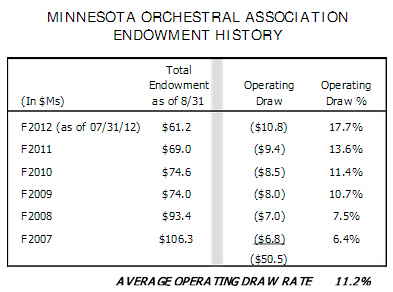
OK, so. Here’s a chart with numbers from the article. Just to be clear, this chart is for the Minnesota Orchestral Association Endowment (other funds from the Oakleaf Trust and St. Paul Foundation, etc., are not included in this chart, and are discussed earlier in the presentation within the article). And I’m not sure where funds raised for Building for the Future campaign fit into all this.

Remember back here when I tried to take a stab at the endowment draw rate from 2009-2011? I’ll copy those numbers here. Bold numbers are ones that (I thought) I knew for certain, based on statements in Strib articles. Italic numbers are the percentages that I needed to add in to gel with Henson’s statement that “the orchestra has withdrawn an average of 10 percent annually over the last decade.” (Actually, if you look on their website, they claim the average rate draw has been more like 9.4% over the last decade. And as best I can calculate, that’s closer to the truth. But 10% does sound more dramatic than 9.4%, and I guess that leads to the question, what’s .6% among friends?)

OK, so…

2002 – 7% or less

2003 – 7% or less

2004 – 7% or less

2005 – 7% or less

2006 – 7% or less

2007 – 6%

2008 – 6%

2009 – about 17%

2010 – about 17%

2011 – about 17%

I didn’t think management would have included 2012, since we aren’t done with 2012 yet. But apparently they are including it in their “last ten years” calculations. So their numbers look like this…(And FYI I’m stealing the 2003-2006 numbers from the list above, because those aren’t included on management’s chart. If these numbers are ever officially released, let me know.)

2003 – 7% or less

2004 – 7% or less

2005 – 7% or less

2006 – 7% or less

2007 – 6.4%

2008 – 7.5%

2009 – 10.7%

2010 – 11.4%

2011 – 13.6%

2012 – 17.7%

So now let’s look at the differences between the two sets of numbers…

2007 is…close enough. I’ll let a .4% difference slide, since Michael Henson lets a .6% difference slide…

2008 is…confusing. On their chart, management says there was a 7.5% draw. In the Strib in December 2008, they said they’d employed a 6% draw. Don’t really know how to reconcile those two figures. Maybe their fiscal years are separate from their calendar years, and there was a discrepancy? Or maybe they were talking different percentages from different funds? Maybe they were flat-out lying to the Strib? Maybe there’s another explanation? I don’t know. I don’t have enough information to tell.

Beyond that, though, the rest of the difference between the two sets of numbers can be attributed, I think, to management shaving off a “7% or less” year and adding in another heavy draw year (2012) that I hadn’t included. That skewed my calculations a few points higher for 2009-2011.

I think it’s interesting to note that the marked increase in the draw rate only occurred once the Great Recession hit. In the Wikipedia article on the 2008-2012 global recession, the Great Recession is defined as “a marked global economic decline that began in December 2007 and took a particularly sharp downward turn in September 2008” (my bold).

And you can definitely see evidence of that in management’s chart. It seems as if things were on a fairly even keel draw-wise in 2007 and before. According to the Star Tribune in December 2008, “The board is allowed to draw up to 7 percent, but spokeswoman Gwen Pappas said the organization has been very firm about avoiding that method.”

So here are some facts, drawing both from that statement of Ms. Pappas’s, and the chart given to MPR:

1) From 2003-2012, the draw rate averaged 9.5% (at most).

2) From 2003-2007, the draw rate averaged 6.9% (at most). From 2008-2012, however, the draw rate nearly doubled, to an average of 12.2%.

So anyway, keep that in mind when you hear the “ten percent over the last ten years” line. Something around 9.4% is technically true, based on the numbers we have now, but I think it would be more helpful to think of it in terms of “twelve percent since the recession began” (or “twelve percent since the musicians’ latest contract was signed” , or “twelve percent since Michael Henson was hired”; take your pick, depending on who you’re rooting for).

I’m curious why management is even bringing the 2003-2007 numbers into this…? Can you think of a reason? The 2003-2007 numbers were actually pretty good, at least according to the Strib statement. Not perfect, maybe, but not especially catastrophic, either. So why bother dragging those in at all? To make it look as if they’ve had a draw rate problem for longer than they actually have? To make it seem as if the problems were more systemic than situational? To keep Michael Henson from looking bad (take a guess at what year he came aboard)? To deflect attention away from what must have been some seriously abysmal investments that were made during the recession? I don’t know. I don’t know what to think.

Seeing the dates when the draw rate ticked upward also makes me wonder where the Strategic Plan fits into all this… The Minnesota Orchestra Strategic Plan was released in November 2011. It says that at the time of publication, they’d been writing the Plan for eighteen months, or since the spring of 2010. Insinuation: management began to see major deep-seated problems that required a major organizational overhaul…I don’t know, in the spring of 2008? At the earliest? Latest? Maybe? How long would you need to see deep-seated problems before you realize they’re deep-seated problems, and that you need to take incredibly drastic action to solve them? I don’t know, and sadly, we haven’t heard from the board about the exact timeline, or the process of or reasoning behind their Strategic Planning, so I can only guess. So I wonder, what specifically were the deep-seated fiscal problems that needed to be addressed? In the spring of 2008, the recession hadn’t really started yet. The endowment draw rates hadn’t climbed yet. The stock market hadn’t totally tanked yet. Were the deep-seated fiscal problems due solely to the musicians’ 2007-2012 contract? (Then why did management ever agree to it? And why was Michael Henson so proud of how things were going financially in 2010?) Was there a major decrease in attendance or ticket sales? (But even if there were, ticket sales consist of a relatively small percentage of revenue, right?) I don’t know. Were donations down? Argh. My brain hurts. I’m so tired of having to dig around and read between lines. It would be really nice if those in power could answer these kinds of questions in detail. I mean, they’ve got a huge website with which to do so. This isn’t the private sector. Those in the orchestra should answer their public’s questions. IMHO.

Another wrinkle: who knows what other numbers have been bandied around? The musicians say they’ve been given conflicting, misleading financial information. Maybe this chart is among that misleading stuff. After all, the chart management provided to MPR doesn’t seem to jive with

And I’m sure there are other similar remarks, too, that I just haven’t found yet. (Give me time…)

So…yeah. Numbers. I don’t know. *shrug* If there are any math geeks out there, feel free to chime in. Or management! Management, you can feel free to jump in, too, if you want. Let’s get a dialogue going. I’ve got an audience, as you know. Endowments (um, and math) aren’t, as Randy Jackson would say, my wheelhouse, so I’d appreciate any input…

17 Comments

Filed under My Writing

A Layman’s Guide to the Minnesota Orchestra Lockout

Someone asked me the other day – “So what’s this whole Minnesota Orchestra lockout thing about?”

Um…

Well.

“How long do you have?” I wanted to ask.

So I’m giving myself a challenge: to summarize the lockout from my perspective in 2000 words. I’ll give myself bonus points if I can stay under 1500.

***

The Minnesota Orchestra musicians’ 2007-2012 contract expired on September 30. Rumors had abounded for months that the orchestra was facing serious financial trouble, and that management would be seeking sharp concessions from their musicians (despite the fact that, within the last five years, the orchestra has cemented its reputation as one of the greatest in the world). Within the last year, a large number of players have either retired or left the orchestra outright, suggesting internal strife. In the spring of 2012, sixteen non-musician employees were laid off. Nationally renowned arts consultant Drew McManus feared that these employees were being used as pawns in the negotiating game. On August 27 the orchestra’s blog, written by conductor Sarah Hicks and violist Sam Bergman, was suddenly shut down; neither author was given the chance to write a good-bye post. Management said it was because their website was being redesigned. Fans knew better. So even from the outside, it was obvious that negotiations were tense.

Continue reading

10 Comments

Filed under My Writing

Matt Peiken’s SPCO and Minnesota Orchestra Podcast

Hey peeps; listen up. I’ve got 50 minutes of juicy arts journalism for you. Matt Peiken from MNuet has produced a podcast you must listen to. I don’t care what you’re doing; drop it, and listen. Here’s a summary:

In this revealing and provocative conversation, Ellen Dinwiddie Smith of the Minnesota Orchestra and Carole Mason Smith of the Saint Paul Chamber Orchestra talk with MNuet’s Matt Peiken about the labor stalemates happening with their respective orchestras, their perspectives about what led to the musicians’ predicaments and steps they see going forward. Among other charges, the musicians make the case that the management of each orchestra is looking to transition from an orchestral focus to one of presenting a wide array of events. MNuet has asked to conduct a similar interview and devote an episode of “Whole Note” to representatives of each orchestra’s management.

Thank you thank you thank you, Mr. Peiken. I’m so thrilled we have an independent journalist in our midst.

Here are some teaser questions from the podcast: What are the missions of the SPCO and Minnesota Orchestra boards? How were certain individuals laid off at the Minnesota Orchestra in spring? Who gave back what when? Is there a kind of collusion happening among administrators at the highest echelons of American orchestras? Are musician-led ensembles in the Twin Cities’ future? Where are our local politicians in all this? And what about the children? Juicy stuff, huh? See, I told you you’d want to drop everything and listen.

If the managements at both orchestras refuse to take up Mr. Peiken’s generous offer to conduct in-depth interviews with them (and I’m guessing they will refuse), then I suggest that he post an mp3 of an hour of total silence. Or an hour of him asking questions to dead air. If those in charge can’t handle the heat, and won’t step up to answer their public’s questions, then let’s hammer home the void of leadership and vision and accountability as mercilessly as we know how. No offense to the good reporters who have been working on these stories over the last six weeks, but I’m so tired of the sound bites in 700-word articles in the mainstream press. This is the kind of in-depth conversation we need to be having. These are the questions we need to be asking, again and again and again, until those in power can’t bear to hear the sound of our voices anymore. Management, if you’re not going to answer the questions I’ve raised, or even acknowledge my existence, then at least sit down with someone like Mr. Peiken. If you don’t, we’ll assume you’re hiding something (what else are we supposed to do?). And we will act accordingly…

5 Comments

Filed under My Writing