Category Archives: Women Violinists

ISGOT: Maya Stuart-King

If you’re a violin nerd, you’re probably familiar with the name of Baron Johann Knoop, who was very possibly the greatest violin collector the world has ever seen. But I’d wager you know nothing about his wife, the mysterious Maya Stuart-King.

From a great article on Cozio.com – (forgive any funky formatting) –

This new focus on literary guests was due to the influence of Johann’s second wife, whom he married in 1899. Maya Stuart-King (1875-1945) was a young violinist who had run away from home at the age of 18 to search for her godmother, a German princess. She never did find her godmother, but she did find a Baron. She met Baron Knoop while playing at a salon in Vienna. The Baron fell in love with her and eventually convinced her to marry him, despite the fact that he was 30 years her senior.

There are a couple different versions to how this marriage came about. According to Mike Ashley, the author of a biography about the writer Algernon Blackwood, Knoop first hired Maya as a governess for his son and only married her some years later when Ludwig turned 18. On the other hand, the author Stephen Graham, who knew both Maya and Algernon quite well, remembered Maya relating events differently:

‘It was in Vienna. I was a violinist and I lived for music. I had my own Stradivarius and was one of a string quartet enjoying high social patronage. One evening a guest at a musical entertainment saw me. It was the Baron and he became infatuated. At first he tried to make me his mistress, but I was elusive and drove him to what was an unwise decision. I was a poor girl of no family; he was a nobleman of great wealth and he was sixty. But he made me a formal proposal of marriage. For me that made his courtship serious. I consulted my friends. They all said it was a golden opportunity for me because the man was fabulously rich. So I accepted him. The wedding itself, in the Russian Orthodox Church with crowns on our heads, was most impressive, and I felt at the time we were achieving something magnificent.

Whatever the case, the marriage was not a happy one for Maya. As Graham recalled, Maya continued with the story as follows:

But once married I soon realized I had lost my freedom. Courtship ceased and the Baron showed himself fanatically possessive. He stopped my playing and deposited my Stradivarius in a bank. It is still there for all I know. He cut me off from my acquaintances and friends and the patrons of my music. I was switched away to Russia, to Paris, to Egypt, and finally to England, and all the while I was his private – almost his secret – personal property. He affected to despise music and would never go to a concert. When he came to live here he had no guests beyond a few members of his family.’

At first Maya obeyed the Baron and did completely as he wished. But eventually, according to Graham’s account, she broke free, thanks in part to a certain German philosopher:

‘He stinted me for money and I was dressed always in black, like one of his German maids. Whatever he told me to do I did. I had no resistance. But one day I discovered Nietzsche and his philosophy was an inspiration. The sloppy faith I had been brought up in was no good; turning the other cheek had made me a slave. The German philosopher said, “Be hard as a diamond”. I could not get as hard as that, but hard enough to begin to live my own life and defy the restrictions which my husband put upon it. Then his power over me dissolved as if I had wrought a spell.”

Once Maya gained some independence from the Baron, she quickly became a favorite in literary circles and befriended many authors, including Graham and Ranier Rilke. But her closest friend – in fact they were almost inseparable from about 1911-1918 – was Algernon Blackwood, a journalist and novelist whom Maya met on a Nile steamer which belonged to the Baron. Blackwood specialized in books about the supernatural and occult. As Graham describes the relationship, Blackwood became her “Slave of the Ring.”  “A love affair began,” writes Graham, “and lasted the rest of his life, though without physical expression. For him Maya became a wonder-child, and then a mystical being with an awareness of invisible things.” Blackwood dedicated virtually all of his books to Maya. 

What the Baron thought of this relationship is not recorded but if he objected to it he was also resigned to the fact that there was little he could do about it, short of divorcing Maya. It seems that the couple had a devil’s pact. The broody Baron needed Maya’s presence – her lightness and gaiety. For her part, Maya enjoyed the Baron’s money and the freedom of being married in letter only. Though undoubtedly not the ideal union that each wished, the marriage nevertheless survived 19 years, and ended only with the Baron’s death.

The story about Maya’s Strad being locked in a bank vault is one I have not been able to confirm. Indeed, it’s not clear which of the many Strads owned by Baron Knoop was actually Maya’s. Interestingly, the accounts of Graham and Ashley conflict with what Doring has written. According to Doring, Baron Knoop actually purchased a Strad as a gift for his wife.  This instrument was the de Barrou’ Strad, previously owned by C.G. Meier. “After Meier’s death,” writes Doring, “this violin of 1714 was acquired by Baron Knoop as a gift for his wife.” But as Meier was still alive at least as late as 1911, and the Baron and Maya married in 1899, this cannot be the same Strad to which Maya referred.

By the early 1900s, Knoop and Maya were more-or-less permanent residents of England, living first in a mansion in Tunbridge Wells. It was here that Graham had his first and only encounter with the Baron. Graham described the castle as “an immense structure, a castellated aggregation of brickwork.  . . The music room, in which no music was allowed, was as big as a church.”

Graham had travelled widely in Russia and had written many articles and books about Russia, including a biography of Alexander II, so one might have assumed that he and Baron Knoop would have much to discuss. But this was not the case. Graham and his wife were not invited to stay at the castle itself “because the Baron would not allow any guests to stay the night.” During the entire weekend they were there, Graham saw the Baron only once, for about 5 minutes.

The Baron had apparently been traumatized by the death of his first wife and child, and the near-death of his son. “He lived in a draught-proof little room,” wrote Graham,“where the temperature was not allowed to vary from 60 degrees Fahrenheit. The rest of his spacious domain he ignored.”

“The Baron was not stricken by disease,” continues Graham, “but was mortally afraid of ill-health. “

Graham summed up his opinion of the Baron thus:  Knoop was a “jealous and morose Russian baron. . . His idea when he saw anything beautiful was to take it for himself and hide it from the rest of the world.”

In 1903 Knoop purchased a large mansion in Wadhurst overlooking Kent and Sussex Weald, “with one of the most beautiful views in the south-east.” And although he himself remained in seclusion, he apparently allowed Maya to invite houseguests. Algernon stayed there frequently and even gave South Park as his forwarding address during the summer of 1911.

Algernon’s biographer, Mike Ashley, believes that Knoop and Maya were the models for characters in several of Algernon’s books and stories. In The Damned, for example, one of the main characters is Samuel Franklyn, a rich but gloomy man. But whereas the fictional Franklyn was grudgingly respected for his philanthropic works, the real-life Knoop seems to have kept his wealth mostly to himself. Aside from a Ruggeri violin that Knoop loaned to the Russian violinist, Carol Gregorowitch, in the 1880s, there is no evidence that he ever loaned any of his instruments to musicians, and the only record of philanthropy he left was a 75 pound scholarship at the Guildhall School of Music awarded each year, starting in 1899, to a promising violinist… [snip]

Meanwhile, the Knoops were being similarly persecuted in their Prussian homeland of Bremen. In 1915, the Prussian government took control of their Muhlenthal estate, justifying this seizure with the fact that one of the owners, namely Baron Johann Knoop, had permanent residence in England, and that his wife, “Baroness May Knoop,” was German-American by birth. By this time, the Baron had anyway abandoned the castle, with his last visit there believed to have been in 1910.

In 1916, probably to give their company a more Russian flavor, the Russian Knoops reorganized their enterprise and renamed the resulting company ‘Volokno’. But as Russia was increasingly hostile to any successful companies, and especially those with German roots, the Knoop family transferred as much of their assets as possible into the Manchester de Jersey company, whose chairman was Baron Johann Knoop.

After June, 1918, all of the Knoops’ Russian enterprises were nationalized (with the exception of the Kraenholm cotton mill in Estonia), and the Knoops – Johann’s two brothers and their families – were forced to flee Russia. 

A few months after the Knoop’s Russian empire was nationalized during the Russian revolution, Baron Johann Knoop died at his castle in Tunbridge Wells. The cause of death was not reported, but it was most likely the influenza pandemic, which killed an estimated 50 million people 1918. In his will he had left most of his estate to his son Ludwig, but Maya received a generous annual stipend, with the provision that she would lose the income should she re-marry. This may have put Maya in quite a quandary in relation to Algernon Blackwood. While she undoubtedly loved him as a friend, it’s not clear that their relationship was romantic, and she had become accustomed to a life that his book royalties could not support.  Graham writes that“Maya might have taken a chance and married him for love, but Blackwood would not.”

Graham continues that “Maya recovered her Stradivarius from the bank where the Baron had stored it, and organized a string quartet and gave music parties.” She belonged to a group called ‘Higher Thought’ which believed that thought more than actions worked miracles. Another member of this group was a coal magnate named Ralph Hilton Philipson, whose first wife had died in 1873. Once again, Maya was courted by a wealthy, elderly widower, and once again she accepted the marriage proposal. But where the Baron had been a dour, possessive personality, Philipson was his opposite – affable and generous, and a patron of many artists, authors and musicians. By all accounts, her marriage with Philipson was happier than her life with Baron Knoop, but the marriage was a short one. Philipson died of food poisoning in December, 1928. Maya herself continued to live in London until her death in 1945. What became of her Stradivari is not known.

Obviously I write non-fiction, and I absolutely love doing so, but fiction will always be the genre that I love the best and feel the most comfortable in. So as soon as I read this post on Cozio, I headed to the library to get a book by Algernon Blackwood in an attempt to discover more about Maya. His stories are spooky, unique, and ridiculously atmospheric; they’re highly recommended. The first one I read was Chinese Magic, which is the story of an older academic man who becomes entranced with a striking young woman. Turns out, there are shades of the Maya/Algernon relationship in just about every story.

I’ve looked around for more information on the Baroness and found little else. I’m writing a novel now (that has nothing to do with music), and I’m committed to finishing that, and I’m going to be busy with it for the foreseeable future, but…I have to confess, I’m totally inspired by the idea of somehow fictionalizing this strange love triangle between a reclusive violin collector, a spiritualist writer, and an independent musical young woman…
Leave a comment

Filed under Not My Writing, Women Violinists

Coming Attractions: Vivien Chartres

EDIT (5/28/2012): This essay has now been posted here.

***

I thought I would start a series of blog entries describing upcoming projects (FYI, I’m going to tag them “Coming Attractions”), so everyone is encouraged to check back as often as possible. There may be relatively long stretches of silence on this blog as I do research and write rough drafts, etc., so I want everyone to stay tuned even if it seems like I’ve abandoned the blog.

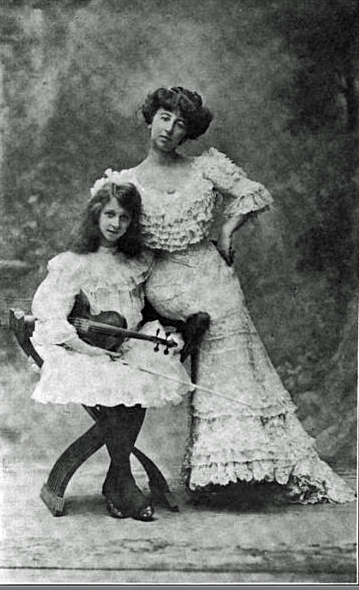
Recently I became interested in the life story of violin prodigy Vivien Chartres (1893-1941). Chartres was a musical phenomenon in the early years of the twentieth century, and in the contemporary press her name was often mentioned in the same sentence as Elman and Huberman. Her story is truly fit for a novel…and unlike most life stories, it actually became one: Vivien’s mother, Annie Vivanti Chartres, was a professional writer who wrote a book about Vivien in 1910 called The Devourers. As you can imagine, since the fictional Devourers is a major primary source, it occasionally gets a bit sticky trying to separate fact from fiction, and the challenge has been a fascinating one that has made me ask a lot of questions… What roles do parents play in raising musical children? What roles should they play? How far should a gifted child be pushed? How do writers fictionalize their own experiences, and how can historians untangle the truth? I’ve been in touch with some people who have helped me uncover some really interesting, thought-provoking things about Vivien and Vivanti, and I’m super excited to be able to share my findings. To the best of my knowledge, this will be the first biography of Chartres available to the general public. So if you’re interested, be sure to check back in the coming weeks. The subjects are extraordinary and I promise that their contemporary relevance will surprise you.

Vivien Chartres and her mother Annie Vivanti

4 Comments

Filed under My Writing, Women Violinists

Link: The Kôda Sisters

Through violinist.com I’ve found a fascinating series of essays written by Margaret Mehl about early female violinists in Japan and the Kôda sisters..

Earthquakes and Pioneering Sisters in Japan

Kôda Shimai: the Pioneering Sisters (2): Kôda Kô

The Kôda Sisters 3

If anyone knows of any online resources about female violinists, or if you have essays like this one to share, contact me! I’d be glad to read them and publicize it here. Er, not that being featured on a tiny blog like this one is going to increase your hits very much, but it certainly can’t hurt, right?

Leave a comment

Filed under Not My Writing, Women Violinists

ISGOT: Lady Anne Blunt

I’m introducing a new series of blog entries called “I Should Get On That.” These are little snippets of information I’ve heard of here and there that I want to dig into deeper but can’t at the moment, for whatever reason.

So, drumroll please.

Today’s ISGOT… Lady Anne Blunt.

According to Wikipedia, she was a writer, a polygot, a breeder of horses, and a fantastic violinist. I’m curious how fantastic a violinist. She studied under Leopold Jansa, who was Wilma Norman-Neruda’s (Lady Hallé’s) teacher. When did she start? Did she ever think of becoming a professional, or did she just study for her own pleasure? When did she start playing? Did she study abroad, or did Jansa come to her? She was born in 1837, so she was Lady Hallé’s near-exact contemporary, and before Lady Hallé came along, there were not many English women violinists at all. How did she start playing an instrument that was so unusual for her era and gender? I’d love to know, but sadly at the moment there doesn’t seem to be much information about her online… And I’m nowhere near a reputable library, so I’ll have to sit tight on this one. Unless, of course, one of my readers emails me some info…

You may have heard of her fiddle, the impeccable 1721 Lady Blunt Strad. It’s currently for sale. So if anyone has a spare….ten or twenty million, call me.

Leave a comment

Filed under My Writing, Women Violinists

Works Associated With Female Violinists

An ever-evolving list. Last updated 24 February 2012.

***

PREMIERES & DEDICATIONS

Atterberg, Kurt – Violin Concerto – Premiere given by Alma Moodie (1919)

Barber – Violin Concerto – UK premiere given by Eda Kersey in 1943; revised version of the score that violinists use today premiered by Ruth Posselt in 1949

Bartók – Violin Concerto No. 1 – Written for his first love, virtuosa Stefi Geyer

Bartók – Violin Sonata No. 1 and No. 2 (Sz 75 and 76) – There is some question as to whether these works were dedicated to Adila Fachiri or Jelly d’Aranyi; the latter performed them with the composer in London in 1922 and 1923, respectively.

Bax – Violin Concerto – Premiered by Eda Kersey in 1943

Beach, Amy – Romance – Written for and premiered by Maud Powell in 1895

Benjamin, Arthur – Romantic Fantasy for Violin, Viola, and Orchestra – Premiered by Eda Kersey in 1938

Coleridge-Taylor – Violin Concerto – Dedicated to and premiered by Maud Powell in 1912

Copland – Violin Sonata – Premiered by Ruth Posselt with Copland at the piano in 1944

Conus – Violin Concerto in e-minor – American premiere given by Maud Powell

Delius – Violin Sonata No 3 – Dedicated to May Harrison

Delius – Double Concerto (for violin and cello) – Premiered by sisters May and Beatrice Harrison in 1920

Dukelsky, Vladimir – Violin Concerto – Premiered by Ruth Posselt in 1943

Dvořák – Violin Concerto – American premiere given by Maud Powell in 1893

Eichberg, Julius – Dedicated six parlor pieces to six of his most famous female students – find them here

Elgar – Violin Concerto – First played through in private performance with Lady Leonora Speyer on violin; first recording made by Marie Hall in 1916

Erdmann, Eduard – Sonata for Solo Violin, op 12 – Dedicated to Alma Moodie

Gade, Niels – Violin Sonata No. 3 – Dedicated to Wilma Norman-Neruda in 1885

Hindemith – Violin Concerto – New York premiere made by Ruth Posselt in 1941

Hill, Edward Burlingame – Violin Concerto – premiered by Ruth Posselt in 1939

Holst – Concerto for Two Violins – Written for sisters Jelly d’Aranyi and Adila Fachiri in 1930

Hubay – Violin Concerto No. 4 – Dedicated to his student Stefi Geyer in 1908

Krenek, Ernst – Sonata for Solo Violin – Dedicated to Alma Moodie in 1924

Moeran, Ernest John – Violin Sonata – Premiered by Eda Kersey in 1923

Mozart – Sonata in B-flat, K 454 – Written for and premiered by Regina Strinasacchi Schlick in 1784

Pfitzner, Hans – Violin Concerto, op 34 – Dedicated to and premiered by Alma Moodie in 1923

Piston, Walter – Violin Concerto No. 1 – Written for and premiered by Ruth Posselt in 1940

Poulenc – Violin Sonata – Written for and premiered by Ginette Neveu in 1943

Prokofiev – Five Melodies; the third is dedicated to violinist Cecilia Hansen

Ravel – Violin Sonata – Dedicated to Hélène Jourdan-Morhange in 1922

Ravel – Sonata for Violin and Cello – Premiered by Hélène Jourdan-Morhange on violin in 1922

Ravel – Tzigane – Written for, dedicated to, and premiered by Jelly d’Aranyi in 1924

Saint-Saëns – Fantasie for violin and harp, op 124 – Dedicated to Clara and Marianne Eissler (Clara was a harpist; Marianne a violinist) in 1907

Sarasate – Romanza Andaluza; Jota Navarra – Dedicated to Wilma Norman-Neruda (later Lady Hallé) in 1878

Schoeck, Othmar – Violin Concerto – Written for Stefi Geyer in 1910-11

Schoeck, Othmar – Violin Sonata No. 1 – Written for Stefi Geyer in 1908-9

Schumann – Violin Concerto – Joachim’s grand-nieces, Jelly d’Aranyi and Adila Fachiri, received word of the manuscript in a séance with Joachim. d’Aranyi played the London premiere in late 1937 or early 1938.

Scott, Cyril – Danse from Deux preludes – Dedicated to Daisy Kennedy in 1912

Scott, Cyril – Violin Sonata No. 1 – Dedicated to and premiered by Ethel Barns in 1908

Sibelius – Violin Concerto – Maud Powell premiered this piece in America in 1906

Stravinsky – “Suite from themes, fragments, and pieces by Pergolesi” – Premiered by Alma Moodie (and Stravinsky) in 1925

Tchaikovsky – Violin Concerto – American premiere given by Maud Powell in 1889

Vaughan-Williams – The Lark Ascending – Written for Marie Hall in 1914

Vaughan-Williams – Concerto Academico – Dedicated to Jelly d’Aranyi in 1925

Vivaldi – His work was played by women performers at his school Ospedale della Pietà in the early 1700s

Vivaldi – Violin concertos RV 387, 343, 229, 349, 248, 366 – Vivaldi wrote these six violin concertos especially for his protege Anna Maria della Pietà (I don’t believe they are available in a modern edition, but I could be wrong on this; you can see the manuscripts for some of them on IMSLP). Apparently he wrote even more for her but I can’t figure out which ones they were. Research fail. But I’ll get on that, ASAP.

Wieniawski – Gigue, Op. 23 – Dedicated to Wilma Norman-Neruda (later Lady Hallé) in 1880

Wieniawski – Capriccio Valse, Op 7 – Dedicated to Adalbert Wilkoszerwski and Teresa Milanollo in 1854

Wilson, Stanley – Violin Concerto – Premiered by Eda Kersey in 1930

Wolf-Ferrari, Ermanno – Violin Concerto – Written for Guila Bustabo in 1946

***

FAMOUS PERFORMANCES

Bach – Double Concerto for Two Violins – Wilma Norman-Neruda (later Lady Hallé) and Joseph Joachim performed this together in London

Beethoven – Kreutzer Sonata – played by Wilma Norman-Neruda (later Lady Hallé) and her husband Charles Hallé in South Africa; their performance was so successful that after it was over, the concert was adjourned

De Beriot – Airs Variée – (don’t know which one) – Performed by Camilla Urso as a child at her recital debut

Beethoven – Violin Concerto – Maud Powell played it with Gustav Mahler on the podium in 1909

Brahms – Violin Concerto – played by Marie Soldat, a friend of Brahms’s; Brahms helped her find her del Gesù violin, which is now being played by Rachel Barton Pine; Gabriele Wietrowitz also played it to great acclaim

Bruch – Violin Concerto No 1 – Maud Powell made her New York Philharmonic debut with it; Teresina Tua made her American debut with it

Elgar – Violin Concerto – First played through in private performance with Lady Leonora Speyer on violin; first recording made by Marie Hall

Elgar – Violin Sonata – After playing it through with his last love Vera Hockman, he referred to it as “our sonata”

Fauré – Violin Sonata in A-major – Lady Leonora Speyer played it with Fauré on the piano in 1909

Grieg – Violin Sonata in c-minor – Inspired by Teresina Tua; played by Wilma Norman-Neruda (later Lady Hallé) with the composer at the piano

Ives – Violin Sonata No. 2 – Patricia Travers made the first complete recording in 1951

Neruda, Franz – Berceuse Slave, op. 11 – Played by Franz’s sister, the famous virtuosa Wilma Norman-Neruda (later Lady Hallé)

Ravel – Piano Trio – Ravel met his friend and muse Hélène Jourdan-Morhange for the first time when he saw her in a performance of this work

Rode – Violin Concerto No. 4 – According to the Victorian book Camilla: A Tale of a Violin, Camilla Urso played the second and third movements of this piece as her audition for the Paris Conservatoire at the age of seven.

Strauss – Violin Sonata – Leonora von Stosch (later Lady Speyer) played this with Strauss at the piano in the summer of 1914, right on the eve of WWI

Vieuxtemps – Ballade and Polonaise – Teresina Tua often played this piece in concerts in Europe and America

Vieuxtemps – Yankee Doodle Variations – Played by Wilma Norman-Neruda (later Lady Hallé) as a child when she made her debut in England

Vieuxtemps – Fantasie-Caprice op 11 – Marie Soldat made her debut with this piece

 Wieniawski – Kujawiack (Mazurka) – to the best of our knowledge, the first piece a female violinist ever recorded (Dora Valesca Backer / Baker / Becker, 1898, available on Youtube)

***

VIOLIN WORKS BY WOMEN

Barns, Ethel – Violin Concertos – Violinist, pianist, and composer Ethel Barns wrote at least two violin concertos and many other pieces. Unfortunately the scores are difficult to find today.

Amanda Maier (alternately, Amanda Röntgen-Maier) – Violin Sonata – Maier, a friend of Brahms and Grieg, wrote this lovely sonata in 1874.

Maddalena Laura Sirmen – Duo for 2 Violins in C-major – written by one of the first professional female violinists

Maddalena Laura Sirmen – wrote six violin concertos; one was praised by Leopold Mozart as being “beautifully written” in a letter to his son in 1778

*Note that Maud Powell arranged many pieces and had many more dedicated to her. Thanks to the work of the Maud Powell Society and Rachel Barton Pine, these pieces have been resurrected. If you are interested, visit the Maud Powell Society’s website for more information.

2 Comments

Filed under Lists, Women Violinists

A (Transcribed) Chat With Lady Hallé, 1894

Here’s a great interview with Wilma Norman-Neruda (also known as Lady Hallé) from Cassel’s Magazine in 1894. Link to the Google scan here.

***

A Chat With Lady Hallé

By the Baroness Von Zedlitz

Violin playing has, during the last century, attained a high degree of real excellence in England, although, we regret to say, not particularly through the instrumentality of English executants. On the contrary, England has produced but few solo violin players of eminence, and violin virtuosity has, as a rule, been most ably represented in this country by foreigners.

Although we may not claim her as our own, by reason of her alien birth and extraction, we are proud to know that the subject of this word-sketch, Lady Hallé, has settled down on British soil, and has chosen her home in our very midst.

Her inherent genius, coupled with early and strict training, undoubtedly has contributed much to the shining success with which, since the date of her earliest musical reminiscences, she has displayed and perfected the brilliant gifts bestowed upon her by Queen Nature.

The power of really pure interpretation on the violin has not been bestowed upon many women, and Lady Hallé may be said with truth to have been the first girl-artist who had the pluck to stand by her inclinations, and who refused to allow herself to be disheartened by outward considerations not consistent with her inborn principles and predilections with regard to her executive art.

At the tender age of seven her wonderful powers began to assert themselves, but – she tells me – they had to be exercised almost by strategem.

When I had the pleasure of a chat with Lady Hallé some days ago at her charming home, she was kind enough to give me some interesting details concerning her eventful career.

“My parents didn’t want me to play the violin,” said Lady Hallé, after we had fallen out of the ordinary routine of small talk, “but my brother Victor, who was then preparing to study with my father, inspired me with the notion that there was more to be got out of his child-violin – a mere toy, without much feeling or tone – then he seemed able to draw forth with his bow.

“It absolutely fascinated me so that I had no rest until I had handled it myself.

“In those days there was rather a strong prejudice against violin-playing among our sex; it was not considered a graceful accomplishment nor a womanly one, but I found it impossible to crush the desire within me to draw the bow across the strings of my brother’s violin; so I lay in watch for the moment when he would go out, and then stole to his room in order to shut myself up and indulge in the sweet notes of the instrument.

“Forbidden fruit, indeed, and therefore all the more luscious to taste!

“To begin quite at the commencement of my career, however, I should tell you that I was born in Brunn, Moravia, my birthday being the 21st of March, 1840. My father held the position of organist and Capellmeister at the Cathedral of that town, and the Neruda family dates back, musically, to the seventeenth century. The earliest musician of our name was Jakob Neruda, who died in 1732.

“His sons were also musicians, and when they died the sons of the younger offspring of Jakob Neruda, called Baptiste Georg, left two sons behind him, both of whom became chamber-musicians at the Court of Dresden. The elder of these brothers was the grandfather of my father.

“It was necessary to go back a little in the history of our family in order to show you that there was a very excellent raison d’étre for my early musical proclivities.

“It became evident to my parents that a career lay before me, although they were quite averse to my taking to the violin. They wanted me to play the piano; but as a child I hated the idea. Matters continued in this wise [sic?] for some time, I always secretly increasing my power over the instrument, without informing my parents of the progress I had made, until one day by accident my father heard the strains of music emerging from my brother’s room, and, overjoyed at the progress he believed his little son to have made, he rushed upstairs and discovered his mistake!”

“What happened then, Lady Halle?” I asked, becoming keenly interested in the turn of events.

“Well,” she replied, after a pause, “my father was very much disappointed and pleased at the same time. I feared that the discovery would lead to a strict prohibition on the part of my parents of my ever touching a violin again.

“But I was overjoyed when my father took me in his arms, his eyes moist with tears, showing me that his artistic nature (for he was every inch a musician) had experienced pleasurable appreciation at the surprise that came upon him, in spite of my brother’s backwardness; and from that day forth my father devoted his spare time to the development of my talent.

[Victor Neruda later became a cellist, so apparently he eventually caught on!]

“Yes, my first laurels were earned at an absurdly early age, and this circumstance, like the origination of my career, occurred, so to speak, by accident. I was practicing one day with my father as usual, for we were very industrious and ardent in our devotions to music, when Professor Jansa rushed in unexpectedly to see my father on some matter concerning a concert which he was arranging. This incident occurred in Vienna. On hearing me play Jansa – I can see his face before me now – appeared to be electrified, and almost beside himself with joy. Nothing would do but I must play at his concert, which suggestion was at first pooh-poohed by my father, but then taken seriously into consideration after the continuously urgent entreaties pressed upon him by Jansa.

“I think I was the least preoccupied member of the trio, for the importance of facing an audience at that age was a thing unknown to me.

“I played at Jansa’s concert and achieved a phenomenal success at my first appearance on the platform; I believe that, entre autres, I ventured upon a sonata of Bach, which elicited a veritable deluge of applause. After that Jansa became my master.”

“Who were your subsequent teachers, Lady Hallé?”

“I have never studied under any others than my father and Jansa.

“I thoroughly disapprove of the system of changing schools so prevalent just now. One master only should develop and train the flexible, impressionable growth of interpretation, so that the young shoots in the form of impressions may not wander adrift and lose themselves in the ocean of infinity. Is it not better to adopt one particular manner of expression and express one’s self well than to try several methods and interpret these indifferently?

“We each have sympathies and special affinities which we should endeavour to portray with our own individuality.

“It is a thousand pities that beginners are sometimes placed under the direction of mediocre teachers. It is suggested that they will not require a good master until their talent is more advanced, and then, when they have wasted years of fruitless labour, and have acquired much that is deteriorating to their technique and style, they find themselves placed under a first-class tutor, who will not tolerate their faults – by this time deeply rooted – and who, in dealing peremptorily with badly-acquired habits, often crushes an intelligence which might have blossomed into something better than good.

“Genius should be dexterously trained from youth upwards, or it loses much of its inborn strength.

“The violin is, next to the voice, the most powerful exponent of musical feeling, and requires to be dealt with poetically, simply, and yet characteristically.

“The player during his period of experiment should try to adopt a style in unison with the nature and idealism of his instrument if he desires to obtain brilliant and beautiful effects. These last named can only be ensured by entirely abandoning one’s self to the devotional study of one’s art, for nothing is more painful than a crude, erring technique or a want of feeling and refinement in the production of musical sounds on this particularly subtle instrument.

“On the other hand, there is nothing more divine, nay heavenly, than the nobility and grandeur of a perfect interpreter of the literature of the violin – heavenly indeed, for we can trace its religious influence back to the year 1650, in which we find that the clergy, once having discovered the artistic capabilities of the violin, were not slow to introduce it to the services of the Church.

“The violin,” continued my hostess, “is generally acknowledged to be the most popular and useful of all portable musical instruments; besides, is it not the principal one in figuring in a stringed orchestra?”

“On question, Lady Hallé. Do you consider violin playing a facile accomplishment?”

“Yes; certainly. There is none that can be so easily mastered, if the learner sets about his task in the right way; for the fiddle exercises a subtle charm over the mind – a charm which furnishes much good suggesting for conceiving and executing the ideal of the composer.”

“Do you agree with the theory of an old fiddle being better than a new one?”

“A violin can only be well made to begin with, and one must not always judge the instrument by its outward appearance. Some of the old Cremona violins have been overrated by reason of the beauty of their ornate designs; but there is every reason to believe that the more modern master-makers have produced, and do produce, as beautiful tones in their violins as those emitted by the ancient ones.

“There is a peculiar fascination, I am told, in putting an old, disused violin through a course of rehabilitation, and in reawakening its old musical capacities. Thus the violin enjoys a sort of mysterious immortality, the effect of which is augmented by the often erroneous theory that no good makers of violins have existed since the Cremona days. The main excellences of a violin are purely mechanical; therefore let it not be judged by its outward appearance any more than a singing-bird be praised for its fine feathers. [In another book I read, her husband, pianist and conductor Charles Hallé wrote in August 1890, “On Monday morning our beautiful goldfinch died in Wilma’s hand, to our great grief. The last two days it had been ailing, but we hoped it would get better again; we were very sorry indeed. If, according to Hector Malot, great affection for animals is a sign of insanity, then Wilma and I are a very insane couple. ” Later in the same book he makes the satisfied observation that “We travel now with no less than sixteen birds.” In light of this, I found her analogy to birds to be rather endearing!]

“Remember the violin is quite three centuries old, and is practically the only instrument that has not undergone any radical change. Many futile attempts have been made to improve it, but all experiments have failed, and the violin will ever maintain its sway over all other musical instruments.”

“Do you know to whom is attributed the invention of the violin in the first instance?” I inquired later.

“It is commonly supposed,” said Lady Hallé, “that a man of the name of Diuffoprugcar, born at Bologna, was the originator, and I am told that there exist three genuine violins of his making, dating back as far as 1520; but I believe that the authenticity of any date in a violin before 1520 is questionable.”

“Which of the ancient makers, in your opinion, are most productive of perfection in tone qualities?”

“There you ask me a difficult question. I love my Stradivarius, and for me there exists not a violin to surpass it in the exquisite delicacy of its intonation. But we have it on the best authorities – to whose superior power I bow in submission – that for sweetness of tone and beauty of design the brothers Antonius and Hieronymus Amati are even now hard to beat.”

After the Jansa concert Lady Hallé’s (then Wilhelmine Neruda) career formed itself, and the little artist threw her heart and soul into her studies. We hear that in 1849 the gifted child made her first appearance in London on the 11th of June at the Philharmonic Concert, where she made her debut before our warm-hearted English public, which has never forgotten her effective rendering of one of De Bériot’s concertos, and ever since has recognized in her one of the most accomplished musicians of the century.

“By this time,” continued Lady Hallé, while alluding to her subsequent studies, “I had traveled a great deal, having visited Leipzig, Berlin, Berslau, Hamburg, and other German cities, where I am bound to say I met with friends who have remained so all my life, and advisers and just critics at whose hearts lay the interest of my future, and who counseled me for the best in all my undertakings.”

“In what year did you first visit Paris?” I asked then.

“In 1864,” was Lady Hallé’s answer, “where I played at the Pasdeloup concerts, at the Conservatoire, and elsewhere. Here, too, I met with remarkable ovations and enthusiasm from the music-loving French, who have ever since accorded me a welcome which could hardly fail to surpass the expectations of even the most fastidious of artists.”

“Did you ever compose any music for the violin, Lady Hallé?”

“No, at least nothing worth speaking of. As a girl I may have indulged in one or two musical fancies, but as a rule I preferred other compositions to my own.”

“And who are your favorite composers?”

“What a question to ask!” exclaimed Lady Hallé with warmth. “For an empire I could not specify any special favourites. I love all music. From Bach and Mozart to Chaminade [interestingly, Lady Hallé is referring to Cécile Chaminade, arguably the most famous and highly regarded female composer around the turn of the century] there is such a wealth of great and noble works, each is so beautiful of its kind, that is would be difficult to specify anything individually.

“When I play Brahms I am enraptured; then comes the passion and grandeur of Wagner; after that, I am bewitched by the beautiful simplicity of Bach or the wild impetuosity of Chopin; and thus each in his turn makes of me a most devoted slave.”

“Will you show me your violin?” I begged, ere I took my leave, and Lady Hallé then proceeded to display a very costly Stradivarius which, she informed me, was the joint gift of the Lord Dudley and the Duke of Edinburgh.

“How curious it is,” I remarked, while examining the deft mechanism, “that such a simple-looking instrument should possess such a wealth of melody and charm!”

“Yes, indeed,” was Lady Hallé’s reply; “but, as I said before, it is not so easy to make it sing. That which is worth speaking is worth repeating; but it is hard to give the violin sympathetic speech unless the words you wish it to utter are the echo of your heart’s own sentiments.

“How earnestly I would wish to impress upon all young girls that violin-playing is not an accomplishment quickly acquired; it demands a life of earnest study and undivided attention. I think I may say that, beautiful as this particular branch of music is, I would rather hear one who plays really well then ten who interpret indifferently.”

To revert to the continuance of her career Mademoiselle Neruda entered into matrimony with a Swedish musician, Ludwig Norman, while she was in Paris. Her husband, however, died shortly after their marriage, and the distinguished violinist has since then been known in musical circles under the name of Norman Neruda. [Actually, Ludwig Norman did not die; the two separated, and possibly even divorced. Whether the reporter heard faulty information or Wilma flat-out lied to her, we don’t know!]

In 1869 Madame Neruda visited England again and played at the Philharmonic Society on the 17th of May. At this stage of her career she was no longer the infant prodigy who had promised to become “somebody”; she had outstripped the years of infantine celebrity, and appeared before a critical audience in the zenith of her musical powers.

The fragile-looking child-artist had developed into a handsome, well-built woman whose brilliancy of talent and charm of execution electrified all those who heard her.

Joachim’s opinion, expressed about her to Sir Charles Hallé, many years ago, was a very correct one, although (with his usual grace) he could not help praising a fellow artist without undervaluing his own unimpeachable talent.

This is what he said of her:-

“I recommend to your attention this young lady. Mark my word, when people shall have heard her play, they will not think so much of me.”

And the public did, and does think very much of her, although they do not think any the less of Joachim on that account; his name is encircled by an aureole of fame which no lapse of time can dim.

At the Philharmonic Society M. Vieuxtemps had occasion to hear Madame Neruda, and was so deeply interested by the perfection of maturity into which the promise of childhood’s genius had ripened that he endeavoured to persuade her to remain in London until the winter, and, in the end, she was induced to take the lead of the string quartet in the Monday Popular Concerts before Christmas, and at once assumed her proper place in the front rank of first-class violinists.

Here it is appropriate to mention that Sir C. Hallé obtained her services for his recitals in London and Manchester, and that she appeared in many provincial towns, where she met with equal and undaunted success, and that Sir Charles Hallé, having lost his first wife in the early days of wedlock, married Madame Neruda in 1888.

Lady Hallé has given concerts in Russia, Prussia, Denmark, Great Britain, etc., not forgetting Australia, and has received many testimonials and orders of distinction from crowned heads.

In her reception rooms I espied innumerable gifts and souvenirs, some photographic, others autographic, testifying to the esteem with which she is regarded by the Royal family, and especially by Her Royal Highness the Princess of Wales, of whom she possesses many portraits, all of which are signed. One photograph struck me particularly as being an excellent likeness of His Royal Highness the late Duke of Clarence and Avondale, taken with his mother, under which are inscribed the simple but touching words, “Alexandra, and my first-born,” which seem to point to the burden of a distressing memory. Yet another interesting portrait is that of Her Royal Highness in her robes of Mus.Doc., also signed “Alexandra.” [Alexandra received a doctorate of music from Trinity College in Dublin in 1885.]

And now I would venture to speak of the personality of this brilliant artist, and to add a few words in humble criticism of her executive talent. Lady Hallé possesses an unerring sense of artistic propriety and technical perfection, therefore the strongest feelings of form and sound are displayed in her fine renderings of no matter what composer. Pathos, dignity, and gracefulness are her chief means of expressing herself, while often she displays a fire of passionate emotion which tells us that the artist’s heart and soul are devoted to her art. The left-hand technique shows how capable she is of executing all difficulties without displaying any symptom of labour, and that the systematic perseverance with which she has applied herself to her studies has borne good fruits, of which the universal public is the happy recipient.

Her manner, which is gentle and courteous, has much refinement about it, and when roused to speak upon matters that interest her she becomes eloquent, while her looks imply that she seriously means what she says.

Her house and surroundings show her artistic fondness for rich warm colours and harmonious decorations, and her desire to have around her the counterfeit presentments of all her confreres in the musical world.

In Australia, when Lady Hallé, accompanied by her husband, Sir C. Hallé, gave a brilliant series of concerts, she was received with much favour, and at the conclusion of their visit to Melbourne, which lasted six weeks, a huge floral lyre was presented to her by the members of the Victorian orchestra as a token of their esteem and admiration.

That Lady Hallé has studied hard and has won her laurels through legitimate diligence is a fact of world-wide renown, and that this constant mental application has not spoilt her youthful enjoyment both of life and natural beauty may be gathered by the extraordinary charm of her artistic capabilities, as well as her amiability and cordiality as a hostess and friend.

Leave a comment

Filed under Women Violinists

Wilma Norman-Neruda And A Short History of Female Violinists

This is the first essay I wrote about female violinists, and the beginning of my addiction. It appeared here on violinist.com in June of 2010. I’ve edited it a bit and added some more stuff that’s popped up online in the last year or so.

***

Here’s a little quiz for those of you who consider yourself somewhat knowledgeable about the history of violin-playing.

Have you ever heard of Ysaÿe? Joachim? Tartini? Sarasate? Kreisler? Of course.

But how about Sacchi? Norman-Neruda? Urso? Hall? Parlow? Jackson? Soldat? Tua? Saenger-Sethe?

The first list contains the names of men; the second, of women. Due to a sad twist of fate, the manifold accomplishments of female violin virtuosas from the late nineteenth and early twentieth centuries have largely slipped from our collective consciousness. In an era when an ever-increasing percentage of our great violinists are women, it is worth taking a step back and recognizing that just a few generations ago, violin-playing was considered to be not just unladylike, but indecent. This review of a concert by violinist Elise Mayer Filipowicz, dating from 1834, is a typical one: although her playing “[gave] our ears great pleasure,…our eyes told us that the instrument is not one for ladies to attempt.” Louis Spohr, according to Paula Gillett in her book Musical Women in England, 1870-1914, believed that women were guilty “of mishandling the violin and lowering performance standards.” A woman named Blanche Lindsay wrote in 1880 that she had “known girls of whom it was darkly hinted that they played the violin, as it might be said that they smoked big cigars, or enjoyed the sport of rat-catching.”

Why did women violinists excite such an acute antipathy? As with so many other deeply entrenched societal attitudes, it seems that there was not one simple explanation, but rather a series of interrelating ones. First and foremost, the violin did not have a particularly wholesome reputation in the early part of the nineteenth century. Although the violin has been associated with Satan for hundreds of years (a belief that first gained traction when portable stringed instruments were played during dances, gatherings which the Catholic Church looked down upon), the connection was solidified in the popular imagination by the performances of Nicolò Paganini (1782-1840), a violinist who looked so macabre and played so brilliantly he was widely assumed to be in league with the devil. Paradoxically, women in the Victorian era were considered to be both spiritually weaker and purer than men, and while it was believed that they needed to be protected from spiritually corrosive forces, they were also expected to set a spiritual and moral example to society as a whole. Playing an instrument so long and so closely associated with the devil was deemed to be incompatible with such a lofty goal.

Other more insidious reasons came into play. In the gender-obsessed Victorian era, men and women alike were all too aware of the aesthetic similarities between a violin and a woman’s body. As if to underscore these similarities, violins and human beings even share many of the names of their parts (the belly, the ribs, the neck, etc.). Not to mention that the range of the violin is almost identical to that of a soprano – a uniquely womanly range. Most people believed that such an obviously feminine instrument required a masculine player – a “master” – to play and dominate it, as they felt that women needed to be “played” and dominated by men. A woman playing the violin was faintly suggestive of lesbianism or self-love. Even Yehudi Menuhin, born in 1916, long after the Victorian era had come to a close, subscribed to a form of this view, writing:

I have often wondered whether psychologically there is a basic difference between the woman’s relationship to the violin and the man’s… Does the woman violinist consider the violin more as her own voice than the voice of one she loves? Is there an element of narcissism in the woman’s relation to the violin, and is she, in fact, in a curious way, better matched for the cello? The handling and playing of a violin is a process of caress and evocation, of drawing out a sound which awaits the hands of the master.

As if these reasons were not vague or bizarre enough, Victorian reviewers often even objected to the way that women looked when playing the violin. The standing, the clamping down of the chin, and quick energetic bowing in presto passages were all deemed to be aesthetically unpleasing and inherently unfeminine motions, verging on un-chaste. Ladies were encouraged to stick to instruments that were thought to be more passive and domestic, such as the piano or the harp, where the fingers moved more than the arms.

Whatever its precise causes, prejudice against female violinists was rampant throughout Europe until the mid-Victorian era. Despite this, a few exceptional female players still made their way into the music history books. Mozart wrote his b-flat minor violin sonata, K. 454, at the request of a female violinist named Regina Strinasacchi Schlick, about whom he declared, “No human being can play with more feeling.” Viotti taught at least two women, one of whom tutored Empress Josephine’s son. Paganini is reputed to have given lessons to a talented youngster from his hometown of Genoa, Italy, named Caterina Calgano. The “sisters Milanollo” – two sisters named Teresa (1827-1904) and Maria (1832-1848) – were prodigies who played the violin together all over Europe in the 1840s. When Maria died at the age of sixteen, the grief-stricken Teresa continued her career as a solo violinist. Still, despite these and other contributions by female string players, it was generally considered strange for a woman to play the violin, and there were no women virtuosos to speak of who could stand in comparison with the best of men.

Into this prejudiced musical climate, a little girl named Wilhelmine Maria Franziska Neruda was born in Brno, now in the Czech Republic, sometime between 1838 and 1840 (as with many prodigies, there are conflicting reports over the year of her birth). Music surrounded little Wilma from the beginning; her father Josef was the organist at the Brno cathedral, and her ancestors had a local reputation of being exceptionally musical. At least five of her siblings showed extraordinary musical promise from a very early age: all were prodigies, and all went on to become professional musicians – Olga and Amalie on the piano, Viktor and Franz on the cello, and Marie on the violin.

Shortly before her fourth birthday, Wilma began to show an interest in the violin. Her father, alarmed at her preference for such an unfeminine instrument, directed her to the piano instead. But, as one 1899 article in a Toronto newspaper delicately put it, “She had a most cordial dislike for the piano, regarding it as an instrument of limitations.” Josef had been teaching one of his sons to play the violin, and one day Wilma got a hold of it. She began playing in secret, resolving that if nobody was going to teach her how to play, she would just do it herself. When she was discovered, instead of disciplining her, Josef relented and began to give his persistent daughter lessons. Much to his astonishment, she caught on more quickly than her brother. By the time she was six, Josef sent Wilma to Vienna, where she studied under Leopold Jansa, a famous Bohemian violinist. Wilma Neruda proved to be one of his two most famous pupils; the other was the violinist and composer Karl Goldmark.

In 1846 Wilma Neruda made her public debut in Vienna, accompanied by her pianist sister Amalie. Shortly afterward their father took them on a concert tour across Europe, along with their cellist brother Viktor. Wilma quickly emerged as the star. In April of 1849 the family gave their London debut. Wilma playing Vieuxtemps’s Arpeggio and Ernst’s Carnival of Venice variations, with Amalie and Viktor accompanying. (Little did she know that when she grew up she would play Ernst’s Stradivari.) Their two concerts were so successful that the family was re-engaged for sixteen more. At these later concerts she played a de Bériot concerto and Vieuxtemps’s Yankee Doodle Variations, as well as a composition entitled “God Save the Queen” – as composed by herself! The critics raved over her intonation and bowing; her up and down bow staccato were said to be some of the cleanest the London critics had heard.

In June of that year she gave yet another concert in England, playing another de Bériot concerto. A Mr. Chorley, from the Athenaeum magazine, wrote in a lukewarm review:

Mdlle. Wilhlemine Neruda – whom we may name since there is small chance of our remarks reaching her painfully – has been capitally trained – and may, in time, emulate those more distinguished girl-violinists, the sisters Milanollo; but childish curiosity and indulgent applause – were they not destructive to their victim – are not the emotions to excite which the Philharmonic Concerts were founded.

Chorley ostensibly claimed to object to Wilma’s appearance because she was a flashy prodigy as opposed to than a full-fledged performing artist, but he was concealing the fact that he was one of the many people who were hostile to the idea of women performers. A few decades later, after Wilma had established a commanding international career, and other women were following suit, he famously complained in the press that “The fair sex are encroaching on all men’s privileges.” Thankfully, as Wilma grew up, such views slowly but surely became more and more unfashionable. Wilma Neruda – along with the Milanollo sisters and another female violinist named Camilla Urso (1842-1902) – were gradually helping to reshape ideas about the appropriateness of the violin for ladies. Although audiences were skeptical at the idea at first, the more they saw women violinists perform, the less threatening they became. It seemed to them that women who had devoted their lives to the violin were not any less feminine than those who hadn’t. It was an uphill struggle, but the battle against prejudice had begun.

In 1852 Wilma and her family arrived in Moscow to give a series of concerts. For one of them, she played in the same concert with the seventeen-year-old prodigy Henryk Wieniawski. After Wilma’s performance, Henri Vieuxtemps came onstage to present her with a bouquet of flowers while the enthusiastic audience gave her a standing ovation. Wieniawski became jealous of Wilma’s great triumph and elbowed his way back onstage, loudly insisting that he was the better violinist and offering to prove it. Outraged audience members clambered up onto the stage to quiet him, but this only angered him more. When a Russian general came to reason with him, Wieniawski prodded him with his bow and ordered him to be quiet. Harassing a member of the military in such a fashion was no small offense in Imperial Russia, and Wieniawski was ordered to leave Moscow within twenty-four hours. His punishment could easily have been much worse. It is strange to think that Wieniawski may have been injured or killed, and his subsequent contributions to violin music lost, over such a trivial scuffle. Despite the insult Wieniawski had paid her, Wilma played his compositions throughout her life. One wonders if every time she pulled out the sheet music she remembered the commotion she had set off in Moscow.

In 1859, at the age of twenty, Wilma became the first violinist in a group known as the Neruda Quartet, comprised of various Neruda children. While touring together, Wilma and her sister Maria met a wide variety of famous Europeans, including Hans Christian Andersen in Denmark in 1862. Sometime during her travels, Wilma met a Swede named Frederick Wilhlem Ludwig Norman. He was a conductor and composer, remembered today as one of the great Swedish symphonists of the late nineteenth century. He had known Robert Schumann during his student days in Leipzig and was now a teacher at the Royal Music Academy in Stockholm. Wilma and Ludwig fell in love and married in 1864. Their first child, Ludwig, was born in November 1864, and their second, Felix, was born in May of 1866.

Marriage and pregnancy almost always spelled an end to female musicians’ careers in the Victorian era. Wilma’s contemporary, the violinist Camilla Urso, counseled all serious female musicians to never get married because she felt they wouldn’t be able to balance their personal and professional lives. In an age before birth control, when it was common for women to bear over ten children, this was a legitimate concern. However, Clara Schumann, the remarkable concert pianist who had raised eight children while successfully concertizing throughout Europe, had proved to the world that marriage and a career were not necessarily incompatible. Wilma was intimately familiar with her example, as her pianist sister had studied with Clara. Not many women were willing to follow Clara’s lead, but Wilma was one of the few who did. Even after she had her two boys, she kept on playing and touring. The only difference was that now, instead of appearing as the diminutive “Wilma Neruda” she was the commanding “Madame Norman-Neruda.” Interestingly her sons also took her hyphenated name, so that they were known as Felix and Ludwig Norman-Neruda. Whether that was because of a quarrel with their father, to bask in their mother’s professional success, or for another reason altogether, is unknown.

Unfortunately Ludwig and Wilma’s marriage was not a happy one. Although they never divorced (Wilma was Catholic), they did eventually part ways. Wilma did not hide the fact that she was separated from her husband from the press; the fact was often mentioned in contemporary music biographies of her.

Wilma kept up her extraordinary work throughout the 1870s, playing concerti by Mendelssohn, Spohr, Wieniawski, Beethoven, and others, as well as various demanding sonatas and showpieces. She continued to gain the respect of her male colleagues; in the late 1870s, the great Spanish virtuoso Pablo de Sarasate dedicated his Romanza Andaluza and Jota Navarra to Wilma.

Playing the violin, however, was only a small part of her overall workload. It has to be remembered that in those days, there were no travel agents making arrangements for musicians. Virtuosos themselves often communicated directly with orchestras to arrange their programs. And not only did they have to determine their own programs, they also had to know who was playing what concerto in various cities across Europe, so that they would not play a piece that had just been performed. There is a fascinating letter in the UK National Archives written to a concert manager in Holland in which Wilma suggests a program for her upcoming tour there. She gave the manager two programs to choose from: first, the twenty-second concerto of Viotti or the eighth concerto of Spohr, paired with the second two movements of the first Vieuxtemps concerto; or second, the slow movement from Spohr’s ninth concerto or Beethoven’s Romance in F, paired with the Mendelssohn concerto – that is, unless Joachim has recently played the Mendelssohn in Amsterdam, as she knew he had recently visited there. It must have taken extraordinary energy to keep up that kind of correspondence with the concert managers of Europe, as well as keep in shape technically, all while raising her children.

During this busy time she often collaborated with her multiple musical siblings. In one concert program in London in 1875 she played first violin in a trio by Bargiel; two pieces by Schumann rearranged for two violins and cello (with Wilma and her sister Maria, now married and known as “Madame Arlberg-Neruda” on violin, and her brother Franz on cello); and finally, to wrap things up, the Schumann E-flat quintet, with Charles Hallé on the piano and Franz on cello.

Wilma Norman-Neruda with her male colleagues, leading the Monday Popular Concerts string quartet

Wilma was the first woman violinist to play chamber music professionally with men. Vieuxtemps – the same violinist who had given her the bouquet of flowers in Moscow, much to Wieniawski’s dismay – suggested in the early 1870s that she lead the fashionable Monday Popular Concerts quartet in London. She was hesitant to accept the offer, but, encouraged by Vieuxtemps, she finally consented. Her concerts there were great triumphs, at which she played everything from Beethoven to Mozart to Cherubini to the Dvorak Quintet. Elsewhere in London she performed Grieg’s violin sonatas with the composer himself at the piano, and in the 1890s she played the Bach double violin concerto with no less a partner than Joseph Joachim, possibly the greatest violinist of the era. It must have been a thrill for their listeners to see the two on the same stage, as Wilma was often compared to him in the press. He once said, “Mark this, when people have given her a fair hearing, they will think more of her and less of me.”

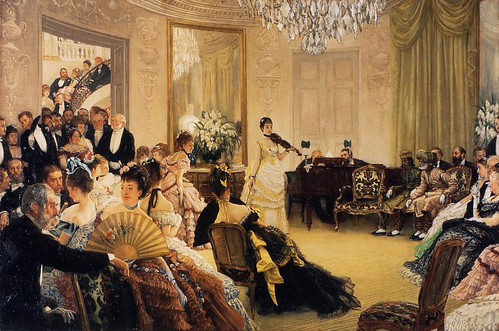
Hush! The Concert, by James Tissot, 1875. The woman in the picture is widely thought to be Wilma Norman-Neruda.

Throughout the 1870s and 1880s, the stigma attached to female violinists gradually began to fade. In fact, Wilma and Camilla Urso both inspired thousands of young girls to take up the instrument, to the point where it became downright fashionable for a girl to play the violin. The press likened her to a female St. George, slaying the dragon of prejudice. By 1890 she was able to reminisce to Oscar Wilde’s magazine The Woman’s World, “When I first came to London [in 1869], I was surprised to find that it was thought almost improper, certainly unladylike, for a woman to play on the violin. In Germany the thing was quite common and excited no comment. I could not understand – it seemed so absurd – why people thought so differently here. Whenever in society I hear a young lady tuning a violin I think of…the reproachful curiosity with which the people at first regarded my playing.” Male reporters at magazines and newspapers recorded their astonishment at just how many young girls were taking up stringed instruments. In the Contemporary Review, one writer named H.R. Hawes went so far as to say, “A beautiful girl playing on a beautiful violin is the most beautiful thing in the world” and “Surely the violin is made for woman, and woman is made for the violin.” He went on to say:

The barrier which for long, in spite of St. Cecilia and the angels, warned off women from violins, in the name of all that was feminine, no longer exists. Indeed, within the last twenty-five years, we have been afflicted with a girl-violin mania. School misses before they are in their teens clamour to learn the violin. It is a common sight in London to see maidens of all ages laden with fiddles of all sizes, their music rolls strapped tightly to the cases, hurrying to the underground railway, or hailing the omnibus or cab in Oxford Street, Regent Street, and Bond Street. Then the Royal Academy, Royal College, Guildhall class-rooms are choked with violin-girls, and no ladies’ seminary is now complete without the violin tutor. Women have already invaded orchestras, and at least one celebrated amateur society can boast of nothing but lady players, whilst the profession as regards soloists divides its honours pretty equally between male and female virtuosi.

There was also a more practical reason that Hawes never touched upon why the violin was becoming more and more popular among women. Since they were large and relatively expensive, and a family had to have a certain amount of space and money to own them, pianos and harps had become the hallmark of domesticity and the middle-class. But as the middle-class grew, and more and more women began to play the piano, its novelty factor began to wear thin. (In the 1890s the magazine Punch ran a satirical cartoon that depicts a newly hired maid directing movers where to put her piano, while her mistress looks on in dismay.) Thanks to the example of female performers like Wilma and Camilla Urso, and women’s desire to play an instrument that would make them stand out from the crowd, more and more ladies began taking the violin seriously. A sort of snowball effect began taking place, and scores of women became violinists. Wilma was the undisputed queen of them all.

Wilma grew so beloved in Britain that, in 1887, when Arthur Conan Doyle was writing his first Sherlock Holmes story, A Study in Scarlet, Wilma’s name was the first violinist’s name to come to mind when he wanted to send Holmes to a violin recital during his investigation. Holmes – a talented violinist himself – came back from the concert and raved over her bow arm. Today, despite all of her other achievements, she is probably most famous for that singular fictional appearance!

In 1885 Ludwig Norman died, leaving his estranged wife a widow. Three years later Wilma married Charles Hallé, who had been widowed himself in 1866. Hallé was a formidable pianist (he was the first pianist to play a complete Beethoven sonata cycle in England) and conductor (he was the founder and first conductor of the famous Hallé Orchestra in Manchester; it is now the fourth oldest orchestra in the world). Wilma and Charles’s paths had crossed for the first time in May of 1849 when the Neruda children had performed at one of Charles Hallé’s Gentleman’s Society concerts; Wilma had been a ten-year-old prodigy and Charles a thirty-year-old conductor. Ever since that first performance they had kept in touch and had often performed with one another. A few months after they were married, Charles was knighted for his musical services to the Empire. Wilma accordingly became Lady Hallé, the name she is most often remembered by today. Together they gave a wide variety of concerts, ranging from chamber music to concerto work. A few years after their marriage, Charles established the Royal Manchester College of Music after decades of dreaming about the project. Although it is unclear if Wilma was on the faculty, her pianist sister Olga was invited to join the staff. Olga worked in Manchester, teaching and performing, until her retirement in 1908.

 Charles Hallé, Wilma’s second husband and lifelong musical partner

In 1890, Wilma and Charles embarked on a tour of Australia, then widely considered by the English to be a wild frontier land. In 1895 they toured South Africa. In his memoirs Charles Hallé recalled one concert where he and Wilma performed the Kreutzer sonata by Beethoven at a municipal concert. There were to be a few numbers both before and after Charles and Wilma took the stage. After they had finished and acknowledged the thunderous applause, a member of the audience came forward and suggested that the rest of the performances be canceled, saying that the Hallés had played so perfectly there was no point in continuing. The rest of the audience quickly acquiesced and the concert was finished. Later, a thousand South African natives assembled to dance war dances and sing in Wilma’s honor.

Tragically, a few weeks after they returned from their monumental South African tour, Charles Hallé died suddenly after an illness of only a few hours. Three years later, Wilma’s son, Ludwig Norman-Neruda, now a famous mountain-climber, died after a fall on a hike in the Alps. Never one to avoid work, even in times of personal turmoil, Wilma embarked on an ambitious tour of the United States and Canada the next year. She ascended each concert podium dressed entirely in black in memory of her son (and perhaps her husband, too).

A Toronto reviewer raved:

The programme she gave last night was an old-fashioned one, with the rarely seen names of Tartini and Spohr upon it; men who were at once brilliant composers, and, the former in the 18th century, the latter in the 19th, exponents of the classic school of violin playing. Lady Hallé, in these days of the strenuous emotionalists, stands almost alone as a representative of the serene and exquisite methods of the old school. Her hand, despite its sixty years, seems as pliant as a girl’s, and sure as clockwork. Her facility is amazing, and her technique beyond what is ordinarily assumed to be perfection. Withal she possesses extraordinary magnetism… Her final numbers were a berceuse of Slavic Colour, composed by her brother Franz, and played with the mute: and a florid number by Bazzini, “La Ronde des lutins.” Technically, this was her crowning number. Her harmonics were as sweet and liquid as a bird’s song: her rapid pizzicati work was amazing, and her staccato passages were marvelously clean. In short, Lady Hallé is an artiste who compels superlatives.

At the age of sixty, Wilma announced her retirement and intention to teach music in Berlin. Although the majority of her performing career was over, she was still greatly beloved by the public. In 1901, in recognition of her many achievements in music, Queen Alexandra bestowed upon her the honorary title of “Violinist to the Queen.” A coalition of royal families came together – among them the royal families of England, Sweden, and Denmark – and presented her with the keys to a palazzo outside of Venice. In 1907 she played at the memorial concert after the death of Joseph Joachim, the violinist to whom she had been so often compared throughout her lifetime.

Wilhelmina Norman-Neruda, later Lady Hallé

Wilma died of pneumonia in Berlin in 1911. She was seventy-two. Although musicians mourned her loss, they also celebrated her extraordinary life and achievements. Thanks in large part to her example, women across the world began to take up the violin in ever-increasing numbers. The next generation of violin virtuosos had a much higher percentage of women, all of whom accomplished amazing things in their own right: Marie Soldat (1863/4 – 1955), a protégé of Brahms and a fierce exponent of his violin concerto; Gabriele Wietrowitz (1866 – ?), one of Joachim’s most distinguished students and founder of a widely acclaimed ladies string quartet (few know that Brahms’s violin concerto came to prominence largely because of the championing Soldat and Wietrowitz did of it); Maud Powell (1867 – 1920), who was not just the first great female violinist from America, but the first great violinist from America, period; Teresina Tua (1867 – 1955/56), who drew audiences to concerts by wearing diamonds and jewels on her extravagant gowns; Irma Saenger-Sethe (1876 – 1958), a student of Ysaye’s who served as his substitute at the Brussels Conservatory when he was away traveling; Leonora Jackson (1879 – 1969), an American violinist whose patroness was First Lady Frances Cleveland; Marie Hall (1884 – 1956), the dedicatee of Vaughan Williams’s Lark Ascending and the first person to ever record the Elgar concerto; Kathleen Parlow (1890 – 1963), one of the first great instrumentalists from Canada and one of Auer’s first North American students; Jelly d’Aranyi (1895 – 1966), the dedicatee of Tzigane and the two sonatas of Bartók…

And the list goes on and on.

It’s tragic that historians have largely forgotten the tremendous contributions of Wilma Norman-Neruda and the women who followed in her footsteps. Without their hard work, we modern-day listeners would regard the playing of such phenomenally talented women like Hilary Hahn, Sarah Chang, and Julia Fischer in a very different way. Not to mention the many women – soloists, orchestral players, chamber players, and amateurs – who might not have taken up the violin if there had been an “unfeminine” stigma associated with it. Perhaps a day is coming when these extraordinary women who trail-blazed for the rest of us can be properly remembered, honored, and celebrated by a wider audience of music-lovers.

8 Comments

Filed under My Writing, Women Violinists

Musician & Muse: A Short Life of Violinist Stefi Geyer

Finally, some of the stuff that I really love to write. Reviews are great fun, too, of course, but essays on the great female violinists are my favorite. I hope you enjoy.

This was originally published on violinist.com in August 2010. Link here.

***

Preface

Last year I heard that violinist James Ehnes was going to be performing the Chausson Poème and first (posthumous) violin concerto of Béla Bartók in Door County, Wisconsin, in August of 2010. As I read about the program, I immediately became intrigued by the virtuosa violinist Stefi Geyer, the woman who had inspired Bartók to write his concerto. The story is fit for a novel, and the First Concerto, if it does not reach the musical heights of the Second, is nonetheless incredibly beautiful and personal and heartfelt. It deserves to be heard more often than it is. Thanks to James Ehnes and conductor Victor Yampolsky for programming this relative rarity, and for bringing my attention to Stefi Geyer, who, as I write in the essay, is an extraordinary musical figure and worth remembering even aside from her association with Bartók.

If you have anything to share about Stefi Geyer, please write me. Thank you to all of the people who I wrote to who contributed their knowledge and expertise on the subject.

***

In early 1908, violin virtuosa Stefi Geyer received a letter from an old school friend. In a previous note she had told him that, despite his intense passion for her, she could never entertain the idea of ever marrying him. This letter would contain his response. She no doubt felt some trepidation as she opened the envelope.

“I have begun a quartet,” he wrote. “The first theme is the theme of the second movement: this is my funeral dirge.”

Stefi Geyer knew full well what this cryptic message meant. In happier times her friend had written her a violin concerto as a testament of his love for her; now, he was appropriating one of the themes from it for a string quartet and twisting it into a bitter song of death.

Incidentally, this quartet was the first in a series of six that turned out to be the most important string quartet cycle of the twentieth century. For this was no ordinary school friend: this was Béla Bartók.

***

Stefi Geyer was born into a middle-class Catholic family on June 28, 1888 in Budapest. At the end of the nineteenth century, Budapest was one of the most beautiful cities in the world, with a colorful history stretching back nearly two thousand years. In 1849 the two cities of Buda and Pest, separated by the Danube River, had been joined by the elegant and technologically groundbreaking Chain Bridge, sparking an economic revolution between the two cities. As a result there was an explosion of growth throughout the last half of the nineteenth century – musically, intellectually, and architecturally. Budapest’s magnificent opera house was finished the year of Stefi’s birth, and the grand Parliament building, begun in 1885, was finished the year she turned sixteen. The boulevards were wide; there were charming cafes on every street corner; and the music scene could stand comparison with Vienna’s. The conservatory in Budapest had been founded by none other than Franz Liszt, and over time boasted such students as Ernst von Dohnányi, Jenő Hubay, Zoltán Kodály, David Popper, Fritz Reiner, and Georg Solti.

Stefi was the daughter of a member of the Budapest police force who was an amateur violinist himself. She began her music studies at the age of three and immediately showed extraordinary promise, such that she gave her first public concert at the age of seven in 1895. She was accepted into the studio of Jenő Hubay, a teacher at the Budapest conservatory. Hubay, today perhaps most famous for his compositions for the violin, had studied under Joachim and was friends with such luminaries as Vieuxtemps and Liszt. Stefi’s fellow students included Josef Szigeti (1892-1973); Jelly d’Aranyi (1893-1966), the inspiration for Ravel’s Tzigane; and Franz von Vecsey (1893-1935), who became the second dedicatee of Sibelius’s violin concerto at the age of thirteen. Like many of Hubay’s most talented students, Stefi performed for appreciative audiences all across Europe throughout her childhood, even garnering a mention in the New York Times for her successes in Austria and Italy in 1902.

Obviously there was a great deal of talent at the conservatory. That talent attracted an eighteen-year-old pianist from the tiny town of Nagyszentmiklós named Béla Bartók. Bartók had also been accepted at the perhaps more prestigious Vienna Conservatory, but, fatefully, he followed his friend Ernst von Dohnányi to Budapest instead to study under a student of Liszt. Bartók had dreams of becoming an internationally acclaimed piano virtuoso, but unfortunately his health did not cooperate. He came down with a case of pneumonia so severe that the doctors gave up on his life. A long rest in the pure air of the mountains, combined with the attention of his beloved mother, were the only things that saved him from a premature death.

It is unclear when and where Stefi and Bartók met for the first time. It seems likely, given their mutual association with the Budapest conservatory, that they had at least heard of one another before meeting. In a later letter Bartok called Stefi a “14-year-old elfish little girl, whom I met in Jászberény.” If he was remembering correctly, that would place their first meeting sometime around 1902. Stefi had relatives in the Hungarian town of Jászberény and would often go there to visit. Perhaps the twenty-one year old Bartók had been among the classmates invited to join her.

In 1903 Bartók ended his studies at the conservatory and embarked on his career as a concert pianist. That same year he wrote a symphonic poem called Kossuth, an homage to the Hungarian Revolution of 1848, and a sign of Bartók’s – and the region’s – ever-increasing feelings of nationalism. In 1904, while on vacation in Slovakia, he famously overheard a Transylvanian nanny singing folk songs to her charges, an encounter that would spark a lifelong passion for folk music. It wasn’t long before he was getting together with a friend, a fellow composer named Zoltán Kodály, and going out to rural communities to document the region’s musical heritage. In 1905 he was offered a job at his alma mater as a piano professor. He accepted.

Stefi Geyer playing Reger’s “Air.”

Once again Bartók and Stefi’s paths must have crossed. It is uncertain exactly when, where, and how, but they eventually became good friends. By early 1907, when Bartok was twenty-six and Stefi nineteen, they were meeting one another to play through the violin and piano works of German composer Max Reger. That summer, Stefi and her brother went to Jászberény to visit their aunt. Bartok came along, ostensibly to gather folk song.

The nineteen-year-old Stefi Geyer was an extraordinary person and violinist. Even in a studio as crowded with talent as Hubay’s, she stood out as one of the conservatory’s most exceptional students. She had already played a wide variety of repertoire throughout Europe, and had even recorded in 1906, back in the days when recording consisted of playing an unedited take into a giant horn. She was very pretty, with blue eyes and blonde hair that she wore in two small buns on either side of her head. That beauty, combined with her grace, cleverness, and talent, proved alluring. On June or July 1, 1907 (depending on what source you read), Bartók began to write a violin concerto with Stefi in mind. He left Jászberény to continue gathering folk song in Transylvania, but the concerto – and the girl – was always in the back of his mind, as evidenced by the letters he wrote to Stefi that summer.

The letters are long, passionate, and wide-ranging: they are Bartók at his most open and unguarded. Sadly, however, we have lost Stefi’s replies, so it is a one-sided conversation. At the beginning of their relationship, Bartók wrote mainly of music – Wagner, snippets of the concerto in-progress, the characteristics of the folksong he was studying – but by late summer, he had moved beyond music to speak of his own personal beliefs about religion and society. “The middle class, which stands between the highest people and the peasant class, is, owing to its stupidity, actually unenjoyable. We like the childlike naivety of the peasants, which manifests itself in everything often with primitive strength; the intellectual strength of the highest people is impressive, but the idiocy of the middle class – including most of the ‘gentry’ – which lacks natural naivety, is insufferable,” he wrote. This was probably not the wisest thing to write to a middle-class girl he wished to woo.

He also encouraged her to break the bounds of tradition – “As regards tradition, it’s but holy gospel for average people. And the Stefi Geyers are born to eschew its yoke… I think that everyone, man and woman, if it is in one’s power, must fight against the bonds of tradition. This fight is actually but a striving for autonomy, to be independent of everyone or of everything, as well as to be in control of ourselves…”

In another exchange, they spoke of the morality of suicide. “I do not see why you should condemn suicide as such a cowardly act!” he wrote. “It’s quite the contrary… As long as my mother is alive, and as long as I have some interest in the world, I will not commit suicide. But beyond that? Once I have no responsibility toward any living person, once I live all by myself (never ‘wavering’ even then) – why should suicide be a cowardly act? It’s true, of course, that it would not be a deed of great daring, but it could not be dismissed as an act of cowardly indifference.”

All of this may have been totally honest on Bartók’s part – if less than tactful – but when he began complaining about, and almost mocking, Stefi’s treasured Catholic beliefs, it precluded any possibility of a romantic relationship. “If I ever crossed myself, it would signify ’In the name of Nature, Art and Science…’ Isn’t that enough?! Must you have the promised ’hereafter’ as well? That’s something I can’t understand.” And then, rather condescendingly – “Will you allow me to supply you with reading matter from time to time?…You needn’t be afraid that reading will blight your youth; even if it were to shorten it, you would be amply compensated by all the pleasure you would get from it.” And then, a few days later: “Why are you such a very weak person, and why are you afraid of reading and learning?! This is what drives me to despair… Would you still refuse to accept books from me even if I only gave you books in which there is merely a total lack of reference to god – or at least only pious reference?!” Finally, perhaps realizing that they both were both holding stubborn in their own beliefs, he wrote, “I would never attempt to talk you out of your faith, distressed though I am by your present state of mind. Move the first moment of crisis, you would relapse, I am sure — Yes, let us drop the subject; we may discuss it again – at some later date, maybe, but not now.” He signed one of these letters, “Greetings from AN UNBELIEVER (who is more honest than a great many believers).”

Some historians, if they mention Geyer at all, imply that she toyed with Bartók. Sentences like “Violinist Stefi Geyer, whom friends remember as a dark, rapt beauty, a trifle spoiled by her early musical success, and more interested in her career than in young Bartok” are not uncommon (although, thankfully, that is an extreme example). But without having Stefi’s side of the story in writing, there is insufficient information to make such claims. The side of the correspondence that we do have – Bartók’s – makes it clear that their relationship was likely doomed from the beginning, thanks to fundamental differences in worldviews.

These fundamental differences didn’t matter to Bartók: despite them, he had fallen very deeply in love, although he surely sensed Stefi‘s hesitancy. “I have a sad misgiving that I shall never find any consolation in life save in music. For some time, I have been in a very strange mood, going from one extreme to the other. One letter from you, a line, even a word – and I am in a transport of joy, the next brings me almost to tears, it hurts so. What is to be the end of it all? And when? It is as if I am in a state of spiritual intoxication all the time.”

Throughout his turmoil, Bartók continued writing the concerto. The first movement was to be a portrait of Stefi Geyer as person and woman – “the idealized Stefi, celestial and inward,” Bartók wrote. Stefi herself later described it as a portrait of “the young girl he loved.” The movement is lush and romantic, with touches of Wagner. The gentle opening theme is pianissimo, and stated alone by the solo violin.

David Oistrakh in the first movement of the concerto.

This first movement makes it clear that in Bartók’s ideal world, Stefi Geyer would be a gentle, acquiescent figure. One cannot help but think of the widely cited Victorian ideal of womanhood: the gentle, unassuming “angel of the house.” Unfortunately for Bartók, Stefi Geyer had already defied that stereotype from an early age, simply by taking her violin studies seriously, and taking Europe by storm as a prodigy.

The second movement was to represent Stefi Geyer as the elfish, witty, sparkling virtuoso violinist. “Cheerful, witty, and amusing,” Bartók called it. Stefi referred to the movement as a tribute to “the violinist he admired.” Its main theme is actually the theme of the first movement, only slightly tweaked and turned around. Once again, the violin enters by itself, but this time it is a brash forte, totally different in character from the theme of the innocent angelic girl.

In other words (or notes) –

Notice the similarity to the first movement theme.

David Oistrakh in the second movement of the concerto.

Was Bartók making a statement here, even subconsciously, that two parts of Stefi Geyer – her womanhood and her career – were diametrically opposed? Interestingly, after a variety of virtuoso fireworks, the last phrase the violin plays in the entire concerto is a return to that lush, romantic “idealized” theme of the first movement.

David Oistrakh in the end of the second movement of the concerto. (Listen to 6:00 to the end to hear the phrases I’m referring to.)

Is this Bartók indulging in one last vain hope that the independent virtuoso violinist might succumb to the gentle, acquiescent, ideal girl? It is impossible to know.

As the autumn progressed, the strains in their relationship became more and more obvious. Bartók wrote in late November 1907, after working on the first two movements, that “Now, I should compose a picture of the indifferent, cool, silent St. G. But this would be hateful music.” Ten days later he wrote, “You are a dear, a good, a fairy-like, an enchanting girl! who has only to draw a few lines to chase the dark, grimly swirling clouds from the sky and makes the bright sun shine on me. – You are a taciturn, a bad, a cruel, a miserly girl! to begrudge me your powers of enchantment!” Finally he came to the conclusion – no doubt to Stefi’s relief – that he was not going to write the intended final “hateful” movement.

But this decision didn’t keep Bartók from composing something to express his feelings over the failed relationship. The last of his Fourteen Bagatelles for piano is a bitter waltz that employs the theme from the violin concerto. He later orchestrated this and used it as the second movement – “Grotesque” – in the Two Portraits. (The First Portrait is basically the first movement of the violin concerto, so he was certainly thinking of Stefi as he wrote.) Some have even theorized that this “Grotesque” movement was originally conceived as the third movement to the concerto.

Two Portraits, Op. 5. At 10:25, the second movement, “Grotesque,” begins. You’ll notice the first movement is basically the first movement of the violin concerto. 

Things only got worse between the two of them. In early February, Bartók finally finished the violin concerto. On the same day, Stefi Geyer wrote him that she could not consider courting or marrying him. He wrote, “I finished the score of the violin concerto on the 5th of February, the very day you were writing my death sentence… I locked it in my desk, I don’t know whether to destroy it or to keep it locked away until it is found after I die and the whole pile of papers, my declaration of love, your concerto, my best work are thrown out.” But thankfully for us, instead of destroying the work, he mailed the manuscript – the only copy he had – to Stefi, inscribed with a line of poetry from Béla Balázs: “No two stars are as far apart as two human souls.” Bartók would employ the poetry of Balázs in later compositions, including Bluebeard’s Castle and The Wooden Prince.

Around this time, Bartók began writing his first string quartet. True to his word, in the first movement he employed Stefi’s “virtuosic” theme and turned it into a mournful dirge.

The first movement of the first string quartet – the movement Bartok referred to as his funeral dirge.

As no one but the two of them had seen the score to the violin concerto, audiences listening to the quartet were unaware of the significance of this first theme. They would, however, have recognized a quotation in the third movement of a popular art song called “Just A Fair Girl.” Some historians have interpreted this as a defiant “toss of the head” to Stefi.

The following year, in 1909, Bartók went on a walk with a teenaged girl named Márta Ziegler, one of his piano students at the conservatory. He had met Márta, the daughter of a member of the Budapest police force, at the age of fourteen. The similarities to Stefi are striking. After they returned from the walk, Bartok’s mother asked if sixteen-year-old Márta was staying for dinner. He answered that they had just gotten married. Bartók later dedicated the opera “Bluebeard’s Castle” to Márta. Even in this opera, there were traces of the “Stefi Geyer” theme, but by now it reminded him of more than just his first love: it served as a compositional shorthand for many complex emotions.

As for Stefi, she kept the score to the violin concerto locked away among her papers, and although she occasionally spoke of it, she never performed it. In fact, there are indications it may have been sold at the end of her life to pay for her medical expenses.

Béla Bartók was not the first composer to come under Stefi Geyer’s spell. Swiss composer Othmar Schoeck (1886-1957) was also afflicted with a deep, passionate love for the virtuosa violinist that lasted for years. Schoeck had first heard her perform in 1905, when she was seventeen. “She thrilled me to the depths of my being,” he said. Their paths crossed again in 1907 when she performed in Leipzig while he was studying with Max Reger (the same composer whose works Stefi and Bartok had played together in Budapest). “My heartthrob, the lovely Stefi Geyer, was here recently; she played wonderfully and enchanted me more than ever,” he wrote to his parents. Even toward the end of his life he sighed, “She knew how to move so beautifully and to walk so beautifully.”

A few months after breaking things off with Bartók, Stefi finally met her long-time admirer in July 1908. Immediately Schoeck began to write for her. First came a tiny Albumblatt, then a full-length Violin Sonata, and then an actual Violin Concerto. All three were dedicated to Stefi. He continued in his attempts to woo her throughout 1908, later claiming they wrote passionate love letters to each other. If they did – and historians are skeptical on the point – they were later burned by his wife. Adding weight to that skepticism is the fact that Schoeck complained to others that all the physical contact he had been able to wring out of Stefi was a chaste kiss, and that Stefi was his only female friend that had not at some point made a pass at him.

Sometime around 1910, Stefi Geyer became engaged to Viennese lawyer Erwin Jung. Predictably, Schoeck referred to him as a “Viennese ponce” – or a person who fakes having class or culture. During her engagement, she invited Shoeck to come to visit her and her family in Budapest. He accepted the invitation, went to Budapest, wrote an unconvincing postcard to his friends that he had gotten over her, came home, and then promptly began writing a violin concerto for her. While he was writing the piece, he began rooming with a Russian medical student named Bertha Liebert. She soon became pregnant, but the baby died the same day it was born. He nonetheless continued to sleep with Bertha while hoping against hope that he could seduce Stefi.

The violin concerto that Schoeck wrote for Stefi.

To Schoeck’s dismay, Stefi married in 1911 and relocated to Vienna, where she took the name Stefi Geyer-Jung and taught. Unfortunately her marriage with Jung was not a happy one, and he eventually began drinking heavily. Throughout this turbulent time Stefi continued with her career, touring throughout Europe and even playing a concerto in Budapest that her old teacher Jenő Hubay had written for her.

Hubay’s fourth violin concerto, which was dedicated to Stefi.

During the late teens, perhaps spurred in part by the war and her unhappy marriage, Stefi seems to have reconsidered the direction of her career. She began studying with violinist Adolf Busch in Budapest, learning new repertoire and new styles of playing. In the process she switched the emphasis of her repertoire from virtuosic Romantic pieces to more restrained Classical ones.

Then, in 1918, catastrophe. Between a hundred fifty and two hundred million people around the world – three percent of the population – died of the infamous “flu.” Otherwise healthy young adults were the primary victims. During this terrifying epidemic, coming straight on the heels of the First World War, Stefi’s husband died. Two years later, in 1920, she married a man named Walter Schulthess, who was a pianist, composer, and concert agent (and, incidentally, a friend of both Schoeck and Jung). Although they both traveled a great deal, they moved their home base to Switzerland, where, in 1923, Stefi began teaching at the Zurich Conservatoire. (She taught violinist Aida Stucki, who became Anne Sophie Mutter’s mentor.)

Her pace of touring did not diminish throughout the twenties. In fact, she gave more than a hundred concerts in Scandinavia in the 1922-23 season alone. In 1924 she traveled to America, but reviews of her performances there have not surfaced. She performed many concertos with all of the major Swiss orchestras, and even performed the violin concerto Schoeck had written for her with Schoeck at the podium. During the thirties she recorded a good deal, and today we have records of her interpretations of Bach, Beethoven, Mozart, Haydn, and even Schoeck. They are difficult to find on disc, but well worth scouting out.

Stefi Geyer playing Kreisler’s arrangement of Tartini’s A-major Fugue

Although Stefi and Bartók had parted fifteen years or so ago under less than amicable circumstances, they apparently somehow reconciled in the teens or twenties. In fact, by 1928, Bartók, Stefi, and her husband were all writing friendly letters to one another. Schulthess and Stefi often played his compositions, and in 1929 Stefi performed in a recital that consisted of all Bartók’s music. In 1940, she even helped Bartók and his second wife Ditta emigrate to America to escape the turmoil enveloping Europe, and she would often introduce her students to this extraordinary man and composer.

Stefi Geyer died in December of 1956 in Zurich. Somehow after her death her friend and fellow musician Paul Sacher retrieved the manuscript and the letters from Bartók that she had kept locked away for so many years. Sacher was the conductor at the world premiere of the piece in Switzerland in 1958, and in the spring of 1961 Isaac Stern gave its American premiere at Carnegie Hall. Although it is not heard as often as the Second Violin Concerto, it is still occasionally revived today.

Much about Stefi’s career remains shrouded in silence. Because more research has been done on men like Schoeck and Bartók than on Geyer, it is tempting to identify and remember her solely as a muse – in other words, as someone only worth remembering because of the extraordinary inspiration she was to others. But Stefi Geyer’s accomplishments as a violinist are just as important and unique in their own way as the pieces that she inspired. To remember her solely as Bartók’s early love does her a great disservice; despite the fact that we do not know a tremendous amount about her life, it is clear, as Paul Sacher said, that “She was a superb violinist, a major soloist and an excellent musician.”

***

Sources

(Note: I wrote this particular essay without sourcing, as I intended it to be a primer on Geyer’s life, rather than an authoritative scholarly essay. So don’t use anything in this essay for scholarly purposes yourself unless you can source specific facts for yourself. I’ll update the essay when new information comes to light and note it here. In the future I will source better. Promise. Nonetheless, below are some of the books and websites I found helpful while writing this piece.)

Books

Musical Symbolism in the Operas of Debussy and Bartók: Trauma, Gender, and the Unfolding of the Unconscious; by Elliott Antokoletz; 2004

Bartók and the Grotesque: Studies in Modernity, The Body, and Contradiction in Music; by Julie Brown; 2007

“Bartók’s Fourteen Bagatelles op. 6 for piano: Toward Performance Authenticity”, by Victoria Fisher; from the book Bartók Perspectives: Man, Composer, and Ethnomusicologist; 2000

Bartók’s Chamber Music; by János Kárṕati; 1976

Béla Bartók: Composition, Concepts, and Autograph Sources; by László Somfai; 1996

Websites

http://en.wikipedia.org/wiki/Stefi_Geyer

http://www.bartoknewseries.com/en/bartok-new-series-13-14

http://www.time.com/time/magazine/article/0,9171,874348,00.html

http://www25.uua.org/uuhs/duub/articles/belabartok.html

http://www.seattlesymphony.org/symphony/buy/single/programnotes.aspx?id=4972&src=t&dateid=4972&detect=yes

4 Comments

Filed under My Writing, Women Violinists