Category Archives: Not My Writing

Article: Short Leonora von Stosch biography

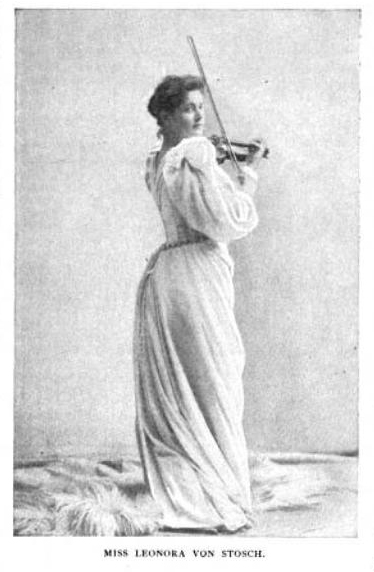
Here is a short article on Leonora von Stosch (later Lady Speyer) from The Illustrated American, 13 February 1892. This dates from early in her career, when she was 20 years old. In a field full of fascinating women, Leonora is one of the most interesting: she was not only an internationally renowned violinist, but also a Pulitzer-Prize winning poet.

***

Miss Leonora von Stosch. – The admired young artist whose portrait is here presented is a native of those country, and was born in Washington in 1872. Her mother is a New Englander, a successful contributor to various magazines, and a natural musician whose vocal and instrumental talents were sacrificed to the advancement of a literary career.

The father of the young violinist, Count von Stosch, a German gentleman of noble birth, came to America some twenty-five years ago, and was naturalized soon after his marriage. He died, and his wife became Mrs. Schayer, the name she now bears.

When not more than eleven years old, little Miss Von Stosch attracted attention by her skill in playing the violin. At a much earlier age she had given evidence of her ability both as pianist and composer. As a sort of youthful prodigy she appeared in concerts at Washington and Baltimore, studying all the while under Prof. Jos. Kaspar, of Washington, who strongly advised her going abroad for the advantage to be gained in foreign schools.

Following his advice, Miss Von Stosch and her mother went to Brussels when the former was in her sixteenth year. She was a diligent student at the Conservatory of Music in that city for twenty-four months. At the end of the first half of the course she was awarded second prize, with distinction, and the next year she carried off first honors.

It was shortly after her graduation that the young American played before Joachim in Berlin, also appearing in a great concert at the Monnaie Theatre, in which many distinguished professionals took part.

January, 1891, found Miss Von Stosch in Paris, ardent as ever in pursuing her course, and studying under Marsick. Circumstances at this time interfered, necessitating a trip home, where success and honor awaited the pretty, gifted girl. She realized, in spite of these triumphs, that her student’s life had not been fully rounded out, and feels it is only a question of time when she returns to the French capital, and enters again in earnest pursuit of the high mark her ambition has sent for attainment.

Her first professional appearance in this country was made with the Seidel’s Orchestra in New York, since when, she has, with profit and honor, assisted at many fashionable muscales in the drawing-rooms of the Four Hundred.

Tall and symmetrical, having a charming face lit by vivacious intelligence, of graceful presence, and with manners a happy mixture of dignity and warmth, few young women have been so graciously endowed by nature as this youthful artist, of whom New York audiences heartily approve.

Leave a comment

Filed under Not My Writing, Women Violinists

Article: Women Violinists of the Victorian Era, 1899

Here is a long article entitled “Women Violinists of the Victorian Era” from the February or March 1899 edition of The Lady’s Realm, a British magazine. The author is unknown. Original here.

***
Before the days of Paganini, and even as far back as the middle of the last century, a girl-violinist appeared now and then upon the concert platforms of Europe. Yet it may be asserted, without misgiving, that all celebrated lady-violinists are of the Victorian Era.

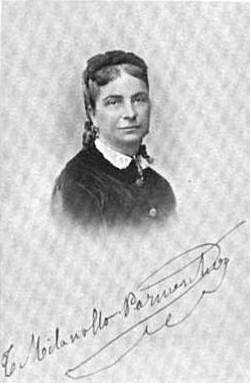
The first women who attained enduring fame as violinists were the sisters Milanollo, the outlines of whose artistic careers have often enough been sketched, though unfortunately not always with accuracy. But the ever-gracious Teresa Milanollo (now Madame Parmentier) has kindly placed at my disposal the fullest details concerning her public life, and has courteously permitted the readers of THE LADY’S REALM to be told more than is usually known of her personal history.

Born at Savigliano (Piedmont), August 28th, 1827, Madame Parmentier is now in her seventy-first year. But the disposition of Teresa Milanollo is still young and fresh, her interest in things musical, and zeal for philanthropic service, as keen as ever.

The vocation of this great artist manifested itself in very early days. At four years of age she was taken to a funeral ceremony in honour of King Charles Félix of Sardinia, and upon leaving the church her father put to her the question: “Did you pray to God, little one?” “No, papa,” was the reply, “I did nothing but listen to the violin.” After this she was persistent in her demands for a violin of her own. Her father instructed her in the elements of solfeggi, and then made for her a little violin in white wood, and put her, for a year, under the tuition of Ferrero at Savigliano. Later on she had lessons at Turin from Caldera and from Morra, but not of Gebhard, as has been often stated.

She was only in her ninth year when she made her début and appeared at several concerts in the vicinity of her native town. In the year 1836 she was taken to France, to play at the Musard Concerts at Marseilles. There she had an immediate success, and went on to Paris, where she had some lessons from Lafont and played once or twice at the Opéra Comique. The same year she went with Lafont for a tour in Belgium and Holland, and in 1837 played at Amsterdam and the Hague. In this year too – the year of the Queen’s accession – she came to London, and was heard at Covent Garden.
In London she took some lessons with Mori and Tolbecque, and was engaged by the harpist Bochsa to make a three months’ tour in Wales.

It was upon her return to France, in 1838, that her little sister Maria, then six years old, was first presented to the public. Soon after this, Teresa put herself under the musical direction of Hebeneck, who made her play his Grand Polonaise in C, at one of the celebrated Conservatoire concerts, April 18th, 1841. In the opinion of all the critics of that time, and notably of Berlioz, her success was immense, and it was this appearance that definitely crowned her reputation.

The same year, the sisters Milanollo played before Louis-Philippe at Neuilly, and from this period, they were inseparable until the death of Maria. The younger sister never received any lessons except those given her by Teresa. About this time the sisters met de Beriot, who communicated to Teresa the masterly bowing of the school of Viotti and de Baillot, and the faultless intonation which so many, even illustrious, performers lack. To de Beriot Madame Parmentier accords the distinction of having “completed her artistic education.”

From this time (1842) forward until 1848, when the melancholy event of Maria’s death from rapid consumption occurred, the sisters were continuously journeying through Europe. In every capital, and in most towns of importance, they appeared at series of concerts; their reputation increasing each year. In Vienna, particularly, the honours of public favour were heaped upon them. They appeared with Liszt at the Castle at Brühl before the King of Prussia, and in Berlin the furore they created had, according to the cirtic Kellstab, been equalled only three times in the century. The three performers whose successes he ranked with theirs were Catalini (the prima donna), Paganini, and Liszt. While in Berlin the sisters twice played before the Court, accompanied by the composer Meyerbeer.

In 1845 they paid their second and last visit to London, where they gave several concerts, and played before Her Majesty at Court.

It is a strange thing that at a time when the music-lovers of the Continent were all wildly enthusiastic for the sisters Milanollo, and their popularity abroad supreme, the English public gave them a comparatively lukewarm reception. But in 1845 England had scarcely earned the reputation of a music-, or rather virtuosi-loving nation. The days of Sarasate- and Paderewski fever had not yet dawned in Britain, and the really musical among us could be counted only by hundreds, instead of, as now, by many thousands.

The terrible sorrow into which Teresa fell, upon the loss in 1848 of her much-cherished sister and pupil, was stupefying in its intensity. But her father, who had recently bought a country estate at Malzéville, near Nancy, urged upon her the wisdom of reappearing in public.  She played, therefore, at a concert in aid of the Association des Artistes Musiciens, gave two quartet concerts in Paris, and subsequently toured in Germany, Switzerland, and Austria.

Her last professional concert was given on April 6th, 1857, at Nancy, and on the 15th of the same month she married General (then Captain) Théodore Parmentier. At the time of their marriage, General Parmentier was aide-de-camp to General Niel, with whom he took part in the siege of Sebastopol. Since her marriage, Teresa Milanollo’s appearances in public have been comparatively few, and all have been at the call of charity.

Many are the charming stories told of the ceaseless benevolence of Teresa Milanollo. During the lifetime of Maria, the sisters had already put themselves into direct personal relations with the poor of Lyons; but it was after Teresa had roused herself from her mourning that she invented the system of “Concerts aux Pauvres,” which she carried out in nearly all the chief towns of France. At these concerts she reserved part of her receipts for the benefit of the poor. Then in each town she appeared again before an audience composed exclusively of the children of the public schools and their parents. To these she played in a manner which strangely silenced and moved her hearers, and at the conclusion of her performances, money, food, and clothes, the products of her self-charged receipts from the previous concerts, were distributed.

From 1857 to 1878 she, a soldier’s wife, followed the fortunes of her husband, and one of her later appearances was at a concert at Constantine, Algiers. Since 1878 the gallant General who is “Grand Officier de la Légion d’Honneur,” and his gifted and famous wife, have resided quietly in Paris; but, generous and accessible as ever, Madame Parmentier is still to be met by a fortunate few in select musical and social circles of the French capital.

Teresa Milanollo is not alone distinguished as the first really famous lady-violinist, she is also remembered for being the most pathetic and soul-moving performer of modern times. All her effects were obtained by legitimate means. Maria’s distinction rested on other grounds. Without pretending to the grand style and electric emotion of Teresa, she had remarkable vigour and boldness of execution, and her staccato was so perfect that she received, in Germany, the nickname of Madamoiselle Staccato, in opposition to her sister, who was dubbed Mademoiselle Adagio.

To Brussels, the cradle, then and now, of so much musical talent, belongs the honour of having given to the world, in the early ‘fifties, some excellent lady-performers on the violin. Among them was a Mademoiselle Fréry, a favourite pupil of Charles de Beriot. Dr. T. L. Philson, who was present in the great concert-hall of the Grande Harmonic when Mademoiselle Fréry competed for the first violin-prize of the Brussels Conservatoire, states that she was not only a fine player, whose performance on that, as on subsequent occasions, was greeted with storms of applause, but a very beautiful girl. He recalls her, with black, flashing eyes and dark hair, sitting behind the stage with her mother, fingering her violin in an agony of nervousness, though apparently calm, until it should be her turn to appear before the judges. When the moment came, to the surprise of every one, her courage failed her. She refused to go forward. Nor could her bashfulness be overcome until de Beriot himself, leaving the conductor’s desk, went to her and led her in her little white frock and pink sash, blushing and trembling, before the audience. The chief merits of this player were her “full, luscious tone,” and refined expression. Like many another talented beauty she was married early (to a pianist, with whom she went to the United States), and disappeared from European musical circles.

Not long after her successes, Brussels – in 1853-4 – hailed with the enthusiasm the début, at the Opera House, of the Demoiselles Ferny, who were pupils of Artot. These two sisters speedily became popular favourites; and the similitude of their name – Ferny – with Fréry, undoubtedly completed the extinction of the earlier star, who deserved to shine a little longer in the recollection of music-lovers.

After Teresa Milanollo, the next name to stamp itself indelibly upon the public consciousness is that of “Norman-Neruda.” Other women-violinists, notwithstanding great talents and sensational successes, scarcely attained to the true immortality of fame. But the position of Neruda, in the hierarchy of musicians, is one that cannot easily be overthrown.

Wilhelmina Neruda, born in 1840 at Brünn in Moravia, began to play the violin almost as soon as she could walk, and appeared in public at Vienna in 1846. Her master was Jansa. At nine years old she played a concerto of de Beriot’s at the London Philharmonic Concert, and was enthusiastically received. In 1865 she married Ludwig Norman, a Swedish musician, and five years afterwards played again at the Philharmonic, and was induced by Vieuxtemps to remain in London until the winter, when she accepted the post of leader of the quartet at the Popular Concerts. From that time it has been the good fortune of Londoners to hear her every winter at St. James’s Hall.

Of her perfect education, refined and intelligent phrasing, and depth of feeling, it is unnecessary to speak. The violin she uses is the “Strad” that belonged to Ernst; it was presented to her by the Duke of Saxe-Coburg and a few other distinguished amateurs.

Upon the death of Ludwig Norman, Madame Neruda married Sir Charles Hallé, with whom she made a most successful tour in Australia. In 1895, as none of us have forgotten, Sir Charles Hallé died, and, upon the suggestion of the Princess of Wales (of whom “Neruda” has long been a personal as well as a musical favourite), a subscription was raised for his widow. In 1896 Lady Hallé was presented by many admirers with the title-deeds of an estate and villa in Italy, and a purse of £500.

For so long now Lady Hallé has been a favourite of the British Public, for so long she has resided in our midst, that it is difficult to think of her as other than an Englishwoman. Yet neither her birth nor her parentage gives us the right to claim her as our own. But there is something in the repose and “at-homeness” of Lady Hallé’s bearing, both in public and private, and much in her devotion and loyalty to the British audiences who have delighted to applaud her through nearly half a century, that warrants the pride we all feel in our lion’s share of possession of her personality and talents. More than any other of the great violinists of the Victorian Era, she belongs to us. England may be proud of being the country of this great artist’s adoption. Her Majesty’s recognition of her husband, and the English title which, through him, “Norman-Neruda” bears, only serve to emphasize our claim to count her one of us.

Gabrielle Wietrowetz was born at Graz in Styria, in 1866. She is the daughter of an orchestral musician, who taught her all he could until she was placed in the Styrian Musical Society’s School under Caspar. Aided by the Styrian Government, Fräulein Wietrowetz entered the far-famed Hochschule in Berlin, where she worked under Joachim. Twice she won the Mendelssohn prize, and, at eighteen years of age, appeared at the Berlin Philharmonic Concert, when she played Max Bruch’s second concerto.

After playing in Bremen and other German towns, she came to London, and, among other engagements, has been heard several times as leader of the “Pop” Quartet. The breadth of her tone and beauty of her phrasing are remarkable; her interpretation of the music of Brahms being particularly striking. A woman of great strength and determination, she puts it all into her playing, adding much charm and tenderness.

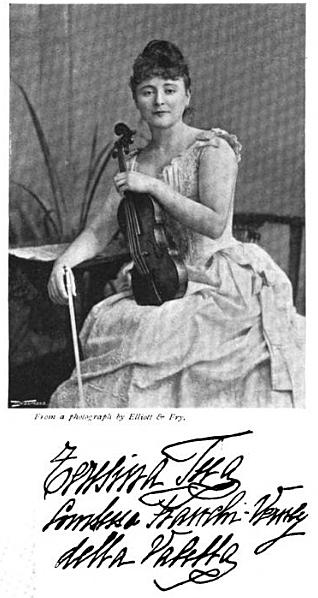
Teresina Tua was born in 1867, and first appeared as a prodigy in Nice when seven years old. After a successful concert, she attracted the notice of a wealthy Russian, Madame Rosen, through whose interest she became pupil of Massart at the Paris Conservatoire. Queen Isabella of Spain, and Madame MacMahon (wife of the Field-Marshal) were also among those whose early notice contributed to the fostering of “La Tua’s” remarkable gifts. She appeared for the first time in England in 1883, when she created much sensation at the Crystal Palace Concerts, and played with success at the Philharmonic. She has visited America, and appeared in most of the chief cities of Europe. Upon her marriage with the Comte de Franchi Verney della Valetta, she retired for a time from public life, but re-appeared in Italy in 1891. In the January of last year she was heard once more in England, and gave a well-attended recital at St. James’s Hall. It is generally agreed that her style is now more matured; some earlier eccentricities having quite disappeared. Her tone is small, but the refinement of her expression and phrasing are delightful. She is, in every sense of the word, a charming player.
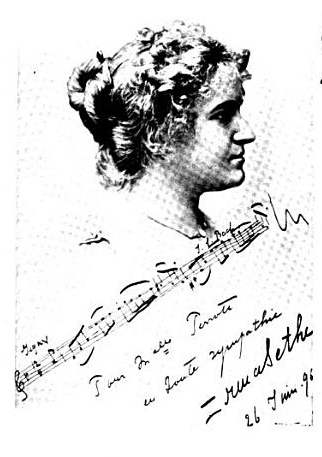
Irma Sethe, one of the most remarkable of living violinists, was born at Brussels in 1876. When only five years old she showed exceptional talent, and her mother persuaded the celebrated violinist, Jokisch, to give the little one lessons on the violin. After three months’ study she was able to play a sonata of Mozart’s, and at ten years of age she played a concerto by de Beriot, and a rondo capriccioso by Saint-Saëns, at a charity concert, when she was received with much applause.

The following year she made a still greater success at Aix-la-Chapelle, with the result that many engagements poured in upon her. But her mother wisely refused to allow her to begin her public career so early. She continued under the tuition of Jokisch until her fourteenth year, but spent her holidays in Germany, where she had lessons from Wilhelmj, who gave her a violin. She studied subsequently under Ysaye, who, surprised at her talent, advised her to enter the Brussels Conservatoire. After studying there eight months, she won the first prize. She was then only fifteen. In 1896 she appeared in London, and, during the Jubilee season, gave an orchestral concert at the Queen’s Hall.

Her playing is remarkable for great breadth of town, for refinement, combined with almost masculine power and intellect, and for an absolutely perfect intonation. In the opinion of many musicians, she is the finest lady-violinist who has yet appeared.

It is fortunate for the music-loving public that Irma Sethe’s marriage, which took place in Brussels last August, has not withdrawn her from the concert-room. With her husband, Dr. Saenger (littérateur and Professor of Philosophy at Berlin) Madame Sethe-Saenger has made her home in a charming modern flat in the Prussian capital. And as much as she delights in her Art, there is ever a wrench when she tears herself away from the calm and luxury of home, to fulfil the numerous engagements which are made for her by her agent Cavour in different parts of the Continent and British Isles. Her recent autumn visit to this country, when she played in the more important of our provincial towns, re-visited Scotland, and made her first appearance in Ireland, proved to her numerous admirers that hand and soul have not lost their cunning, nor wifehood staled the marvellous artistic power of Irma Sethe-Saenger.

Of English lady-violinists of the present reign, the earliest perhaps to commend herself to critical favour was Miss Browning (now Mrs. Osborne Ince) whose name is almost forgotten, though she is still living in our midst, and in touch with London musical life. This player had a breadth of tone which, in days of too exclusive devotion to technique, is refreshing to recall.

It was in 1874, in her very youthful days, that Miss Emily Shinner went to Berlin to study the violin. At that time – it is hardly credible in our more enlightened days – female violinists were not admitted to the Hochschule, so Miss Shinner had to content herself with taking private lessons from Herr Jacobsen. But one morning she was suddenly made aware of the fact that a lady-student who, in ignorance of the rules, had travelled all the way from Silesia, was, through the kindness of Professor Jachim, about to be examined for admission to the Hochschule. The English student lost no time in presenting herself as a second candidate. The result of the examination of both ladies was their acceptance of probationers, and they became thus the first two lady-students for the violin admitted to the famous Berlin Academy. At the end of six months, Joachim heard Miss Shinner play, and decided to take her as a pupil, whereby she gained the further distinction of being the first girl-violinist to study for the profession under the great master of our day.

About fifteen years ago, Miss Shinner was called upon, at short notice, to take Madame Neruda’s place as leader of the “Pop” Quartet. It appears to have been Miss Shinner’s destiny to break new ground, for she was the first lady to receive the honour of appearing in Neruda’s accustomed seat at the Popular Concerts. The middle movement of the quartet was encored; but so inexperienced was the young leader that it was only upon the hint of Mr. Ries that she accepted the encore and began it again. Since that time, Miss Shinner has always been more or less before the English public, and has devoted herself particularly to chamber music and quartet playing. Only two years ago she played Bach’s double concerto in conjunction with Joachim at the Crystal Palace. Her marriage, with Captain A. F. Liddell, took place in 1889.
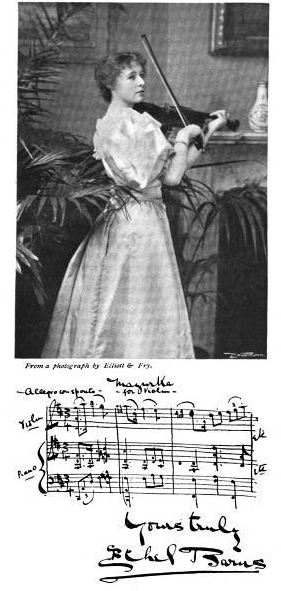
Miss Ethel Barns is known both as a performer and as the composer of some charming violin solos. If there be anything in graphology, one ought to read some exceptional characteristics – an infinite power of taking pains, a precision, a force – in her musical hand-writing, characteristics which are all invaluable to a violin-player.
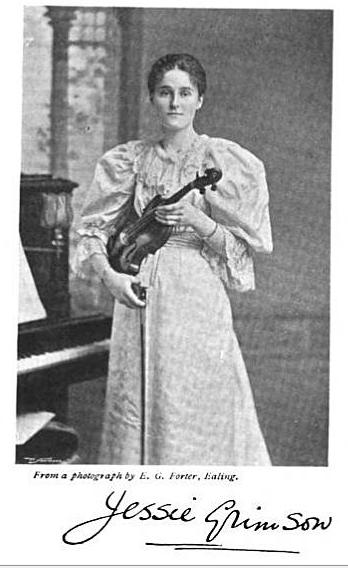
Another English violinist, just now coming to the front, is Miss Jessie Grimson. She was trained by her father, Mr. S. Dean Grimson, until 1889, when she won a scholarship at the Royal College.

Among a crowd of stars, whose persistent shining reveals them at last to sight, one appears sometimes with sudden meteor-flash. Miss Leonora Jackson is one of these.

Madame Soldat is a French player of exceptional ability, and the leader of the Viennese Ladies’ Quartet.

Among other lady-violinists who have become known to English audiences during the Victorian Era are Bertha Brousil, who now devotes herself to teaching; Terese Liebe, once resident in London, but at present living abroad; Marrie Motto; Nettie Carpenter; Anna Lang; Frida Scotta, who has appeared in most of the continent capitals, including Moscow in 1896; Marianne Eissler; Beatrice Langley; Louise Nanney; Camilla Urso; Edith Robinson.

We, of this time, have outlived the dark ages when the violin was looked upon as an exclusively manly instrument. It is one of the surest marks of progress in the Victorian Era that those days are passed. The fame of a Paganini, of an Ernst, of a Joachim, of a Sarasate, is a fame which women have proved themselves full worthy to share.

Leave a comment

Filed under Not My Writing, Women Violinists

Interview: Daisy Kennedy

Here’s a link to a fantastic interview with Australian violinist Daisy Kennedy (1893-1981). I don’t feel comfortable copy/pasting it here, so I’d recommend moseying over there and reading (and listening!) to it ASAP. It gives an intriguing glimpse into the European violin scene around the turn of the century. Enjoy.

Leave a comment

Filed under Not My Writing, Women Violinists

Article: A Talk With Madame Beatrice Langley

This article appeared in The Windsor Magazine sometime in early 1898. It is by Charles Cathcart.

***

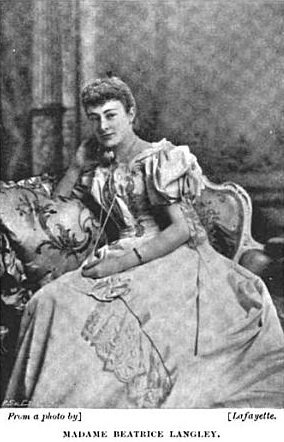
A bitter, north-easterly gale, accompanied by blinding sleet and snow, was sweeping over Primrose Hill as my dripping hansom pulled up with a jerk at Madame Beatrice Langley’s comfortable house near Regent’s Park; but before I had been many minutes seated near the blazing fire, sipping tea and listening to the sparkling conversation of my genial hostess, all recollection of the refrigerating process I had just experienced had faded from my mind and my spirits had risen considerably. Indeed, so completely did Madame Langley’s witty comments upon all sorts and conditions of men and matters engross my attention, that fully half an hour must have passed before we came to actual business.

“It was in Dublin,” my hostess then said, in answer to my opening question, “that I first played in public. My mother, at that time a well-known amateur singer, had promised to sing at the Antient Concert Rooms for the benefit of some charity. The song, I remember, was Braga’s famous serenade, and I played the obbligato.”

“Was that long ago?”

“Yes, for I was quite a child, barely nine years old; but I had, of course, been learning the violin for several years; indeed, I cannot remember the time when I did not possess a fiddle of some sort. In 1886 I became a pupil of Mr. Joseph Ludwig, but after I had studied with him for seven years I went to Professor Wilhelmj, then just returned to England.”

“Did you remain with him long?”

“Two years. But before going to him I had made my début.”

“Where did that take place?”

“At one of the Crystal Palace Saturday afternoon concerts. Then engagements began to come in, and the most important concerts at which I played were the London Symphony Concerts, the Queen’s Hall Orchestral Concerts, and Madame Albani’s London Concerts.”

“But didn’t you go on tour with Madame Albani?”

“Yes, but that was later. I toured twice with Madame Albani; indeed, it was Madame Albani who gave my ‘send off,’ as they say in America. The first time I met her was one evening at dinner, before I had made my début, and after dinner I was asked to play. I played several solos, and next day Madame Albani asked me to go with her on tour.”

“Was that tour made in England?”

“Yes. We went all through England, and everywhere the public seemed to like my playing. I enjoyed the tour immensely. Last year, as you may know, I was the violinist in Madame Albani’s concerts in Canada, and we had a perfectly delightful tour right across the continent, from Halifax to Vancouver and Victoria, and we also gave a few concerts in the United States. In all we gave thirty-three concerts. Madame Albani had also engaged Mr. Braxton-Smith and Mr. Lempriére Pringle, and in Canada we were joined by Miss Beverley Robinson, daughter of the late Lieut.-Governor of Ontario. From beginning to end the tour was a kind of triumphal march, for, of course, Madame Albani is immensely popular in Canada, as, for that matter, she is popular everywhere.”

“I am told that you were married just before you sailed for Canada.”

“Only three days before!” Madame Langley answered, with a look of amusement.

She is the wife of Mr. Basil Tozer, a prolific writer of newspaper articles and the author of several books on sport.

“I wonder how your husband liked your going on tour for the honeymoon,” I continued; “he went with you, I suppose?”

“He did, and he rather enjoyed the absurdity of the situation. Afterwards, in Canada, strangers were constantly blundering by saying the wrong things to him. One day, for instance, in Montreal – or in Toronto, I forget which – an inquisitive stranger, with whom he was talking casually, inquired whether it was true that I had a husband ‘knocking around’ with me. Upon his answering that such was actually the case, and that he, my husband, knew the gentleman intimately, the stranger became quite confidential, and presently remarked in an undertone, ‘Say, I guess you might introduce me to that husband right away,’ and, of course, my husband did so. Then – when we were in Winnipeg, I think – I remember reading in a newspaper that ‘yesterday Madame Albani and her husband were seen sleighing, accompanied by a small boy, probably their son.’ That ‘son’ was my husband!”

“Does your husband look so young, then?”

“About ten years younger than he is, though he has travelled in every part of the world except Australia – by the way, we ought to be in Australia now.”

“With Madame Albani?”

“Yes. Just before Christmas Madame Albani asked me to accompany her as violinist on her tour in Australia and South Africa, but, much as I should have loved the voyage and the tour, I could not see my way to leaving England for six whole months, especially as I had already accepted several engagements in England for this year.”

“And how did America impress you?”

“Very favourably indeed,” Madame Langley replied promptly; “and I think the Canadians themselves perfectly delightful. As for the audiences, well, you can’t help liking the public when they seem to like you, and the larger the city, the more enthusiastic to audience – at least, such as my experience in Canada, and several artists who have toured there say they agree with me. The biggest ‘house’ we had was in Winnipeg, where the Drill Hall is said to have scating accommodation for 5,000 persons. On the night of the concert it was packed.  Some of the people came scores of miles in sleighs, others two hundred and two hundred and fifty miles by train, to be present at the concert. I shall never forget the sight of that Drill Hall, or the applause of that audience, as long as I live. It was perfectly splendid. Then, too, everybody was so hospitable. During the week or [?] days we spent in Winnipeg we were feted almost to extinction, and in such towns as Halifax, Montreal, Toronto, Kingston, Vancouver and Victoria – everywhere, in short, where we stopped for a week or more – people hitherto perfect strangers to us seemed to vie with one another in entertaining the company. I must say that in this respect the Governors of the various provinces set the example – an excellent example, too, we thought it.”

“So you prefer Canadians to your own countrymen and countrywomen?”

“Oh, no, I don’t mean that.”

“But you prefer Canadian audiences?”

“No, I don’t mean that, either. What I like about Canada, and about the States, too, is that an artist appearing there for the first time in reality runs entirely upon his or her own merits. For instance, an artist with a big name comes over from Europe, having been duly ‘billed’ in immense letters and boomed by the Press. At first the public flock to hear him, ready enough to approve and applaud; but if the artist with the big name fails to please, his song, or his playing, or his performance, or whatever his entertainment may be, falls quite flat, and very soon the towns hundreds of miles away, which he means to visit, hear that he is ‘a frost’ – for nearly all news goes by wire in America – so that when he arrives there, in spite of all his advance booming, he finds only empty houses awaiting him. For your American citizen is nothing if not practical, and, like our English tub-thumper, when he asks for his dollar’s worth he ‘means to get it’ – not that he always does. Now take the case of a really clever and well-taught, but unknown, artist. He appears upon an American platform for the first time. He is received in silent. The audience hardly look at him. If they speak of him at all they merely criticise his appearance. He sings, or he plays. Gradually the audience become attentive. Then he seems slowly to hypnotise them. Their interest expands; their admiration increases. Finally he stops; the spell is broken; he leaves the platform amid a storm of applause, only to be recalled again and again, and the next time he makes his appearance he is greeted with quite an ovation before he has sung a note or touched his instrument, as the case may be. Then glowing reports about him are flashed from city to city, so that from the first his success is assured all along the line. These remarks apply to women as well as to men artist,s and the artist may have been raised in Germany and christened with a name of fifteen syllables, or he may be called Tom Jones, and have first seen light in Whitechapel, it makes not one whit of difference, provided he please his public.”

“Did you study abroad at all, Madame Langley?”

“No, I studied entirely in London,” she answered with a bright smile. “That is something to be proud of in these days of foreign competition!”

“And you were not even born in Germany.”

“No, I was born in Devonshire, in a secluded townlet called Chudleigh.”

We continued our conversation, and I soon gathered that my hostess entertained the highest opinion of Madame Albani, not only, of course, as an artist, but as an individual. Incidentally, too, she let fall a remark that I have heard made before, a remark to the effect that Madame Albani seems never to say an unkind word about anybody, but that she is, on the contrary, ever on the look-out for talent, and ready to help any young artist in whom she discovers the germs of genuine merit. Now, oddly enough, from what I am told about Madame Langley herself, and from what I saw of her during my brief visit, I should say that the selfsame remark might truly be applied to another lady.

Upon the subject of musical agents and musical managers Madame Beatrice Langley waxed eloquent. With but one exception, she personally has been fairly treated, though she prides herself upon never in her life having asked for an engagement either for a concert or for “at homes,” at which latter she plays largely.

Madame Langley is an enthusiastic Wagnerian, and seldom misses an opportunity of being present at a Wagner concert. Also she is interested in politics, and, besides being a lover of art, she is an omnivorous reader, and appears to be thoroughly posted in topics of the day and well abreast of current literature.

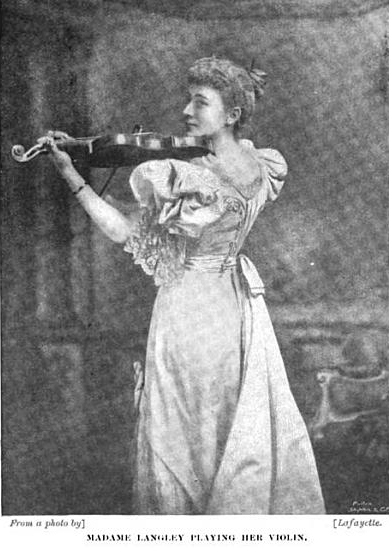
“Would you care to see my fiddle?” my fair hostess asked presently, as she refilled my cup. I replied that I should like, not merely to see it, but to hear it, whereupon she favoured me with Bach’s famous “Aria,” played most exquisitely on her favourite violin, a Maggini, which her father, Colonel Langley, late of the Royal Artillery, gave her as a wedding present. This was the violin which she took to Canada. As Maggini died in the year 1630, the fiddle must be at least 267 years old; nevertheless, it is in perfect condition.

Madame Beatrice Langley is, I believe, the only woman violinist in London who has ever played in public the difficult A minor variations of Paganini. Her tone is quite wonderful, and, listening to her playing, one could almost imagine her Maggini was a ‘cello. During her absence from the room for a few minutes, I glanced through her albums of Press notices, truly a marvellous collection of unanimously favourable criticisms, and presently I came across one in particular that I well remembered having read before. It was taken from the Times of January 2nd, 1897, where, under the heading “Music of the Year,” Madame Beatrice Langley’s name is coupled with that of Sarasate. According to the Times, Sarasate, Ysaye, and Madame Beatrice Langley were “among the most successful violinists who appeared during the year.” Among the Canadian newspaper cuttings I noticed one that tempted me to ask Madame Langley rather a personal question as she re-entered the room.

“Are you a Romanist?” I ventured to inquire.

“Why, yes,” she answered, “I am Catholic. I suppose that paragraph about my playing in the Catholic Cathedral of St. Boniface, in Winnipeg, made you ask that question. I played several times in church on Sundays while in Canada, and the Maggini sounded magnificent – at least, so I was told. Most of the churches in Canada are very good for sound, you see, and the atmosphere is so crisp and dry that it suits the fiddle to perfection. Do I ever teach the violin? Yes; and I find teaching very interesting, especially when pupils show particular talent and are industrious.”

“One more question, Madame Langley, and I have done. I must put this question to you because it is one that everybody asks everybody else: Do you ride a bicycle?”

“I do,” came the laughing reply; “at least, in the country. My husband will not let me ride in town.”

I remarked that “Mr. Beatrice Langley” must be wise in his generation, and soon afterwards I took my leave.

Leave a comment

Filed under Not My Writing, Women Violinists

Article: As I Found Miss Bang At Lake George

This is an article from The Violinist from October 1920, “By a Pupil”, about violin teacher Maia Bang. I haven’t been able to find out much about her online. Can you help me and contact me with any information about her?

***

When a visitor reaches Lake George in summer he is greeted by green hills, a blue lake, and a peaceful village. He soon learns that there are gathered here violinists from various parts of the globe. The raison d’etre of this interesting group is the advent to Lake George, for the summer, of Professor Auer and assistant teachers.

One of the best known of these teachers is Maia Bang, who came to this country about three years ago, at the same time as Professor Auer. Her “Elementary Violin Method,” the first two volumes of which are already in the hands of many prominent teachers, is fast gaining her friends in this country.

Miss Bang likes America, but is a staunch and loyal patriot of her native land, Norway. It is indeed pleasant to hear one who loves them so, describe the mountains and fjords of Scandinavia.

Miss Bang combines art and science in her teaching. She never lacks enthusiasm, and while critical of details is always encouraging to pupils, and never lacks appreciation of all efforts. She demands the correct things, but supports all attempts. She is democratic, looking with happy approval on the movement for putting violin instruction in the public schools. She gives hope and help to each of her pupils as his individual talent merits or requires.

Miss Bang admits of no limitations in her teaching. She says, “We can make all things. There is no ‘perhaps.'” If one follows the directions given, the goal is sure, provided, of course, that there is no serious handicap in the adaptability of the pupil. There being no phase of violin art which she has not analyzed, all one has to do is to apply the analysis. This is brought out effectively in her Violin Method mentioned above, the last part of which is now in the making. These volumes are in accordance with the principles of Auer, who, it is well known, possesses the last word with regard to methods and requirements of the modern virtuoso.

The pleasure and inspiration in writing such a method was brought out when one afternoon in a quiet and friendly conversation she remarked that her mind was teeming with ideas, and that as she writes the ideas do not come at the beckon of her will, but easily without any effort, as it were from above.

Miss Bang is a generous friend, a strong yet gentle character, an unusually interesting person to talk with on account of her originality and genuineness. She possesses a happy disposition, with a fine appreciation of the humorous. She is reverent to all things sacred, including other people’s personalities. She loves sports of all kinds. She is clever with children, and very inventive in methods to interest and to control their work.

4 Comments

Filed under Not My Writing, Women Violinists

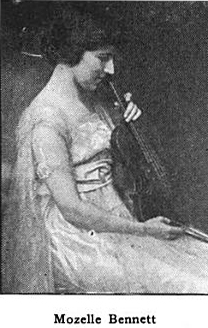
Article: Good Bowing, by Mozelle Bennett

Here’s an article by violinist Mozelle Bennett from the March 1922 issue of The Violinist.

***

For the solo violinist who hopes to step “over the top,” I would offer a few suggestions. Although he already knows, he probably does not realize just how much a few little points, which have been discovered by the great masters mean to the young artist.

During my study in Eugene Ysaye’s Master Class he often repeated – “Good bowing counts seventy-five percent in violin playing.” Learn to use the point of your bow and change the bow without twisting it at the point. Practice scales making a crescendo at the point.

Practice playing on the opening strings – G – D – A – E – with one stroke of the bow, using most of the bow on the G string, making a crescendo at the point, then back again on the E – A – D – G, using most of the bow on the E string, and keeping the bow so close to the next string that it finally is impossible to detect when the bow changes strings.

Then practice the G major and G minor scales in the first position with the same bowing, holding down the fingers very firmly on the first string until the first note on the next string has been played.

All of the scales should be practiced, carefully following these suggestions, and a perfect legato will be the result.

Good Bowing, I have discovered in my concert work, is one of the greatest secrets of success.

6 Comments

Filed under Not My Writing, Women Violinists

Article: Nicoline Zedeler and the Observance of the String Level

Here’s an article from The Violinist from October 1920 by violinist Nicoline Zedeler…

***

That the technic of the bow arm is of infinitely more importance than that of the left hand is gradually being understood, but in spite of the increasing number of articles and treatises on the subject there are certain phases of right arm technic which still receive scant attention. One of the most important of these is the observance of the string level, and it is Theodore Spiering who has so persistently and so successfully called attention in his teaching to this feature of right arm technic.

Even though the violin student learns to hold his bow correctly and is taught the control of the arm in its sub-divisions of upper arm, lower arm and hand, which implies all that goes with muscular effort and relaxation, he nevertheless would often find himself handicapped by sudden awkward hand and arm positions did his knowledge of bow technic not include the observance of the string level. For only when each stroke, each movement of the arm and hand has passed the stage of analytical effort and has become automatic, the violinist’s technic has at last become reliable and free from conflicting muscular action. It is a well-established fact that when the arm is too high or two low the tone immediately reflects qualities which to a well-trained ear at once discloses the cause. The muscles of the arm struggling to bridge over the distance between the level of the arm and the level of the string are so much occupied with this conflict that they cannot apply themselves to the real task of inciting the string. The thin tone, as one result of this conflict, is also noticed when players who are not conversant with string crossings endeavor to play many notes on one bow.

This brings us to the very important subject of articulation. In rapid string crossings articulation very often is indistinct, for the reason that the crossings are not perfectly performed. The played must consistently bear in mind the string level on whic hhe is playing and he must train himself to quickly distinguish each musical pattern as it appears in the composition. If, for instance, rapid figures consisting of broken chords or other harmonic sequences are not read as patterns, the difficulty of their performance is at once enhanced, and needlessly so. In order to make my statement clearer let me say that I would always try to repeat by means of the same fingering the original pattern. In other words, the same fingering should suggest itself to the mind in each repetition of the pattern. This idea of a uniform fingering is carried out in scales, but it is the application of such logic to the more complex problems which often is neglected.

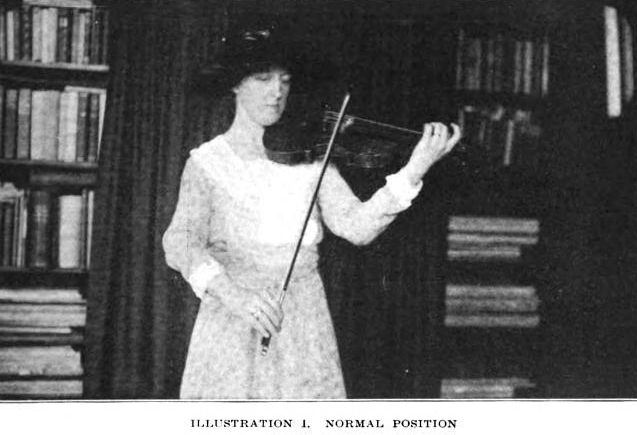
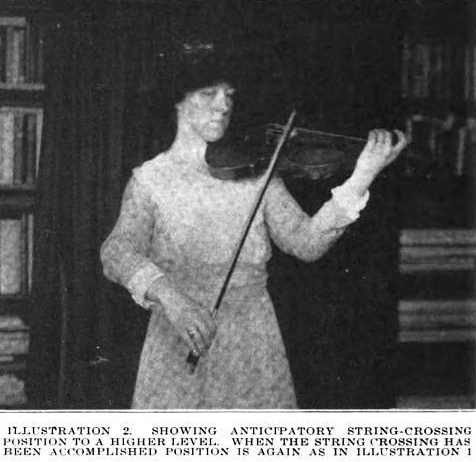
The two pictures accompanying this article represent the bow in normal position (illustration 1) and the wrist in its string crossing movement toward a higher string level (illustration 2). This anticipatory movement of the arm and hand is necessary when the higher level is to be retained. When one or two notes are to be played on a higher level and an immediate return to the level on which the playing has been done is effected, there is no necessity for the arm to change its level, only when a higher level is to be adhered to for the time being, does the anticipatory movement illustrated take place. Not only does this insure a greater facility of string crossing, but what is almost of more importance, it insures greater articulation in this way, that the movement of the hand in regaining its normal position brings with it a much more definite grip of the string than when this anticipatory movement is not carried out.

Leave a comment

Filed under Not My Writing, Women Violinists

Article: Woman’s Position in the Violin World, 1901

Every once and a while I come across historic articles that speak about the trend of women playing the violin in general. At least in my online research, they’re not as common as you might think. I just came across a fantastic website of digitized Etude magazines. Particularly awesome is a women’s issue from September 1901. I haven’t read the whole thing yet, but I just had to share this article, entitled “Woman’s Position in the Violin World”…which includes a much-coveted discussion about women playing the violin. Hurrah! Speaking from a modern perspective, it’s interesting to see how male violinists were perceived. This is a bit scandalous to say, but more than once the thought has crossed my mind that Victorians were often sexist…against men. In this article alone they are assumed to lack tenaciousness, steadfastness, and morality, among other things. Is it fair to say the sexism sometimes went both ways? … I think it is.

As an aside, it’s interesting to go through the covers, keeping an eye out for what roles women are playing. In the early years, they start out solely as passive listeners listening to men performing, or as accompanists for men, or as pianists in a domestic setting. Then in August 1910 Maud Powell and Cecile Chaminade and some other women are on the cover…with men. Jenny Lind makes an appearance in December 1913. In February 1920 a woman finally appears with a violin in a full-cover image (and it’s about time). In March 1921, a professional piano student appears in “the Master’s Studio.” In December 1922, there’s a really striking image of a woman in a fancy gown playing a violin concerto; it’s captioned “Her Hour of Triumph.” (You go, girl!) A liberated flapper who is terrorizing her old teacher with jazz makes an appearance in August 1926 in a cover entitled “The Jazzo-Maniac And Her Victim.” Because that jazz is seriously frightening stuff. Have you heard what Gershwin’s writing nowadays? … And then there’s October 1931‘s cover, which consists of a man and a woman, he playing piano and she playing violin. Apparently it is set in a fantasy decade in which women wore dresses from the Civil War and wore flapper bobs, and men wore outfits from the Regency period (and lipstick, apparently). But the sentiment of the image is nice, leastways; it’s captioned “Perfect Harmony.” It’s a pretty shocking transition to see in the space of twenty years, to say the least. (For additional images of women on the cover of Etude, check out November 1932, October 1933, September 1936, August 1939, January 1940, January 1946, September 1948, and August 1954.)

Anyway, here’s the article I was talking about. Expect to see more Etude articles as I get the chance to scout around the website more.

***

About sixty years ago two young Italian girls, Teresa and Maria Milanolla, astounded European audiences with their beautiful violin-playing. They had been trained by the best virtuosi of their day, and their instrumental abilities, coupled with their youth and their charming personality, easily won the hearts of all music-lovers who had the privilege of hearing them play. Teresa, the elder of the gifted sisters, was born August 18, 1827; Maria was born June 18, 1832, and received her earliest instruction from her sister. Marvelous as it may seem to those who, in mature years, are still struggling with comparatively simple problems of violin-playing, these two Italian children were, in 1840, so far advanced in their art that they were enabled to appear with uncommon success on the concert-platforms of Germany, England, Belgium, Holland, and France. Maria’s untimely death (at Paris, October 21, 1848) greatly affected her sister’s artistic career; and though, after a long period of retirement, Teresa resumed her work as a concert-violinist, she was not heard in public later than 1857.

It may come as a surprise to those who associate woman and the violin with the “innovations” of quite recent years, that two young girls should have achieved success as violinists so long ago as did the Milanolla sisters, for it is hardly more than thirty years ago that the girl, more especially the American girl, who appeared in the street with a violin under her arm was generally regarded as a new, if not ridiculous, species of feminity. Little more than a quarter of a century ago violin-playing was hardly considered an “elegant” accomplishment for any young lady. Indeed, most parents had very decided views on this question, and they did everything in their power to discourage, rather than encourage, their daughters in a field of art which seemed to them to promise only social degradation. The ignominy attached to the ancient usuage of “fiddler” had not yet entirely lost its force. It was surely bad enough for a man to be a fiddler; but the mere thought of a refined young gentlewoman playing the violin, either in private or in public, was, indeed, intolerable.

Nowadays all this is changed. Narrow prejudices of earlier days have given place to common-sense appreciation. Ignorance of art-matters in general (in this country), and of the high position in musical art occupied by violin-playing, is wholly a condition of the past. Musical knowledge and a wider general culture have superseded ignorance and the most puerile conceptions of feminine refinement and social dignity. Briefly, society’s attitude toward the woman violinist is so completely metamorphosed that a young girl, possessed of neither wealth nor great physical or mental charms, but capable of playing the violin tolerably well, is strongly fortified for social and even material success. And for the young violiniste who is possessed of marked artistic ability in conjunction with pleasing personal attributes, there are absolutely no limitations to social conquest. For her the fiddle opens many a door which remains obdurately closed even to the wealthy. Her fiddle does not plead for her; it commands.

But, it will be asked, what is the woman violinist’s true position in the world of musical art? Ah, that is an entirely different question. Many stern, unyielding critics of to-day refuse to believe that a woman is capable of achieving greatness as a player of the violin. These critics, both professional and amateur, concede woman’s fitness to accomplish agreeable things as players of the king of instruments, but they are unwilling to believe that she possesses either the mental qualifications or the physical strength and endurance to enable her successfully to compete with man in the mastery of violin-technics. Time alone will decide whether these critics are right. But something may be said, even now, both for and against their opinion.

Experience has taught us that woman is, at least in many respects, peculiarly fitted to play the violin, and to play it exceedingly well. The gifted girl has infinitely more tenacity than the average gifted boy. When she is in earnest, her art is an all-governing passion. She applies herself to study with the devotion that characterizes her sex. Her zeal and ambition are steadfast: no petty pleasures could make her unfaithful to her work and her art.

But what shall we say of the average gifted young man? His progress is impeded, his development endangered by a thousand and one unprofitable divertisements. He is not blessed with a fine moral sense of his obligations to himself and his art. Harsh or unjust as such an accusation may seem, a glimpse into the lives of the talented young men who either are studying or have studied at the various European music-schools more than verifies such an unflattering estimate. The whole manner of life and thought of the gifted young woman, her sense of responsibility, her firm purpose and her nobility of character,—all are in fine agreement with an art which demands from its devotees what is good and true and beautiful.

On the other hand, it cannot be denied that, where the higher art of violin-playing is concerned, the average gifted woman labors under certain great disadvantages which too often prove fatal, insurmountable barriers to success. How many are blessed with the physical strength which is necessary to carry them through the long hard years of musical servitude? The limit of their physical endurance is not often commensurate with the demands of their art; and just when the greatest effort is required of them—when their highest musical and instrumental possibilities are dependent upon a continuance, if not an increase, of energy and vitality—they fail to put forth the requisite strength, and stop far short of their aspirations.

Then, again (and here we touch on delicate and dangerous ground), in the art of violin-playing, as in all the other arts, woman is, according to her critics, deficient in originality, and weak in her intellectual grasp of the greater compositions. Whatever there may be of truth or injustice in such an estimate of woman, this is assuredly not the place to attempt to verify or disprove our critics’ conclusion. It is true that many women violinists now before the public prove themselves to be clever imitators rather than original players. They shun all compositions which make serious demands on the intellect, and their repertoire may be said to consist of superficial nothings. But it is equally true that we have had, and still have, violinistes who play such concertos as the Beethoven and the Brahms with as little hesitancy as could be expected of any man. How well or ill they succeed in such bold attempts, however, is a question which elsewhere may be discussed with greater profit than here. Let us rather view the work and personality of a few of the best women violinists of the present day and the latter half of the nineteenth century.

Lady Halle.

Few violinists have had a more brilliant career than Lady Hallé, better known in the musical world as Wilhelmina Normann-Neruda. Few have better merited success than this distinguished artiste; few have retained their powers as concert-players throughout so great a number of years. Born at Brünn, March 21, 1839, Lady Hallé must look backward fully half a century to recall her earliest triumphs. Hardly more than two years have elapsed, however, since she visited the United States and demonstrated to thousands of intelligent admirers how well deserved was her European reputation. The freshness and purity of her style were as delightful as of yore, her technical equipment was most admirable and never betrayed her years. Indeed, her listeners found it no easy matter to believe that she was not in the first flush of womanhood and artistic strength.

It is more than twenty years ago since I first had the pleasure of hearing Lady Hallé play. Though possessed of only a boy’s imperfect musical judgment, I remember well how deeply her beautiful qualities impressed me. More especially do I remember her staccato work in the last movement of Vieuxtemps’s E-major concerto. Its wonderful crispness and rapidity were a revelation to me.

Lady Hallé is a highly-polished, exceedingly brilliant player, thoroughly at ease in all compositions of the virtuoso school; but to designate her as a virtuoso, implying thereby that her gifts and attainments are of an instrumental rather than musical order, would be a serious belittlement of her knowledge and her art. She has always been an earnest player, fortunate in her ability to play bravura pieces and compositions which demand intellectuality equally well. Her teacher, Leopold Jansa, who was far greater skilled as a quartet player than a soloist, early inspired in her a love for chamber-music, with the result that Lady Halle’s musical development kept pace with her budding virtuosity. Though the reputation she has earned is that of soloist, she has frequently appeared in public in London in conjunction with the quartet concerts given in that city for many years by Joachim.

Lady Hallé’s career as a soloist is necessarily approaching its termination; but that her musical and instrumental vitality have not yet departed, and that her abilities justify a continuance of her public work, her comparatively recent visit to the United States proved beyond a doubt. When Lady Hallé returned to Europe from this trip, she took up her residence in Berlin, where she has since been engaged in teaching the art she so nobly represents.

Camilla Urso.

In what may be termed New York’s premusical days, when Alboni and Sontag thrilled American audiences with their vocal art, there appeared in New York a young girl, a mere child of ten, who astounded musicians and music-lovers with her remarkable violin-playing. That Camilla Urso, the prodigy, gradually developed into the serious-minded and highly-accomplished artiste is a fact of which no one familiar with our musical history of the past forty years requires reminder, for since those early days, when the little wonder-girl achieved her first American triumphs at the concerts of Alboni and Sontag, her name has been closely associated with many of our most noteworthy musical ventures.

Camilla Urso was born at Nantes, France, in 1842. She had the good fortune to receive her instrumental training under Massart, that wonderful pedagogue to whom so many brilliant violinists are indebted for their artistry. As early as 1852 she came to the United States, accompanied by her father, practically making in this country the beginning of her artistic career. Shortly after this first successful trip she returned with her father to Europe, and devoted the next ten years or more to conscientious study and the achievement of a European reputation. Then she revisited the United States, and finally concluded to make this country her future home.

It is a much-to-be-regretted fact that the work of so accomplished an artiste as Camilla Urso has not had commensurate material reward. In this respect, at least, the gods have certainly been less kind to her than she deserved, and when, but a few years since, an enterprizing proprietor of vaudeville theaters made to her what seemed a brilliant offer, she was severely criticised in many quarters for accepting this opportunity of redeeming her broken fortunes. Without attempting to set up a logical defense of the position which she took in this unfortunate affair, it should be said, in all fairness, that she deserved the widest sympathy rather than the condemnation of her thoughtless critics.

Camilla Urso’s playing has always been characterized by uncommon digital ability, an exceedingly dexterous wrist, and that fine finish which is almost invariably the product of the school in which she was trained. About ten years ago she met with a mishap in New York, and for a time it seemed as though she would not recover sufficiently to resume professional work. As it was, her wrist remained affected, and certain bowings, particularly staccato, remain constant reminders of her accident.

 Teresina Tua.

It would be difficult to imagine a more charming and captivating violiniste than was Teresina Tua in the early eighties. It is hardly an exaggeration to say that both her personality and her art entranced all Europe. Her exceeding loveliness of face and form bewitched her audiences before they heard her play, and it was not long before she was known throughout Europe as “Die Geigenfee” (the violin fairy).

Surely it will always be deplored by all who heard her play in those days—myself among the number—that Teresina Tua’s career was so metorically brief. Comparatively few people are familiar with the unfortunate circumstances which, in reality, had the effect of abruptly terminating her public work. Her sudden retirement from public life, at a time when she gave such splendid promise of future greatness, will always remain an enigma to the majority of her admirers.

Teresina Tua was born in Turin, Italy, May 22, 1867. When only thirteen years of age she received the first prize at the Paris Conservatory. Like so many other players, she owed the development of her remarkable gifts to the genius and faithful guidance of Massart. Under this master her talents ripened so rapidly that, in 1880, she played an ample repertoire of concertos and solo pieces with an artistic perfection which almost defied criticism. Everywhere she played she was the idol of the day. In 1882 she made her first concert-trip through Germany; and in orthodox old Leipzig, as well as in the home of Joseph Joachim, the beautiful Italian girl’s playing created nothing less than a sensation.

Teresina Tua’s visit to the United States, in 1887, proved the first in a series of misfortunes which resulted in her retirement to private life. Feeble health, combined with wretched mismanagement, destroyed all possibilities of success in the United States. What should have been a most brilliant and profitable season proved only a dismal fiasco. She appeared at few concerts, and the critics, as well as the public, withheld from her the homage to which she had grown accustomed. She returned to Europe quite disheartened, if not embittered, with her experience in America, and not long after she decided to abandon the concert-stage altogether. Leaving the scenes of her many triumphs, she returned to Italy, where, several years later, she married an Italian nobleman. Several times it has been rumored that she would re-enter public life, but she has doubtless preferred domestic peace and happiness to the trials and tribulations incident to a public career.

 Maud Powell.

It seems as though it were but yesterday that a little American girl came soberly walking toward the old conservatory, a fiddle tucked under her arm, and resolution plainly written on her comely face. Yet twenty years and more have passed away since then, and the little girl has grown to womanhood and accomplished laudable things. She has more than fulfilled the promise of her childhood, for she has outstripped all her American sisters in the art of violin-playing, and stands to-day the representative woman violinist of the United States.

Miss Powell’s success was not so easily won as that of many of our gifted players. Her career is a striking illustration of the possibilities of earnest endeavor and unfaltering resolution. When she returned to the United States, in 1885, she did not meet with that immediate success which sets all doubts aside; but step by step, year after year, she has risen in the public’s esteem, till her position is at last firmly established and her future success assured.

After a year or more of study at the Leipzig Conservatory Miss Powell decided to go to Paris, feeling that the training of the purely French school was best suited to her needs. But the experiment proved less satisfactory than she had hoped it would; and, after lingering in the French capital for a period of about two years, she betook herself to Berlin, hoping to find in Joachim her ideal of a great pedagogue. But there, too, she was doomed to disappointment. The methods of training pursued at the Berlin Hochschule failed to enlist her sympathies. She did not find at the Hochschule what she had long sought in vain. Nevertheless she decided to remain in Berlin, and during her comparatively brief stay she remained true to her purpose to succeed, and continued her work under Joachim as a painstaking and industrious student.

It must be confessed that when Miss Powell left the Hochschule her playing was crude and immature, revealing none of the admirable qualities which now strongly characterize her work. She had, it is true, a certain degree of technical ability which enabled her to play important compositions with reasonable accuracy; but beyond this there was little in her performances that was truly interesting to the intelligent and exacting musician. In those days, however, girl violinists were not as numerous in the United States as they are to-day, and Miss Powell experienced little or no difficulty in obtaining lucrative engagements.

It was just at this period of her career, during the first few years of success in her native land, that Miss Powell began to reveal those qualities which have since elevated her art. Not content with financial reward and meaningless successes, she applied herself each year more seriously and vigorously to study. The results which she has achieved prove not only a justification of her early self-confidence, but they prove also how important a factor in success is dogged perseverance.

Miss Powell’s abilities are sure to command respect wherever she may play. Her reappearance in the United States last season, after an absence in Europe of several years, materially assisted in strengthening her position both at home and abroad. She has again returned to Europe, where, it is hoped, she will repeat her successes of recent years.

Leave a comment

Filed under Not My Writing, Women Violinists

ISGOT: The Kubelík Girls

I was reading the Wikipedia entry on Jan Kubelík and came upon this peculiar sentence…

In his personal life, in 1903 he married Countess Marianne Czáky-Szell, with whom he had eight children, five violinist daughters and three sons

Bold mine.

Really? Five violinist daughters?

Additional Googling has yet to uncover any more details.

(By the way, not trying to start a competition here, but I found I prefer Marie Hall’s recording of the Ries Perpetuum Mobile to Kubelik’s. What do you think?)

5 Comments

Filed under Not My Writing, Women Violinists

Images: Lillian Shattuck’s Scrapbook

The first professional string quartet made up of women was called the Eichberg String Quartet; it was based in Boston and active in the late Victorian era. One of the ladies in the group was a woman named Lillian Shattuck. Someone at Harvard scanned her scrapbook and it is now being hosted at the Harvard University Library website. Take a look if you’re interested in seeing some beautiful portraits of women violinists from the turn of the century.

Here’s a link.

Edit (27 May): The link doesn’t work. It worked yesterday. It’s as if the Harvard University Library website doesn’t want anyone to see their collection. Well…try googling “Lillian Shattuck” Harvard. And a big thumbs down to the Harvard University Library website. I applaud your digitization of this important collection, but next time it would be nice if you’d include, you know, a link so that people, you know, can go visit it.

Edit (30 May): Try the comment section for a working link.

5 Comments

Filed under Not My Writing, Women Violinists