Category Archives: My Writing

Is Minnesota Orchestra management lying to us?: Part II: Michael Henson Edition

When I read the latest Star Tribune article on the Minnesota Orchestra crisis, one quote in particular struck me as being so patently absurd, and so directly opposed to everything that had come before it, I felt like I’d wandered into a new upside-down dimension. Either Michael Henson is going off the rails, or I’m becoming dangerously entrenched and reading much too deeply into a couple of sentences, and I’m not sure which it is. If you could convince me I’m crazy, I’d appreciate it. Thanks.

Here’s the portion of the article that made me feel as though a Rod Serling sighting was imminent:

Michael Henson, president and CEO of the orchestra, said on Friday that no immediate financial crisis exists, but he likened the investment funds that help fund each season to a retirement account.

“You can’t spend 90 percent of it in the first four years of retirement,” Henson said. “You need to make it last.”

He indicated the orchestra would like to draw no more than 5 percent annually from the funds; the draw rate has averaged nearly 10 percent over the past 10 years, he said.

Before I begin, I’m going to assume that Henson was quoted accurately, and that his words weren’t manipulated or misrepresented in any way. We should hear within the next couple of days if he objects as to how his comments were portrayed.

With that assumption out of the way, let’s try to unpack this “no immediate crisis” remark.

First, I’d like to say a few words on the nature of crisis.

If you are on track to spend ninety percent of your income in your first four years of retirement, then you are in IMMEDIATE CRISIS.

If you’ve staked the long-term fiscal health of your organization on overly “optimistic economic assumptions and the hope of limitless benefactor generosity,” then you are in IMMEDIATE CRISIS.

If you say on your website that “if the Orchestra continues to operate at its current rate of spending, our endowment will be depleted by 2018“, you are not only in IMMEDIATE CRISIS, you’ve been in IMMEDIATE CRISIS for years.

If your only hope of creating a “fiscally responsible” organization means cutting musicians’ pay somewhere between 25-50%, then you are in IMMEDIATE CRISIS.

If you knew you wouldn’t be able to work for the next few years, and knew your only income would be your life savings, and you knew you’d run out of that savings by 2018, then you would be in IMMEDIATE CRISIS.

If you knew that all American resources would, at the current rate of spending, be depleted by 2018, then newsflash: we would all be in one hell of an IMMEDIATE CRISIS.

Call this what it is:

AN. IMMEDIATE. CRISIS.

Financial crises don’t start when your checks start bouncing. Crises start when you make the calculations and realize that all resources will be depleted by a particular point in time (say, 2018) if you don’t make major unprecedented changes (“significant departure[s] from the traditions of the past,” according to management) that run the risk of changing the face of your organization. The risk of such a thing happening is, in and of itself, a crisis. A huge one. Period.

I’m racking my brains and I can only come up with three explanations for this bizarre statement. Leave a note in the comments if you can think of another.

1) The orchestra is truly IN IMMEDIATE CRISIS!!!ZOMG111!!!1!ELEVENTY!!!1!…but Michael Henson either A) lied or B) accidentally said it isn’t. That means that Michael Henson is either A) a liar or B) incompetent.

2) The orchestra is not in immediate crisis, and management is misrepresenting what’s actually in the endowment in order to get a sharply concessionary contract.

3) Henson didn’t actually use those exact words, and didn’t mean to insinuate that the Orchestra isn’t in crisis right now, but he made a statement that led Graydon Royce to feel comfortable risking his and his paper’s reputation by interpreting it in that way. I have no reason not to trust Mr. Royce. (And like I said, we’ll see in the next few days if any statements emerge from Henson disputing how his remarks were interpreted…) If this is true, then that means Michael Henson is communicating poorly at a moment in time when he needs to communicating with crystal clarity. It also suggests that he hasn’t thought enough about how to explain the Orchestra’s problems coherently and persuasively. If you need unprecedented concessions from your musicians because if you don’t get them, the organization as you know it will no longer be able to “survive”…then for God’s sake, run with that. Yes, Campbell and Davis made some pretty damaging PR mistakes within the last few weeks, and that sucks. But Campbell and Davis have s*** to do. Those guys were probably sneaking a five-minute phone call into the Star Tribune in between eating caviar, approving billion dollar mergers, and telephoning Tim Pawlenty to ask if he’d be interested in being CEO of the Financial Services Roundtable (where Davis is a director, FYI). But this is Henson’s full-time jobFor which he is being paid $400,000+ this year alone. He should be fully capable of handling a simple newspaper interview without mucking up his message.

Some additional questions…

If there isn’t an immediate crisis, why tamper with working conditions? How much would the changes in working conditions save the orchestra? Have they run the calculations on that? Why haven’t they made those calculations publicly available with their proposed contract? They’ve got an awesome shiny website with which to disseminate such information…

Also: why not agree to an independent financial analysis?

I’d like to take a moment to discuss the current musicians’ contract, which management is saying doomed all prospects of fiscal sustainability. This shamefully irresponsible contract was signed in October 2007, according to this Playbill article. Michael Henson came aboard in September 2007, so I’m not sure if he had any say in negotiating or ratifying that.

But even if he didn’t, dude was super-proud of how things were going financially at the Minnesota Orchestra as late as July 2010…almost three years into that irresponsible five-year contractIn retrospect, this is a hilarious article to read. [Edit 10/15: This article has since been removed from the Minnesota Orchestra website. Feel free to draw your own conclusions as to what that means. There has been no explanation so far. You can take a peek at the screenshots I took here.] For a bit of perspective, let’s remember that the much ballyhooed Strategic Plan was published in November 2011. In the introduction we read that “the ideas in this plan have been developed, tested, and honed over the last 18 months.” So that means management started working on the ideas contained within the Strategic Plan in the spring of 2010. Insinuation: they were seeing “significant financial issues and unsustainable fiscal practices the organization must resolve to ensure a sound future” before the spring of 2010. (This meshes with the claims of the Open Letter, which claims, “This is a journey that began several years ago, when the Board of Directors of the Minnesota Orchestra recognized that the organization could no longer survive [my bold] based on optimistic economic assumptions and the hope of limitless benefactor generosity.”) So, having established that, I’d like to let Michael Henson from July of 2010 say a few things. Remember that during this time, he had not only been seeing “significant financial issues and unsustainable fiscal practices” within his orchestra for at least the last few months, if not the last couple of yearshe was also, behind closed doors, writing a plan to address those financial issues and unsustainable fiscal practices.

Take it away, Michael Henson of July 2010!

The former Bournemouth Symphony head is strategising his way through the recession – and winning. [my bold]

“There’s no single strategy to beating the downturn,” Michael Henson asserts. “There has to be a whole series of strategies to maintain a focused approach. The priority is continuing the excellence in the artistic work.” With orchestras across the US hard hit by the recession – and management strategies the number-one talking point at the League of American Orchestras’ conference in June – the Minnesota Orchestra stands out as a beacon institution among the bad news. It’s planning a European tour in August (its second in two years), expanding its online content and starting a large-scale renovation project at its home venue – having recently announced the end of a highly successful fundraising scheme. “I would say the support we get from the community is unique,” Henson boasts.

“Minnesotans are highly educated and committed to education,” he goes on, “and with a community this size – around 5m people in the region – we have a wide range of arts organisations, and a collective desire from individuals and corporations to support them.” In 2008-09, contributions accounted for 44 per cent of the orchestra’s $32.5m income. “On top of that, we’ve made some concessions at various points, there’ve been some layoffs and pay cuts in administration,” Henson notes; in August 2009, he took a seven per cent pay cut himself [heh], while Osmo Vänskä, music director since 2003, took 10 per cent [the organization’s fiscal leader took a smaller pay-cut percentage-wise than the music director? classy]. At the same time, Henson negotiated modifications to the musicians’ contract, resulting in around $4.2m in cost savings up to 2012 – mostly through salary and pension reductions, and a wage freeze in FY2010. The orchestra currently numbers 95 contracted players, with six positions open; delaying filling those positions could save up to $1.8m in the long term. [Why are these concessions not mentioned on management’s website? Have they slipped Henson’s mind? Pity, because he seemed awfully proud of them in 2010…]

The orchestra announced in June 2009 that it had raised $14m of its $40m goal for the renovations. One year later, thanks to a last-minute $5m donation from the Target department store chain, it announced it was up to $43m. “The extra will mean we have enough to do it right – to improve chair Y as well as chair X,” says Henson. It also bodes well for the orchestra’s more long-term fundraising programme, “Building for the Future”, which aims to supplement its endowment by $30m, and provide a further $30m for artistic and educational endeavours. Including the renovation funding, the campaign has raised $82m of its $100m target. “Even though we’re in a recession, we have to keep up the commitment to the long-term vision,” Henson continues. “The board agreed to take the risk on this.”

This year, Minnesota will be the only US orchestra represented at the Proms, a fact with added significance for Henson. “We have already made six live broadcasts this season on the BBC,” he notes (another echo of his Bournemouth days). “Our appearances at the Proms, the world’s greatest music festival, have grown from our close relationship with the BBC and will contribute to the process of increasing our visibility.” Its 2010 tour will also take it to the Edinburgh Festival and the Concertgebouw Amsterdam. “We have to keep up our international presence,” Henson says, indicating again his multi-stranded approach to building up the orchestra’s standing. “It’s all about keeping the key priorities in mind.”

This does not sound like a man (or a board) who has been seeing “significant financial issues and unsustainable fiscal practices” for months or years. Nor does it sound like a man (or a board) who is thinking very deeply about those significant financial issues and unsustainable fiscal practices and writing a Strategic Guide of how to address them. And this surely does not sound like a man (or a board) who is anticipating the necessity of a sharply concessionary contract – a “significant departure[s] from the traditions of the past” – a mere two years later, in September 2012. So of course one has to wonder: was Michael Henson being disingenuous to this reporter, or is he being disingenuous to us now?

In case you were thinking this was just a bad interview…may I present to you the Michael Henson of December 2009

Henson says the last fiscal year was also one of artistic success for the orchestra both at home and abroad.

“We are quietly pleased with the results,” he said. “We are in control of a difficult situation and I think we are looking forward to the future with a similar amount of control, mindful of the economy we face.”

He says the coming year will continue to present economic challenges but he is confident the orchestra is keeping a careful handle on the situation.

That’s nice. But if you were drawing out of the endowment at an average of 10% during this time, then you were (by the parameters you set forth in the Star Tribune yesterday!not in control of a difficult situation. You were not keeping a careful handle on it, and you had no right to be pleased – quietly or otherwise – with how things were going. Yes, I know that when non-profits are struggling, there is a reluctance to admit how bad things are for fear of scaring away donors and fostering death-spirals. But if things are bad, and you sugarcoat them, when the chickens come home to roost, you can’t treat the public like clueless idiots for asking why your tune has changed. You can’t be in a house, smelling smoke, feeling heat, and hearing smoke alarms, while simultaneously telling people you’re totally in control of any fire that may be forming on the property…and then, when the flames start coming out the windows, scold the public – who wasn’t even in your damn house – by saying, “Guys, I’ve been talking about this raging inferno for years. Help me put it out!”

Of course that leads me to wonder: maybe the fire wasn’t actually burning yet?

Here’s another article from December 2008:

As was the case last year, the orchestra drew only 6 percent from its endowment to help address the budget. The $191 million endowment was down 11 percent because of stock-market performance. The board is allowed to draw up to 7 percent, but spokeswoman Gwen Pappas said the organization has been very firm about avoiding that method.

Okay, so… Based on that 2008 article, let’s try to figure out what’s been happening with the endowment draw rate. I’m using an average of 7% for pre-2007 years, even though Ms. Pappas said the organization had been avoiding that percentage, and it may well have been lower…

2002 – 7% or less

2003 – 7% or less

2004 – 7% or less

2005 – 7% or less

2006 – 7% or less

2007 – 6%

2008 – 6%

I obviously don’t have all the numbers, but based on the ones I do, I don’t think it’s particularly outrageous to assume that, if Henson’s “ten percent over the past ten years” statement is actually true, then in 2009, 2010, and 2011, the board must have increased the draw rate to an annual average percentage of 17%+. This seems frankly unbelievable, especially since Richard Davis went on record in December 2010 as saying, “This was a season characterized by disciplined budget management and significant expense cuts, which kept our operations stable in an unpredictable environment.” I don’t know if anyone would call a 17% annual draw “disciplined budget management” (especially not the Richard Davis of 2012), but…okay. I’d be curious to know what all happened in 2009 that necessitated such a dramatic climb in the draw rate. Yes, the crashing economy no doubt had a lot to do with it…but does that explain all of it? (Or, is Michael Henson lying about the draw rate?)

Also, since the post-2009 draw rates were clearly such dramatic outliers, regardless of exact percentages, why didn’t Henson say something like “over the last three years, our draw has increased to an average of 17%+, but before the recession began, it was no higher than 7%”? Were ulterior motives at play? Did he want to make it look like the huge draws were an indication of systemic failure, rather than merely a result of the recession? (This meshes with management’s insinuation that problems have been in place “for many years.”) Did he want to keep the public from placing the blame on him? Did he just pull that number out of nowhere, forgetting that a quick Google search is all it takes to check his statements against Star Tribune articles?

[Important Edit 10/29: More information on draw rates here.]

And why isn’t Henson willing to clearly discuss everything that happened in his tenure, positive or negative? It smacks of a rather desperate insecurity. He was proud to say in December 2009 that he was in control of a difficult situation, and that he was pleased with how things were going. In July 2010 the Minnesota Orchestra felt comfortable posting an article on their website saying, “The former Bournemouth Symphony head is strategising his way through the recession – and winning.” Implication: management thought they were strategising their way through the recession, and winningBut now we’re being told that, “Whoops; our bad; we didn’t actually mean ‘winning’; we meant ‘veering ever-closer toward an inevitable fiscal Armageddon.'” Then why didn’t you tell us then???

Binds like this don’t happen overnight. If the Orchestra’s only options truly are to deplete their endowment by 2018 or impose 25-50% wage cuts, there is an immediate crisis, no matter what Mr. Henson says. Obviously someone, somewhere, screwed up. Badly. And even if part of the blame rests on the musicians’ 2007-12 contract, not all of it lies there. If the problems really were this serious back in July of 2010, and December of 2009, and December of 2008, then Michael Henson knew about them. And he had a duty to say something. Or at least email whoever was in charge of the website and say, “Guys, you might want to take down that ‘Michael Henson is winning’ article…it will come back to bite us in the a** in 2012 when we’re forced to reveal how hopelessly f***ed we are…”

Michael Henson is either misrepresenting the facts now, or he was misrepresenting the facts then. Period.

(Also, I have a funny little factoid for y’all: when you Google “Michael Henson Minnesota Orchestra”, my Hundred Questions are on the first page. So every time Michael Henson does a Google search on himself and his employer, he’s going to be reminded of me. Aww.)

Like I said, convince me I’m crazy. Please. Because this just seems too wild to be true. As always, the comments section is open to everybody.

Update, 9/26.According to the musicians’ blog, at their most recent negotiating meeting, the musicians asked management questions about “inconsistencies found within the Board and Management’s financial information.” I’m assuming at least some of those questions were similar in nature to the ones asked above…? “The meeting proceeded with an assurance from the Board and Management that the Musicians would receive answers to these questions later…” Interesting. Feel free to speculate as to what that means… If I hear or read anything from management addressing what I wrote above, I’ll add it to this entry. If you hear anything, post it below.

15 Comments

Filed under My Writing

Hello, Minnesota Orchestra Management!

Hello Minnesota Orchestra management!!! Welcome!!!

Slap on a name-tag and step right up! We’ve been waiting for you!

Just in case the discs I sent you on 19 September didn’t burn correctly – or they don’t work on your system – or they’ve gotten lost – here is a link to the hundred-ish questions I’d like you to answer re: the Minnesota Orchestra…

Here’s the link again.

And here’s the link again!

:)

Here’s a link to a PDF version of my questions.

And here’s a link to a .doc version of my questions.

And if you want any more document formats, let me know, and I’ll convert them right away for you.

I’m trying my best to make it as easy as possible for you!

I’ll keep this entry at the top of the blog for as long as it takes until I hear back from you!

When you’re done, let me know. We’ll get in touch about how you want to deliver your answers. My return mailing address is on the manila envelope I sent you. Or you can comment in the comment section. Or contact me through Facebook. Somehow we’ll touch base with one another.

Anyway, thanks so much for your time. You really have no idea how much it’s appreciated. Can’t wait to hear from you, and neither can my readers…

Edit, eight months later (5/30): I’m still waiting…

13 Comments

Filed under My Writing

Hundred-ish Questions Send-off!

Hello dear readers!

I just wanted to let you know that today I sent out three packages containing my Hundred-ish Questions for Minnesota Orchestra management. I made a little video last night showing everybody what I put into them…

Sorry I look so tired here. In case you haven’t noticed, I’ve been blogging a lot lately… :)

Here’s a PDF of the file I sent out. As you can see, it’s basically the same thing as what’s in my blog entry, with a few tiny tweaks.

And here’s a copy of the receipt, with my phone number whited out…

So there’s proof I sent it out! And yes, I did spend $25+ on this likely fruitless endeavor. (I was picking up the 16x16x16 box for someone else, but the $3.29 “retail package sales” was for tape because I’m poor and all I had were old crappy manila envelopes that needed more than my spit to stay stuck for more than ten seconds.) The fact that I so readily spend such a large percentage of my income on this type of quixotic quest is probably one reason I’m not as wealthy as Campbell or Davis.

Unfortunately, my computer keeps telling me I still have files to burn. Whut? This obviously leaves me thinking, um, did those files actually burn? I thought they did, but…if they didn’t burn…and management puts in the CDs and there’s actually nothing on them…well, awk-ward. This wouldn’t be the first time technology has let me down. [Edit 9/20: Thanks to a reader comment, I realized this sounded like I didn’t check the discs before I sent them. I did. See comment section here for a discussion of the particular weird issues I have with my particular weird laptop.] BUT I did put my blog’s address in the PDF, and I’m guessing that Michael Henson at least has (maybe) (possibly?) heard some vague rumblings of this blog’s existence, so… One way or another, management should find a way to get those questions, unless they’re really really stupid. They can’t deny a paper copy didn’t get delivered, anyhow. In a last-ditch effort to entice Campbell and Davis and Henson and their colleagues here, I’ll sticky an awesome colorful greeting at the top of the blog. Ooo, shiny.

The guy at Pak Mail said it should be in Minneapolis by Monday or Tuesday. For what that’s worth.

Anyway! That’s today’s news.

I’m not sure what to expect (absolutely nothing?) but at least we tried.

I’m working on some other stuff, too. It’s interesting what’s all online about various people. If you know where to look. *shrug*

6 Comments

Filed under My Writing

Minnesota Orchestra and SPCO 2012 Negotiations: Week -2

Hullo, y’all. New week, new blog entry. Here’s my coverage of week -4 and here’s my coverage of week -3.

***

16 September 2012

Not much has happened on the Orchestral Apocalypse front since I wrote last. I thought maybe there’d be stuff in the Sunday newspapers about this week’s developments, but…no dice. I’ve recently been reminded – politely – that the local reporters I’ve been snarking at lately are good people who are doing their best in a very difficult confusing situation. Sigh. This is no doubt true. So if any reporters are reading this, I’m sorry if I’ve come across as insensitive over the last couple of weeks. I’m not frustrated at you: I’m frustrated at the infrastructure. I’m pissed that no one has the time or resources to give this story the attention it deserves. Newspapers can’t afford in-depth coverage; news broadcasts don’t have time; bloggers aren’t experts and don’t have access to important people; and then the public gets screwed. We live in a media-rich world in which no media source is rich enough to be able to cover all the stories that deserve to be covered. And that just sucks. Boo.

This morning I published a very long blog entry called “A Hundred-ish Questions for Minnesota Orchestra Management.” In it, I (you guessed it!) ask management a hundred questions, give or take a few, about the direction they want to take the orchestra, from the point of view of a dedicated patron and orchestra lover. I’m planning on sending multiple physical copies out in a week or so. And I’m also planning on asking someone from the musician’s negotiating committee to pass a copy along, if they feel it would be appropriate to do so. (Obviously it will be up to them if they actually deliver it.) (Edit 9/18: I’ve heard from a reliable source that it will be most likely to get to those in charge via mail, so that’s what I’m going to do. Soooooooo, dear management, keep checking your mail, guys! Because I will keep badgering you about this! xoxo) So if you’ve got a question you want to ask management, comment away. This may be your best chance to catch their ear.

Although there may not have been many developments lately, there has been some interesting analysis going on…

Writer and composer Colin Eatock wrote a blog the other day called “When Should a Conductor Speak Up“? It discusses the question: where’s Osmo? At the end of his article Eatock concludes: “But if the management of the Minnesota Orchestra ‘wins’ this dispute, and forces a harsh contract on the players, and Vänskä seems content to go along with it all, then the artistic damage done will be on his head.” Them’s fighting words, Mr. Eatock! I’m not sure if the situation is that simple. Osmo is going to have to choose the least worst option from a bunch of very bad options, and his decision of how to handle the situation is going to be a deeply personal one. I don’t think we should be judging him quite yet. IMHO. *shrug* Still, an interesting article.

(But while we’re on the Osmo topic… This will be a bit of a flight of fancy, so hang on tight. In September 2009, Vänskä renewed his contract until 2015. To refresh your memory, the stock market crashed in the fall of 2008. [Remember the suspension of the McCain campaign? Ahh, yes. Those were…interesting times.] In September 2009, the Dow Jones was at about 9500, down from a high of roughly 13,000 in May of 2008. Not that the Dow is the be-all, end-all of economic data; I’m just using it to back up my own personal recollection, which is that, in September 2009, even the anemic recovery we’re currently experiencing seemed a ridiculously optimistic proposition. Ridiculously optimistic. I’m guessing that Minnesota Orchestra management was quaking in their boots: if they see financial disaster coming now, surely it seemed even more alarming and imminent back then? Right? Anyway, here’s where I’m going with this: one of the things Vänskä must have thought about before renewing his contract for such a length of time was whether or not the orchestra seemed likely to be financially stable through 2015, and whether or not his musicians seemed likely to be relatively happy with the musicians’ contract everyone knew was going to be re-negotiated in 2012. I’ve only met the man once in a CD signing line so I can only surmise; but I wonder: if he had known this was coming, would he really have wanted to stay? What numbers did he see when he was deciding whether or not to sign his new contract? Who did he discuss financial issues with? Did he look at statements and projections himself? Did he trust what the CEO and/or board of directors told him? What kind of picture was painted to him about the organization’s fiscal future, back in the dark uncertain days of 2009, that nonetheless reassured him enough to sign a contract past 2012, when everyone knew the musicians’ contract expired? Did some financial catastrophe hit the Minnesota Orchestra between then and now that was unforeseeable in September 2009? Or was Vänskä just not paying any attention to money? That idea seems hard to swallow; we all know the dude’s a notorious perfectionist. Would a man who brings a metronome to a Minnesota Orchestra rehearsal really not spend hours poring over his orchestra’s financial statements and projections while making a decision whether or not to stay until 2015? Is this perhaps a point in favor of the musicians’ claim that different people have been shown different numbers at different times? What do you mean, the tinfoil hat isn’t attractive on me? I think it’s a lovely look! … I don’t know. It’s just a thought I’ve been having, and it won’t go away. Feel free to tear it apart in the comments.)

Here’s another interesting article from violist Robert Levine, called “On governance.” Excerpt: “We also assume that most board members know what they’re doing. I’ve come to realize that’s not really true in most places. There’s very little formal training or support for board members, so new board members often model their behavior on what they see around them – which is to say that boards tend to perpetuate how they work and how well they function.” Read the whole thing; it’s thought-provoking.

TPT Almanac ran a segment about the SPCO negotiations on 14 September. Newsflash: Carole Mason Smith and Dobson West are in the same room and on camera together and not killing each other! I’m so impressed, guys!! Eye contact is…negligible to non-existent. But still! I can’t imagine Minnesota Orchestra management doing something like this (psst: Minnesota Orchestra management: that’s your cue to prove me wrong). Anyway, Carole and Dobby, let me hug you both. Yes, even you, Mr. Dobby. It will be a very very very brief hug because to be frank I don’t trust you farther than I can spit, but still. A hug. Congratulations, guys. Let’s do more of this in the future!

(I feel like a marriage counselor.)

http://www.mnvideovault.org/index.php?id=23740&select_index=1&popup=yes#1

Here’s some late breaking news I found just as I was wrapping this post up…

Looks like the Minnesota Orchestra had a great concert this afternoon at Lake Harriet. Look at this crowd… Holy frigging crap. That doesn’t look like the Minnesota Orchestra at Lake Harriet; that looks like the New York Philharmonic in Central Park. And when you remember that this concert was only scheduled twelve days ago, and that it wasn’t advertised on the Minnesota Orchestra website…well, um, wow. Congratulations, you guys. If any of my readers made it to the show, talk to me! The comment section is, as always, open to everyone.

The Minnesota Orchestra musicians have also announced a second concert: Musicians of the Minnesota Orchestra raise money for Community Emergency Service. This concert will be in Edina on 23 September 2012 at 4pm. I’m working that day, too, so I won’t be able to make it. Anyone else able to go? I’m not sure how many of the musicians will be there, but I’m sure you’ll be in for a treat regardless of how many make it.

18 September 2012

The big news of the day comes from this video of the Minnesota Orchestra Lake Harriet concert.

It’s definitely worth a watch, but if you can’t or don’t have time, here’s the meat of the message transcribed:

When we hear that $14 million in taxpayer money is being plowed into building a new lobby for Orchestra Hall, but that the budget for filling the hall and paying the salaries of those who fill it with great music has to be slashed by thirty to fifty percent…that’s upsetting. And we know it’s upsetting to a lot of you as well. I actually had no problem paying my share of the tax that built Target Field. But if we had built that ballpark – if we had built that little jewel in the Warehouse District and then the owners of the Twins had turned around and told us they could only afford to have the St. Paul Saints play there – that would have made me pretty upset. That would have made me feel like I had been duped into paying for a building rather than paying for the continued existence of major league baseball in the state of Minnesota, which is what I thought I was paying for. Minnesotans know the difference between major and minor league sports teams, and we know that you know the difference between major and minor league arts. You have always supported the best, and it has made this one of the greatest places not just in this country, but in the world to be an artist or a musician.

Those words come from violist and certified badass Sam Bergman. Who knew violists could orate?

This video made me realize that musicians have one key advantage that management will never, ever, ever have: passion for this orchestra. Let’s face facts. Jon Campbell and Richard Davis (and maybe Henson, too, to a certain extent, but I’ll leave him out of the analysis for the moment) aren’t particularly invested in what happens here. Hardly anything is at stake for them. No matter how it ends, Campbell will still be employed at Wells Fargo, collecting money and enjoying health insurance coverage. There he’ll go back to meeting (or not) with the unwashed, unsatisfied rabble. He’ll go back to dealing with allegations that Wells Fargo has been dodging taxes. He’ll go back to dealing with the headaches of being on the board of a non-profit health care organization that was associated with a debt collection agency that used “aggressive and possibly illegal attempt[s] to collect payments [from patients]…even as the patients were seeking emergency treatment and other health care services.” (Google Accretive for the whole awful story. I don’t know exactly what Campbell had to do with all this, if anything, but it is an unavoidable fact that, being on the Fairview board of directors, he’s been battling fallout from scandal this summer.) According to this website, he’ll go back to being the director of Peregrine Capital Management (“a boutique equity firm“) – the chairman of Fairview Health Services – a trustee at the Minneapolis Foundation – the Chairman of the Board at the Greater Twin Cities United Way – the Director at Abbot Downing (which “provides comprehensive services to ultra-high-net-worth clients“). God only knows what else he’s got on his plate besides that. Same goes for Richard Davis. No matter what happens to the Minnesota Orchestra this fall, he will go back to US Bancorp, and back to enjoying the $25 million Forbes says he has earned there in the last five years. He’ll go back to being praised as the new “golden boy” of Wall Street by the New York Post. At least according to this website, he’ll go back to being a member of the Board of Governors at the American Red Cross – a member of the board of directors at The Clearing House – Chairman of Financial Services Roundtable – Director of BITS Financial Services Roundtable (which “represents 100 of the largest integrated financial services companies providing banking, insurance, and investment products and services to the American consumer”). In other words, Campbell and Davis both have so many responsibilities and commitments that the Minnesota Orchestra is probably roughly priority #3,955 for them…and understandably so.

Soooo…remind me again why they’re on the orchestra’s board of directors? Why do they have a hand in making such consequential far-reaching decisions? Is it because of their money? Their power? Their influence? Is it too much to ask that the minimum qualifications for a seat on the board of directors of “the greatest orchestra in the world” be money, power, and influence plus “basic knowledge of how a major orchestra works” plus “enthusiastic passion for first-rate symphonic music” plus “deep-seated respect for all of the organization’s employees”? Really? Is the bar for management really set that low when the bar for musicians is set so high? Question: how are we expecting Campbell and Davis to make informed decisions on behalf of the orchestra when they’re off doing a billion other things, and busy making a billion other dollars doing them? Yes, they’re rich – obscenely so – but no matter how much you idealize and idolize the wealthy, you’ve got to admit that the ability to amass money doesn’t turn a person into an omniscient all-knowing superman who is able to magically keep track of all the specialized s*** that must go down at all of these companies, charities, and organizations. Especially when the IRS and state attorney general enter into your professional life.

Guys, it’s okay to admit you can’t do everything. None of us is God. Sometimes as fallible human beings, we bite off more than we can chew, and that’s okay. But you’ve already bitten so much off that you’re not going to be able to swallow, much less digest, without having to deal with some serious stomach problems and/or clogged toilets.

I think I’m going to add that to my Hundred-ish Questions: how on earth are you able to keep up with the needs of all the organizations you either work at or serve? It just strikes me as being patently impossible. Jack of all trades, master of none.

So anyway. The point of that ramble is this: the passion advantage currently stands at 1,000,000 to 1. The musicians are winning. And according to this metric? They will always win. Why? Because money alone can’t buy passion. No matter how many millions you have in the bank.

In other news, this article called “The Commoditization of Symphony Orchestra Musicians” has been making the rounds, and is worth a read.

Also, here’s a short video from progressive group Minnesota 2020 about keeping the best musicians in Minnesota. Not much, if anything, new in there, but it’s a video, so…have at it.

21 September

This week has been relatively quiet, hasn’t it? We’ll probably start hearing more within the next few days, though. The SPCO meets with management today. There’s been no word yet if management has approved the formal language of the proposed contract, or if the musicians are still expected to give feedback on it without having the language in place. Minnesota Orchestra musicians and management meet on Monday. This may well be the calm before another storm the likes of what we saw on September 4 and September 5. If the SPCO releases the formal language of their proposed contract within a day of Minnesota management releasing something big…I will be forced to wonder if some kind of coordination is happening in an attempt to influence media coverage. Because bad news is always more powerful when it’s given all at once, as opposed to released on a drip.

Okay, okay. I’m taking off the hat now.

There are a few miscellaneous things I wanted to pass along…

(1) I haven’t actually had time to listen to this yet, but Star Tribune writer Graydon Royce was kind enough to stop by the blog the other day, and he passed along this link… “I would also refer you to a forum in which I participated last week with blogger Drew McManus and Orchestra League president Jesse Rosen on WQXR, New York… http://www.wqxr.org/#!/articles/conducting-business/2012/sep/14/how-troubled-orchestras-can-bounce-back-and-flourish/ ” Like I said, I haven’t had time to listen yet, but maybe you do! Tell me what you think. You can stop by the comment section below to read all Royce’s feedback.

(2) I forgot to mention that a statement by Osmo was read at the Lake Harriet concert. It’s a thing of beauty:

“When I arrived in Minneapolis in 2003, I set many lofty goals for the Minnesota Orchestra. I knew that with hard work and dedication to our art, we would be able to achieve them and take our place among the greatest orchestras in the world. Our musicians have met every challenge I set out for them, and I could not be prouder of what we have achieved. And I also believe that, if we stay focused on our mission of bringing great music and great musicians to Minnesota and the world, we can have even greater days ahead of us.”

Frankly this was a way more pro-musician statement than I was expecting at this stage of the game. Consider for a moment… I don’t think anyone was expecting him to say anything at this event (were you?) This was a pretty anti-management event. It was put on without management’s permission or support, and included a fiery speech attacking management’s proposals. And by submitting a statement to be read at it, Osmo gave the event his subtle, tacit approval. I don’t know what’s going on behind the scenes, but from where I’m sitting, this statement struck all the right notes. Bravo. This isn’t the first standing ovation I’ve given Osmo Vänskä, and it certainly won’t be the last.

(3) MPR has a new article out today called “Twin Cities orchestras make public appeal amid contract negotiations.” I personally found  it pretty slapdash for an MPR report, but maybe I’m just having a bad day. Let me know what you think. I was concerned about the omission of two things in particular: (A) the fact that SPCO musicians haven’t yet seen the formal language of management’s contract, and (B) the fact that working conditions remain a vitally important focus of the negotiations at both orchestras (commentators and journalists really, really need to highlight the importance of these, since 99% of the population doesn’t understand what working conditions mean to professional orchestral musicians). I’m still interested in / puzzled by Minnesota management’s claim that the musicians have offered no counter-proposal. I know there’s more to the story than that. Management has been demonstrably disingenuous on their website, so why would they start telling the truth now? I know these musicians; they’re some of the smartest people you could imagine. And let’s be honest: the long-term fiscal health of the orchestra is a h*** of a lot more important to them than it is to anyone on the board of directors, including Michael Henson (we all know he’ll find another high-paying job elsewhere after this is all over, no matter how it ends). Maybe for whatever reason the musicians can’t or don’t want to speak about this, and that’s understandable, but at some point when we’re doing the autopsy of these negotiations, it would be interesting to hear more about the whole “lack of counter-proposal” thing.

Michael Henson also said something hilarious in the MPR report:

Minnesota Orchestra President Michael Henson said management is incredibly respectful of the musicians and their talent. But he too says transparency is now what is needed, particularly as the contract deadline is now less than two weeks away.

Bold mine. Hahahahahaha. What a dry sense of humor. Oh, those Brits!

However, this statement from Henson comes as a great relief to me. Because if Michael Henson believes that transparency is vitally necessary, then clearly there’s no excuse for him not to be working on my Hundred Questions, right? If transparency is key, he should not only take two minutes to acknowledge he received my questions, but he should be answering them, too. Soooo….cool beans! I can’t wait to hear from him. Let’s put the kettle on; I’m sure he’ll be here any minute… *dusts off the sticky at the top of the page, which, you may notice, now includes a link to the hundred questions, a PDF version of the hundred questions, a doc version of the hundred questions, and an offer to convert the hundred questions into whatever format anyone on the board desires*

Okay, the snark of those last two paragraphs is too much for even me to handle. Paging Michael Henson. Reality called, and they want you back. Come join us, Mr. Henson. The waters of reality are warm, refreshing, and inviting.

Let’s end on a high note. The Musicians of the Minnesota Orchestra have begun a petition to “keep world-class musicians in the Minnesota Orchestra.” I’ve heard that over 1000 signatures were gathered at the Lake Harriet show (!), and right now, less than 36 hours after releasing that petition, the musicians are looking at an additional 950+ names. (If you haven’t already, please take a moment to sign yourself!) So, if those Lake Harriet numbers are indeed correct, within the span of a couple of days, the musicians have gotten approximately two thousand signatures supporting them, without the money, PR advantage, and web presence that management has. Also remember, the people who share things on Facebook and read orchestra blogs and sign change.org petitions are a tech-savvy demographic that skews young (and probably liberal). And as consultants are fond of reminding us, the young aren’t the core audience at Orchestra Hall. Think of what those numbers might climb to if we’re able to reach the coffee concerts crowd.

In that MPR article, a PR consultant named Jon Austin said, “The number of people whose hearts and minds they are competing for, frankly, is pretty small. Probably could fill the Minnesota Orchestra Main Hall and maybe overflow into the lobby a little bit. But it’s a pretty small number.” LOL. Sorry, I just can’t let this stand. This statement may have been well-meaning, I don’t know, but it’s just so factually inaccurate, it’s just…wow. I have no idea what the reasoning behind this “pretty small” assumption was, or why MPR decided it was a judgment worth printing. The Minnesota Orchestra alone has 9100+ Facebook likes, and you know the vast majority of the Minnesota Orchestra’s fans are not on Facebook. Judging by the number of people who attended the Lake Harriet concert on such short notice; the reaction my blog has gotten; and now the number of signatories the musicians’ petition is attracting…I’m absolutely thrilled to be able to tell Mr. Austin that his assumption is flat-out wrong. Huzzah! The number of people who are concerned about the future of the Minnesota Orchestra and the SPCO could clearly fill Orchestra Hall several times over…at the very, very least. Mr. Austin is totally underestimating how many people have opinions about this conflict, either pro- or anti-management, and if performances are affected in the coming weeks (as I’m guessing they will be), that number will climb dramatically, quickly. And that’s not just the wishful thinking of an orchestra lover: we have the data and the attendance and the signatures to back it up. So please, let’s not fall back on the old tired stereotype that only a handful of people cares about orchestral music, because as we’ve seen in the last couple of weeks, that’s just not true…at least not in the Twin Cities. There is more than enough bulls*** floating around out there right now; we don’t need any more. Let’s have a little reality check here: one of the very few things we know for certain about this conflict is that, no matter what happens, thousands and thousands of people care. Period.

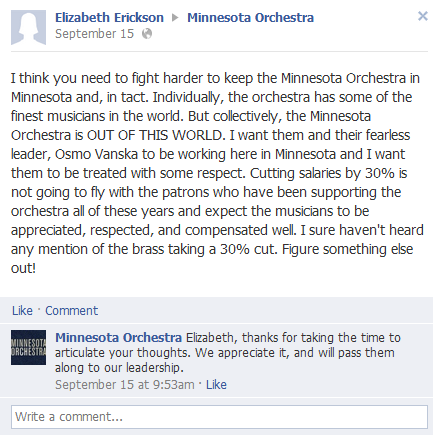
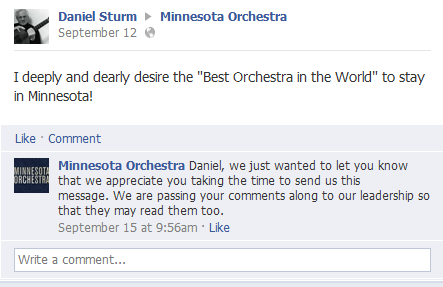
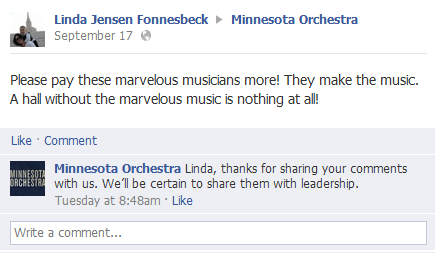
Speaking of the Minnesota Orchestra’s Facebook page… (I went there for the first time in a long time to get that 9100 likes figure.) And while I was there I noticed something that y’all may find interesting…

Whenever anyone expresses frustration or dismay over management’s proposals, the Orchestra writes a little note along these lines…

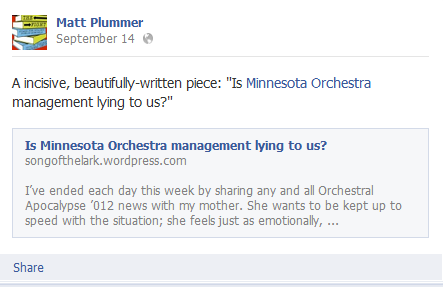
And so on and so forth. Interestingly, there are only two posts they haven’t acknowledged…

and

Heh.

As the Internet meme goes…

I did have the thought that it might be worth eventually posting a link to the Hundred Questions on Facebook if I don’t hear an acknowledgment of its receipt relatively soon. I don’t want to annoy anybody, but… Dude, I spent a long time on those questions. It would be really nice to get some acknowledgment, even if it’s something along the lines of “YOU HAVE ABSOLUTELY NO RIGHT TO ASK ALL THESE THINGS, FOR SHAME.” I really don’t think an acknowledgment is too much to ask for.

Am I the only one who feels bad for whoever is running the Minnesota Orchestra Facebook page? You know s/he has no input into any of this, and yet s/he must toe the line as politely as possible, with the threat of being fired by email hovering over his/her head (if this reference doesn’t make sense to you, click this link and look at the questions right above “Website Stuff”). Anyway, tough gig, that. I’m guessing I’d get the termination email sooner rather than later.

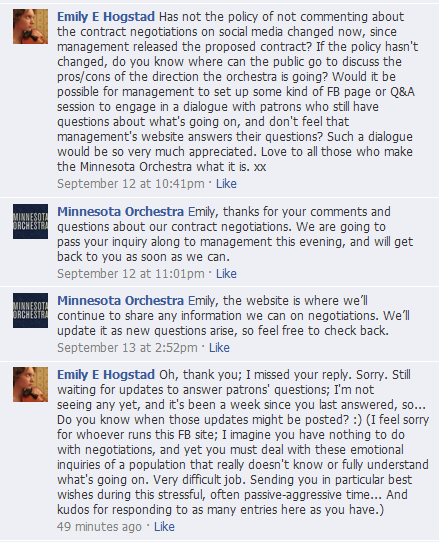
I do want to take a moment to praise the Orchestra’s new stock response to patrons’ concerns. It has changed from “look at our pro-management website” to “we will share your concerns with management.” This is an improvement, and a move toward dialogue. I recently had this conversation…

So, um, yeah. I think that kind of speaks for itself. It might be worthwhile to keep checking on that, as I believe this is the first we’ve heard that management is claiming it will eventually update its website “as new questions arise.” Of course new questions have arisen in the last week, and as best as I can tell, nothing has changed on the website except for the section called “Industry News” which is where management gets some kind of weird kinky thrill linking to articles about orchestras in distress. (Fun factoid: positive industry news, or at least non-negative industry news, like what we’ve heard lately out of the National SymphonyChicago Symphony, and St. Louis Symphony, has never been posted in “Industry News.” I’m not sure what to take away from those omissions besides the fact that management doesn’t really want to provide a comprehensive “view of the current landscape,” and that they must think we patrons are stupid idiotic simpletons who can’t understand the need for sharp concessions unless we only see articles that support management’s thesis.) (Another fun factoid: management officially considers the Huffington Post to be a “reputable news source.” That’s an…interesting perspective. Apparently a blog entry written by an anonymous author on a gossipy website famous for such Pulitzer-eligible journalism as “Kathy Griffin Without Makeup Is Barely Recognizable“, “Ohio Woman Finds Out Husband Was Her Father“, and “Miley Cyrus Flashes Side-Boob, Talks Sex Scenes, and Losing Her Virginity“…apparently that website is a more reputable, more serious news source than this one. Come on, management. I haven’t even talked about side-boob here once. What do I have to do to be reputable? Turn anonymous, steal others’ work, and start salivating over the Amanda Bynes trainwreck?

I can only assume though if they’ve seen that Huffington Post blog, they’ve seen this one. Don’t pretend you haven’t. Come out, come out wherever you are! I won’t bite; I promise. I may poke at you, and poke hard at times, but I do it out of love, and out of a pure desire to see this orchestra be the best it can be. My first loyalty is not to you; it is not to the musicians; it is to the orchestra as an institution. I swear. Plus, did you see the video I posted of myself? I’m a 5’5″ 90-pound shrimp. You could snap my arms like toothpicks. For God’s sake.

22 September 2012

Not much analysis on my part today, but here’s some news…

From MPR: “Does SPCO, Minn. Orchestra musicians’ skill justify their pay?” FYI, the short answer is “yes.” And the long answer is “yesssssssssssssssssss.” I can certainly think of some people who don’t deserve their salaries, but happily the SPCO and Minnesota Orchestra musicians are not among them.

From MPR again: “Labor talks at SPCO apparently fruitless.” That headline seems just a tad disingenuous; judging by the article, there may have been some fruit, just not enough fruit to end in a final agreement. Heck, that article doesn’t even say if musicians got the final language of the proposed contract that they were waiting for. According to the previous MPR article, talks were scheduled for both yesterday and today, and it doesn’t appear that they were cut short, as I believe they were at a certain point in the negotiations not too long ago. So I’m going to believe there was progress, if only because I want to.

Also, in an exciting twist, the Chicago Symphony is now on strike. Hullo! Atlanta, YOU get a labor dispute; Indianapolis, YOU get a labor dispute; Minneapolis, YOU get a labor dispute; St. Paul, YOU get a labor dispute; Chicago, YOU get a labor dispute! EVERYBODY GETS A LABOR DISPUTE!!!! WOOOOOOOOOO

20 Comments

Filed under My Writing

A Hundred-ish Questions for Minnesota Orchestra Management

Are you a patron who is confused by what’s happening right now with the Minnesota Orchestra? Do you have a question you want to send to management? If so, I want your input! This is an open letter I’d like to send to the board of directors, and I’d love for you to add to it.

 ***

Dear Minnesota Orchestra management,

Well, this is awkward.

A few days ago I wrote a blog entry titled “Is Minnesota Orchestra management lying to us?” In it I called you dangerously oblivious incompetents “who are too arrogant to realize they know nothing about the organization’s very reason for being.” Despite the bravado, those were tough words for me to write. I’m a peacemaker who gets anxiety attacks when criticizing anyone about anything. So let’s “reset” our relationship: I’d like to give you a chance to convince me (and my thousands of readers) that I’m a raving partisan lunatic.

How? I’ve come up with a list of approximately a hundred questions that I’d like anyone on the board of directors to answer publicly, but especially Jon Campbell, Richard Davis, and Michael Henson. Ideally I’d bring my voice recorder and come visit y’all myself, but I’m guessing it will be difficult for us all to find mutually convenient times in which to ask and answer all these questions aloud. So I’m thinking it might be best if you answered them in writing. Take 10, 15 minutes out a day for a few days. Answer a few a day over the next couple of weeks. If certain questions are too sensitive given the current negotiations, say so and move on. When you’re done, save as a PDF and send it to me (try contacting me through Facebook, or if that doesn’t work, ask the musicians to get it to me), and I’ll publish it here unedited. Surely despite the no doubt extraordinary demands on your time, you could find a spare quarter hour every day for a week or two to explain yourselves and your plans more fully…since they will, after all, affect the future of one of the great orchestras of the world. Pretty important topic, that! Plus, I know you agree: transparency is key.

These aren’t meant to be judgmental gotcha questions. I’ve done my best to phrase them fairly and neutrally. I don’t mean to vilify. My only purpose in asking them is to try to get inside your heads, since I’ve had such difficulty doing so over the last couple of weeks. Ultimately, all I want is to understand the future you’re envisioning for the orchestra that means so much to me. I promise.

Clearly you have utmost confidence in the direction you want to take the Minnesota Orchestra. So what would you have to lose by explaining that direction more fully, and inspiring confidence in others? If you answer me, you could reach an audience of literally thousands (“Is Minnesota Orchestra management lying to us?” got thousands of hits in the last few days, and those are just the views I can see; I know there are many more I can’t). You could cultivate goodwill among your musicians, your patrons, your public…reassure those who are afraid you’re in over your head…force me to eat my own bitter words. Agreeing to give a hugely in-depth interview to a blogger (especially one who has been highly critical of you!) would be a daring move that would prove you’re serious about bold leadership and a robust dialogue…and as a bonus, it would be a “forward-looking digital…initiative to reach broad audiences & raise visibility.”

You have everything to gain in such an open and honest exchange of ideas, and absolutely nothing – nothing – to lose.

So let’s have at it. Would you mind answering all – or heck, even some – of these questions for us? And if you have time for nothing else, can you at least clarify some questions I had about your website?

And if not, why not?

I’ve given the Minnesota Orchestra a lot of free publicity over the last two years. I’ve spent hours upon hours writing about the Inside the Classics series – the Greenstein Microcommissionthe Sibelius Midori showyour shows in Winonayour January 2012 Brahmspalooza. I don’t get paid for doing this. I do it out of love and enthusiasm for this orchestra. These posts have been read by hundreds, if not thousands, of people all over the world, largely by a well-educated young tech-savvy demographic that I’m guessing you’re rather desperate to reach. I’ve done you guys a favor. So would you mind doing me one? I guarantee you, you won’t be able to read my past blog entries about the Minnesota Orchestra and say I don’t share your stated goal of supporting “an artistically excellent, fiscally responsible, world-class orchestra that benefits our audiences, supporters, community and musicians for years to come.” I’m here; you’re here. Let’s talk.

Here goes.

Personal Questions

How many Minnesota Orchestra concerts have you attended over the last year?

What were your favorite five, and why?

Do you feel your attendance (or lack thereof; I don’t know) at concerts is relevant to your ability to oversee the orchestra?

Would you like to be more involved with your patrons? If so, how?

What did you think of Judd Greenstein’s Acadia?

Who are three of your favorite musicians in the orchestra to watch, and why?

When and where did you study music?

How would you describe your relationship to music in general, and orchestral music in particular?

Who is your favorite composer, and what do you like most about his work?

What kinds of music do you listen to the most?

What do you bring to your job that uniquely qualifies you to safeguard and support the Minnesota Orchestra?

What do you feel you can learn from your musicians?

What do you feel they could learn from you?

What role do you envision a musicians’ union as playing in today’s world?

Do you believe classical music is dying?

If you do, why? What moves you to devote so much time and energy to trying to keep it alive?

If you don’t, why? What do you believe is keeping it alive, vital, and relevant?

What are the biggest mistakes you’ve made during your tenure?

Why do you think you made those mistakes?

What steps have you taken to avoid those mistakes in the future?

What have been your biggest successes?

Why do you think you achieved those successes?

In your opinion, what mistakes have the musicians made in the last five to ten years?

Why, in your opinion, did they make those mistakes?

What, in your opinion, have been their biggest successes?

Why do you think they achieved those successes?

How have you felt about the press’s coverage of the labor dispute thus far?

Artistic Vision

Would you classify the upcoming season in the convention center as more similar or dissimilar than what you have envisioned for future seasons in the new Orchestra Hall?

If you personally had total control over programming, and didn’t have to answer to anybody, what percentage of shows would be pops and what would be classical? And why?

What does the phrase “heightened artistry” from your Strategic Business Plan Summary mean to you?

Do you believe that artistic quality can be heightened if a relatively large percentage of musicians are actively seeking employment elsewhere?

How big of a concern is turnover to you?

What steps are you planning on taking to minimize turnover after the new contract takes effect?

Do you feel confident you have an understanding of the way in which turnover may or may not affect artistic quality? Please elaborate.

Do you have a plan in place to meet the challenges of heightening artistic quality while also dealing with potential turnover and demoralization?

When are you planning to hold auditions for seats that are now empty?

Have you thought about what to do if many of your principals leave in a short period of time, since they are the ones most likely to find work elsewhere the fastest?

As a purely hypothetical question, if Vänskä told you that your proposals ran a high risk of severely impacting the artistic quality of your orchestra, would you consider altering them in any way?

Have you thought about what you want to see in your next music director?

Have you thought about how you want to attract the next music director?

Why specifically is touring important to you?

Why specifically is recording important to you?

What kinds of educational and outreach programs would you like to see the orchestra adopt?

How specifically would you like to use new technology in relation to the orchestra?

Money

How much money will the changes in working conditions in your proposed contract save the orchestra?

Do you have any idea why the musicians aren’t satisfied with previous audits of the orchestra’s endowment?

Why not have another one if it satisfies your musicians? Is it a matter of cost, or are you resisting for another reason?

Do you believe Minnesota can afford to support two world-class orchestras with internationally competitive benefits and salaries?

Do you feel the Minnesota Orchestra would have been able to meet more of the musicians’ demands if the recession had not hit, and if so, how many more? Some more? A lot more?

Was it more or less difficult than you thought it would be to raise the capital for the Building for the Future campaign?

Do you feel you personally contributed in any way to the orchestra’s current financial catastrophe, or do you feel it was inevitable and largely, if not completely, out of your control?

Do you believe the fiscal health of the orchestra will improve after the recession? If so, how and by how much? If not, why not?

If turnover is high and artistic standards decline, do you believe this will affect your ability to fundraise? Or do you believe the quality of a major orchestra is relatively irrelevant when it comes to fundraising?

Have you been in contact with anyone at SPCO management about their situation? Have they been in contact with you about yours?

How do you feel overseeing a non-profit organization is similar to overseeing a for-profit one?

How do you feel overseeing a non-profit organization is different to overseeing a for-profit one?

Treatment of Employees

How well do you feel the various staff members of the Minnesota Orchestra have communicated with one another in the run-up to this crisis?

Why did you insinuate in the press that it will be relatively easy to replace your musicians? (E.g.: “So couple what’s happening in the marketplace with a large supply – not to dismiss the fact that we don’t want to lose any of our wonderful musicians – but there may be some changes” and “there’s a risk that they find their way to another place.”) Talking that way obviously doesn’t affect the budget at all, and I know that many people (including me) were puzzled and disappointed by this attitude. Would you care to elaborate why you said what you did? Why not take an attitude more along the lines of “We can’t afford these wonderful people, and we’re terrified and devastated we’re going to lose them. They have done us proud. We’re so sad to see them go”?

Do you feel it will be relatively easy to replace any musicians who may leave?

Do you feel your musicians are unwilling to compromise?

Do you feel your musicians are more interested in their own personal finances than in the long-term health of the orchestra, or do you feel they are selfish and/or clueless about what it will take to chart a sustainable course forward?

Do you believe your musicians regard salary as being more than, less than, or equally important as working conditions?

How many musicians do you think will leave within the next, say, three years if your proposed contract is adopted as-is?

What number of musicians would have to leave before you’d start feeling alarmed about turnover?

Who made the decision to shut down the Inside the Classics blog?

Do you know what the rationale was behind that?

Did anyone consult with Sam or Sarah beforehand?

Why weren’t they given a chance to write a good-bye / hiatus post of their own?

Why did the author of the good-bye / hiatus post insinuate that Sam and Sarah were unable to both blog and plan for the upcoming season, when they’ve done both for years? Why not just leave the blog blank?

Did you ask the musicians’ permission to post your proposed contract online before you did so? If so, what did they say?

If you didn’t ask the musicians’ permission, why not?

Is it true that what you’re negotiating in private is different than what you’re proposing in public, or are your musicians lying?

How did you feel that releasing the contract would help negotiations?

If negotiations persist past 1 October, would you be open to posting the expired contract alongside your proposed one, so it is easier for reporters and the general public to put your proposed changes into context?

Do you believe musicians should have a greater input in how the business side of the orchestra is run?

If so, what role do you envision for them?

One of my blog readers commented that he knows of someone who worked for the Minnesota Orchestra who was recently informed of her termination via email. Is this true, and if so, what do you know about that situation? Is this standard procedure?

Do you know who was in charge of making the decision to inform her in that way?

If you haven’t already, would you be willing to apologize to her and whoever else may have been fired in that way?

Website Stuff

In your opinion, is the general tone of your website respectful and kind to your musicians?

What are you envisioning when you say “new concert formats and content”? Could you elaborate on that phrase?

Why did you insinuate that musicians are reluctant to participate in outreach efforts or play chamber music in community locations?

“Musicians in other major orchestras have agreed to concessions.” Why did you not mention here that the Minnesota musicians also agreed to concessions in 2009? I understand that you would like to (or need to) see further concessions, but it seems misleading to not mention what they’ve already given. It implies that audiences are unable to see the gravity of the situation unless only certain facts are set before them, and I personally feel a little condescended to because of that.

“What will happen if the Orchestra’s contract proposal fails to gain approval from the musicians?” Your answer doesn’t actually answer that question, instead addressing ticket prices. Could you please clarify?

Why aren’t Mr. Campbell’s words about “there may be some changes” in the Minnesota Orchestra management FAQ under “Will pay cuts cause the best talent to leave the orchestra”? Could you add his words there? If not, why not?

Do you truly believe the musicians share your desire for a “contemporary, world-class, flexible, artistically excellent community resource that can operate within its means regardless of external economic factors”?

In your strategic plan, you mention that “classical music event attendance decreased from 13% of all adults in 1982 to 9% in 2008,” according to the NEA’s “2008 Survey of Public Participation in the Arts.” Happily, that report is online, and I have it right here. I’m assuming you got your percentages from page 18…

Percent of adults attending classical music events

1982 – 13%

1992 – 12.5%

2002 – 11.6%

2008 – (during recession)  9.3%

But of course the United States population has grown over the years, so let’s move over a column and look at the numbers in millions…

Millions of adults attending classical music events

1982 – 21.3

1992 – 23.2

2002 – 23.8

2008 (during recession) – 20.9

I don’t think it’s unrealistic to posit that if the Great Recession hadn’t occurred, there would probably have be more people attending classical music events now than there were in 1982…according to the report you cited. Am I wrong? If I am wrong, how? If I’m right, what was the rationale behind including the more alarming percentages as opposed to the more reassuring numbers? Why not include both to paint a more accurate, nuanced picture of the fiscally challenging future? Do you not trust your audience to interpret more nuanced numbers?

You cited the 2010 Giving USA report for 2008 and 2009’s “national arts funding is declining” figure. Would you be averse to updating that to include 2010 and (if available) 2011’s figures? (I know this strategic plan was published in November 2011, so those may not have been available upon publication, but surely an addendum could be easily added?) Unfortunately, I can’t see the 2010 Giving USA report; one has to pay for more than a summary of it, and, as I’m sure you’d agree, summaries rarely paint the whole complicated picture…

Since you did not include both sets of numbers from the NEA report, and the Giving USA report is (to the best of my knowledge) unavailable for free to the public, would you understand if patrons would be hesitant to take the other numbers in your report at face value, especially since many of them come from reports that are not cited, much less available to the public or to reporters?

Miscellaneous

What’s your favorite color?

Chocolate or vanilla?

Puppies or kittens?

Well, I think that wraps it up on my end. Looking forward to your response, or at the very least, response about why you don’t want to respond!

Wishing everyone the best for a speedy satisfactory resolution, with as little acrimony as possible.

Best,

Emily E Hogstad

***

So. Those are the questions I came up with. What would you guys ask Minnesota Orchestra management if you had the chance? I’ll gladly add your questions to the list under a separate category called “Reader Questions.” Remember, this is your orchestra, and if you’re confused about anything about this situation, you deserve to ask questions about it. In fact, it’s your duty to ask questions about it!

Please include your full name and hometown in your comment so that management knows I’m not “stuffing the ballot box”, so to speak. If you don’t want your full name posted here, I’ll contact you privately and ask for it.

PS: Musicians? Don’t think I’ve let you off the hook…

11 Comments

Filed under My Writing

Minnesota Orchestra and SPCO Negotiations: Summary of Week -3

On 30 September the contracts of the musicians of the St. Paul Chamber Orchestra (SPCO) and Minnesota Orchestra expire, and tense negotiations are ongoing. I’ve written thousands and thousands of words (literally) on the subject, and if you want, you can find those here. If you just want a summary of what happened last week, click here.

SPCO

In early September the SPCO musicians were claiming that management was proposing a contract that included 57%-67% salary cuts. (Interim CEO Dobson West later denied this.) In advance of meetings between musicians and management on Monday and Tuesday, management proposed a new contract. This one included salary cuts of 15%, a reduction in the size of the orchestra from 34 to 28 players, retirement packages for players over 55, and a new two-tiered salary in which current players would be guaranteed $62,500 a year, while new incoming players would only be guaranteed $50,000. In this Star Tribune article, West refers to the new contract as a “significant stretch for the Society and its donors.” Although the outline of the contract was released on 7 September, it is unclear when management originally drafted and approved the ideas contained within it. I’m also not clear why it took this long to get to this point, as negotiations have been ongoing since December of last year…?

Happily, the musicians didn’t reject the terms of the proposed contract outright, and in fact they almost seemed vaguely hopeful about them. “The musicians of the SPCO are encouraged, and we think our supporters should be, too, to learn the SPCO management has found money to spend. However, we are puzzled by how they intend to invest these funds. We hope to learn more in our upcoming negotiations scheduled for next Monday and Tuesday.”

After these meetings occurred, MPR reported that management never showed the musicians the formal language of the contract. In fact, according to the musicians, management will not be able to draft the language in the contract and share it with musicians until “next week at the earliest.” Nevertheless, management would like “a response” from the musicians by the next negotiating session on 21 September, which would only give the musicians a few days – at the most – to look over the document.

Since then, nothing more has come out, and so I can only assume that the musicians are still waiting on management to draft and share that contract. In the meantime, time is ticking, and their current contract expires in sixteen days. So, um, no pressure or anything…feel free to take your time, guys…it’s not like you’ve been negotiating for the last ten months or anything…

Minnesota Orchestra

Developments in Minneapolis were a lot more depressing this week.

If you’ll remember from last week, after management released their proposed contract without the musicians’ say or knowledge via website, the musicians fought back by requesting an independent audit of the orchestra’s finances, alleging that different people have been given different numbers at different times. Management responded thus: “Every year the Minnesota Orchestra performs a thorough, independent audit process by one of the nation’s top accounting firms. We have shared all of our recent audited results with the Union and answered these questions many times in our negotiation sessions over the last five months.” This doesn’t address the musicians’ allegation, so feel free to speculate. (I’ve used the phrase “feel free to speculate” so often on my blog lately I feel inclined to trademark it…)

Sadly, it’s becoming increasingly clear that management’s proposals will cause many musicians to retire or seek work elsewhere (if they aren’t already, and many clearly are). In an interview with the Pioneer Press that made musicians around the nation cringe, board chair and Wells Fargo executive vice president Jon Campbell said of potential turnover:

“The number of highly trained musicians that this country is producing every year is really quite remarkable. If you just take the top echelon of music schools in the U.S., they produce almost 3,000 performing artists a year. So couple what’s happening in the marketplace with a large supply – not to dismiss the fact that we don’t want to lose any of our wonderful musicians – but there may be some changes.”

Campbell did not elaborate on whether he would like to implement an accelerated schedule of auditions to replace the departing players; if he is envisioning an orchestra with a large percentage of substitute players; or if he feels the musicians won’t be able to get work elsewhere and are therefore in effect trapped in Minnesota. Unfortunately, nobody followed up on that question.

Campbell’s colleague Richard Davis, head of the management negotiating team, commented in another interview:

“These are real people with real lives, and they have to protect their own financial circumstances and artistic integrity. There’s a risk that they find their way to another place, and those who can leave will. It’s going to be a personal decision where they want to perform.”

As you can imagine, these comments were not particularly well received by those who view the morale of musicians as being even a halfway important part of an orchestra’s artistic and fiscal success.

I stayed up late a couple nights last week writing a few essays about those two quotes. You can dig them out of my blog if you want. They made the rounds nationally. Mainly they consist of me pressuring management to admit publicly that it will be very difficult to heighten artistry if Minnesota faces a high turnover rate in the next few years. (As of right now, they’re still claiming they’ll be able to raise artistry while simultaneously struggling with high turnover and demoralization. Have fun with that, management!) I get the feeling I might be screaming at a brick wall, but hey. I tried. It’s the best I can do.

***

The musicians of both orchestras are organizing free concerts in the next few weeks, ostensibly to thank the public for their support, but I imagine also to court goodwill. On 16 September at 4pm the musicians of the Minnesota Orchestra will be playing at the Lake Harriet Bandshell in Minneapolis. Orchestra violist Sam Bergman will host. Details available here. On 2 October at 7:30pm the musicians of the SPCO will be giving a free concert at Macalester College. Minnesota institution Garrison Keillor will be hosting this show. Details here.

I know this will sound totally ridiculous, but despite the geyser of bad news this week, I’m feeling bizarrely hopeful. Maybe it’s a bad case of Gingrichian delusion; I don’t know. But I’m getting the sense that more and more people are asking vitally important questions we’ve left unasked and unanswered for far too long. Who is really in charge of our orchestras? What credentials should decision-makers have? Who should have what powers? How should the world of business and philanthropy intersect with the world of artistic excellence? When budgets are tight and salaries need to be cut, what inexpensive efforts can management and musicians take to respect one another? Yes, this is a time of flux and change and very possibly grave danger for many orchestras. Yes, many many tears have been shed and no doubt will be shed. Many sleepless nights will be had. And the situation in the Twin Cities will certainly get much worse before it gets better. But these questions, and others like them, needed to be asked. Badly. And I’m beginning to think we needed a few crises to shake us up and make more people ask them.

Either that, or I’ve gone totally completely insane from blogging so much lately. That could very well be, too.

Keep those prayers and positive thoughts coming. We need every single one.

More next weekend.

1 Comment

Filed under My Writing

Is Minnesota Orchestra management lying to us?

I’ve ended each day this week by sharing any and all Orchestral Apocalypse ‘012 news with my mother. She wants to be kept up to speed with the situation; she feels just as emotionally, intellectually, and spiritually invested in the Twin Cities orchestral scene as I do.

Last night I was explaining to her about the artistic goals in the Minnesota Orchestra’s Strategic Business Plan Summary. I told her there was a section devoted to “key targets for artistic programming.”

“What are those targets?” she asked.

I opened the document and read them off. “Symphony orchestra of the highest caliber.”

“That doesn’t seem very realistic if management has their way,” she said. “Won’t a lot of musicians leave?”

“Outstanding classical concerts in Orchestra Hall,” I read.

She considered. “They might be outstanding, but they probably won’t be as outstanding as they have been.”

“National & international touring to significant venues…”

“Why would they want to tour if they have so many subs? Wouldn’t that be embarrassing?”

“Live at Orchestra Hall series to feature popular & jazz artists.”

We both shrugged; we don’t care for most popular and jazz artists enough to warrant a two-hour drive to Minneapolis. We can see those here in Eau Claire.

“Exceptional artistic leaders & guest artists…”

“Will they want to work with a demoralized disorganized orchestra?”

“Vital summer & holiday festivals.”

“Meh. Depends what’s on the program, I guess…”

“New concert formats & content.”

“What does that mean?”

“Forward-looking digital and traditional media initiatives to reach broad audiences & raise visibility.”

“Sounds good, but if the quality of the orchestra goes down the crapper, do they really want to be broadcasting that?”

I was going to flip the page forward to read more but I accidentally clicked backward, to this page, and there I found a sentence that I hadn’t read before. And it made me stop dead in my tracks.

Continue reading

46 Comments

Filed under My Writing

Minnesota Orchestra and SPCO 2012 Negotiations: Week -3

New week, new blog entry: here’s Week -3 of Orchestral Apocalypse ‘012! In case you’re just joining me, here’s a link to the entirety of my coverage of Week -4, or if you just want a summary of week 4, here you go.

I have a feeling I’m going to be writing many, many paragraphs today. So please be patient with my rambling. Let’s get started…

***SPCO***

Yesterday news broke that the SPCO management has offered a new contract to its musicians in advance of meetings on Monday and Tuesday (10 and 11 September). Here’s an MPR article: “SPCO proposes new contract for musicians.” According to the Star Tribune, “The offer boosts minimum salaries from the previous proposal, reduces the size of the permanent orchestra and creates a special retirement program for musicians 55 and older.” Go and read both articles yourself; there’s a lot of relevant stuff there I don’t need to repeat verbatim. A part of me celebrates that there appears to be some kind of movement; the other part worries this was all planned from the beginning. [I actually said in the comment section of my Tumblr blog post a couple days ago: “Does management *really* want to get a 28% (or 50%, or 67%) cut? Or are they lowballing so they can eventually come up to, say, 15%, get what they secretly wanted in the beginning, and have the advantage of looking like they’re compromising? Same goes musicians…” And when a 23-year-old with no training in arts administration guesses the exact percentage a couple of days before it’s revealed… I don’t know. That just strikes me as weird.]

The musicians at first had no comment, since they needed to read the contract through with their attorney. However, they did express a hesitant, very faint hope: “The musicians of the SPCO are encouraged, and we think our supporters should be, too, to learn the SPCO management has found money to spend. However, we are puzzled by how they intend to invest these funds. We hope to learn more in our upcoming negotiations scheduled for next Monday and Tuesday.” Later they wrote on Facebook: “Just to clarify, how is this proposal investing in the preservation of artistic excellence by buying off experienced, seasoned musicians to bring in new players at a lower rate? New players, of which there would be plenty if many of the over 55 musicians took the retirement package, would only receive $50,000, which is more like a 30% cut from the current base salary.”

I don’t know what to think. I see reason for faint hope here, and also reason for dejection. So I guess take away what you want. For now I’ll go with hope, simply because that’s been in such short supply lately.

The SPCO also started off their 2012-13 season yesterday in a performance of Beethoven and Stravinsky. The Pioneer Press raved about the performance, while the Strib shrugged. Apparently leaflets describing the situation from both management and the musicians’ POVs were handed out both in and outside of the Ordway. That must have been an awkward dynamic for audiences…

***Minnesota Orchestra***

In the MPR article linked above, Minnesota management had more words about the audit the musicians are proposing: “Every year the Minnesota Orchestra performs a thorough, independent audit process by one of the nation’s top accounting firms. We have shared all of our recent audited results with the Union and answered these questions many times in our negotiation sessions over the last five months.” This obviously doesn’t address the musicians’ allegation that different numbers are being given to different people in different situations, so…as I’ve been forced to say so many times on this blog before, “feel free to speculate.” (I’m so sick of saying that.) We also found out in this article that the next negotiating session isn’t scheduled until September 24.

We also finally heard from the folks at the Pioneer Press, so we can confirm they’re not dead, as I feared yesterday. Actually, I should put the snark away for a bit: they were busy collecting information for an enlightening article called “SPCO, Minnesota Orchestra in tough contract talks.” Highly recommended reading. I’d still like the musicians and management to be asked more pointed questions, but hey, this is much better than no coverage at all. And space was clearly limited. So I’ll take what I can get.

There was a paragraph in that article that I think warrants some very deep analysis. (In fact, such deep analysis that I stayed up until 1:30 in the morning writing about it…)

Board chair [Jon] Campbell accepts there could be some turnover.

“The number of highly trained musicians that this country is producing every year is really quite remarkable,” he said Wednesday. “If you just take the top echelon of music schools in the U.S., they produce almost 3,000 performing artists a year. So couple what’s happening in the marketplace with a large supply — not to dismiss the fact that we don’t want to lose any of our wonderful musicians — but there may be some changes.”

So, wow. Massive essay incoming.

I’d like to play devil’s (and musicians’) advocate with Mr. Campbell for a moment. Yes, there are a lot of great graduates from top music schools, many of whom would be delighted to get any job in the field they trained for. Nobody disagrees with that. (Psst: just for future reference, it’s kind of insulting to imply we don’t understand there are lots of great musicians out there without jobs. Musicians aren’t stupid; we are more than aware of our obscenely accomplished colleagues and their professional struggles. But alas, you don’t play in an orchestra for a living, and you clearly don’t understand our weird insular culture, so I’ll be kind and cut you some slack. Just remember for next time. Okay?) And you know what? Many of those great graduates would likely fit in very well with the orchestra…that is, if they were hired one or two or three at a time, over a period of years. But that would not happen here. Your proposed contract encourages a scenario in which ten, twenty, thirty musicians – maybe more! – could quit, all within one or (if we’re lucky) two or three seasons. That means (unless you want to be beholden to subs long-term) you’d need to recruit ten, twenty, thirty newcomers over the course of a couple years. And no matter how great those newcomers would be, they simply would not have the cohesion and vision and experience the current players have. Period. No matter how fantastically gifted they are, it will take months and very possibly years for them to learn the Minnesota way of doing things…especially if only, say, 80% or 70% or 60% of the “original” musicians are left. (Remember, at least according to the musicians, 10% of the seats are already vacant. So even today, way before the new contract takes effect, we’re only at 90% “original” musicians.) I really cannot overstate what a huge learning curve these new musicians will have to navigate. Think of how complicated things would get if multiple principal seats open at once…which, of course, seems likely, since principals are the ones most likely to get good jobs quickly elsewhere. (Exhibit A: Timothy Paradise.) Remember the concertmaster hunt? Remember the years of searching that took? Think of the hassle of that. Then multiply it tenfold.

Amidst all this, let’s spare a moment’s thought for poor Osmo Vänskä. If a mass exodus does materialize, his job will be made immeasurably more difficult. Immeasurably so. Remember, he’s committed to recording a Sibelius cycle that people all over the world have their eyes and ears on. He is staking a big part of his hard-fought reputation on the assumption this orchestra stays world-class. If this new contract results in a high turnover and consequent artistic decline, I imagine he’ll be so frustrated – and probably humiliated – that he’ll accept a position elsewhere as soon as he’s free to do so. (Heck, I wouldn’t be surprised if he wants a change of scenery regardless of how this contract pans out. He’s been here since 2003, after all…) Who would blame him for leaving? You can’t expect an internationally renowned conductor to stay in Minneapolis out of the goodness of his heart, no matter how good said heart is. If the chattering classes ascribe Vänskä’s departure to turnover, it would leave Minnesota with a soiled reputation, scrambling to find an inspiring dynamic new music director on top of trying to replace a huge number of musicians and dealing with the demoralization of the rest. What a headache for management! Are they prepared and willing to take all that on? I want to hear them say they are.

Also think of what the sudden high turnover rate would mean for the audition process. According to the musicians’ union, despite the fact that 10% of the seats in the orchestra are vacant (more than ever before), management is resistant to making new hires. (This is understandable; subs are cheaper, and auditions are inconvenient and time-consuming.) But in order to have any remote hope of sustaining artistic quality over the next, say, five years, management would need to put forward a plan – preferably in the next couple of months – describing in great detail how they will replace those ten, twenty, thirty musicians in a very, very short period of time. Even then it would be a stretch, and it would be a logistical nightmare to pull off. They’d need to find ten, twenty, thirty weekends where the hall is available (frankly, probably impossible at this point) – schedule around Vänskä’s already-scheduled out-of-town concerts – form and coordinate the schedules of audition committees – wait for the winners of the jobs to become available (a process that often takes months) – wait for the new members to gain tenure… It would be ridiculously ambitious (dare I say impossible?) to tackle the massive turnover problem while still keeping the orchestra’s world-class edge. Honestly, if I was in management’s shoes, I’d much rather have the challenge of trying to squeeze millions of dollars out of reluctant donors!

So. If anyone from management ever brings up the fact there are lots of talented young players who would kill to have a Minnesota Orchestra job: remember, it’s not that simple, and Campbell’s casually implying so makes me wonder if he understands this. A major orchestral audition is not like a Subway or Walmart interview, and for good reason. Realistically speaking, it will probably take at least five years to hire all the replacements. And in that time, artistic quality will almost certainly deteriorate, likely severely, as the newcomers attempt to get their bearings.

Of course once artistic quality starts deteriorating, attendance will decline. Donors will become less enthusiastic about opening their pocketbooks. And then we run the risk of becoming a disappointment or – shudder – even a laughingstock during the proposed 2014 or 2015 European tour that management is clearly super-excited about. And so the vicious downward spiral will continue. We’ll end up with a gorgeous new hall with a confused mishmash of an orchestra within it. If the building is the most important thing, you might as well disband the Minnesota Orchestra itself and hire a house orchestra of freelancers. At this point, I’m honestly wondering why management just doesn’t propose that. I believe it would mesh more closely with their stated goals. Maybe that will be their next suggestion. God, I hope not. But I don’t know.

Anyway. Management says that one of their goals is to create a “symphony orchestra of the highest artistic quality.” If this is indeed their goal, I’d think that they’d want to avoid such a nightmare mass exodus scenario at all costs. And I’d think they’d really want to avoid it when Orchestra Hall is under construction. As difficult as it would be, desperate fundraising, canceling tours, cutting salaries somewhat while retaining great working conditions, thinking of creative ways to retain and satisfy players, drawing on a shrinking endowment for a few more years – basically, anything else you can think of – would be a much easier, safer bet than attempting a major renovation of the orchestra roster. I’d be so interested in hearing more from management on this topic. Reporters, if you’re reading this, please ask them some of these questions!

On a closing note, I don’t think it’s unreasonable to request that Campbell’s words be put in management’s Q&A under “Will pay cuts cause the best talent to leave the Orchestra?” instead of the condescending non-answer that’s there now. Be up front with us: your current proposals will cause musicians to leave, very possibly en masse. And if musicians leave en masse, artistic quality will suffer. And if artistic quality suffers, you will, by definition, fail at your stated goal to maintain a “symphony orchestra of the highest artistic quality.” Period. If that’s the direction you want to take us, or feel obligated to take us thanks to the terrible economy and Minnesota’s inability to support a world-class symphony orchestra…then say so. Tell us that. Yell it from the roof-tops. But please don’t hide the truth. Don’t sugarcoat it. You are serving the public, and your public deserves to know.

All that being said, it’s fantastic to hear some acknowledgment from management that, yes, it is possible that musicians will leave. That’s progress! It’s better than the Lame Paragraph of Naive Hope on their website. So kudos to Mr. Campbell for that. Hopefully he and his colleagues can go on record answering some more of these difficult questions ASAP.

Before I sign off for the day… Here’s some happy news: “Grantmaking to the arts rebounded significantly in 2010, growing to $129 million, which is 20% above 2009 levels. The rise follows an almost steady decline in arts giving since 2004.”

9 September

Could it be…

Could it possibly be…

A relatively news-free day in Orchestral Apocalypse ‘012?

Really?

What am I supposed to do if I’m not blogging about orchestral crises? Practice? Go outside and feel the sunlight on my face? Take a long hot bath while trying not to fixate on how desperately out of touch Jon Campbell is? I’m adrift…

Yes, the only piece of news today is this one from the Star Tribune called “What price orchestral excellence?” (Yes, I too find that prepositions are over-rated.)

I was probably more overjoyed than I should have been to read that someone on the board apparently subscribes to the radical notion that musicians are people (to paraphrase a famous quote). Here’s Richard Davis. head of the management negotiating team:

“These are real people with real lives [as opposed to fake people with fake lives? hmm], and they have to protect their own financial circumstances and artistic integrity. There’s a risk that they find their way to another place, and those who can leave will. It’s going to be a personal decision where they want to perform.”

Okay, so. Slowly but surely we’re inching closer to what I need to hear from management: an acknowledgment that their current proposals will make it impossible for them to achieve their own stated goal of creating a symphony orchestra of the highest possible quality. But if today we hear acknowledgment that musicians are people too, my friend, then maybe by Tuesday we can get to “yes, we probably will lose a lot of musicians”…and then maybe by Thursday “yes, artistic quality will decline because of this.” And then by Friday maybe we could shoot for “yes, we’re really looking forward to fundraising after revealing the fact we want more money to finance a crappier product” and “yes, we’re really really looking forward to the headache of replacing multiple principal players at once” and “yes, we’re really really really looking forward to seeing what the London critics think of our ensemble of 30-50% subs during our planned 2014-15 European tour.” I want to hear management say those things: without them, I just have to assume the members of the board are idiots or, worse, cynical disingenuous liars. Reporters, are you out there? There are a lot of simple questions that will be easy for you to ask and difficult for them to answer. Ask those questions. Get a scoop. This is a story.

(Also? Davis’ words need to go verbatim under the question “Will pay cuts cause the best talent to leave the orchestra?” Stat.)

I do have to say, I’m surprised that Davis and Campbell aren’t coordinating their messages better. One implies in a brutally insensitive manner that seasoned musicians are easily replaceable by fresh-faced college graduates; another speaks semi-reasonably and semi-respectfully about how many will choose to work elsewhere. What is this, some bizarre orchestral board version of good cop, bad cop? Because it’s not working. It just sounds weird – disjointed  and it makes me more worried than ever that they’re in way over their heads. I think I speak for hundreds, if not thousands, of people when I say: you need to get your s*** together. Don’t think we aren’t watching you.

I’m also frustrated with the Star Tribune, since in their article they repeated a claim that we heard from musicians a few days ago: that “the board ‘rejected outright’ an offer two years ago of an additional $1.5 million in reductions.” Nobody has elaborated on that story. What’s up? What reductions were suggested? When exactly, under what circumstances? Why didn’t management take it? Why did the reporter mention it if he’s not going to provide any context? This reminds me of Wolf Blitzer when, after Paul Ryan’s nomination acceptance speech, he said something along the lines of “it will be interesting to see what the fact-checkers have to say about some of these claims…” Holy frick, what? No! You are the fact-checker! H***, what is a reporter if he’s not a fact-checker? Some kind of truth-immune clearinghouse for biased press releases? No! Do your job! Do it better! Unlike me, you actually have access to these people! Use! It!

I’m also confused by the following sentence: “Final contracts at the Minnesota Orchestra and the SPCO likely will not include the draconian numbers in the initial trial balloons…” What? Who said that, and when? Is this an admission this is all just a sick game? That one or both sides are floating false numbers and percentages just so they won’t need to compromise? Who let that cat out of the bag? That’s not a kind of leadership to aspire toward…and certainly not the kind of leadership a world-class orchestra deserves. No, that’s just frigging lame.

I have low blood pressure, but I’m going to need hypertension medication by the time this is all over. Holy crap.

I wonder what Vänskä is thinking at this point. I can’t imagine he’s happy; he has so much at stake. Could he have any input or influence in the following weeks? Or is management so entrenched that they wouldn’t even listen to their own music director? There’s another question I’d like someone to answer on the record: what would you do if Vänskä said your current proposals would severely impact the quality of the orchestra? Would you agree with him and then work to publicize his statement, or would you contradict the judgment of your own music director? Management, if you absolutely must, choose one or the other: your version of fiscal stability OR sustaining the level of artistic excellence the Orchestra has now. But don’t pretend we can have both. To do so is cowardly, cynical, disingenuous, incompetent…and I could go on, but I’ll stop.

Well, I should probably take a day off when I can. SPCO management and musicians are meeting tomorrow and the next day. Hopefully there won’t be any news out of those until late Tuesday or Wednesday. I am just…at this point I am sick and tired of news. Hopefully what we hear out of St. Paul will be good, or at least faintly hopeful.

Here is a video of some adorable kittens:

12 September

Oooookay, so! Forgive the stretch of silence here over the last few days, but there’s been a flurry of activity in Orchestral Apocalypse ‘012. The other day a crazy raging delusional b-i-t-c-h wrote a provocative blog called “Is Minnesota Orchestra management lying to us?“, and it went just a tad viral, and I’ve been a little distracted keeping up with what the blog’s author has to say in the comment section. Have you read her work? She’s insane.

Let’s get back to some real news.

***SPCO***

Musicians and management talked on the 10th and 11th, discussing the new proposal that was originally floated by management back on 7 September (15% salary cuts, smaller orchestra, severance packages, $50,000 guaranteed salaries to new players, and some other stuff). According to MPR, musicians are not being shown the legal wording of the contract, and in fact, will not see it until “next week at the earliest.”

Let me get out my calendar here. Unless I’ve fallen into some bizarre Twilight Zone vortex in which the traditional rules of time no longer apply, “next week at the earliest” would mean “Monday September 17th.” Correct? And that’s at the earliest.

Okay, got it. So when does management want a response?

By the next negotiating session.

Which is – ?

21 September.

Which is Friday.

And, granted MPR is reporting this correctly, and assuming I have not lost my ability to read and comprehend simple sentences, management can’t guarantee the language will be available on Monday. In fact, they can’t even guarantee the language will be available by Friday. Which – in case you missed it when I said it a few sentences ago – is the same day they want a response from musicians.

Just…

What?

I personally can think of only three explanations why this is happening. Chime in in the comments if you can think of more.

1) People in management are incompetent. If this proposal was even a remote possibility before it was floated, shouldn’t the basics of it have been drafted back in, say, August? If it wasn’t a remote possibility, did something major change financially within the organization over the last four weeks? If so, what?

2) People in management are trying to intimidate the musicians by throwing a lot of stuff at them right before a strike and hoping the musicians want to avoid a strike or lockout so badly that they won’t fight back.

3) People in management routinely sign long complicated contracts with wide-reaching legal and fiscal consequences without having the exact phrasing of those contracts available to them for more than a few days…or even, conceivably, a few hours…or, even more unbelievably, not at all. Really, management? You really do that? No? I didn’t think so. Then why are you asking your musicians to do so? What am I missing?

For crap’s sake. These discussions have been going on since December 2011. What the h*** is happening? Who dropped the ball and why? Will any of the story – or the Minnesota story – ever come to light? How can we dig this information up? I understand that hardly anybody can talk now. I get that. But once this all passes over, we need to demand accountability. Because we need to know who is incompetent – on either side – and pressure them to leave their jobs to someone a little…more able. As residents of the Upper Midwest, we deserve truth and transparency in our arts organizations. Because this isn’t just their orchestra: it’s ours, too.

***Minnesota Orchestra***

Not much news out there about Minnesota besides the furor over the crazy chick’s blog. The Minnesota Orchestra musicians’ blog mentioned it here. I do have a caveat to what they had to say…I don’t know if I’d call myself totally independent. I do, as I’ve said since the very beginning, have personal and professional connections with members of both orchestras, and no connections to anyone in management. (It’s a lot easier for poor disabled 23-year-old Wisconsinites to come up to the stage to say hi to musicians; members of management tend not to make themselves as available to the public nearly as easily or as often as musicians do. Maybe that’s something they should keep in mind in the future? It’s a lot easier to be disgusted by the actions of people you don’t know, and the tone of this blog would probably be very very different if I knew even a couple of people in management as well as I know a couple of musicians. But anyway, I’m digressing.)

However, despite the fact I do have connections with some of the musicians, I want to make it crystal clear: I haven’t talked about the details of the negotiations with ANYONE. Anyone. Nobody has told me anything about negotiations; nobody has contacted me about negotiations; I actually joked with one friend that he should try communicating with me telepathically. I’ve sent my love and best wishes to a couple musicians, but that is it. All I’ve heard from them is what we’ve already heard in the press: the fact that many musicians are discussing leaving, and that they are deeply distressed over the direction management wants to take them. And that’s not exactly news.

Anyway. Just wanted to remind everybody of that.

13 September

We appear to be in a kind of Orchestral Apocalypse limbo, with the SPCO musicians waiting to hear the formal language in management’s proposed contract, me still wondering how management can in good conscience ask the musicians to give their opinion on the contract without giving them time to consider the actual contract, and the Minnesota musicians not set to meet with management until 24 September. I welcome the lull; I have responsibilities in the real world, and it’s nice to leave my laptop without having the nagging feeling I’m missing out on some major crisis.

In fact, the only piece of worthwhile Apocalypse news today comes from Drew McManus in his blog post “A Bad Idea in Any Economic Environment.” He thinks it’s dangerous for the SPCO to have a two-tiered salary system for musicians. Thought-provoking stuff. Be sure to check out the comment section of his post.

Quick question: is anyone going to the Minnesota Orchestra musicians’ Lake Harriet bandshell concert on September 16 at 4pm? I’d love to go but I’m working. Would anyone be able to go and offer a report? I will give you a big virtual gold star if you do.

This beautiful gold star could be yours if you go to the Lake Harriet concert and write about it!! Act now!

14 September

No news today except for the fact the musicians of the SPCO have announced they’re playing a free concert at Macalester College at 7:30pm on 2 October. Garrison Keillor will be hosting. Details here. Feel free to speculate what this means, if anything, in regard to negotiations…

More news as it develops.

15 Comments

Filed under My Writing

New Tumblr For Minnesota Orchestra and SPCO Negotiations

As y’all know, I’m writing a series of mini-articles about the Minnesota Orchestra and St. Paul Chamber Orchestra’s ongoing negotiations. As y’all also know, the rest of my blog is mainly geared toward leisurely essays on music history. Those are two very different animals with two very different audiences. So I decided to start another blog (or more accurately, a Tumblr) focusing solely on negotiation news. That is now live at http://orchestra-negotiations.tumblr.com/ I’ll still be posting everything here, too, under oft-updated weekly entries tagged Orchestral Apocalypse ‘012. However, if you want updates without having to constantly refresh and scroll here, the Orchestra Negotiations Tumblr, and its associated RSS feed, will probably be your best bet.

Thanks for the support and interest, all. Sending best wishes to both the Minnesota Orchestra and the SPCO.

19 Comments

Filed under My Writing

Minnesota Orchestra and SPCO 2012 Negotiations: Week -4

The Minnesota Orchestra and St. Paul Chamber Orchestra’s musicians’ contracts both expire on September 30, and a lot hangs in the balance. Despite the nearness of this important date, I haven’t been able to find a decent up-to-date compendium of information about the discussions. I wasn’t going to blog about the situation myself beyond what I already have, for the simple reason I find the subject matter sad. But after the Minnesota Orchestra’s Inside the Classics blog was suspended (or ended, or put on hold, or whatever the crap it was) a few days ago, I got more than sad; I got pissed, and I decided I might as well channel that pissedness into something semi-useful. I had some spare time, and I figured I could at least assemble some links for people so they can read up on the situation without having to compulsively stalk Google News. Everything I write here will be based solely on what has already been said in blog entries, interviews, newspaper articles, etc. There will be no gossip here – no secrets – no “I heard from such and such who said that such and such said such” – no unnamed sources – no scoops: just information that is already publicly available to anyone with an Internet connection. Work by other writers who use any of the above methods of information-gathering will be promptly ignored, because that’s just not my style. You guys can use Google Blogsearch if you really want to read that kind of stuff (although I’m not sure why you’d want to).

Before we begin, keep in mind I’m not a journalist, or a union drone, or an arts administrator. I’m just a blogger, a freelance violinist and violist, and a patron of both the SPCO and the Minnesota Orchestra. I have an instinctive sympathy for professional musicians. I want both orchestras to continue to perform at the highest possible level, and for the long-term. And as I’ve mentioned in this blog before, I have professional and personal connections with people who are in both ensembles. So yes, I will do my best to be fair, but no, I will not be neutral. If you feel this renders what I have to say irrelevant, feel free to stop reading.

I’m planning on doing one entry a week, with each entry being updated as many times as I deem necessary throughout the course of the week. That way I won’t spam you with dozens of short updates. Visit daily if you want to see the most recent stuff. Or, if you patronize violinist.com, as I know some of you do, keep an eye out for updates, as I’m also planning to post them there, too.

Remember, even if you’re not in the Twin Cities, you can help by liking the Musicians of the SPCO and Musicians of the Minnesota Orchestra on Facebook. Doing so will keep you up-to-date on what’s happening and give you suggestions for how to help.

Here’s to speedy, satisfactory resolutions for both organizations. Love you guys.

***

Week -4 (30 August – 8 September)

30 August 2012

The St. Paul Chamber Orchestra (SPCO) and Minnesota Orchestra are currently in the process of re-negotiating their musicians’ contracts, both of which (coincidentally) expire on September 30. In the next few weeks (and possibly beyond…) there will be a lot of news coming fast and heavy from all four sides. What’s happening in the Twin Cities has the potential to become a national story, and y’all really should keep an eye on us to see what our orchestras and our communities do right…or wrong. I’m keeping a running entry here discussing what is going on from my perspective as both an SPCO and Minnesota Orchestra patron and music blogger. Anyone with additional thoughts or news, please chime in.

To start, Minnesota Public Radio ran a primer on the situation here.

***SPCO***

Five days ago, an article called “Fearing for ‘our orchestra as we know it'” written by Evelina Chao, assistant principal viola with the SPCO, was posted on the St. Paul Pioneer Press website. You can read that here. (I recommend doing so.) Chao writes, “Unfortunately, in recent negotiations to sign a new contract (our current agreement expires Sept. 30) the SPCO management and board have proposed wage cuts of 57 percent and 67 percent, as well as reducing drastically the number of concerts involving our full ensemble. These proposals have caused some musicians to sell their homes, audition for jobs elsewhere, and request leave in order to seek work in another field… Corporations reduce costs by outsourcing work. We believe our management envisions reducing costs by making wages untenable for existing musicians, causing them to leave, and by importing people from elsewhere to perform as SPCO musicians on a per-service basis.”

On August 28, MPR ran a story about various SPCO musicians heading to the Minnesota State Fair to share their talents and spread awareness of the situation to the public. In this article, SPCO Interim President Dobson West is quoted as saying, “I don’t know how they arrived at those numbers, but they are not correct numbers. We have never proposed that kind of a magnitude of a cut.” I’ve been unable to find an interview in which Mr. West discusses (what he feels are) the correct numbers. When he does make them public, I’ll post a link to them here.

That same day, the musicians of the SPCO released a PDF summary of the negotiations so far. You can read that here. This document discusses some eyebrow-raising changes to insurance, tenure procedures, seniority pay, sub compensation, etc. Go read it. It’s…pretty depressing. Cue up some happy, triumphant music to listen to afterward; you’ll likely need it.

***Minnesota Orchestra***

We’ve heard comparatively little coming out of Minneapolis this week, but my gut tells me that’s likely to change within the next few days, as musicians and management are meeting today (August 30).

One story that has flown entirely under the radar is that on August 27 the orchestra’s blog was unceremoniously stopped with this truly bizarre post. All it says is, “The Inside the Classics section of our website is currently being redesigned. Sam and Sarah’s blog will be temporarily inactive, as we plan the 2012-13 season at the Minneapolis Convention Center, which begins February 8, 2013. We look forward to sharing the new season with you.”

Sorry…whut?

The Minnesota Orchestra blog is (um, was) written by a violist (Sam) and the principal pops conductor (Sarah); they co-host the Orchestra’s Inside the Classics series. Clearly there was no serious discussion about the cessation of the blog with either of them. There were no good-byes, and no hint of an impending ending or break in previous entries. The author of the Truly Bizarre Post is not Sam or Sarah, but rather a shadowy figure, heretofore unknown, named “admin”. Don’t let the excuse that they’re busy planning the upcoming season fool you: the Inside the Classics series has been going on for years now, and both Sam and Sarah are consummate professionals who are fully capable of updating a blog and planning a concert series at the same time. I can literally think of no credible reason why this happened. (Someone is scared they’ll write a pro-musician entry? Someone doesn’t want the public asking questions about the negotiations in the comments section? An escaped enraged zoo monkey came into the Orchestra’s offices and started slapping on a keyboard and miraculously typed those exact words and then by accident clicked post?) And “admin” is going to blame the blog’s break – or whatever it is – on Sam and Sarah’s implied inability to balance both, when they’ve balanced both for years? Really? … As my best friend says, “LAAAAYAME!” If whoever is behind this entry is going to lie so transparently, he or she could at least do us the favor of lying entertainingly. How about telling us how Sam and Sarah are going on an exciting African safari for the next six months?

As a music blogger myself, this really annoys me. (Clearly.) I can’t think of two better bloggers on orchestral culture, and it just seems the height of stupidity and irresponsibility to kick those articulate voices to the curb, presumably with no warning. Hey, Minnesota Orchestra, if you’re trying to foster good-will with your public, here’s a news flash: you’re failing. Miserably.

1 September 2012

First off, a welcome to my new blog readers. Hello! This article spread like influenza; night before last I laid in bed with my laptop until one in the morning, repeatedly clicking refresh on my stats page, shocked at the numbers I was seeing. (You guys stay up late!) There is clearly a real thirst to know more about what’s happening. Hopefully this interest is a sign of how beloved these two orchestras are. Like I said above, please feel free to comment here and engage in a dialogue. I approve all blog comments that aren’t spam, no matter how violently you disagree with what I’m doing. Look in the comment section for proof of that.

Onto business.

I forgot to mention in my last entry that on August 27 MPR put out an article with the provocative title, “Do the Twin Cities need 2 orchestras?” Upon reading that question, angry defensive heartburn ensued. However, despite the tone of the headline, it actually turned out to be a pretty pro-orchestra article, and draws the conclusion that yeah, two orchestras are cool…and even necessary. Thanks for the coverage, MPR, but please don’t use skeptical headlines like that again, or I might be tempted to fling back the question: “Do the Twin Cities need 2 sports teams?” And that would not be a classy move on my part.

Moving on…

***SPCO***

There has been relatively little news out of St. Paul over the last forty-eight hours. However, I was happy to see this article on MinnPost’s website because it included a long-awaited public response from SPCO Interim CEO Dobson West on Evelina Chao’s Pioneer Press article. It’s worth checking out in full, but here’s the Reader’s Digest version: “We have never proposed and wouldn’t propose salary cuts in the 57 to 67 percent range. That magnitude is way beyond anything we have proposed… We are not reducing in any way our commitment to the community in terms of the number of concerts we perform. We perform roughly 120 concerts per year. We will continue to do that… It is not our intention at all to turn this into a per-service orchestra. We understand that it is important to the overall sound to have a constancy among our musicians…  We have a great ensemble. Everybody – the musicians, staff, board, and management – loves this ensemble. We do not want to do anything to damage it. But we cannot ignore the financial realities we face, and that other arts organizations – in particular, orchestras – face. We need to address the largest single cost we have, which is our musicians.” I’m happy to hear from management, but unfortunately these remarks muddy the waters more than anything: they make very clear that one side is either point-blank lying, or else very very stupid. Who is it, and which is it? As best as I can tell, no actual numbers or percentages – or really any details about management’s proposals, period – were discussed in this interview…just refutations of Chao’s article. So feel free to speculate, I guess. As MinnPost rather helplessly notes: “Until journalists are invited to the bargaining table, this is what we know.”

The organization MN2020 put out a pointed editorial called “Sour Notes” drawing parallels between the SPCO’s situation and the exciting national pastime of union-bashing. Regardless of your opinion of the author’s politically progressive viewpoint, I think we can all agree on its closing line: “Mediocrity yields no rewards.” Artistic…or fiscal.

***Minnesota Orchestra***

There’s not much to report from the other side of the river. Today the Minnesota Orchestra musicians posted a blog entry describing the latest talks with management. Here is the entirety of the entry: “On August 30 and 31, the Musicians met with the board and management in two sessions totaling 5 hours. The parties continued to discuss both artistic and financial issues, and agreed to meet again in September.” End entry. This is by far the vaguest report we’ve gotten yet. I was interested to see the talks apparently extended to August 31; last I heard they’d only been scheduled for August 30. Read into that what you will.

2 September 2012

***SPCO***

Over the last week, the musicians of the SPCO and the musicians of the Minnesota Orchestra have taken markedly different approaches to the PR battle. The SPCO has been blogging, posting on Facebook, writing editorials, soliciting testimonials, giving interviews…while the Minnesota musicians have been almost totally silent. The differences in approach are striking, and it will be interesting to watch how they play out in the upcoming weeks.

SPCO bassoonist Carole Mason-Smith gave interviews to progressive radio hosts Nancy Nelson on August 30 and Jack Rice on September 2. You can listen to the interview with Nelson here (Ms. Mason-Smith’s interview begins at 44:30, after Nelson gives an amusingly stereotypical liberal apology for shouting her guest down in a previous segment…it’s like a real-life version of Russ Lieber from The Colbert Report!). The interview with Rice starts here (at 29:00). Personally, although I’m unabashedly liberal and likely agree with the majority of their opinions, I’m not a tremendous fan of either Nelson or Rice’s interviewing styles…although of the two, Rice elicits the more enlightening conversation by far. Keep in mind if you’re politically conservative, or in any way sympathetic to management’s positions, your mileage may vary with these interviews. However, despite any Olbermann-esque tendencies on behalf of the hosts, Carole Mason-Smith was a brilliant, lovely, level-headed surrogate for the SPCO musicians. Kudos to her. She also recently appeared in this lovely little interview with Fox 9. If you watch it, you can see some Telemann!

As an outside observer, I do have to say that the SPCO musicians have really kicked management’s butts in the PR battle over the last couple of weeks. In interview after interview after interview, the conflict has been framed almost exclusively in pro-musician terms, and management has done hardly anything to push back against that narrative…save for Dobson West’s brief (and confusing) interview with MinnPost on Friday. Do they not think they need to win an argument in the court of public opinion? – are they still formulating a strategy of their own to communicate their vision? – do they not have a vision? – are they waiting until we get closer to September 30 to discuss these things? If they are waiting until closer to the deadline to speak, why don’t they say so? At this point your guess is as good as mine. But the silence is deafening. And very weird.

On September 1, conductor and SPCO artistic partner Edo de Waart gave an interview in the Minneapolis Star Tribune, discussing his upcoming concerts with the SPCO. He was asked, “Are you following the contract issues at SPCO?” He responded with a simply lovely sentiment: “If you ask me this question in two weeks, I would say yes. Since I’m only a partner, I do not inject myself into it. My point of view is this: If a country with 350 million people that prides itself as one of the greatest countries that ever was can’t sustain a 35-piece full-time chamber orchestra, the only one in that country, that’s really shameful. I’m not blaming anybody, but there should be a way that can exist. This is a jewel. It’s a beautiful little orchestra. It cannot, in my view, it should not be made smaller and it needs to keep its competitive edge by attracting the best players by paying a decent salary.” This is a simply beautiful summation of what I feel in my heart, and I thank the maestro for verbalizing it.

That same day, the SPCO musicians released a collection of charts discussing their salaries and such, the detail of which would make the graph-obsessed Paul Ryan proud. I am notoriously math-impaired so I’m not going to comment on them, but if you want to delve into the numerical geekery yourself, click here.

***Minnesota Orchestra***

We’ve heard nothing new from Minneapolis besides what I wrote yesterday. In the absence of news, we send the organization our thoughts and best wishes.

4 September 2012

Here’s a switch from Sunday: today there is no news from St. Paul, and a couple of items out of Minneapolis…

***Minnesota Orchestra***

According to the Minneapolis Star Tribune, the musicians of the Minnesota Orchestra will put on a free concert at the Lake Harriet Bandshell on September 16 at 4pm. Instead of relying on the Minnesota Orchestra to organize the show, the musicians are doing it all themselves. Courtesy of an unfortunate sentence fragment, it’s unclear who the conductor is, but it seems to be bass player William Schrickel. Banished “Inside the Classics” blogger / orchestra violist Sam Bergman will serve as host. The Minnesota Orchestra Musicians’ website says the Lake Harriet Bandshell concert used to be an annual tradition, but it hasn’t been observed since 2007. So it’s very, very cool they’re bringing it back this year. The program includes work by Beethoven, Dvorak, Williams, and Heitzig, among others. You should go!

In other Minneapolis news, public radio personality Marianne Combs re-posted a link to the “Do the Twin Cities need 2 orchestras?” article from last week. There’s no new information in Combs’s post, but you might want to follow the comments, if only to take the pulse of the public radio crowd.

5 September 2012, 11:30AM

No news from Minneapolis yet today, but geez the SPCO more than made up for that: management has released a mother lode of documents. Late last night my reader “St. Olaf Musicians” left the following link in my comment section:

http://updates.thespco.org/

This is a link that came in a September 4 email to SPCO patrons from the interim CEO Dobson West. I have not found this site in my (literally) hours of reading about this conflict. I am not sure when it went live. It has never appeared on a Google News search or a Google Blogsearch search. It also – as best as I can tell – is not linked from the SPCO website. No media outlet has yet acknowledged its existence. We’ll see if reporters pick up the story today or tomorrow.

There’s enough information here to keep a journalist busy for days. Highlights include a Pioneer Press editorial co-written by Dobson West on September 1 (why did this not appear with a Google News search? why haven’t any other websites or newspapers picked it up?), summaries of negotiations from management’s perspective, and letters between attorneys. And that’s just touching the surface. There is a lot of stuff here.

I won’t be able to offer the context and perspective that this chunk of information deserves. I’m too young and have no experience in arts administration. So, hey, American arts journalists and bloggers and anyone who can translate this stuff into plain English and doesn’t have an ideological ax to grind: Listen the crap up. I’m likely naive in hoping for this, but it is really time for you guys to step up to the plate. This is not a time to imitate the vapidity, commercialism, and false equivalences of a 24-hour news network. This is the time for some serious hard-hitting journalism. A lot is at stake. And these stories are not adding up.

Once I’ve had time to process these very dense documents, and check them against the documents the SPCO musicians have made available, I’ll offer some thoughts and questions from my perspective as a patron.

As a totally off-topic nitpick, am I the only one who is really turned off by the way that West signs his letters to SPCO board and musicians as “Dobby”? Has he never read Harry Potter? This is not a character you want people to think of when they read your name in a business setting. In a conversation as important as this, every word counts, every word makes an impression. Best to come across as professionally as possible with a full name, and not risk associating yourself with an obsequious house-elf with Dark Wizard masters. Yes, this complaint may be illogical. But on the other hand, illogical first impressions very quickly add up to an opinion.

As always, feel free to share what you think here.

Below I’ve reproduced the email that my reader “St. Olaf Musicians” says was sent out to SPCO patrons yesterday.

September 4, 2012

Dear SPCO Patron,

I want to take this opportunity to welcome you to The Saint Paul Chamber Orchestra’s 2012-13 season.

Our season kicks off with a free concert at 7pm this Thursday night in Saint Paul’s beautiful Mears Park as part of the Concrete and Grass Music Festival. On Friday, Saturday and Sunday, Artistic Partner Edo de Waart joins us for a program featuring Stravinsky’s Concerto for Strings and Octet for Winds alongside Beethoven’s grand Eroica Symphony. The following weekend we welcome two Artistic Partners to the stage when Edo de Waart and Christian Zacharias join the orchestra for Brahms’ magnificent Second Piano Concerto alongside two of Strauss’s finest works, the Opus 7 Serenade for Winds and Metamorphosen. We hope you have the opportunity to join us for these great season-opening programs.

We’re proud to announce that more than 2,500 people have now joined our SPCO Membership program. SPCO Members can attend unlimited SPCO concerts for only $5 per month. We’re especially pleased to see that a significant number of brand new audience members have joined us through this program. In addition to our affordable new Membership program, our regular ticket prices are also affordable at only $10, $25 or $40 each. Low prices are part of our commitment to being accessible to the broadest possible audience. As a result of our accessibility efforts, our annual attendance has increased by over 20,000 over the last decade. What’s more, we’ve been able to significantly reduce our marketing expenses, so that we are now generating more net revenue than we were with higher ticket prices. We’re delighted that what makes good sense for our mission has also proven to be a financial success.

In the midst of the excitement surrounding the start of our new season, you may also have heard that the SPCO and its musicians’ union are in the process of negotiating a new contract, as the current contract expires on September 30. The SPCO, like many orchestras across the country, faces a challenging financial situation due to long-term changes in the arts funding landscape, exacerbated by the economic downturn. We’ve done much to avoid deficits in recent years through aggressive expense reduction on the administrative side of the budget, having eliminated over $1.5 million in annual expenses since 2008, including reducing the size of the staff by 17%. However, the work we’ve done to date has not been sufficient to solve our financial challenge, and we will have a deficit of up to $1 million for the fiscal year that ended in June. If nothing changes, we will face even larger deficits in the years to come.

Our future health and vitality is dependent on aligning our expenses with our predictable, sustainable revenues. Musicians’ salaries and benefits comprise the single largest expense item in the SPCO budget and we are now looking for the contract to be a part of the solution. It is our sincere hope to work as collaborators with our musicians in solving this challenge. We value our musicians’ considerable talents, training and dedication, and we are confident that by working together we can develop a solution that ensures the SPCO is both financially sustainable and artistically vibrant.

There have been some rumors circulating about what the SPCO Board and Management intend to accomplish through these negotiations, so I’d like to take this opportunity to set the record straight. The SPCO does not intend to reduce the number of orchestra concerts we offer to this community. We do not intend to cut musician compensation in half, create a part-time orchestra or move to a freelance model. We are committed to having a chamber orchestra of the highest caliber in this community for years to come, but we will only be able to accomplish this if we have a contract that we can afford.

As the season begins, it’s likely that our contract negotiations will become a more prominent part of the public discussion. If at any point you have questions about what you are hearing, we invite you to contact us directly. We will continue to provide you with updates as there is news to share, and you may also visit our negotiations updates webpage at thespco.org/contract.

Meanwhile, enjoy the start of the 2012-13 season! And if you’d like to enjoy even more SPCO music in the comfort of your own home (or on your iPhone or iPad), we invite you to visit our Listening Library at thespco.org/music, where you’ll find more than 250 full-length SPCO recordings available for free listening.

Thank you for supporting the SPCO. Now more than ever, we’re extremely grateful for the support from our audience members and generous contributors. We look forward to seeing you this season.

Sincerely,

Dobson West

President

…Sigh.

This isn’t going to end well, is it?

5 September 2012, 3:30PM

***Minnesota Orchestra***

The Minnesota Orchestra management has launched a new website discussing the conflict from management’s POV. You can find that here. It’s loaded with as much information as the SPCO’s new pro-management website is.

The centerpiece of the website is management’s proposal. According to this MPR article, under this proposal, “the average wage of a musician in the orchestra” will drop from $135,000 to $89,000. The Minneapolis Star Tribune says, “The average base salary of a musician would fall to $78,000 from a current level of $109,000.” “Average wage” and “average base salary”: those are important distinctions to keep in mind as you follow this story.

Public radio personality Marianne Combs summarized the information dump in an article titled “MN Orchestra opens up about contract negotiations.” “The orchestra has launched a web page on its site with links to the 2012 contract proposal, the orchestra’s most recent annual report, and supplemental information on the negotiations, the endowment and other financial challenges. For journalists this is great news – it means we have access to a wealth of information that will help us to better analyse the situation, and tell you the complete story. Check back in the coming days as we dig in to the details to sift out the most important facts, and talk to the Minnesota Orchestra musicians to hear their side of the story.”

It’s comforting to hear that MPR is on this. Their coverage of “Orchestral Apocalypse ‘012” has consistently outshone the Pioneer Press and Star Tribune’s. If you only have time to follow the coverage of one media outlet, follow MPR.

***SPCO***

The Star Tribune also is on the SPCO story that I posted about earlier today. Not much new information in that article, though.

It’s times like these that one wishes instantaneous cloning was possible. One brain is simply not enough. These kinds of discussions would be confusing enough with just one orchestra, but then when you have two going through basically the same thing at the same time in the same metro area…it becomes mind-bending.

And the cynical part of me wonders if management wanted it this way. Do you think it was coincidence that both orchestras released the exact same kind of data within twenty-four hours of one another, after clearly spending a long time assembling it, and very possibly a long time sitting on it? Are the orchestras’ managements coordinating in any way? If so, how? For that matter, are the orchestras’ musicians coordinating in any way? If so, how? I wonder.

Is anyone else reading through these dozens and dozens of pages? What are you noticing? What are you thinking? What are you feeling? Anyone up for a group therapy session? Anyone wanting to get drunk yet? I don’t even drink and I want to get drunk. Badly.

All the analysis I have to offer right now is that this is sad, and I’m sad. I’ve been steeling myself for this conflict for months, but…it’s still sad.

6 September 2012

The bombshell of the morning is that the Musicians of the Minnesota Orchestra are claiming that management went public with its proposal without telling the musicians they were going to do so (if I’m understanding correctly). I don’t really know what to say to that, but here’s the most recent Musicians of the Minnesota Orchestra blog entry. And here’s a Star Tribune article about what happened.

Lots and lots and lots of questions here. What kind of warning did management give to musicians before making the contract public? If they didn’t give any warning, why not? Because going public without telling the musicians beforehand seems…unnecessarily dickish. (Kind of like shutting down the Inside the Classics blog without telling its authors. Sorry, but I’m still bitter about that one.) Is it true there were no counter-proposals from musicians? If so, why? The musicians say that two years ago management rejected $1.5 million in concessions from musicians. What’s the story behind that? We desperately need someone to cut through all this spin.

One thing I’m seeing a lot of on various blogs and newspapers is analysis of salary cuts, with only brief mentions here and there of the proposed changes to working conditions. Call me crazy, but I’m not convinced that the salary cut is the most important thing at stake here. Yes, a 25% pay cut makes a big flashy exciting headline. It entices people to click on links and take umbrage. But I’m guessing the musicians consider the myriad of other changes within the contract to be the bigger issue. As trombonist Doug Wright says in the Star Tribune this morning, “…They are trying to erase 40 years of accrued working conditions” (italics mine). Keep an eye on this in the coming weeks; remember this is not just a battle over salary and numbers. The musicians believe they are fighting for not just a world-class salary, but world-class working conditions that will attract – and retain – world-class talent. They claim that many will seek work elsewhere if the proposals are enacted, and unfortunately, it seems they have a legitimate concern: look at the number of musicians who left the orchestra just within the last season alone. And according to the Minnesota Orchestra Musicians’ website, for what that’s worth: “The Minnesota Orchestra has an unprecedented number of unfilled positions at this time – more than 10% of the orchestra. The Musicians are deeply concerned that there are no auditions planned at this time to fill any of the vacancies.” One important question that will help you decide where you stand: do you think the musicians are bluffing when they say that many of them will quit if management’s proposals are enacted? I have the advantage of knowing some of these musicians. The ones I know? They aren’t bluffing.

I haven’t yet had the time – or frankly, the inclination – to wade through the massive information dump the Minnesota Orchestra management put out. (I’m still stuck in the SPCO’s.) But I did glance through it, and one portion of Minnesota’s Q&A really rubbed me the wrong way. It can be found here, under “Will pay cuts cause the best talent to leave the orchestra?”

Salary is one factor that helps people to determine whether they want to remain in a job. [And the award for “Most Obvious Sentence In The History Of Ever” goes to… Minnesota Orchestra Management! Congratulations!] There are many other factors as well, especially in a mission-driven organization like the Minnesota Orchestra. This orchestra has many great advantages for musicians. The Twin Cities are a terrific place to live, with a cost of living lower than in many other cities where top orchestras are located. And the Minnesota Orchestra has a great artistic profile because our board, music director and management are committed to ensuring that our organization continues to tour, make recordings and engage in artistically significant projects. [Yeah, musicians: what have you done lately to raise the orchestra’s artistic profile? Pffff.] This positively impacts the daily lives of Minnesota Orchestra musicians.

So, if I’m reading that right: “well, the Twin Cities are awesome, and we’re still going to let our musicians tour and record and stuff, so despite unpopular wide-reaching changes in their contract, and despite the fact many of them could make more money and have more fulfilling careers elsewhere, we think and hope the musicians will stay”? Hmm, where have I heard phrases about how one should avoid planning for the future based on hope rather than reality lately…(hint: it’s the fourth paragraph down).

I’d be grateful if a reporter could ask someone in Minnesota management what their thoughts are about the very real possibility of a mass exodus. What happens if, say, even ten of the musicians leave? (And unfortunately, I can envision a scenario where many more than ten leave…) Is management prepared for such a scenario? How would they feel if such a thing transpired? Would they feel regret? Sadness? Shock? Do they feel that an orchestra full of substitute players will be able to retain the same high artistic standard as full-time players?

It seems awfully naive to expect to sustain a world-class orchestra by providing less than world-class wages and working conditions. I’d be so much more comfortable if the powers-that-be openly acknowledge that yes, their proposal may well make people leave, and negatively affect the quality of the orchestra…but that’s what tough economic times call for, and that’s a sacrifice Minnesota is willing to make. I don’t like when political parties earnestly claim we can balance the budget without raising taxes or cutting entitlements. And I don’t like it when a similar tactic is used here. Management may be telling musicians that they can’t eat their cake and have it, too…but neither can management when they paint an unrealistically rosy picture of the orchestra’s artistic future.

On a closing note, I want to caution everyone following this story: take nothing, absolutely nothing, at face value. Refuse to trust anyone. (That includes me.) Orchestra contracts are complicated, complicated beasts that are impossible for outsiders to fully understand. If you’re not in the business – and sometimes even when you are in the business – you will not be able to judge the accuracy or implications of what anyone is saying. Period. There will be endless ways to massage numbers, phrases, proposals…especially when negotiations are ongoing, and the terms are (presumably) open to shifting. So take everything that is being said right now with not just a grain of salt, but a f***ing salt mine. And hang tight.

7 September 2012

Hey guys, are you ready for your daily dose of orchestral acrimony? If so, take an aspirin, pop some popcorn, and gather round!

Here’s MPR’s story “Orchestra contract talks a matter of money vs. artistry” and here’s a MinnPost article that briefly discusses the conflict. I love this line in MinnPost: “With current contracts for both the Minnesota Orchestra and the St. Paul Chamber Orchestra set to expire Sept. 30, we’re hearing a lot more than we usually hear from both sides, maybe more than we want.” Take it from someone who has spent hours every day this week attempting to comb through it all: we are hearing more than we want. A lot more.

***SPCO***

Not much news from the SPCO today. Hopefully patrons and journalists are still paging through the information dump from a few days ago (I know I am). The biggest piece of news, which I suppose is not really news at all, is that the musicians are pissed. Last night I read this status update on the SPCO musicians’ Facebook page, with a link to the MPR story linked above: “Good news! According to this article, the SPCO musicians’ average salary is $110,000, whereas last week our management was quoted saying our average salary was $90,000, and we are supposed to believe their budgetary forecasts?”

SPCO musicians? As Jon Stewart says…could I see you over at camera three?

Look. You have a point. (Although I’m not sure which article it was where management quoted the $90,000 figure…it would be great if you could include that link, too, because there have been so many articles lately.) However, despite the fact you have a point, this update made me strangely uncomfortable. Such a tone was unnecessary. It may be cathartic, but it will win over no new converts to the cause, and will only serve to further antagonize your opponents. Yes, I know you guys have been through hell this last year. I can only imagine what it must feel like. You have been disrespected and condescended to, and you have every right in the world to be upset. But imagine what someone who hasn’t been following this story day in and day out might think if they hear one side use snark. Status updates and blog entries are forever. You must never write anything in the heat of the moment. And remember: public opinion exists not on a pro-musician or pro-management continuum…public sentiment can very very very very very easily turn anti-musician AND anti-management. So please, please, court goodwill wherever you can. Be sickeningly sweet in public, even if you keep a Dobby dartboard in your basement. And yes, I realize I’m one to talk…in the course of this blog project, I have compared the Minnesota Orchestra management to penises and linked SPCO Interim CEO Dobson West to a house-elf…but I’m not associated with you guys. Be better than me. And everybody else. (At least in public. Privately, feel free to say what you want.)

Okay, unsolicited lecture over. Just…be careful, okay? And work on the assumption that people who are just tuning into this story are going to get tired of both you and management. Quickly.

That being said, Dobson West does come off in interviews and in SPCO documents as annoying, incompetent, and out-of-touch, and often breathtakingly so. In the MPR article, he says, “The world has changed around us and we can’t continue on, using the same old model. Will we get it right the first time? Who knows? But we are intent on finding a long-term solution.”

I think that deserves to be repeated: “Will we get it right the first time? Who knows?”

“Who knows?”

“Who knows?”!?!?!?!?

Yes, I too find that calling for risky controversial change and then expressing a flippant doubt to MPR that the risky controversial change might not actually work always serves to highlight a person’s executive competence and leadership abilities!

Sorry. I’m falling victim to the same bad temper as everyone else. Sigh. But…camera three time again.

Look. Mr. West, the  St. Paul Chamber Orchestra is not some kind of non-profit laboratory. There is no “first time.” There is “a one and only time.” If you blow this chance, if you make any mistakes, the SPCO will suffer, and very possibly suffer very badly. However, we all know you won’t need to worry about that, because by the time the worst is over, you likely won’t be here. Because in a few years, if not earlier, you’ll get another job (that is, if you can get hired if you drive the SPCO into the ground, but face it, you probably will). Then I and my Twin Cities friends will get stuck with the task of rebuilding. And that is not cool. So please please please don’t be so flippant. This was a huge misstep on your part, and it would be lovely if you’d apologize, or at the least explain what the h*** you meant.

***Minnesota Orchestra***

Despite all that, the biggest news of the day comes from the Minnesota musicians, who are requesting “an independent audit of the organization’s finances, including its endowments.” (Star Tribune article here. Question: have the journalists over at the Pioneer Press died? Do we need to send someone over there to check if they’re okay?) The request was made in a letter from chief union negotiator Bruce Simon to Paul Zech, counsel for the orchestra board’s bargaining team. I guess the insinuation is that management is massaging numbers upward to make things look better when they want to fundraise and polish their resumes, and then massaging them downward again when they want sharp concessions from musicians. According to the Star Tribune, management said in a statement, “We’ve answered these questions many times in our negotiations sessions, so we have no specific comment today.” It’s not clear from the article which questions management is referring to, although I’m assuming they concern the state of the endowment. I can’t find the full text of the statement myself, so, um, feel free to speculate as to context. It does strike me as strange that something discussed in negotiation sessions is regarded as something the public doesn’t need to see. I thought we were in a brave new world of transparency in our negotiations? If one side is justified in going public with a proposed contract without telling the other, why would an audit on an endowment be considered unreasonable? Am I missing something very big and very obvious? All I found on management’s website about the endowment was a shiny superficial annual report and strategic plan that says very little, if anything, about what is actually in it. If anyone else knows what, if any, information about the endowment has been made public, let me know. What would the downsides of an independent audit be, besides the expense? It’s not exactly a secret that nobody at the table trusts, respects, or particularly likes each other. So wouldn’t it be a good idea to bring in an independent party to get everyone on the same page? Or am I just hopelessly naive?

There’s also some disheartening news about working conditions (remember that phrase from yesterday?) that no one but MPR is covering. “The orchestra proposes reducing the musicians’ average salary from $135,000 a year to $89,000. It also would reduce the amount of paid medical leave available to them. The players receive up to 26 weeks of fully paid medical leave because of the physical stresses of the job. Under the proposed contract, that pay would be cut in half after 13 weeks of medical leave.”

I need to take a deep breath after that sentence. It hits home more than anything else that has been discussed so far. I’m a freelance violinist and violist. I’m also disabled with a variety of illnesses that leave me in perpetual chronic pain. I’ve had to give up many jobs over the years because of injuries. I understand the physical, mental, emotional agony of a musician unable to play, and I understand it intimately. And so I say with authority: this is not a reduction to be made lightly. If you are not a professional performing musician, you do not understand the potential implications of this reduction. Period. No exceptions. I’d like to know 1) how many people in the orchestra have needed more than 13 weeks of medical leave in, say, the last ten seasons, 2) how many weeks of fully paid medical leave peer orchestras offer, and 3) how much money this measure would save. (Although, on second thought, I don’t trust anyone’s numbers at this point, so maybe point 3 is irrelevant…) If I was in the Minnesota Orchestra, this provision alone very well could be the breaking point that would encourage me to retire or seek more flexible work elsewhere. If it becomes a financial necessity for players to perform through pain and injury, their very careers could be at stake. The consequences of this proposal really cannot be overstated. Something like this makes the salary stuff seem like a side-story.

I got a Minnesota Orchestra season brochure in the mail yesterday. I laughed bitterly when I saw it. Given what has transpired over the last few days, I have the feeling that I might just as well tear out the first few pages of that brochure and put them through the shredder. Maybe I will, if only to experience some kind of weird twisted catharsis.

7 September 2012, 4:30 PM

Remember oh, I don’t know, maybe about 24 hours ago, when I mentioned that there might be a mass exodus of musicians from the Twin Cities? Exhibit A: the principal clarinetist of the St. Paul Chamber Orchestra, who has been with the group since 1977, has submitted his letter of resignation. Dear managements: How many players will have to leave before you admit your plans may be having an adverse effect on retaining and attracting world-class musicians? I’d like two hard numbers, please: the number of musicians you think will leave by the end of the 2012-13 season, and the number you think would indicate we have a problem. That would be awesome. Thanks.

***

I continue my blogging on this entry. So feel free to hop over there.

18 Comments

Filed under My Writing