Category Archives: Labor Disputes

Picketing

I hate to rain on your Fourth of July parade, but I was part of a rather gloomy MPR article yesterday, along with Bill Eddins, Drew McManus, John Budd, and Norman Lebrecht. (Pretty heady company there.) An excerpt…

No union musician will play at the Minnesota Orchestra as long as the lock out continues, Hogstad said, and one shouldn’t forget what she calls rage among some audience members who feel their concerns have been dismissed by management.

“I would like to send a very clear message to the MOA and anyone who is planning on renting out the hall, that as long as there is no resolution of this there will be picketing and leafleting by patrons,” Hogstad said.

So. The cat is out of the bag. If the dispute is unresolved within the next few weeks, there will be picketing. Period. Anyone that books that darn hall will have to answer to angry patrons. It doesn’t take a rocket scientist to guess what day and time various events are likely to be scheduled. You want to book the hall for a wedding? Know your guests will have to deal with picketing. You want to have a Christmas party? Know your guests will have to deal with picketing. You want to have a corporate dinner on stage in Hall? Know your guests will have to deal with picketing. Symphony Ball? Know the board will have to deal with picketing. Yes, come Symphony Ball time, the board will either have to engage in meaningful conversation with patrons, or ignore us and watch our waving signs and wonder what we’re up to. I imagine that more than one banker or lawyer will wish the old blue tubes were up blocking the view of the streets. (Is it too late in the renovation process to install curtains…?) Picketing picketing picketing. Picketing. Peaceful picketing, and respectful picketing, but picketing nonetheless. Firm picketing. Resolved picketing. Picketing.

Continue reading

17 Comments

Filed under Labor Disputes, Minnesota Orchestra, Uncategorized

Young Musicians’ Concert, and More

In case you’re wondering, I’m still alive. Just haven’t had much to say, since nobody else has much to say. One hopes some kind of negotiations are happening behind the scenes. Not holding my breath on that, though.

Nonetheless, I wanted to mention that the Young Musicians of Minnesota are giving a concert on Saturday July 27. All details here. The program includes the feisty, rebellious Beethoven Egmont Overture and Tchaikovsky 4, as well as Mahler’s Adagietto. They’re still looking for string players to help fill out the section. So if you’re a musician around 25 or younger (or know any musicians around 25 or younger), check out the details in the link. More concerts are in the works. Check out their Facebook page for updates.

Also, just a friendly reminder that when I’m too lazy to write full-fledged entries on the blog, you should visit me on Facebook, too. I usually post something there at least once every couple of days. You don’t need to sign up for Facebook to look at the page. Bookmark that and check it just as often as you check the blog. You’ll get all sorts of little snippets of news there, such as the blow-by-blow of the mini-battle in MinnPost that’s been going on between MOA HR director Esther Saarela and reality – Jon Campbell’s insights on leadership (hint: he followed exactly none of them during the lockout debacle) – and the date of the upcoming Symphony Ball!! (Yes, this is a thing, that exists.) (Yes, the card promoting it was mailed to at least one musician family. Can’t figure out if it’s malice or incompetence on behalf of the MOA.) (Yes, musician supporters really need to have an alternate ball ourselves.) (And yes I’ve already caught myself looking at various dresses, trying to decide what look might be most ironically glamorous while hitting the pavement to protest outside the hall during the event…should it come to that.) (MOA, trust me: you do not want it to come to that.)

And you are checking the musicians’ Facebook page every day, right? Good.

Don’t bother with following the MOA’s. The other day they did yet another sweep-through, deleting all patron wall posts from the time the lockout began to 21 June. And they still won’t respond to anything I or my readers ask, unless they don’t know they’re my readers. But remember…as the MOA’s email blast from a few months ago said: “Your feedback is enormously valuable to us.” …

2 Comments

Filed under Labor Disputes, Minnesota Orchestra

Summary of Recent Negotiations at American Orchestras

In light of the great news coming out of Pittsburgh (their orchestra settled their contract A YEAR EARLY!, AND they aren’t facing 30-50% cuts in compensation! yay, Pittsburgh!), I decided a summary of recent contract negotiations at major American orchestras was in order.

The orchestras are listed in order of endowment size (and you’ll definitely notice that toward the bottom of the list, as endowments get smaller, there is more friction and instability at the negotiating table). I focus largely on base salary here, but keep in mind there are many other moving parts to a contract, including working conditions and pensions and all that other fun stuff; however, those are more difficult for an outsider to properly compare and analyze, and I’m not going to write much about them, so go do some homework yourself if you want to learn more about those things.

I also rate each orchestra with my personal opinion as to whether said orchestra recently went through a “market reset” (the Minnesota Orchestral Association’s Orwellian phrase for “foisting massive cuts in compensation onto musicians”).

Endowment figures come from the Minnesota musicians’ website, and are probably a year or two old. If anyone steps forward with comprehensive updated endowment information, I’ll update the list.

Continue reading

14 Comments

Filed under Labor Disputes, Minnesota Orchestra, The Orchestra Business

Introducing the Young Musicians of Minnesota

For many centuries, authors have written about the imminent death of orchestral music. The topic takes on a special urgency during economic downturns, labor disputes, and times of societal upheaval. The cause of death varies. Nonetheless, a refrain emerges: young people are apathetic about the loss.

A stock picture of young people. As the young people say nowadays, Y U NO LIKE ORCHESTRAL MUSIC?????

Young people, shown here in their natural state of not caring about orchestral music

The conventional wisdom goes something like this… We attended schools that didn’t offer the musical education our parents received. Most of us listen to a lot of music on a variety of devices rather than listening to it live. We text and Tweet, and therefore don’t have the attention span to devote to Mahler. We can’t remember a time when we could watch performances of orchestral music on the major networks. (Actually, most of us have difficulty imagining a time when the major networks were relevant…) We don’t have the money or the stability to commit to the subscription packages that make up the reliable core of an orchestra’s ticket revenue. We’re not always interested in traditional forms of delivery of orchestral music. We don’t go to as many concerts as we could or probably should.

All those points have a certain validity.

And yet…

Continue reading

4 Comments

Filed under Labor Disputes, Minnesota Orchestra

MinnPost Editorial

I have a commentary in MinnPost today. Check it out. It raises questions we have about the Minnesota Orchestra’s past and future fiscal performance. Thanks to MinnPost for printing it.

An excerpt:

The management and board of directors of the crippled Minnesota Orchestra have repeatedly stated that their financial plans are sound. Unfortunately, many outside observers are not so sure…

Edited: MinnPost has recently begun accepting “original letters from readers on current topics of general interest” that are 300 words or less. Would you like to submit one?

2 Comments

Filed under Labor Disputes, Minnesota Orchestra

The Minnesota Orchestra Thinks You’re All Idiots

The leaders of the Minnesota Orchestra think that you’re the stupidest audience in the United States. Maybe even in the world. Maybe even in the known universe. There’s no other way to explain what’s on the front of their webpage right now.

Is it true you are asking musicians to accept 1983-level salaries?

That is not the case. In 1983, Minnesota Orchestra musicians earned $33,000 a year, and health care and pension costs were more modest, manageable expenses.

Today, we are offering an average annual salary of $89,000 per musician in addition to a benefit package that is far more generous than that of the average professional, totaling $30,000.

I don’t comb the Minnesota Orchestra website every day anymore, so I’m not positive when this was put up, but I’m guessing it came about after violist Sam Bergman’s impassioned speech at the Bruckner/Mozart concert, and the musicians’ full-page ad last weekend in the Strib.

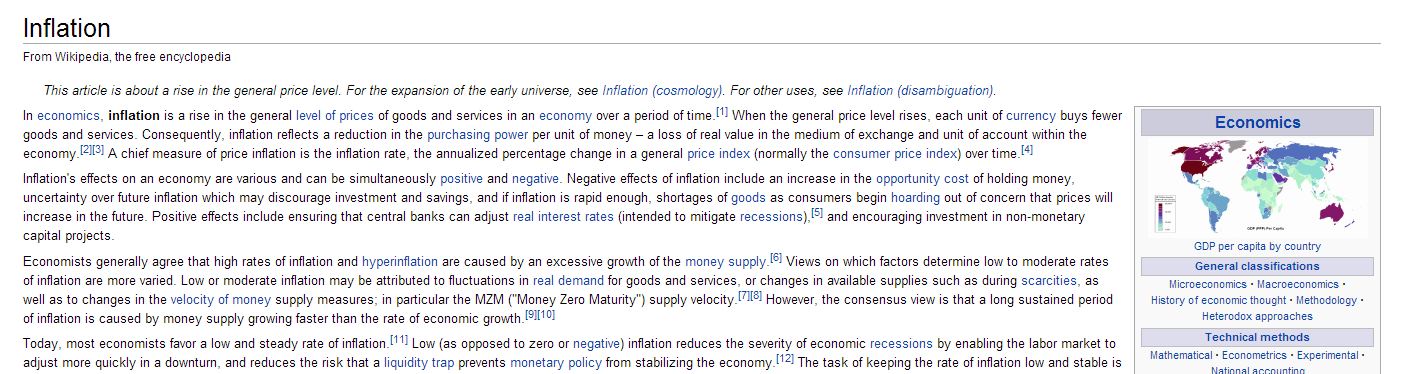
The bankers (may I repeat, the BANKERS) (the ~FINANCIERS~, if you will) in charge at the Minnesota Orchestra might be interested to know that there’s a thing called “inflation.” It even has a Wikipedia page, so you know it’s real.

INFRACKINGFLATION

Inflation. Turns out, it checks out.

Continue reading

15 Comments

Filed under Labor Disputes, Minnesota Orchestra

Huh?

So this is just…weird.

You are now entering a dimension not of sight or of sound but of mind. Seriously, there's no sound. The concerts are canceled.

You are now entering a dimension not of sight or of sound but of mind. (Seriously, there’s no sound. The concerts are canceled.)

First off, the MOA canceled the rest of the season today. (No surprise there; we were all expecting it.) Here’s the truly bizarre press release making the announcement.

Second, the MOA has offered dates to talk with musicians in late May. Absent the introduction of a new variable into the equation, I’m not sure what there is to talk about…but whatever.

Third, they’ve scheduled three new concerts that apparently aren’t Summerfest, but are in the summer. These new concerts have no title (go, marketing team!), so I will quote the MOA’s press release and call it “The Summer Lineup.” In a totally classy move, tickets are $45 apiece, general admission, thereby alienating poor students like me even further. Hip hip hooray; good on you, MOA. (At their concerts, musicians have always made sure there’s a $20 price-point, which is greatly appreciated.)

Continue reading

12 Comments

Filed under Labor Disputes, Minnesota Orchestra

Email Writing Time

Email writing time, guys. The musicians want us to email and/or call Jon Campbell and Richard Davis. Click here for details. So…you should probably do that.

For the record, here’s the email I sent:

Hello Mr. Davis – Mr. Campbell –

If you’ve been following media coverage of the Minnesota Orchestra lockout, you know exactly who I am. My writing on the lockout is read internationally, and has been cited by MPR, the Pioneer Press, and the most widely read blog in the classical music business, Slipped Disc. I unfortunately have not heard back from you, despite repeated requests to talk to you, so I contact you again. It certainly does not speak well for Wells Fargo or US Bancorp that their leaders are so unresponsive to impassioned community outcry.

Alex Ross, the critic at the New Yorker, whose words you used to trumpet on old season brochures, wrote about you the other day… http://www.therestisnoise.com/2013/05/amplification.html He is the most influential music writer in the business, and he does not lightly write something like what he writes below.

“The Minnesota Orchestra, whose musicians have been locked out since the beginning of the season, is veering toward catastrophe. A number of players have departed for other ensembles; the orchestra’s use of state funds has raised serious questions and is under review; powerful board members have created a fearful atmosphere; and, as Graydon Royce reports, Osmo Vänskä, Minnesota’s brilliant music director, is threatening to resign if the situation is not resolved soon. In his latest piece, Royce alludes to a column I wrote in 2010, in which I said, “For the duration of the evening of March 1st, the Minnesota Orchestra sounded, to my ears, like the greatest orchestra in the world.” The idea was not to issue a hard-and-fast superlative but to undercut the entire business of ranking orchestras. Still, I stand by the statement, at least as far as the musicians themselves are concerned. As for the board and the management, I am tempted to apply a superlative of a quite different kind. I’ll simply say this: do the board and management actually wish to destroy the Minnesota Orchestra? So far, their actions seem to be moving steadily toward that end.”

Until you demonstrate a renewed commitment to dialogue with both musicians and patrons, I will continue to share Mr. Ross’s views. As you are no doubt aware, not a single person in the music business supports your position. A counter-proposal is not and never has been necessary for negotiations; indeed, in November, independent industry expert Drew McManus called your insistence upon a counterproposal a “trap.” Other orchestras with more dire financial problems have agreed to submit to binding arbitration. I’d hope you’d never make a major investment, as you are asking the musicians to do, without knowing how the board and staff of the companies you invest in performs in comparison to other boards and staff (especially if said board and staff were simultaneously and independently being investigated by the state legislature for potential mis-use of funds). And despite what you have heard, the musicians are not going to cave any time soon. And even if they eventually do, by that time, there will be so many vacancies, it will take literally years to hire replacements…and good luck hiring any subs with the pay you’ve proposed. The orchestra will be comatose and paralyzed, if not liquidated altogether. This is not the teachers’ union, and you are not Scott Walker. Today you face two options: stepping away and letting others try for even a little while, or driving the orchestra – Minnesota’s orchestra – over a cliff. There are no alternatives.

If you destroy the Minnesota Orchestra, I can promise you, as a historian, that it will be a legacy that will long outlast any donations you made to the lobby. This community – in fact, this country – will never forget your names, or what happened on your watch. There would be absolutely no harm in stepping aside…or at the very very least, soliciting ideas from others about how to proceed. I urge you to consider doing so.

Emily E Hogstad

Well, that was therapeutic.

So. Write Richard Davis and Jon Campbell. They won’t reply to you, but it will feel good. Share your emails in the comment section as an inspiration to others. And if you call Davis or Campbell, do let me know who you hear from, and what you said, and what their secretaries said to you in return. Remember, be firm, but be polite. We don’t want to stoop down to other people’s level…no matter how angry we are. Best wishes in your activism…

7 Comments

Filed under Labor Disputes, Minnesota Orchestra

Review: Minnesota Orchestra Musicians, Bruckner and Mozart

Once upon a time, Minneapolis had an orchestra, and it was recognized as one of the greatest in the world. On the strength of its artistry, $100 million were raised to support it in the depths of the Great Recession. Half of that money went to support new artistic initiatives and the endowment, now the fourth largest in America…larger than New York’s and Los Angeles’s. The rest went to a huge new lobby of glass and stone, currently nearing completion on the south end of Nicollet Mall. It will be finished by early July.

But there will be no orchestra to open Orchestra Hall. Last October, three men – two banking executives on the Minnesota Orchestral Association board of directors and one spectacularly inept orchestra manager from Bournemouth – slipped the Minnesota Orchestra a potent sleeping potion in the form of a lockout. The MOA has not presented an orchestral concert since late July, and they will not be presenting any this July, either. Even after seven months of not paying musicians’ salaries or benefits, they claim they don’t have the money to present concerts…and it’s simply too expensive to play and talk, CEO Michael Henson explains. Mr. Henson continues to receive around $400,000 a year in compensation, the orchestra manager who doesn’t actually manage an orchestra. He makes a perplexing bedraggled picture, pleading poverty while wearing a yellow vest and hard hat and showing off his fifty million dollar lobby. The state of Minnesota is currently investigating the MOA’s finances. Things in Minneapolis have gotten so bad that a quarter of the orchestra’s seats are empty, with more musicians departing every month. There is no end in sight.

Every eight weeks or so, the musicians of the Minnesota Orchestra cook up a short-lived antidote to the potion: they put on a concert of their own. With the help of two of their former music directors, as well as their current conductor, Osmo Vänskä, this season the musicians have put on extraordinary performances of Dvořák, Shostakovich, Bach, Beethoven, and Sibelius. A few weeks ago they announced a late April concert: a program of Mozart and Bruckner, to be conducted by their former music director, eighty-nine-year-old Stanislaw Skrowaczewski. The soloist in the Mozart clarinet concerto would be principal Burt Hara, one of the great orchestral musicians in the world. As always, the tickets sold fast.

A Minnesota Orchestra lockout concert is different from any other orchestra concert you’ve ever been to. They will be sold out, so they will be crowded. The audience will skew young. Everyone present will be an intense, intelligent lover of music. You will find yourself waving across the hall at people you’ve only met once before; they will eagerly wave back to you. You will feel like you’re at a family reunion that has a concert built into it, because the musicians have gotten to know patrons, and the patrons have gotten to know musicians, and the invisible wall at the edge of the stage has crumbled. Turns out we’re no longer just fighting for our musicians; now we’re fighting for our friends, too. You will hear the kind of roaring applause and hoarse screams usually reserved for the debuts of prodigies. You will meet and chat and sit with politicians, multi-millionaires, and occasionally local celebrities, all of whom are disgusted with the action of the board. These concerts will be, simultaneously, the most emotionally taxing and the most emotionally fulfilling experiences you will have as a listener. They will reaffirm your belief about the power and relevancy of orchestral music. And they will give you the strength and inspiration to fight for excellence in all aspects of your life. You will also cry into your pillow once you get home, overcome by the enormity of what you have just experienced.

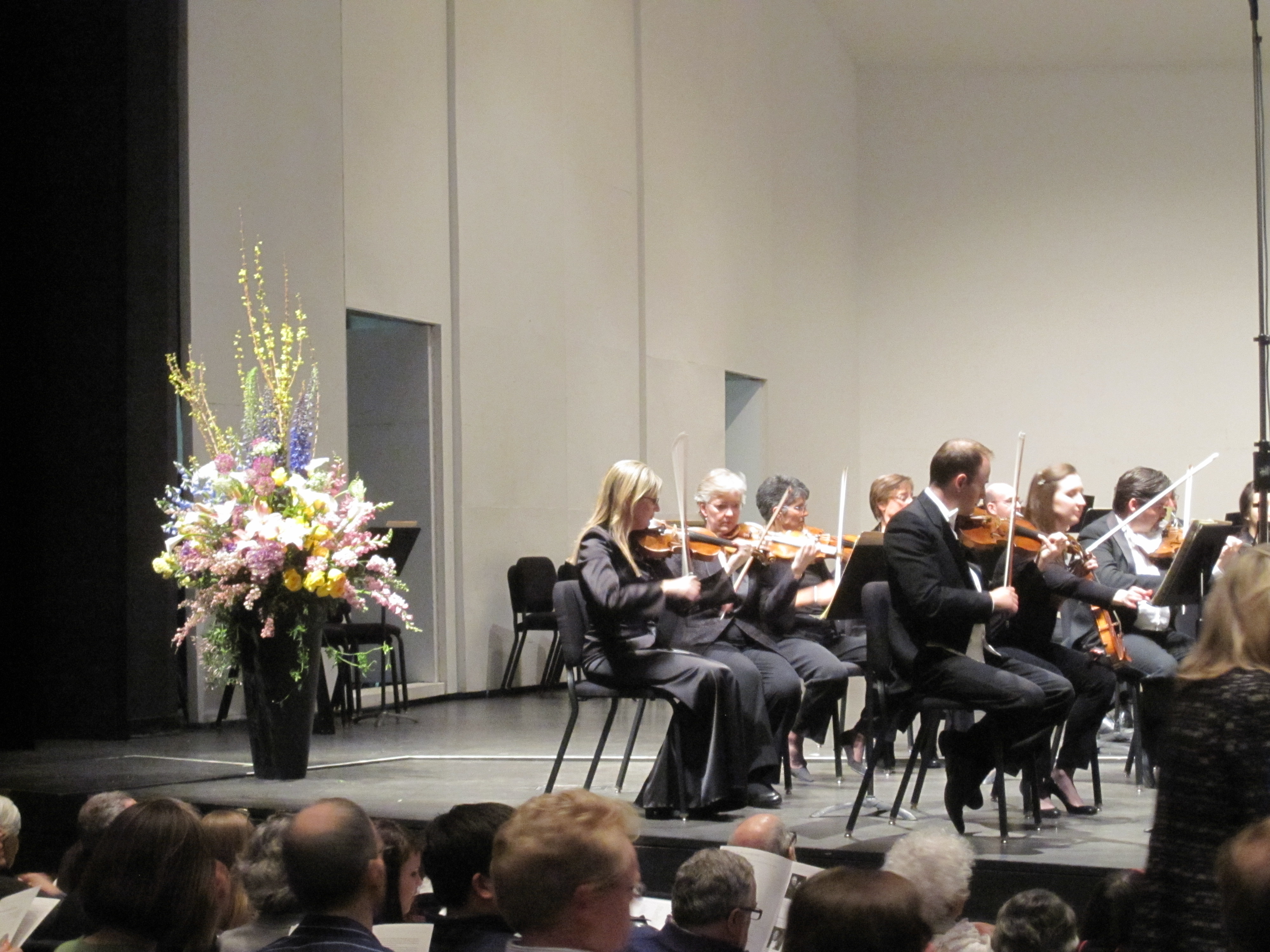
Of course lockout concerts would mean nothing without a passionately engaged audience, and I’m proud to say that the Minnesota Orchestra has the most devoted audience in America…maybe in the world. Behind the first violins stood a eight-foot-tall tower of flowers. I’ve never seen a more beautiful arrangement. Their color and fragrance were all the more beautiful after our long – both literal and metaphorical – winter. They’d been sent with love by a translator from Japan, who has loved the musicians of the Minnesota Orchestra for many years, but who could never bring herself to write to tell them so until the lockout began. Their recordings helped her pull through terrifying health scares and the devastating earthquake of two years ago. Eriko couldn’t be in Minnesota in person, but her pillar of flowers stood like an angel sentry on the corner of the stage. At the time of the concert, she was across the world in Japan, meditating.
IMG_3991

Eriko’s flowers

The musicians received two or three standing ovations before a single note sounded. Skrowaczewski came onstage, eyes sparkling. The Minnesota Orchestral Association will never invite him to conduct again, thanks to his unabashedly heretical pro-musician views, but it is clear he is enjoying playing the role of the rogue. Then out came Burt Hara, our magician of a clarinetist. He has worked at other orchestras over the years, but, thankfully, has always returned to Minnesota. He is the living personification of why we patrons are working so hard to pressure the board to back down from its proposals: Hara could easily get a job anywhere in the world, and whoever would win his seat here would simply never be able to fill his shoes. End of story. Michael Henson has gone on record saying every musician in the orchestra is easily replaceable. Michael Henson has no expletive-ing clue what he’s talking about.

Every phrase of orchestra and clarinetist was a new delight, blossoming like the flowers in Eriko’s arrangement. The variety of tones that Mr. Hara has at his command is nothing short of miraculous. Anyone who can’t tell the difference between a player the caliber of Burt Hara and his theoretical replacement not only has no business running an orchestra, but is ultimately destined for sad and pathetic failure in the field of orchestral management. In case this remark was too subtle for anyone, it’s directed squarely at Jon Campbell, the Wells Fargo vice president who is chair of the Minnesota Orchestra board of directors. Despite being one of the most powerful people on the Minnesota Orchestra board, Jon Campbell never actually goes to Minnesota Orchestra concerts. If you can’t appreciate Burt Hara – and there’s no way you can, if you never go to concerts – then have the simple human decency to step aside and hand your job over to someone who does.

I was still basking in the glow of the Mozart when, after intermission, as the lights were dimming, Mr. Hara came out into the hall. The audience began to applaud him. He grinned and shushed us. “Shh!! Not for me; for them!” he said, motioning toward the stage, and at that, my heart overflowed with admiration. He sat down in the empty seat next to me and smiled. Joyful, invincible energy radiated from his very pores.

After intermission, as has become tradition, violist Sam Bergman stepped up to the edge of the stage. By now the whole locked out audience knows what that means: a barnburner of a speech is at hand. And although all of Sam’s speeches have been extraordinary, this one was especially so…and the audience’s impassioned reactions said as much as Mr. Bergman.

He said, “It has now been almost seven months since the corporate managers of the Minnesota Orchestral Association decided that the best way to move this orchestra forward into a successful future was to lock out its musicians, set a non-negotiable annual budget that would be dwarfed by all of our peers, and demand an array of cuts the likes of which have never before been seen at any major American orchestra. Under their plan, the base salary of a Minnesota Orchestra musician would plummet, overnight, to a figure that, adjusted for inflation, equates to what our predecessors were making in 1983.”

The audience gasped.

“Under their plan, untold numbers of public orchestral concerts would be scrapped and replaced with musicians being farmed out to play private corporate rental events at Orchestra Hall.”

Cries: actual moans of shock and pain. It was as if someone had stabbed all two thousand audience members at once.

“Under their plan, the final authority on the hiring of new musicians for our orchestra would be stripped away from our Music Director, and given instead to the corporate management team.”

Another indignant communal cry. People actually began to weep in horror. I closed my eyes, tight. I knew this was the board’s plan, and I’ve known it for a long time, but to hear so many music lovers react to it so viscerally was nightmarish.

Although the news was grim, Sam’s speech ended on a note of desperate optimism. “Together,” he promised, “we will make our collective voice heard; together, we will reset the priorities of this sadly drifting organization; together, we will ensure that our audience will never again be marginalized and ignored; together, we will do away with the cynicism and ideology that has led us to this precipice; and together, we will move this orchestra forward into a truly artistically sustainable future.”

Together. Yes.

In this context, Bruckner suddenly meant something. (In this context, anything means something.) As fate would have it, almost a year ago to the day, I’d written a rather…controversial blog entry called “I Hate Bruckner, Part I.” Clearly Fate has a sense of irony that puts Stephen Colbert to shame. You say you hate Bruckner?, Fate says. Well, then, how about for your first live Bruckner experience, I snag you a legendary Bruckner conductor, sprinkle dozens of friends onstage and in the audience, and top it all off with the orchestra The New Yorker has labeled the greatest in the world. That’ll be a good introduction to Bruckner. Oh, and also, by the way, said orchestra is facing imminent dismemberment, if not outright dissolution. So enjoy!

It was a lot to swallow. But lucky for me, I wasn’t setting out on my first live Bruckner journey alone. I just happened to have beside me one of the world’s great orchestral musicians, who knew the piece inside and out, and who would teach me how to approach it. He swayed gently to the sounds, nodded before each woodwind entry, breathed in and out with every phrase. Through his body language, he showed me what to listen for. Big swaths of sound that had once been a meaningless brick wall took on a shape and direction: a narrative. He wasn’t doing this to teach me. He was moving with the music because he could no more stop the flow of music through him than I could stop breathing. I was just lucky enough to sit beside him to witness it.

At the first solemn horn call of Bruckner 4, my horizons began to broaden, and the appeal of the music slowly dawned. Time and space simply – disappeared. At every repetition of every phrase, the musicians clawed at every note as if their very careers depended on it…and maybe they did. The seats rumbled with each massive fanfare.

The graceful old man gestured on the podium, drawing out the magnificent sound from his mind’s ear.

The massive tower of flowers stood guard.

As time drifted on I was unsure if we had been in the hall an hour…or twenty-four hours…or twenty-four years. We fell into a collective trance. How long had the lockout gone on? Was there even a lockout? Surely not… All two thousand of us were swept away in the music and looking out over a cliff together – out at an ocean, perhaps. Or maybe we were on the top of a mountain, landscape spread far to the horizon. But as Sam had said, we were together…and surely, to be all together in our dark night in that dark hall…surely that means something? For as long as this lasts, we won’t be alone. Giant chords shifted beneath our feet and resolved in strange and glorious ways. A strange irrational peace descended upon me, the kind that comes when I recite well-worn phrases from my wrinkled Book of Common Prayer. Stan raised his arms, a prophet in the bright stage lights. Suddenly the past and future meant nothing; there was only the power of the present. This is transcendence.

The integrity of Stan – the generosity of Eriko – the eloquence of Sam – the passion of Burt – the courage of the Minnesota Orchestra musicians to sacrifice their very livelihoods in an attempt to preserve their beloved institution from decimation – the buzzing energy of the agitated Minneapolis music scene – and most of all, the untrammeled power of live orchestral music. You would be unwise to bet against.any of these things, let alone all of them at once. They may be under fierce assault, but I swear to God that Minnesota will not rest until all those things are celebrated as they deserve to be. Silence may win in the short term. But in the end, you will not deny the power of this music, nor the power and professionalism of these musicians. Our story is not over yet. This city will keep fighting until the very bitter end to find our musical happily ever after…no matter how many barriers the management of the Minnesota Orchestra sees fit to put in our way in the meantime.

There was a long silence after the earth-shattering final chords were struck. We all could read one another’s mind: this moment is too sacred to end. Then, gingerly, we began to applaud, gradually getting louder and louder, until the hall was a roiling sea of applause. The orchestra received such a long ovation that, in order to make it stop, the musicians had to leave the stage.


27 Comments

Filed under Labor Disputes, Minnesota Orchestra, Reviews

Balancing the Scales

Hey, remember my article on ratios between endowment size and base salary? The MOA has acknowledged its conclusions!

Well, sort of.

The MOA recently sent out an email poetically entitled “What does it take to balance the scales?

What does it take to balance the scales? You tell me.

The vivid imagery of the subject line makes me want to write a haiku! “What does it take to / balance the MOA scales / sustain’bility”

The email is just the MOA’s latest attempt to bring the public round to their point of view. (Alas, the PR firm they’re paying $50,000 a year to has to earn its keep somehow.) If you’re a musician supporter and have blood pressure problems, just ignore it; it’s chockablock with misleading facts and figures, contains nothing new, and in general is just not worth your bitter impotent rage. I could address it point by point, and maybe eventually I will, but honestly I’m only one woman, I’m sick, and I’ve got better crap to do. If you have any specific questions about any of the claims, feel free to ask, and I’ll happily answer.

But there is one fascinating point that I wanted to bring to y’all’s attention…

Continue reading

5 Comments

Filed under Labor Disputes, Minnesota Orchestra