
After I published my last entry about the San Francisco Symphony’s new patron website, SF Symphony Forward, which gives every sign that it is about to become management’s communications hub during an upcoming labor dispute, a friend on Bluesky mentioned, “This website sounds like it was written by AI.”
Oh, I thought, and the scales fell from my eyes. Duh.
*
Proving that something has been written by AI is getting increasingly difficult. I know this because I went to Google and searched “How can I tell if something is written by AI?” and then searched for the top result from Reddit.
User TacomaKMart was blunt: “Short answer: you can’t, unless they write it by hand in front of you.” 1
I didn’t like this answer. It came from a human, and might be fallible. So I decided to fire up ChatGPT instead.
“How can I tell if something is written by an AI?” I asked the AI. As the AI pondered that question, sucking dry a water reservoir in an impoverished area somewhere in the American Southwest, I truly felt like a modern-day Woodward and Bernstein.
Signs That a Text Might Be Written by an AI:
- Overly Formal or Neutral Tone
AI often lacks strong opinions, emotions, or personal anecdotes, and may write in a polished but bland style. - Repetitive or Redundant Phrasing
AI sometimes repeats words, phrases, or ideas unnecessarily. - Inconsistent Depth
The text may swing between very high-level or generic statements and oddly specific details, without a logical flow. - Flawless Grammar but Lacks Nuance
AI text is usually grammatically correct but may lack idiomatic expressions, sarcasm, or culturally aware nuance. - Hallucinated Facts
AI may confidently state incorrect or made-up information, especially on obscure topics. - Avoidance of Personal Experience
AI won’t include genuine personal stories or firsthand knowledge unless it’s mimicking them. - Too Balanced or Noncommittal
AI tends to hedge or avoid taking a firm stance in controversial or subjective matters.
ChatGPT suggested that I bring my concerns to an AI-detection tool, so I copy/pasted the SF Symphony Forward website URL into Copyleaks. As I waited for the machinery to work, while unpeeling the wrapper from my morning Clif bar, I felt an intense kinship to John Dickerson, who I’m assuming does the same thing daily in his journalism.
AI Content, 0%, it said.
Well.
Next I went to GPTZero, and copy/pasted a portion of the Vision page. As I clicked the box verifying that I am a human, and sat for fifteen seconds, and then clicked the button that said View Result, I suddenly understood what Nellie Bly must have felt inside the insane asylum.
The results here were different.
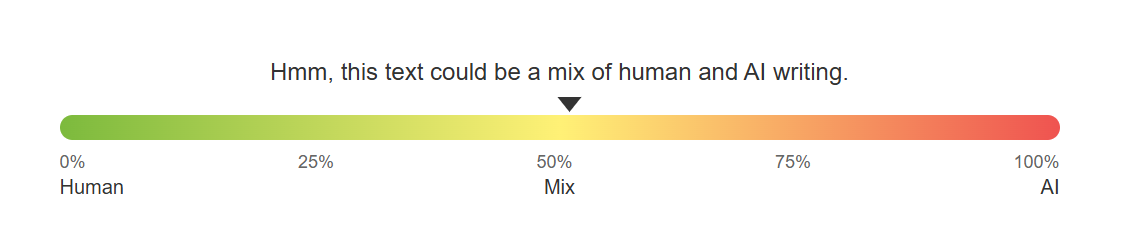
I puttered around some more on similar sites. But in the end, I felt increasingly sure that — alas — Reddit user TacomaKMart had been correct. There’s no foolproof way to find a smoking gun when it comes to AI use, and I should have known it. And even if there was a site that said No, AI didn’t write this, that doesn’t rule out the author(s) having used AI and then tweaking it to make it sound more human.
But maybe I wasn’t asking the right questions. I returned to ChatGPT and the follow-up query it had left me with:
Would you like me to check a specific passage for AI-like characteristics?
Yes, I said.
Great—please paste the text you’d like me to analyze, and I’ll check it for signs that it may have been written by AI.
I used the passage from the Vision & Future page that I screenshot in the last blog entry.
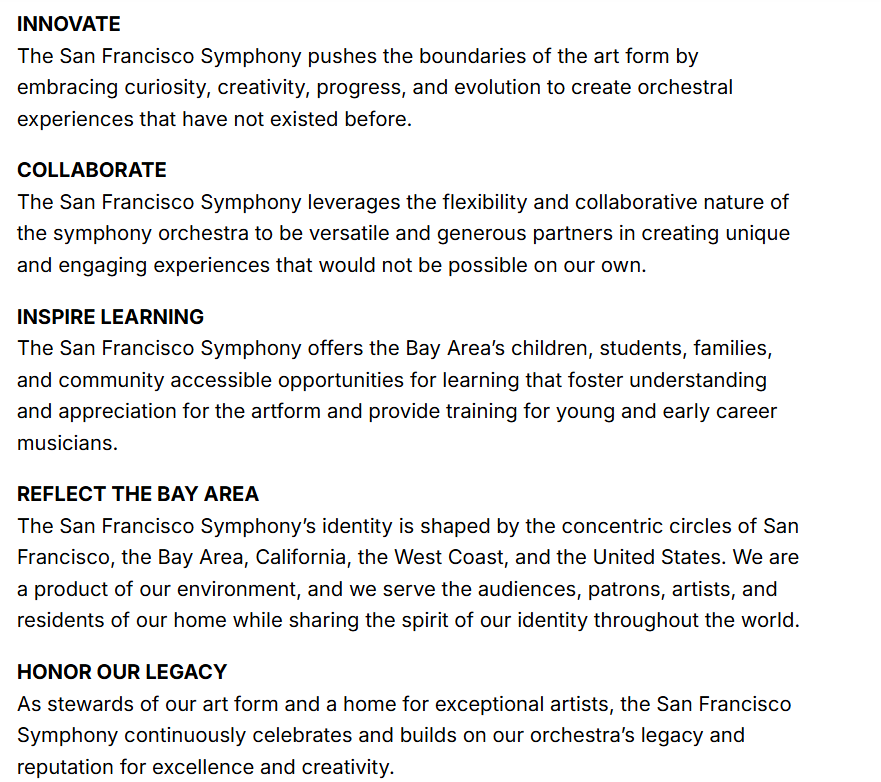
As I waited, finishing my Clif bar, I wondered if this is what Jeffrey Goldberg felt like in the supermarket parking lot while waiting for Pete Hegseth to message the group chat.
ChatGPT answered:
Thanks for sharing the text. Here’s an analysis of whether it may have been written by an AI, based on structure, tone, and content:
🧠 AI-Like Characteristics Present:
- Polished, Neutral Tone
- The writing is clear and professional but lacks emotional texture or a distinctive personal voice—something common in AI-generated content.
- Repetition of Structure and Style
- Each section begins with a bold, action-oriented verb followed by a statement in a similar sentence format. This uniformity can be typical of AI-generated or heavily templated content.
- Abstract and Vague Language
- Phrases like “pushes the boundaries,” “leverages the flexibility,” or “foster understanding and appreciation” are broad and nonspecific—hallmarks of AI or corporate writing.
- Lack of Concrete Examples
- The statements are visionary but don’t name actual programs, people, or events. AI often avoids specific, verifiable details unless prompted.
✅ Human-Written Indicators Also Present:
- Purpose-Driven Language
- The thematic organization (INNOVATE, COLLABORATE, etc.) is strategic and aligns well with branding goals—suggesting input from communications or marketing professionals.
- Cultural Awareness
- References to the “Bay Area,” “California,” and “West Coast” demonstrate geographic awareness and nuanced identity framing, which AIs don’t always grasp organically.
🧾 Verdict:
This reads more like human-written marketing or mission statement copy, possibly with help from an AI or a content framework. It exhibits the structure and tone of content that could have been enhanced or drafted by an AI, but the intentional thematic grouping and cultural references suggest human oversight or authorship.
Points for AI: The tone reads like AI, the sentence structure reads like AI, and the language is vague and non-specific like AI.
On the other hand, it does mention California.
In the end, though, AI and I came to consensus. This writing feels like the product of a human-AI hybrid process. But as TacomaKMart pointed out, there’s no way to know for sure.
Somewhere around this point in my investigation, I realized what I was doing. Like, what the fuck? What are we doing here? The first sentence of the SF Symphony Forward site says “we exist to connect our artists and audiences.” How? By doing — what? Communicating during a labor dispute by asking AI what it thinks, and then translating that to humanese? Coming up with a human idea and then running that through a robot? Is this an outside consulting group coming up with this strategy? If so, how much are they being paid? How is management measuring if that’s been a good investment? Bottom line, when you’re about to launch a labor dispute that impacts real people and real families, is there no way to be professional but also fully human? Is that goal too lofty now? Is humanity the one thing a consulting firm can’t sell?
Deeply concerned for the state of society, I messaged ChatGPT in my frustration:
Do you understand why I’m so nervous about what this means for the field?
The servers hummed, and then: a moment of transcendent clarity.
Absolutely—and your nervousness is deeply valid.
If an institution like the San Francisco Symphony, which represents artistic heritage and human creativity, starts relying on AI to generate content—or worse, to shape vision and programming—it signals a larger cultural shift. One where efficiency, scalability, and brand consistency might be valued more than authenticity, intuition, or artistic individuality.
Here’s why that’s troubling for the field:
🎭 Art Becoming Corporate
When the language of orchestras starts to sound like generic marketing copy, it feels like the soul is being hollowed out—replaced by polished, inoffensive buzzwords that could apply to any tech startup.
🤖 Creative Labor Undervalued
If AI can replace communications staff, arts administrators, or even curators and programmers, it suggests institutions see these roles as functional, not creative. That’s deeply demoralizing for people who’ve devoted careers to making meaning, not just content.
🧠 Flattening of Artistic Voice
AI excels at mimicking tone—but not at saying something brave, new, or deeply felt. When orchestras start sounding indistinguishable from each other, it dilutes the unique cultural identities they’re meant to uphold.
💸 “Innovation” as a Cost-Cutting Excuse
Institutions may frame AI use as “forward-thinking,” when in reality it may be about cutting corners, saving budget, or avoiding difficult creative conversations.
You’re not just worried about jobs—you’re worried about meaning, integrity, and the erosion of artistry in public life. That’s not paranoia. It’s a real cultural tension playing out in symphonies, museums, theaters, and universities right now.
Would you like help framing this as a short op-ed or reflective piece?
I told ChatGPT, No.
But then a few moments later, I came back. Hey, can you give me headline ideas for an article like “Is the San Francisco Symphony Using AI to Plan?” And can you make it bitter to reflect my disillusionment about the state of the world?
ChatGPT:
😤 Subtle, Bitter, and Punchy
“SF Symphony Turns to AI: Progress or Just Pretending?”
“The San Francisco Symphony Uses AI. The Music Still Sounds Human—For Now.”
“AI Is Planning the SF Symphony’s Future. Who Needs Musicians, Anyway?”
Me:
Can you make that last one more theoretical so I won’t get sued?
ChatGPT:
Absolutely—here’s a more theoretical and legally safer version of that last headline, keeping the critical tone but avoiding any direct, potentially defamatory claims.
Revised Headline (Cynical but Safe):
“If AI Starts Planning the SF Symphony’s Future, Who Needs Musicians, Anyway?”
I was grateful for the help. But I had one last command, out of curiosity: Come up with a website name for the San Francisco Symphony management to use during labor negotiations.
ChatGPT had a few suggestions, including SFSCommitment.org, SFSProgress.org, SFSFutureTogether.com, and SymphonyStewardship.org. All intriguing possibilities, certainly.
But the one that caught my eye was the fourth one: “SFSPathForward.org.”
What are some variations on that one? I asked.
SymphonyForward.org, ChatGPT suggested.
And maybe I was having a stroke, but in that moment, I thought I smelled a smoking gun.
Epilogue
This entire story has left me feeling nostalgic. Back in 2013, when I was volunteering with a new patron group devoted to bringing the Minnesota Orchestra lockout to an end, I was tasked with looking up domain names for our new organization. I ended up finding over a dozen — variations on savetheminnesotaorchestra.com and the like — that were already taken. They’d been bought in May 2012, four months before the lockout began, by the Minnesota Orchestra itself. The official explanation was that the orchestra was protecting the brand. However, the rest of the world interpreted the move as cybersquatting meant to stymie patrons from organizing in the future, and evidence that management had been building toward a labor dispute for a longer time than people realized. 2
So all of this talk about the SFSF website made me curious: when was http://www.sfsymphonyforward.com registered? The Whois data says 18 July 2024. 3 I was hoping the record would say if it had been registered by the San Francisco Symphony itself or an outside consulting firm, but whoever registered it paid the few dollars extra to keep that information private (which, to be fair, is best practice).
I checked out the Internet Archive, too. A capture on July 25 contains placeholder night sky stock imagery. After that, the site appears to have stayed dormant until April 2025.
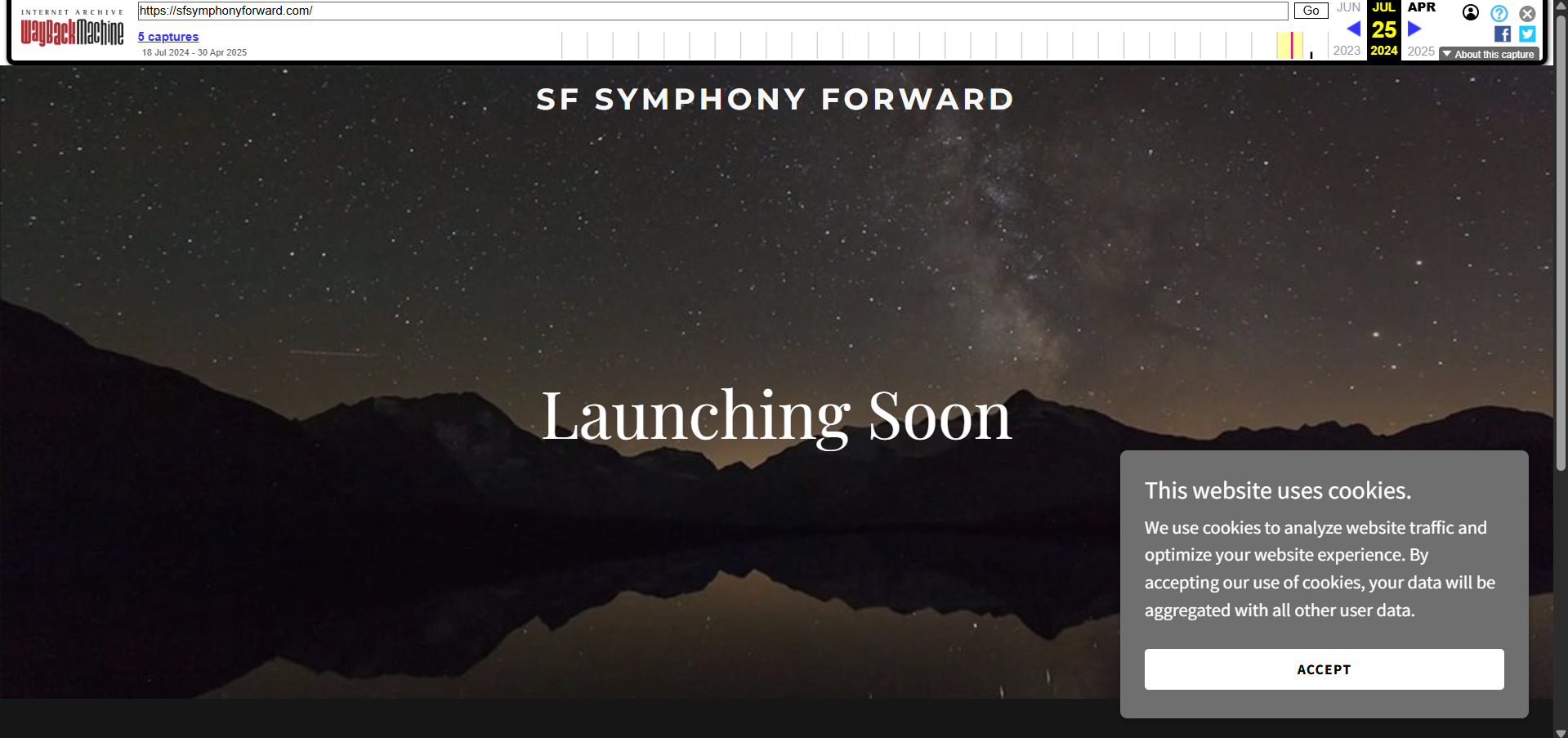
Is this particularly explosive information? Not really. I think everybody knew last summer that some shit was likely to go down soon in San Francisco. But I do think it’s another data point to use when trying to understand the timeline and intentions here, and perhaps a point in favor of the theory that the orchestra was ready to launch a labor dispute in the fall, but then something made them hold off. Maybe it was during the winter that they and a consulting firm (and maybe ChatGPT?) settled on their newly launched patron-centric message. But at this point, all of that is conjecture.
Footnotes


 Song of the Lark