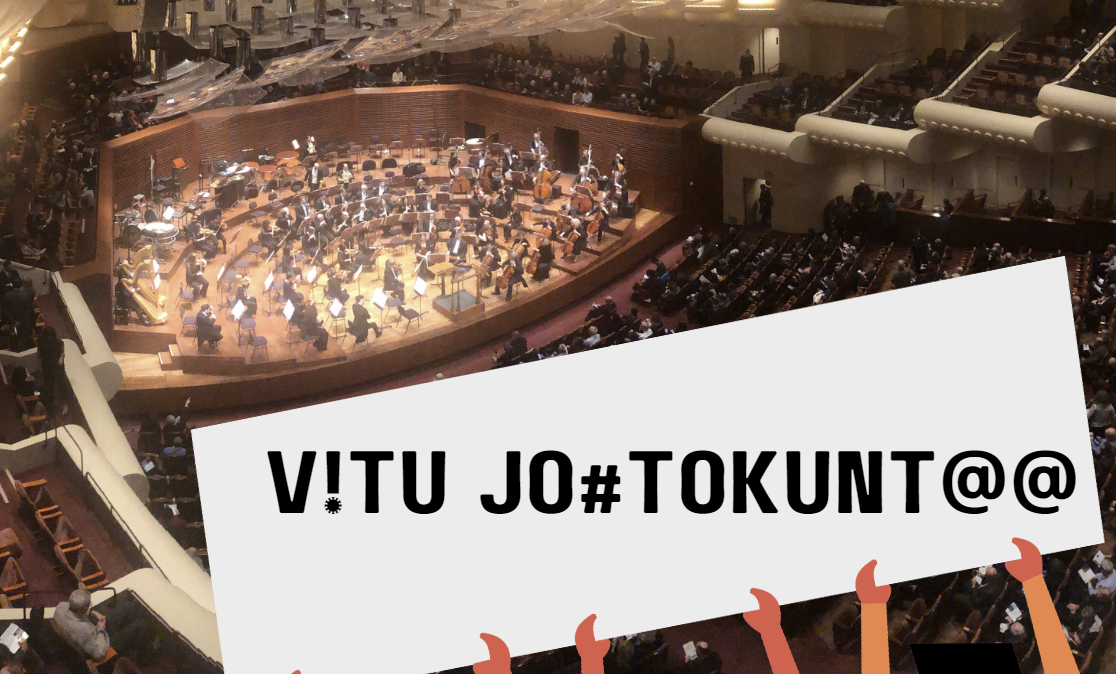
There has been a seismic development in the ongoing San Francisco Symphony saga. A patron named Laura Leibowitz went to a concert this June and held up a sign during an applause break.
Amid growing public outrage over the Board of Governors’ failure to retain the acclaimed Finnish conductor [Esa-Pekka Salonen] beyond his five-year contract ending after the 2024-25 season, audience member Laura Leibowitz displayed a sign during the June 21 performance that read “F— the board” in Salonen’s native language. An image of her with the sign went viral on social media, increasing scrutiny of the organization’s direction and finances, prompting the organization to threaten a ban of Leibowitz in Davies Symphony Hall.
Fortunately, the orchestra’s senior director of operations immediately leapt into action, writing in a letter to Leibowitz, “Should this conduct occur again, you will be subject to further disciplinary action, up to and including removal from Davies Symphony Hall and/or suspension of privileges to enter and attend activities of the San Francisco Symphony.”
Leibowitz told the Chronicle that “a ban would be devastating, as she considers the local classical music community like family. She has reached out to the ACLU to consult her rights and is considering her next move.”
Leibowitz has been a regular concertgoer at the orchestra since 1991.
Obviously, there are many lessons to take away from this violent attack on our social and symphonic mores. I thought I’d break a few of them down.
Signs are the number one threat to an orchestra’s financial sustainability. Signs are widely recognized as a gateway drug to banners, which in turn is a gateway drug to organized applause-break chants. When one angry audience member sees another angry audience member indulging in the immoral behavior, the contagion spreads. And what happens if these loud lost souls move on to even harder drugs, such as the alcohol available in the lobby? This is a slippery slope. Every time an obscene Finnish sign is raised, the San Francisco Symphony’s accumulated deficit climbs by another million dollars. We are lucky that someone intervened when they did.
Women who have been attending the symphony since 1991 are the best demographic to alienate and antagonize. The more loyal the customer, the more urgent a matter it is to ban them from your business’s premises. All for-profit corporations know this, and it’s time we start running our non-profits more like for-profits. There is an old saying in the world of business: “The customer is always wrong.” Only the stupidest businessmen do not understand this.
The timeline of this particular audience rebellion is working in management’s favor. This was not Esa-Pekka Salonen’s final bow. He still has a year left to serve as music director. And the musicians’ contract doesn’t expire until November. So even if a multi-month strike or lockout happens and knocks out the back half of Salonen’s final season, this board versus patron conflict is going to keep escalating for four more months. Fortunately, during that time, audiences definitely won’t start connecting with each other, planning additional direct actions, brandishing dozens of signs at once, or reading and writing editorials and inflammatory blog entries. There is no precedent for that in American orchestral history.
It is totally normal for orchestra patrons to contact the ACLU about interactions they’ve had with an orchestra’s management. In fact, all responsibly-governed orchestras have an entire subset of patrons and subscribers who are constantly in talks with the ACLU. Truly, a long-time patron invoking the ACLU is a (and I hate to use this word, but…) sign that the orchestra is doing everything right. People in the industry know that every world-class orchestra’s tour to Carnegie Hall kicks off with a minimum of ten patrons complaining to the press that their civil liberties have been violated.
The San Francisco Symphony needs to keep writing threatening letters to patrons who will then immediately take those letters to the press, thereby publicizing them even more, giving other patrons ideas, and cementing the public press narrative of PR-Challenged Out-of-Touch Upper Management vs. Pissed Off Patrons. This is productive! It is a wise use of staff time and resources, and speaks well about the priorities within the organization. It will not make San Francisco Symphony employees’ working lives even more miserable than they already must be.
It is long past time for orchestras to start keeping a database of concertgoers (with mugshots). Fortunately for the San Francisco Symphony, it is located in Silicon Valley. So I think there could be a productive partnership to be struck here between the orchestra board and a tech company to create some kind of facial recognition database that could better track the identities and whereabouts of these sick sign perverts. Perhaps that database could even be monetized in some way, or the information scraped to train AI with. This could be an exciting cutting-edge partnership that will lure in future donors, thereby engorging the Silicon Valley donation pipeline, since (as we all remember) Salonen couldn’t get that particular job done in four years, two of which happened during a pandemic.
Fellow audience members should warn the orchestra administration if they witness — or even hear rumors about — other audience members partaking in crafts. Perhaps a hotline could be set up to report the subversives. Public service announcements discussing the dangers of permanent markers and cardstock could be made. To underline the gravity of the situation, letters in blue envelopes with the San Francisco Symphony’s seal on them could be sent to these people to let them know that they’re under investigation. Perhaps lie detectors have a role to play here. There are no bad ideas when you’re brainstorming.
Three words: cameras in bathrooms. Extreme? Perhaps. Necessary? Yes. Hall restrooms are prime spaces in which deviant activities (such as sign assemblage) can happen. The higher-ups must monitor the goings-on. (An auxiliary benefit to monitored bathrooms would be that upper management could see who has been using too much toilet paper, which will help push the San Francisco Symphony to both financial- and eco- sustainability. We in the orchestra industry call that a win-win!)
Moving forward, every San Francisco Symphony patron must undergo a full body search before entering the concert hall. Now, this may sound extreme, but remember: we live in a post-Signgate world. Paper is more insidious than a firearm, because paper cannot be found by metal detectors. Paper is a flat substance, and, terrifyingly, can be folded. Music lovers must demand safety. If elderly volunteer ushers have to strip search us so that we can hear Mahler 3 live, then that’s the price we must pay. Great art requires great sacrifice.
Orchestras would benefit from maintaining their own paramilitary forces. Think about it. What happens if Laura Leibowitz fails to obey authority, even after being warned in a sternly worded letter that she faces a San Francisco Symphony ban? If she dares to enter and raise a second obscene Finnish sign, what is stopping her from attending a third time for, say, Bruckner’s seventh symphony (besides Bruckner’s seventh symphony)? No, she must face consequences. Of course, there’s a big problem here: the orchestra as it exists today does not have the manpower to make good on their warnings. Who is going to take Liebowitz into custody if she doesn’t comply? If I may borrow an apocryphal quote from Andrew Jackson, “The San Francisco Symphony has made its decision. Now let it enforce it.” What better way to solve this issue besides maintaining a standing army of mercenary fighters headquartered in the box office (this area could also serve as a detainment facility)? I live in hope: I believe that law enforcement can be trained so that Ms. Leibowitz can be removed from the premises without distracting other concertgoers. Her removal could be planned to coincide with brass fanfares.
Fortunately, there is absolutely nothing else going on right now at the San Francisco Symphony that requires management’s attention. By my count, the only problems are a music director abandoning ship, a stalled search for a new music director, an ongoing audience mutiny, an expiring musicians’ contract, a rapidly worsening PR crisis, and crippling amounts of debt. The orchestra is extremely lucky to have time to give this truly terrifying incident the attention it deserves.
I’ve been writing about orchestras for about fifteen years now, and people from Wisconsin are great writers, so I took the liberty of tossing together a few sentences that the SFS management is welcome to use or adapt when they announce the new regulations.
The executive order that the orchestra president will sign will expand security investigations to all levels of balconies, facilitating the coordination of the efforts among various departments, including the Ushers Unit, the Toilet Paper Usage Investigation Committee, and the SFS Sign Deviants Unit. Those accused and investigated will be judged based on their trustworthiness and whether they are able to commit donations that would leave them susceptible to coercion. These are people the rest of us consider sad, sick, even pathetic. Note that an investigation about concealed signage may be commenced based on the accusation of a fellow audience member, even if the fellow audience member prefers to remain anonymous. One of my friends said the other day, why worry about those individuals? You don’t claim they’re all pro-Salonen, do you? The answer is obviously no. Some of them are very energetic, very loyal patrons. Some of them have that unusual affliction through no fault of their own. We’re not disturbed about them because of their morals. We’re disturbed about them because they are dangerous to this concert hall. Thank you. God bless you. And may God bless the San Francisco Symphony.
*
Proposed orchestral soundtrack for the background music to the speech:
Yesterday the San Francisco Chronicle ran an article headlined “How will S.F. Symphony navigate through crisis? Its leaders discuss the future in first interview.”
The authors spoke with Chief Executive Matthew Spivey and Board President Priscilla Geeslin. Awkwardly, only the ghost of music director Esa-Pekka Salonen was present.
The San Francisco Symphony finds itself at a turning point. Along with the New York Philharmonic and St. Paul Chamber Orchestra, they are in the middle of musician/management negotiations. San Francisco’s contract expires in late November. They also recently got word they’re losing their music director Esa-Pekka Salonen, who announced back in March (in his own separately released statement, no less) that he would not be renewing his contract due to fundamental disagreements with the orchestra’s board of directors. The official management response to the loss of one of the most sought-after music directors in the world has been a resounding “meh.” Patrons are crying about it. Now the orchestra is steaming full speed ahead toward triple icebergs: leadership loss, a potential work stoppage, and financial crisis.
Before we start, here’s my personal theory of the case:
The San Francisco Symphony is dealing with two separate problems. (The word “problem” is underselling it. They’re crises, really.) The two are entangled, but they’re fundamentally separate.
The First Problem is whatever happened to them financially between 2010 and 2024.
The Second Problem is, there’s a leadership problem. There’s a communications problem. There’s a values problem. There’s a respect problem.
Everything else I’ll ever have to say about this leadership team will be colored by that assumption: that there is a money problem, and then, apart from that, a vision problem.
With that out of the way, let’s dive in and read some tea leaves.
The San Francisco Symphony has experienced a tumultuous period since Music Director Esa-Pekka Salonen announced his decision not to renew his five-year contract.
“I do not share the same goals for the future of the institution as the Board of Governors does,” Salonen offered as the impetus for stepping down from the role after the 2024-25 season in a statement released on March 14.
Since then, it has come to light that the 113-year-old orchestra has struggled with budget deficits for more than a decade, with the 2022-23 season expenses at $78.6 million and revenue only at $67.4 million.
Okay. So. Temporarily bypassing the whole pushing-your-music-director-until-he-goes-overboard bit… Numbers. Budgets. Timelines. Deficits. These are facts. These are verifiable. These are the building blocks to creating a shared reality: the first step to solving the First Problem.
By the way, if you want to dig into the First Problem, you should! To entice you, here’s as brief a summary as I can muster, conveniently formatted in one long run-on paragraph so the normal people can skip it.
The San Francisco Symphony maintains an invaluable online archive of 990s and audited financial reports. For context, this is much more information than American orchestras traditionally provide to patrons on their websites. However, in this particular context, where we need to assemble a timeline of the past decade-plus to fact-check claims, it’s a double-edged sword: yes, it’s a lot of information, but also…it’s a lot of information. Many geological epochs ago, I wrote a lot about my hometown band, the Minnesota Orchestra; I return to their example a lot. They provide an annual year-in-review report that includes mission highlights and simplified financials. (Sample here.) By contrast, the SFS separates those two things in their reporting. They have a Season Review / Impact Report about their artistic accomplishments, but that document doesn’t include any financials, so you have to rely on 990s and financial reports for numbers. The SFS’s 990s and dense financial reports can be tough for a normal person to extract meaningful information from, but yesterday afternoon I tried my best. Check out the sixth page of the audited financial statement for what seemed to me to be the best overall summary of what’s going on. The 2023 financial report records “total revenues and releases” of $89,416,000 and “total expenses” of $83,179,000. Now obviously a non-profit orchestra is not making $6 million in profit annually. It just looks that way because of the comparatively complicated way that the SFS has chosen to summarize its finances for laypeople. Back in March, Janos Gareben at the San Francisco Classical Voice actually tried digging into this and even contacted the orchestra to get some clarification. A SFS spokesperson told him that “the $144.9 million shown on the [990 form for fiscal year 2022] includes ‘realized’ gains from investments but does not include ‘unrealized’ gains or losses.” Still, it appears that Gareben wasn’t able to completely untangle the numbers, either, as his ultimate conclusion about them was “Fiscal year 2021 showed revenues of $66 million against expenses of $53 million, and fiscal year 2020 had revenues of $65 million against expenses of $73 million.” To the best of my knowledge, no outsider has done a deep-dive on these numbers to explain to the layperson, so my understanding of how exactly the orchestra got from there to the deficits is mushy. To be clear, I’m not saying anyone cooked any books or anything like that. I’m just saying, there is so much information here, and the SFS is such a behemoth of an organization, it’s tough to find the story inside the numbers without an expert, given the veritable ocean of information we have right now.
Orchestra CEOs around the country will agree: I am not someone who should be interpreting 990s. I make my living writing about dead people. So until some independent outsider steps in to untangle all this – (dare I hope, a member of the press?) – I can’t offer much commentary about the San Francisco Symphony’s First Problem.
However, as a patron who has watched organizational implosions awfully similar to this one for years and years, I can offer commentary about the San Francisco Symphony’s Second Problem. That’s the ground I’m most comfortable on, anyway. So let’s move on to that.
Salonen has declined to speak publicly about the Symphony or his impending departure.
But in a joint interview with the Chronicle, CEO Matt Spivey and Board President Priscilla Geeslin addressed the organization’s challenges and future plans.
It is so striking to me how Salonen has ghosted these people. Either that, or he wasn’t invited to the interview in the first place. Which would be insane, because yes, he announced his departure in March, but he doesn’t actually leave until June 2025. I know this because the San Francisco Symphony press room announced his June 2025 departure as the “culmination” of his contract.
That’s one way to announce a breakup! “My husband announced our divorce as the culmination of our relationship following the completion of our marriage contract.”From this press release.
Lest we forget, the headline of this piece is: “How will S.F. Symphony navigate through crisis? Its leaders discuss the future in first interview.” Guys, you can like it or not, but Esa-Pekka Salonen is the San Francisco Symphony’s leader, and involved in navigating the crisis. He should be here.
I’m curious, did the reporters ask why he wasn’t? Did they leave an empty podium? An empty chair? Did they set a place setting for him at coffee? I’ve heard he’ll drink coffee without cream.
If you normally don’t follow orchestras, I cannot underline to you enough how weird it is for a music director to be absent from a high-profile article about the orchestra’s future. Sure, he’s a lame duck, but he’s the duck with the baton! And healthy orchestras respect their ducks, even when they’re lame! This metaphor is getting away from me.
“We as an organization have the opportunity to be a major part of the revitalization of this city and its incredible arts and culture ecosystem,” Spivey said at Davies Symphony Hall.
“Sometimes the most interesting and creative ideas have been born out of a limitation or a restriction in some way.”
I’m sorry, what?
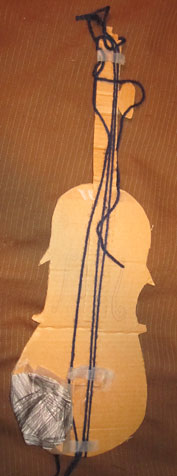
I made this when I was a child and had no money for a real violin. Was this a new business model all along??
From this point on, the article turns into an search engine optimized Q&A because…sure. Why not?
What is the current financial situation at the San Francisco Symphony?
“Last season, we were facing what would have been roughly an $11 million deficit on a roughly $80 million budget,” Spivey said. But thanks to what he called “extraordinary, one-time contributions,” the organization has stayed afloat. Moving forward, the Symphony says it is planning within realistic financial resources and focusing on building a stronger philanthropic base.
“It’s important going forward as we expand the range of our programming, that we have the opportunity to connect to a broader audience,” Spivey said, highlighting the need to develop relationships with new potential donors.
Okay. Sounds like Spivey and Geeslin are looking for a music director who might want to rethink the funding model, rethink audience development, reanalyze outreach, etc.
Someone who (and I’m just spitballing here) might say something like, “I felt that orchestras, even before the pandemic, were facing a challenging time, especially in this country but also globally. The funding model needs to be rethought. The audience development needs to be rethought. The outreach needs to be reanalyzed.”
Are there projections for future deficits in the 2024-2025 season?
The budget for the 2024-2025 season is still under consideration.
My reaction to this:
“We’ve had a lot of conversation internally as we’ve been doing the planning for ’24-’25 and beyond,” Spivey explained, “to make sure we understand what level of resources we have and what we can expect in terms of ticket sales and the philanthropic pipeline going forward.”
This timing feels batsh*t.
Spivey just said they’re working with an $80 million annual budget. The San Francisco Symphony’s fiscal year starts on September first. That’s in eighty-seven days. Like…is he still considering minor budget adjustments or is he talking major ones? Are there questions about the level of resources he has? What’s all happening in that pipeline? What are the projections? What’s the plan? What do you mean?
In short, how much improv is happening within an eighty million dollar budget for a season that starts in eighty-seven days? The repertoire has been announced. The guest artists have been booked. We already know that. Again:
So I guess there are a few potential interpretations here. Either this is a lie, or a misquote or misunderstanding, or just bull…or there’s an unspoken insinuation that there’s a big ticket item that’s still being negotiated.
How will the financial situation affect the Symphony Gala on Sept. 25?
Oh, thank God someone asked.
Geeslin stated the “biggest departure” during the annual event is…
Me, timidly: Salonen?
Geeslin stated the “biggest departure” during the annual event is the scaling back of the pre-performance reception, and the elimination of the Symphony’s elaborately decorated tent for the dinner and after-party.
Oh. Well. Close.
This has the same energy as Ruth Bukater standing on the deck of the Titanic and calling “WILL THE LIFEBOATS BE SEATED ACCORDING TO CLASS?”
Any room for a gentleman, gentlemen?
But thank God we got the reporting on the elaborately decorated after-party dinner tent. We needed to know the fate of the elaborately decorated after-party dinner tent.
Are there efforts to attract new donors from the tech and venture capital sectors?
Yes, the Symphony is actively seeking to build relationships with new donors across the Bay Area. But Spivey noted that what’s “really important to understand is that the time it takes to build a relationship, when they arrive at a place where they’re deeply invested and feel inspired to give philanthropically, is long… it takes anywhere from seven to 14 years for donors to mature in that way.”
Butbutbutbutbut! You did – you – you already – you did the thing already! About this! You hired Salonen! A big part of the answer to attracting these new donors was supposed to be hiring Salonen! Who, by the way, you did not push to keep to give seven to fourteen years to. Am I crazy? Do we not live in the same reality? You’d been addressing this! Then you undid what you started doing to address this! Without acknowledging you ever undid what you started doing to address this!
Are there plans to expand the board and set minimum trustee-giving levels?
They said the Symphony is always looking to expand its board.
“Right now, our board sits at about 50 people, and we can go all the way up to 80,” Geeslin said.
All current board members give at the Maestro Circle level ($15,000 minimum).
“Some people think having a board minimum, you leave money on the table. I’m of the mind that we ask people to give at a certain level when they come in and then, of course, they will hopefully give more,” Spivey said.
Well, my first concern is obviously:
Will people even want to join without an elaborately decorated after-party dinner tent?
My second concern is… I know I’m just a writer, but, with effort, I can handle the calculation. Thirty more people, times a fifteen thousand minimum, equals… $450,000.
And that’s great. If we can find thirty more people with $15,000 a year to spare who also want to jump aboard a sinking ship with a reputation for organizational dysfunction, that’s a hypothetical whole entire $450,000. And that’s not nothing!
What are the plans for renovating Davies Symphony Hall?
Funding to evaluate potential changes to the Symphony’s home venue ahead of its 50th anniversary in 2030 has long been secured, but any plans for the renovation are in the preliminary stages.
The current goal is to get the entitlement from the city that would allow the possibility of renovation ahead of any historic landmark status for Davies that may restrict the process.
“We began working with the architect Mark Cavagnero to imagine what a potential renovation could look like,” said Spivey.
“There’s no obligation to rush into a renovation project,” added Spivey.
I’m glad to see that the savings from the elaborately decorated after-party dinner tent are going to be re-invested in the venue proper.
I think a lot of people who haven’t watched similar disputes play out over the years are really going to be stuck on this. The orchestra can find the money to spend multiple hundreds of millions of dollars on a building but not enough to close a budget deficit? And I hate to be the bearer of bad news, but honestly? It’s possible.
Here’s a tough-to-swallow truth about big ticket donors and foundations. They love edifices. This is a whole documented phenomenon. You can look it up. It’s been nicknamed the “edifice complex.”
I’m generalizing, but in many communities, it’s common for donors to be more interested in funding buildings than day-to-day operations. Why? Operations are ephemeral. You can’t carve your name on them. They don’t offer the same professional or social cachet. A performance is here today, gone tomorrow. But a building is something concrete you can show your friends, your colleagues, your rivals, for decades to come. You can even throw corporate parties inside them! Plus, halls shape their built environment: an environment that is often, in the case of orchestras, in densely populated downtown locations. It’s like a miniature stadium. Those are attractive benefits to people who wield political or financial power.
Needless to say, over the years, many orchestras have had labor disputes coinciding with big capital campaigns for hall renovations. It’s a trope at this point.
To the symphony’s credit, it has stated publicly that “our priority is to stabilize the organization financially and support our artistic output.” But they’re also simultaneously ramping up for a capital campaign, so I mean… It’s clearly on the horizon.
There are ways that an organization might attempt to mitigate the more damaging side effects of a community’s tendency toward edifice complexes, and guide folks to supporting day-to-day operations. One might be hiring a beloved music director who is famous for innovative thinking and engaging, cutting-edge programs that are exciting to sponsor. Well, whoops.
By the way, the San Francisco Classical Voicearticle I mentioned earlier included an ominous detail…
Questions remain, especially about where the orchestra would perform during the construction — estimated at three years by the architect and two years by the SF Symphony administration. Davies would mostly be unavailable for rehearsals and performances, and the orchestra’s old home, the War Memorial Opera House, is fully booked by San Francisco Opera, San Francisco Ballet, and others…
Unlike the New York Philharmonic’s three-year-long $550 million renovation of David Geffen Hall, during which the orchestra played in Carnegie Hall and elsewhere, the SF Symphony would have no such options locally.
In 2012, the Minnesota Orchestra left Orchestra Hall during a renovation. It was supposed to play concerts at the Minneapolis Convention Center auditorium a few blocks away. As it turned out, the Orchestra Hall renovations ended up being finished before the sixteen-month-long musician lockout was. Now, I’m not saying that history will repeat itself in the future. But I’m also not saying that it won’t.
Is the departure of Music Director Esa-Pekka Salonen final?
Despite a petition from the Symphony musicians asking the board to find a way to keep Salonen, yes.
But Spivey said that while Salonen’s role as music director is ending, his relationship with the Symphony will continue.
“He will most certainly be a regular guest that comes back and works with the orchestra,” confirmed Spivey.
Is Salonen in the room with us right now? I know the phrase “is the [X] in the room with us right now?” is a meme, but I’m literally asking you, is he in the room with you right now? If not, why not? Where is he? Why are you talking about his future when he’s not there? He is alive. Esa-Pekka Salonen is alive!
Has the search for the next music director begun?
No, but the search will commence soon.
Folks, the classical music world plans its calendar out years in advance. The search should have started the day Salonen announced his departure. Heck, renowned orchestra CEO Deborah Borda has been quoted as saying that searches for future music directors are perpetually ongoing. Honestly, I wouldn’t even be mad if they lied about this one while awaiting the formation of an official search committee, just so it seems like they care. I genuinely can’t tell if they want a music director right now — I’m guessing they don’t until they finish their negotiations with the musicians — but at least pretend for the press, you know? If they’re bargaining in good faith, there’s no time to waste here. Why are they pretending there is?
“We will want to ensure that the person that we find not only is passionate about what they do on the stage, but they’re passionate about building this organization,” said Spivey, noting that the new music director will also need to be “a rallying force for continuing to build our audiences and that philanthropic support.”
Geeslin emphasized the collaborative arts environment in San Francisco, noting that the new director will join a vibrant leadership community.
Great. Conductors love…joining vibrant leadership communities and building philanthropic support. It’s the reason the best of them get into music. They love hobnobbing at gala balls with fellow leaders. Especially in tents.
Seriously, what are you doing to attract this hypothetical new director? Do you think this interview is helping? Who is this interview even for?
How does the Symphony plan to restore public trust?
Yes! Yes! This is a great question! Yes!
Spivey is optimistic. “There are a lot of positive drivers that will enable us to not only overcome those financial challenges but actually land in a very successful place down the road,” he said. “There’s an opportunity to build a philanthropic pipeline in the long term and ultimately, the opportunity to connect deeply to become a really vital part of the arts and culture scene and what makes San Francisco special.”
My follow-up: can you be more generic?
*
The interview ends there.
So. Hey. San Francisco Chronicle.
Look. I don’t blame you. Your dearly beloved arts critic just retired. You had to bring in people who don’t know the field, who are experts in other things, who probably have ten thousand other plates spinning and are existentially nervous about keeping their jobs, because everyone who writes for a living nowadays is existentially nervous about keeping their jobs, and trust me, I feel you. I am counting down the days until Chat GPT starts spitting out mean long-winded gif-encrusted labor dispute essays. But how were they supposed to know what to ask? Without training or experience, how were they supposed to parse the 990s? Or the financial statements of an organization that is spending, raising, and investing hundreds of millions of dollars a year? Again, there are literally hundreds of pages of numbers to go through, and they’re dense. I don’t blame them for not having the bandwidth to dig in here.
No, right now I feel like the bigger problem is how weird the orchestra leadership is acting.
Don’t get me wrong. Running an orchestra is hard. Running an orchestra well is incredibly difficult. It gets especially impossible when there are money troubles.
But the thing that grinds my gears here is, the stuff I’m talking about isn’t about money. This is about governance. This is about communication. This is about respect for a great artist. Respect for a great artist is free. Good optics are free. Answering questions intelligently, with empathy? Free.
I’m going to make a prediction. In the eyes of the public, this leadership team’s original sin won’t have anything to do with the First Problem. It won’t have anything to do with money. Instead, it’s all going to trace back to the decision to push Salonen overboard without a lifejacket and then act like it was no big deal, like they wanted to ghost him all along. So before they can solve whatever financial issues are or aren’t lurking in their 990s, the San Francisco Symphony has to address their Second Problem first. And they have to do it once and for all.





 Song of the Lark