Tag Archives: echo chamber

Response to Jon Eisele’s MinnPost Editorial

Here’s a link to Jon Eisele’s piece in MinnPost: “MN Orchestra board member: We seek our musicians’ partnership to build a strong future.”

I’m not going to spend the time nitpicking every little thing in it that’s misleading or unsatisfactory, so I’ll just pick out a few highlights…

Here’s Mr. Eisele’s answer to why the mission statement was changed:

Our mission statement was changed in our new strategic plan to signify a new emphasis around serving our community. This language change is important, not because the “orchestra” isn’t part of it, but because it communicates a pivotal shift in what we see as the role of symphony orchestras in the 21st century. A shift to a more community-minded and responsive organization is a positive and needed repositioning for our orchestra.

For those of you who haven’t memorized the orchestra’s old and new mission statements… It went from

Our mission is to enrich and inspire our community as a symphony orchestra internationally recognized for its artistic excellence.

Our mission will be implemented by:

  • Enhancing the traditional core of concerts with innovative approaches to programming and format;
  • Providing the finest educational and outreach programs;
  • Representing and promoting the Minnesota Orchestra and the State of Minnesota to audiences across the state,  across the country and around the world through tours and electronic media;
  • Maintaining an acoustically superior hall with a welcoming environment.

To:

The Minnesota Orchestral Association inspires, educates and serves our community through internationally recognized performances of exceptional music delivered within a sustainable financial structure.

Seriously, now. Which mission statement sounds like it’s more interested in serving its community? If community service really was at the heart of the Minnesota Orchestra’s new mission, then why remove references to “the finest educational and outreach programs”, “representing and promoting the Minnesota Orchestra and the State of Minnesota to audiences across the state” and maintaining a hall with “a welcoming environment”? I think this is a fair question.

Also, I’m failing to understand how not addressing a community’s questions about its finances is in any way, shape, or form serving them…

Another point: I was disappointed that Mr. Eisele took words directly from the Minnesota Orchestra’s website and Mr. Campbell and Mr. Davis. I would have much preferred to hear from him in his own words.

The website:

These donations would not have been contributed to the Orchestra if there were not a building project to support.

Mr. Eisele:

The vast majority of donations we received for the hall campaign would not have been contributed to the orchestra if there were not a building project to support.

Mr. Campbell, Mr. Davis:

 In 2010, we asked our musicians to help alleviate growing deficits by taking a 22 percent wage reduction. We told them that even this sizable reduction would not resolve our financial problems. It would, however, make the cliff less steep in 2012. The musicians chose not to participate in those reductions. That was their legal right, and so we must grapple with even bigger financial issues today.

Mr. Eisele:

It was the musicians’ legal right to do so, but it has made the cliff we face today all the steeper.

Mr. Campbell and Davis:

Why would we seek harm for any member of this iconic organization?

Mr. Eisele:

Why would we want anything but the best for the organization?

And so on and so forth. It would have been lovely to hear more from Mr. Eisele, and fewer rearranged talking points. We’ve already read the talking points, thanks.

I couldn’t help but note that Mr. Eisele ignored the DeCosse’s question, “Has the community raised almost $47 million to renovate an Orchestra Hall that will not include a first-rate Minnesota Orchestra?” That’s troubling, especially when it’s probably the most pertinent question that the DeCosses raised.

On top of that, there are no answers in Mr. Eisele’s piece to questions like:

  • Why the orchestra trumpeted its financial health from 2008-2010
  • Why Mr. Henson misled the state legislature
  • Why an independent analysis would be harmful
  • Why orchestra experts like Drew McManus, Robert Levine, and Bill Eddins are so off-base in their assessments
  • Why we shouldn’t be listening to all the former music directors who claim these cuts will be catastrophic
  • Why there was a $6 million draw from the endowment in 2011 that did not go to operating expenses
  • How much revenue will come from the newly renovated hall, and how

Etc., etc., etc.

We believe the board and the community that supports the Minnesota Orchestra deserve that level of respect.

I look at it another way. I believe the community that supports the Minnesota Orchestra deserves the respect of the board. They are there to serve us and the musicians. Serving us would include submitting to a full independent financial analysis. This isn’t about the musicians anymore. It’s about the taxpayers who footed the $14 million bill for the Orchestra Hall renovation.

In short, this is a hugely unsatisfying piece. I doubt the DeCosses are satisfied. I know I’m not.

Leave a comment

Filed under My Writing

Guest-Blogging, MOA Annual Meetings, and Advent Reminder

I was asked by Mr. Norman Lebrecht over at the Slipped Disc blog to contribute a summary of the Minnesota situation. Here ’tis. As I say in the article, I welcome any clarification from the MOA. (Heck, even an acknowledgement of my existence would be nice… *waves* I know you know I’m here, MOA! It’s getting awkward never hearing from you! Trust me, there’s absolutely nothing to be afraid of! I’m only 90 pounds, and I’m disabled, to boot! So come on over and pull up a chair!) Anyway. The lesson I took away from writing the Lebrecht entry? It’s much more difficult to write something in 850 words than it is in 3000!

I also have an answer to a question I’ve been hearing a lot of lately: when is the MOA’s annual meeting? And that question is invariably followed up by, can we protest at it?

According to the Star Tribune, the annual meeting of the Minnesota Orchestral Association will take place on Thursday December 6. We don’t know when in the day or where, so unless information is leaked and publicized in time, sadly we cannot protest at it. (I’m guessing that the MOA is keeping the time and location under pretty tight wraps. I can’t imagine they’re very keen on the idea of a public demonstration outside their annual meeting.) We have no idea what will happen there. (Some tough questions for Mr. Henson, such as, why did you lie to the state legislature? Discussion of canceling more concerts? Discussion of hiring replacement musicians? A full vote of confidence in MOA leadership from the board? Musician bashing? Union bashing? Musicians’ union bashing? The mind boggles at the possibilities!) In years past, Graydon Royce has reported on the meeting, so keep an eye out on the Strib’s website for that.

To be a fly on the wall there. There would be so much material for this blog, I’d be busy until Christmas. Oh, well. I’ll have to make due with all the material that is public, and to be fair, there is a lot of material that is public. I’m working on a couple of essays at the moment, examining management’s latest Strib editorial and Doug Kelley’s string of non sequiturs on Almanac. And I know Mary is working on another installment of her financials series. And I know of at least a couple other people who are digging around in tax forms and Internet archives and the like. And I imagine Graydon Royce is researching stuff, as well. So take heart; this story isn’t over yet, by any stretch of the imagination. Despite any discouragement you may have, keep your chin up, and stay tuned. We’ve only just begun to fight.

Hope you’re having as enjoyable a holiday season as possible, given the circumstances. Have you checked out the Song of the Lark Advent Calendar? If you haven’t, you should! We’re – er, I’m – still accepting submissions for memories / encouragement for all those affected by the lockout(s), to be sent to songofthelarkchristmasproject [at] gmail.com. I’d really appreciate hearing from you! And if you want to send out some polite letters of protest along with your Christmas cards this year, I have just the entry to help you do just that.

6 Comments

Filed under My Writing

Drew McManus’s Latest, and Popcorn

There aren’t many blog entries that I devote blog entries to, but here’s one I will: Drew McManus’s “The Empire Strikes Back.” (This was also the title of Robert Levine’s latest.) (Combine those two entries with my recurring popcorn GIFs, and it appears the Minnesota Orchestra blogosphere is now on a movie kick.) (But who can blame us? With every passing day, the conflict gets more and more theatrical.)

Here’s Mr. McManus:

EXTERIOR PLAIN OF HOTH MINNEAPOLIS – HELICOPTER SHOT – DAY:

A white snowscape races toward camera … the MAIN TITLE quickly recedes, followed by a roll-up. Episode V: THE EMPIRE STRIKES BACK…

Although certainly not science fiction, the recent opinion piece co-authored by Minnesota Orchestra Association (MOA) board chair Jon Campbell and MOA negotiation chair Richard K. Davis and published in the 11/28/12 edition of the Minneapolis Star Tribune still managed to contain what some might consider a rather cinematic tone…

And it goes on, very entertainingly, from there.

Mr. McManus brings up an important point that I should have thought of earlier, but didn’t. If the musicians submit a counterproposal, they’re at risk of turning the conflict from a lockout into a strike, and losing unemployment benefits, thereby strengthening management’s position, all while guaranteeing the musicians (and the many patrons who support their cause) nothing. I actually knew all of those piece of information individually, and yet never connected the dots to think of how they might relate to one another. Sooooo, this is proof that you need to read as many media outlets as possible, because I’m not always going to make all the connections that need connecting. I’ll try to keep you as up to speed as possible, but I’m only one woman, going through her first orchestral labor dispute, and learning as I go along. So keep an eye on MNuet’s News & Reviews page. Be well-informed, folks!

Drew McManus is, as I’ve said before, the Nate Silver of the orchestra world. He’s calm, rational, level-headed, professional, uber-careful, always. So when he starts posting snark and parody………………….well. Crap is hitting the fan.

I think at this point the MOA should go on Stephen Colbert’s Absurd-U-Chart, which is reserved for things that are “offensively absurd, like rabbits with pancakes on their heads, and owls.” I think that’s about the level of crazy we’ve reached here. Let’s see how long it takes the MOA to figure that out and come back to earth.

I’d also like to repeat what Mr. McManus says, among other things, in the comment section:

I’ve also offered to travel to Minneapolis at my own expense to conduct a live interview with them which would subsequently be published here in audio format.

I hate to use more popcorn GIFs, but…

https://i0.wp.com/www.reactiongifs.com/wp-content/uploads/2011/05/popcorn_yes.gif

(Also, in case you were wondering, I have my own response to the Campbell/Davis editorial cooking. So stay tuned.)

Edit 1:30PM: Here Robert Levine discusses Drew McManus’s entry.

11 Comments

Filed under My Writing

Is Minnesota Orchestra Management Lying To Us, Part 3: Yes

Yesterday proved to be an important day. Graydon Royce penned and published the single most important article yet written about the orchestral apocalypse. So go read it. Now. Please.

Let’s all take a moment to acknowledge that Graydon Royce is the King of Minnesota Orchestra Investigative Reporting.

Your crown, dear sir.

The article begins:

For four years, the Minnesota Orchestra board has walked a tightrope between managing public perceptions about its financial health and making its case to cut musicians’ salaries.

I’m not writing in a newspaper, and I’m not speaking on behalf of anyone but myself, and I don’t need to be delicate, so please, allow me…

The Minnesota Orchestral Association lied to the public about its fiscal health in order to get what it wanted. Yes, I know that we’ve sidestepped the L-word in the past. I wrote “obfuscations” once; the MOA then wrote about “misrepresentations“. So I’m going to be the first to be blunt, and say lie. They lied. They lied, as in “they presented false information with the intention of deceiving.”

THEY LIED TO US.

Continue reading

23 Comments

Filed under My Writing

A Michael Henson Retrospective

A few days ago, I took a trip through the 2010 Minnesota Orchestra e-tour site. That’s the place where I found the “winning” article from Gig Magazine, where the Minnesota Orchestra was described “as a beacon institution among the bad [economic] news.” Not long after I blogged about that article, it mysteriously vanished from the Orchestra’s website. Luckily, a reader had told me to take screenshots, and so I posted those. We’re going on seven weeks now, and management has yet to address the disappearance.

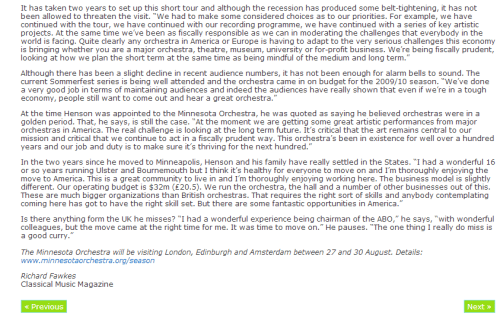
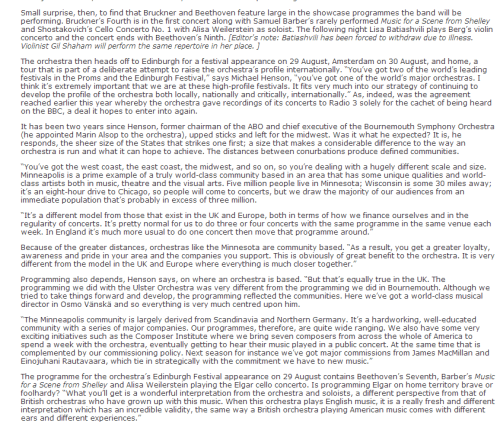
Anyway! During my recent return trip to the e-tour site, I found some more quotations that I feel compelled to share with you now. They’re from an interview that Minnesota Orchestra CEO Michael Henson gave to Classical Music Magazine in August 2010 called “Flying the flag.” I’m not even going to bother with the cache. Here’s a direct link. When that’s taken down, here are the screenshots. Click for bigger images.

Mr. Henson is speaking…

“We’re being fiscally prudent, looking at how we plan the short term at the same time as being mindful of the medium and long term.”

“The current Sommerfest series is being well attended and the orchestra came in on budget for the 2009/10 season.”

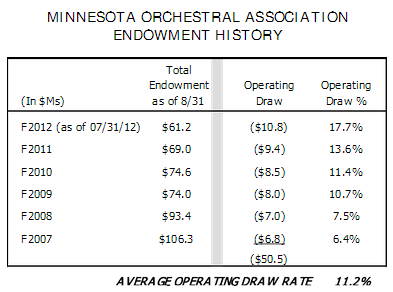
In the 2008-2009 fiscal year, the Minnesota Orchestral Association, or MOA, says their operating draw percentage was 10.7%; in 2009-2010, the orchestra says the operating draw percentage was 11.4%. (I say “says” because guest blogger and local nonprofit professional Mary Schaefle reports that the numbers released to the public don’t match the MOA’s tax returns, and so far, we have not received clarification from the MOA on this point.) As Jon Campbell, the chair of the MOA board of directors, and Richard Davis, the immediate past chair, put it, “In Minnesota, we were able to deliver balanced budgets through large, unsustainable endowment fund draws and ‘bridge-the-gap’ fundraising.” Which – and correct me if I’m wrong about this – is bad. But according to August 2010 Michael Henson, unsustainable endowment fund draws and “bridge-the-gap” fundraising are also….fiscally prudent, and being mindful of the short and medium and long term. Or something.

Although there has been a slight decline in recent audience numbers, it has not been enough for alarm bells to sound.

But… I thought national trends indicate a need for change…

So I guess there’s a need for change, but there hasn’t been enough change for alarm bells to sound? Or in other words, there’s no need for changes that require a significant departure from the traditions of the past?

Clarification would be very cool right about now.

“We’ve done a very good job in terms of maintaining audiences and indeed the audiences have really shown that even if we’re in a tough economy, people still want to come out and hear a great orchestra.”

In the fiscal year lasting from 2009-2010 (the year Mr. Henson had just finished as he gave this interview), overall attendance dropped by 7%, from 270,000 to 250,000. Is this “a very good job in terms of maintaining audiences”? I suppose if you get convoluted about it, and if most other American orchestras saw their attendances plummet by 10% or 15% that year (and I don’t know if they did), you could make that case. Otherwise…I dunno. Please forgive me if I’m not completely convinced. I’d love to hear more of the subtleties of the argument, and more figures to back the argument up. If Mr. Henson ever sits down with a reporter like Matt Peiken from MNuet, these remarks could form the basis of a fascinating and productive discussion. (Mr. Peiken has asked to interview Mr. Henson; Mr. Henson has not yet accepted the invitation. Maybe he will now.)

(And yes, I’m aware that a big chunk of that attendance drop can be ascribed to the fact there were 9% fewer concerts in the 2009-2010 season, as Mary has explained here. But Mr. Henson wasn’t talking about revenue here; he was just talking about audience maintenance.)

At the time Henson was appointed to the Minnesota Orchestra, he was quoted as saying he believed orchestras were in a golden period. That, he says, is still the case.

A visual representation of our era

Yes, apparently we are in a…golden period. Pretty fricking depressing Golden Period, if you ask me, but…OK.

 “At the moment we are getting some great artistic performances from major orchestras in America. The real challenge is looking at the long term future. It’s critical that the art remains central to our mission and critical that we continue to act in a fiscally prudent way. This orchestra’s been in existence for well over a hundred years and our job and duty is to make sure it’s thriving for the next hundred.”

What?

I agree with Michael Henson about something?

Yay!

This warrants a celebration.

OK, celebration over.

Now. Remember, at the exact same time that he was saying all of these things…”golden period”, “people still want to come out and hear a great orchestra”, “we’re being fiscally prudent, looking at how we plan the short term at the same time as being mindful of the medium and long term”…Mr. Henson was, behind closed doors, not only approving endowment draw rates of over ten percent, but Strategically Planning the Strategic Plan that would culminate in 20-40% pay cuts for musicians, prominently highlight how “stressed” orchestras are, and produce a drastically altered mission statement that can be interpreted as the MOA having no interest in supporting orchestral music at all. By management’s very own admission, the Strategic Planning began in the spring of 2010: months before these sentences were ever uttered to Classical Music Magazine (or, for that matter, Gig Magazine).

So, to sum, as he was giving these rosy interviews to the international press, behind closed doors, Mr. Henson was saying (formatting mine for emphasis):

  • “the status quo can no longer be preserved” (from the Open Letter)
  • “…this is a journey that began several years ago, when the Board of Directors of the Minnesota Orchestra recognized that the organization could no longer survive based on optimistic economic assumptions and the hope of limitless benefactor generosity” (from the Open Letter)
  • “…the reality is that over the past three years we met regularly with our musicians and others with a stake in our future to share the clarity of our financial challenges“… (from the Open Letter)
  • “Board and management have been communicating the financial position of the Orchestra with musicians for three years.” (from the Misrepresentation vs. Reality chart)
  • “As part of the strategic planning process, the board openly shared the Orchestra’s financial situation with musicians in a series of meetings spanning three years.” (from the Misrepresentation vs. Reality chart)
  • Would you like me to keep going? Because I could keep going. But alas, I have pity for this dead horse.

So.

What are you feeling right about now? Personally, I’m suffering from a bad case of confusion, and the only thing that has a chance to cure it is a long, long hours-long sit-down chat with Mr. Henson himself.

Here are some more quotes that struck me as odd as I was paging through old newspaper articles. Lots of interesting ones…although, awkwardly, none of them are as damaging as what is actually still on the Minnesota Orchestra’s own website.

Terms of his [Henson’s] contract were not disclosed. According to public documents, [Tony] Woodcock, his [Henson’s] predecessor, earned an annual salary of about $300,000. – Pioneer Press, 22 September 2007 [According to public documents, Mr. Henson’s salary in the 2010-2011 fiscal year was $360,283; total compensation was $389,861. We are currently waiting on numbers from the 2011-2012 fiscal year. Since I don’t have a paid account with Goldstar, I have no access to the 990s that would go into the details of Mr. Woodcock’s compensation.]


Henson believes the hall’s finest characteristics must be preserved. He has visited the new Guthrie Theater, MacPhail Center and the Walker Art Center and came away concluding that while all three make distinct visual statements, it is what happens inside the building that matters most.

“There is no point in having a great building without having great art inside it,” he said. – Star Tribune, 24 February 2008


The Minnesota Orchestra has raised $24 million toward its $40 million Hall renovation. Michael Henson, president and CEO, told the Orchestra’s annual meeting Wednesday that $10 million was raised in September alone. In other financial highlights, the Orchestra balanced its budget for the third consecutive year even as total attendance declined, and ticket revenue rose 4.4 percent…

“We must balance artistic initiative with fiscal responsibility,” Henson told the noon luncheon in downtown Minneapolis. “We’re quite pleased with these results in a challenging year.” – Star Tribune, 9 December 2009. [In the 2008-2009 fiscal year, the year Mr. Henson is referring to here, the MOA states the endowment draw rate was at 10.7%, over double what they now say is “sustainable” and responsible.]


Michael Henson, Minnesota Orchestra CEO and president, hinted Monday that the organization’s renovation of Orchestra Hall might be expanded. Henson’s optimism came after Gov. Tim Pawlenty included $14 million for the project in the state bonding bill. Coupled with private and corporate fundraising of $24 million, the orchestra has now raised $38 million toward a plan that was announced last summer at $40 million.

“You recall that the project was downsized from $90 million,” Henson said, referring to a previous plan announced in 2007. “If we can generate more money through our fundraising, then it would make sense to grow the project, but it’s too early to say that, and we’ve made a priority to be fiscally responsible.”…

It is no secret that the orchestra has been pleased with its fundraising. Last June, when Toronto architects Kuwabara Payne McKenna Blumberg Architects (KPMB) were chosen to spearhead the renovation, pledges for $14 million had been secured. That grew to $24 million by last December’s annual meeting. An organization’s ability to raise private capital helps its chances in the legislature. Henson said he was pleased that “the governor has shown confidence in this project. It’s a very good day for the orchestra.”

KPBM was expected to deliver sketches last December, but that likely was delayed to see whether fundraising might be robust enough to expand the project.  – Star Tribune, 15 March 2010


A gift of $5 million from Target has pushed the Minnesota Orchestra past a $40 million fundraising goal for its Orchestra Hall building project. With the Target donation, the orchestra has raised $43 million to expand and refurbish the 1974 hall’s lobby and surrounding terraces.

Target’s is the campaign’s largest corporate gift. The state of Minnesota contributed $14 million through state bonding, and one individual gave $5 million, according to Michael Henson, the orchestra’s president and CEO.

At the same time, the organization announced that the building project is part of an even larger fundraising effort it calls the Building for the Future Campaign. That initiative has raised $82 million toward a $100 million goal and has been talked about only within the orchestra and the philanthropic community. The campaign includes $40 million for the building project, $30 million for the orchestra’s endowment and $30 million to support artistic and education programs.

However, Henson said, within that framework it’s possible that more money could be dedicated to the renovation.

The $40 million was a “focused budget,” he said. “By passing that amount, we’re not going to increase the scope of the project, but we will increase the quality of finishes and other aspects that give us additional value.” – Star Tribune, 15 June 2010

????

So, um.

Wow.

But those weren’t the only articles I read. Over the course of a lazy afternoon, I carefully studied a couple dozen in which Mr. Henson discusses his work in Minnesota. In none of them was there any hint of an impending apocalypse, or even a “market reset.” True, there were articles about cutbacks in staff after the Great Recession began, and occasional mentions of a “difficult economic climate“, but just about everybody suffered staff cutbacks after the Great Recession began, and of course we all knew we were in a “difficult economic climate.”

Here. Don’t take my word for it; check out Highbeam or EBSCO yourself. The search term you want to use is “Michael Henson” orchestra. Leave any interesting links I may have overlooked in the comment section, especially if they prove me wrong. Because I’d love to be proven wrong. Go ahead. Make a fool of me.

I eagerly await Mr. Henson’s (and Mr. Campbell’s, and Mr. Davis’s) clarifications.

…………………..Because they’d better clarify.

Here’s a final observation from Mr. Henson from August 2010:

“These are much bigger organizations than British orchestras. That requires the right sort of skills and anybody contemplating coming here has got to have the right skill set. But there are some fantastic opportunities in America.”

Indeed.

So. What have we learned?

Assuming the MOA wants to support an orchestra (and at this point, I’m not convinced they do; they can get back to me on that one when they change their mission statement back to include the word “orchestra”), we’re going to keep circling round and round until we agree on the answer to one simple question:

Can you sustain – nay, heighten – the artistry of an orchestra while also cutting its budget by twenty percent over the course of one season? Can you pay twenty percent less for a product and still get a better product? (Especially when you can’t outsource the assembly of said product to China?) Do you believe that an orchestra that pays roughly half as much as the best orchestras in this country – that consists of demoralized dejected players seeking work elsewhere – that has no seniority pay – that has a management team reviled by musicians and music-lovers across the world (and I’m not exaggerating when I say that)…do you believe that such an orchestra will ever become a professional destination for world-class players? (Especially if – sigh; when – Osmo leaves in 2015?) I say no. (Robert Levine, a member of the Board of Directors of the League of American Orchestras, also says no.) (Arts consultant Drew McManus has also expressed doubts.) I maintain that no matter what Mr. Henson says, easily walkable geography does not a desirable location make.

If you don’t have the money to sustain an orchestra’s quality, should you level with your public and say they can’t support the quality of ensemble they’ve grown accustomed to unless they pony up tons more cash and quickly, or should you promise your patrons the moon in the cynical hope they won’t notice when your orchestra starts to decline? As a patron, what kind of management do you want to have in charge? People who are level with you about the challenges ahead, or people who consistently sidestep the truth over a period of years?

Hopefully we all agree: eventually we’ll reach a tipping point. Obviously we can’t buy a world-class orchestra for, say, $0 a year. So somewhere along that sliding scale between $32 million and $26 million and $0, we’ll lose our “world-class” quality. So where is the Minnesota Orchestra’s tipping point? Is it at $30 million? $28 million? $25 million? $10 million? If we’re going to cut twenty percent, then what keeps us from cutting, say, thirty percent? Forty percent? Fifty percent? After all, that would give us more money to invest in the endowment. It would protect us against another major recession and give us more money to use on educational programs. How about we cut ninety percent? Ninety-five? Ninety-nine? How about the musicians pay us to have the chance to play in a world-class orchestra? All right; now I’m being hyperbolic. But hopefully you understand the broader point I’m trying to drive home here. Where is that tipping point? How close to the bone can we shave without seeing a marked decrease in quality (and an accompanying decrease in financial support)? Do we know? If so, how do we know? And why was the community never given a chance to discuss this? Because we’re not dumb. We could have helped you solve the problem, you know. It’s our orchestra, and we deserve to have a say in its future.

The only way I can reconcile Mr. Henson’s words (without labeling him a self-serving cynic who specializes in painfully inept incompetence) is to assume he honestly believes that a world-class orchestra – (in a golden age of orchestras) – will thrive artistically – (and therefore, financially) – after he brutally gouges the salary and working conditions of his musicians, and misleads and then infuriates his devoted public. Personally, I find that idea to be roughly as realistic as the idea of an obese man flying around the world to deliver toys to every good boy and girl on the face of the earth, and so do many experts in the field. The idea may be comforting at first glance, but in practice, it’s unworkable. But for whatever reason, a lot of people on the board appear to agree with Mr. Henson.

So what do you think? What I think isn’t important. It’s what you, the patrons, think that really matters. (Or, at the least, what should really matter.)

As always, the comment section is open.

5 Comments

Filed under My Writing

MinnPost Editorial by Paula and Cy DeCosse

As the Orchestral Apocalypse drags on, many readers have wondered what important donors are feeling about now. We have our first indication in this MinnPost editorial, “We’re locked out, too: Questions for MN Orchestra management,” by Paula and Cy DeCosse.

Their editorial begins:

The recent announcement of additional Minnesota Orchestra concert cancellations only deepened the gloom of hundreds of Twin Cities patrons and music lovers. We’ve already missed six weeks of concerts, and now the holiday concerts have been canceled as well. Orchestra Hall is under construction; the Convention Center auditorium is dark. The musicians are locked out – and so are we!

As the conflict has dragged on, with letters from the board citing unsustainable deficits and musicians protesting a 30-50 percent pay cut (management says the cuts would be 20-40 percent), we in the community are trying to make sense of it all. We have a lot of questions.

The whole thing is highly recommended reading. It covers several of the most important questions we’ve been asking here, calmly, succinctly, and persuasively. (And for what it’s worth, to the best of my knowledge, this is the first mainstream press mention of the “winning” article.)

Mr. and Mrs. DeCosse were one of the sixteen donor couples profiled on the Orchestra’s website. In light of their editorial today, if you click the link and the page is gone, I have screenshots I can share.

8 Comments

Filed under Not My Writing

Matt Peiken’s SPCO and Minnesota Orchestra Podcast

Hey peeps; listen up. I’ve got 50 minutes of juicy arts journalism for you. Matt Peiken from MNuet has produced a podcast you must listen to. I don’t care what you’re doing; drop it, and listen. Here’s a summary:

In this revealing and provocative conversation, Ellen Dinwiddie Smith of the Minnesota Orchestra and Carole Mason Smith of the Saint Paul Chamber Orchestra talk with MNuet’s Matt Peiken about the labor stalemates happening with their respective orchestras, their perspectives about what led to the musicians’ predicaments and steps they see going forward. Among other charges, the musicians make the case that the management of each orchestra is looking to transition from an orchestral focus to one of presenting a wide array of events. MNuet has asked to conduct a similar interview and devote an episode of “Whole Note” to representatives of each orchestra’s management.

Thank you thank you thank you, Mr. Peiken. I’m so thrilled we have an independent journalist in our midst.

Here are some teaser questions from the podcast: What are the missions of the SPCO and Minnesota Orchestra boards? How were certain individuals laid off at the Minnesota Orchestra in spring? Who gave back what when? Is there a kind of collusion happening among administrators at the highest echelons of American orchestras? Are musician-led ensembles in the Twin Cities’ future? Where are our local politicians in all this? And what about the children? Juicy stuff, huh? See, I told you you’d want to drop everything and listen.

If the managements at both orchestras refuse to take up Mr. Peiken’s generous offer to conduct in-depth interviews with them (and I’m guessing they will refuse), then I suggest that he post an mp3 of an hour of total silence. Or an hour of him asking questions to dead air. If those in charge can’t handle the heat, and won’t step up to answer their public’s questions, then let’s hammer home the void of leadership and vision and accountability as mercilessly as we know how. No offense to the good reporters who have been working on these stories over the last six weeks, but I’m so tired of the sound bites in 700-word articles in the mainstream press. This is the kind of in-depth conversation we need to be having. These are the questions we need to be asking, again and again and again, until those in power can’t bear to hear the sound of our voices anymore. Management, if you’re not going to answer the questions I’ve raised, or even acknowledge my existence, then at least sit down with someone like Mr. Peiken. If you don’t, we’ll assume you’re hiding something (what else are we supposed to do?). And we will act accordingly…

5 Comments

Filed under My Writing

Musings on the Campbell/Davis Minnesota Orchestra Editorial

Here’s a Strib editorial from Jon Campbell and Richard Davis entitled “Minn. Orchestra makes a stand.” It’s… Just go read it. If you’ve read this blog before, you’ll know what I think of it.

There’s not much new in it, but one new thing is a big new thing: Campbell and Davis have finally confirmed the 17% endowment draw in print. Despite my sadly limited mathematical abilities, I anticipated this number on September 25. I’m not exactly sure what the thought process was behind this small but meaningful tweak in PR strategy, but make no mistake; it is a marked departure from what has been said in the past. This is a risky, double-edged sword of a figure to publicize. Yes, it demonstrates the gravity of the situation quite neatly, but it also begs the inevitable (unanswered) question: when donors for the Building for the Future campaign were being courted in 2010, and 2011, and 2012…were they told that the orchestra’s finances were being managed so poorly that the organization was being forced to draw from the endowment at an annual rate of 17% to meet their obligations? (Because make no mistake: given the figures they’ve cited, if they were drawing at a rate of 17% in 2011, then they were also drawing at a 17% or 18% or 19% rate in 2010, too. Even I can figure that out, and trust me, John Saxon and I were never very close.) (Edit 10/29: We now have more concrete information about rate draws from 2007-2012. They aren’t quite as extreme as 17%, but they were pretty darn high.) I really wonder if donors were told, because in December 2010, Richard Davis proudly proclaimed, “This was a season characterized by disciplined budget management [bold mine] and significant expense cuts, which kept our operations stable in an unpredictable environment.” But we now have conclusive proof from Richard Davis himself that this was, to put it politely, total cow crap. (Because let’s get real: a draw rate over 10% isn’t “disciplined budget management” ……is it???) If they lied to the paper, why wouldn’t they lie to their patrons and donors? (Or to their musicians, for that matter?)

Bottom line: how many people would have donated to the lobby renovation if they’d known the Orchestral Apocalypse was coming? I’ve read comments online again and again and again from people who said they would never have donated to the hall construction effort if they’d known that a 30-50% pay cut for musicians was in the works. I haven’t heard a single donor say, “Well, if I had to choose between keeping all of our musicians in town, or building an amazing new lobby, I’d definitely take the amazing new lobby!” I mean…I’m sure there were people and companies who wanted their money to go to the hall rather than the musicians, but…I know there were lots of people who felt otherwise, too. And their concerns should be acknowledged.

Here’s an FAQ from management’s website:

Why not “re-allocate” the $47 million raised to reduce deficits instead?

The donors who have contributed to the Orchestra Hall renovation would not have contributed these funds if there weren’t a building project to support and we need to respect their intent. For example, the State of Minnesota provided $14 million (funds that we need to match) to support the renovation and these funds cannot be used for a different purpose. Similarly, many foundations and corporations have specific guidelines around capital support that our project fulfilled; this support cannot be re-allocated.

But interestingly, their answer says nothing about individual donations. I have the summer 2012 Showcase right here… There are roughly 150 individuals or couples who appear to be non-corporations who gave $10,000 or more, who presumably do not have specific guidelines around capital support, who could theoretically re-allocate their funds. Of course we’re too far along now in the renovation to re-allocate much (if anything), but… Yesterday I did some quick back-of-the-envelope calculations. On the low end, these individuals gave roughly $32 million. On the high end, they gave about $70 million. A certain percentage of that was doubtless used for construction. How many millions of dollars would be re-allocated if their donors could do it all over again? Based on the information we have now, it’s impossible to know.

I wonder… In a perfect world, where cost isn’t an issue, would management be afraid to contact these donors in a short independently conducted survey? Maybe have three questions:

1) When you made your donation, were you aware that the orchestra was drawing from its endowment at an annual rate of 17%?

2) Would that knowledge have encouraged you to donate less, or more?

3) Knowing what you know now, if you could go back in time, would you donate to the hall construction effort or request that your gift go toward other operating expenses? Or would you have chosen to withdraw your donation altogether?

I have no idea what the answers to such a survey would be, but they would be so interesting to parse.

I don’t know. Maybe these wealthy individuals knew about the high draw rate. Maybe they were all told of the likelihood of a months-long lockout and orchestra dismemberment, but they still felt the need for a hall was more pressing. Maybe every single one of them wanted their money go to a new lobby. But we haven’t heard from them except through management’s filter, so we just can’t know. However, if these big donors are anything like the small ones, there are some who are feeling awfully betrayed right now.

To sum it all up, I’m impressed that Campbell and Davis finally came clean about the 17% draw. But I’m less impressed that they didn’t answer the inevitable accompanying questions that such a high number raises, like: why didn’t you tell us this was happening two years ago?, and why did you lie to us?

While we’re asking questions about the funding for the hall, I have a couple of quick ones… Would the hall renovation have even been possible without the $14 million from the state of Minnesota? Why did then-Gov. Pawlenty, once opposed to using state funding to remodel the hall, change his mind a few weeks later (without explanation), and decide at the last minute not to veto the Orchestra Hall renovation? Interesting questions. Unfortunately we’ll never get answers to them, because the ex-governor recently left his political career behind him, likely forever, to become the CEO of the Financial Services Roundtable. You may be interested in looking at a list of that organization’s directors; a certain name will be familiar to you. Who knows what all happened there, and what (if anything) it has to do with the hall and the orchestra and the fact Pawlenty changed his mind so quickly. It’s very possible there’s nothing there there. But…oh, wouldn’t it be fascinating to know for sure?

I never donated to the Building for the Future campaign (thank goodness), but I did donate an encouraging blurb to their website, a fact which now humiliates and angers me to no end. I really feel like I was taken advantage of. Would I have taken the time to write what I did if I’d known such flagrant mismanagement and misrepresentation was occurring behind the scenes? Well, holy crap, no! Of course not! So I can only imagine how utterly cheated certain individuals who actually gave money might feel.

Are you a donor? As a donor, were you ever given a different picture of the organization’s finances than members of the Strib-reading public were in December 2010? Were you ever told about the endowment fund draws in the upper teens? Would you consider a 10%+ draw to be “disciplined budget management”? Were you ever given any indication that a months-long lockout was just around the corner? Would you have reconsidered your donation if you’d known this was all going on? Do you think money was mismanaged in any way? Or are you cool with it all? Do you feel like you were lied to? Or do you trust management to do what’s right, and to honor your intentions? No snark or sarcasm here; I’m genuinely curious.

I know that I won’t give to the Orchestra until the current leadership is gone.  I just don’t trust them to paint fair, accurate pictures of their financial status. Do you blame me? I wonder how many other individuals feel the same way I do, and how this will affect the orchestra’s ability to fundraise in future…

***

PS – Oh, and also? The idea of the “playing and talking” period being over the last few months is just…stupid. Like really, really stupid. It’s not really like the musicians had a choice. They were kinda contractually obligated to play. Management is not going to win any PR points with that, and whoever thought they would is…kind of delusional.

PS 2 – And also also, I find it odd that management has chosen to put up the link to the “A change in key” Strib editorial on its Industry News page, apparently subtly endorsing it, but then refusing to actually do what it recommends. Um

9 Comments

Filed under My Writing

A Red Letter Day for the Redline Express…

Drew McManus is a wizard, and he has a special potion, and he has offered it to Minnesota Orchestra management, and they have partaken in it. How else to explain this totally unexpected way-out-of-left-field possible geyser gush of transparency?

At the end of last month, I published an article that examined the value of comprehensive perspective when it comes to considering proposed changes in collective bargaining agreements. Since then, I have obtained a copy of the complete redline agreement the Minnesota Orchestra submitted to musicians as their last official offer (which was subsequently voted down on 9/29/12) and concluded it would be educational to begin examining the document here at Adaptistration.

The document has been verified as complete and accurate by official representatives from both the Minnesota Orchestra (MO) and the Minnesota Orchestra Musicians (MOM); my thanks to both groups for their cooperation.

A visual representation of what I felt like after reading Drew McManus this morning

Could it be…that…

Management is starting to care about public opinion?

Maybe?

A little?

What?

What?

Because…

Minnesota Orchestra representatives didn’t need to agree to do this. As Mr. McManus notes, “This sort of endeavor has never been tried before mostly because obtaining a copy of a complete redline agreement, even after a contentious dispute settles, is next to unheard of.” Maybe I’m missing something very big and very obvious, but…what would management have to gain by agreeing to do this, besides possibly some public support? (And even that isn’t guaranteed, depending on how they react. If they play their cards poorly, this could end up to be a net PR loss for them.) And no offense to Mr. McManus, but the broader public doesn’t read Adaptistration. If representatives from the orchestra had declined Mr. McManus’s request, I’m guessing that only a handful of largely pro-musician people would have noticed…and at this point the majority of us is so disgusted with management that it wouldn’t have changed our tune at all. So might this mean that management is trying to reach out to the online pro-musicican set? Maybe? If not, who are they trying to reach? Why did they decide to do this? Who are the representatives from the orchestra? Do they have faith in their ability to publicly defend their contract? Is that faith warranted? Did Michael Henson okay this? Is he losing control of his chess pieces? I don’t know. But I really wasn’t expecting this, to say the least.

And then take a gander at this paragraph:

The MO and MOM have indicated a degree of willingness to provide additional insight, justification, and rationale behind why changes have been presented and/or why changes are opposed. This input will be included wherever possible; similarly, spokespersons for both sides have been invited to leave comments at any respective article to offer additional insight and clarification.

Insight, justification, AND rationale?

What?

I mean, yay, obviously, of course, but –

What?

*settles in*

*pops some popcorn*

This could get very, very interesting very, very quickly.

As I mentioned in the comment section of an earlier entry, I find that one of the bizarrest things about this whole bizarre conflict is the fact that an uneducated 23-year-old from Wisconsin ended up being the one who wrote the most words about it. I think that’s fricking insane. And so I can’t express how delighted and relieved I am to hear that other more experienced voices are speaking up. I look forward to their insights with gratitude.

And I’m so very glad that the person spearheading this effort is Drew McManus, who is always so calm and polite and professional. I think of him as the Nate Silver of the orchestral world. If I was planning on writing about arts disputes for a living, I’d want to write like him. We desperately need someone in this conversation who isn’t panicking that her beloved orchestra is slipping away, who isn’t personally and professionally associated with various musicians, who isn’t contemplating moving from Minneapolis if the orchestra’s quality seriously declines. As I’ve said since the beginning, the stakes are too high for me to be clear-headed. So let’s all give a round of applause to Mr. McManus for taking on this project, and let’s (this feels so weird to be saying) give a round of applause to management (wow this feels weird to be saying) for seeming to possibly try to attempt to perhaps take a little tiny step toward transparency, maybe (what did I just say?). Let’s give Mr. McManus lots and lots of views, okay? I challenge you to make this the most popular online phenomenon since Snowqueen Icedragon’s “Master of the Universe.” Maybe if we make it really popular, we could succeed in getting a film adaptation of the contract made. I guarantee you such a thing would be more interesting than the Fifty Shades movie.

Anyway. I’m not sure if this exercise will clarify much. It could clarify a lot; it could clarify relatively little. It might change minds; it might harden them. But at the very least it will be interesting. And will be the closest thing to accessible public dialogue that we’ve seen yet.

And so once again we find ourselves in a roller coaster in uncharted territory. Boy, this story has been weird.

Stay tuned…

1 Comment

Filed under My Writing

What Do the Minnesota Orchestra and the SPCO Mean To You?

I have a simple question for y’all.

What do the Minnesota Orchestra and the SPCO mean to you?

How have they inspired you, moved you, transported you? When did you first see them? When did you last see them? What makes you love them? What makes them special, and worth preserving in their current forms? Write down your thoughts and then post them in the comments section here (or if you want to communicate through email, leave a comment saying so, and I’ll get in touch with you privately as soon as possible). Write a few sentences, or write an essay. I’ll then re-post them as actual entries that you can then spread and share with your friends and family. I want to hear funny anecdotes, profound experiences, intellectual epiphanies: anything. Let’s take a minute to remember what we’re fighting for. I’ll post them all under the tag What Orchestras Mean. I think in the middle of the fight it’s vitally important to occasionally step back and remember all the amazing music we’ve been blessed with.

By the way, Minnesota Orchestra and SPCO managements are more than welcome to participate in this! :D Even if you don’t want to answer my questions, feel free to take part in this activity! (*shrug* Hey, it’s worth a shot…)

7 Comments

Filed under Not My Writing