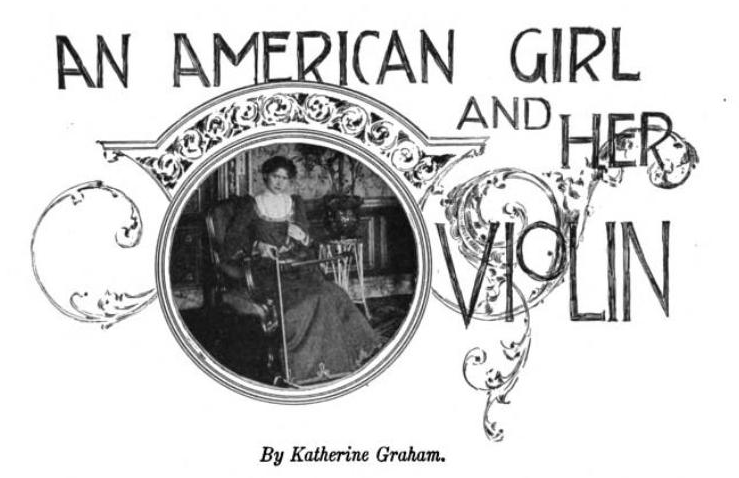
Article: An American Girl And Her Violin, March 1900

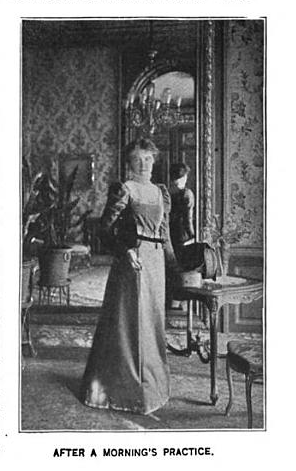
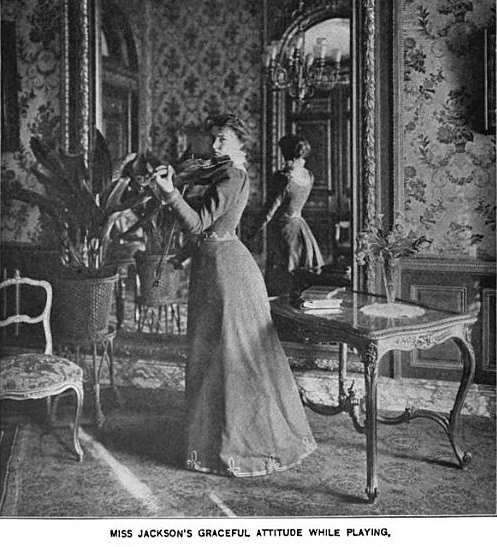
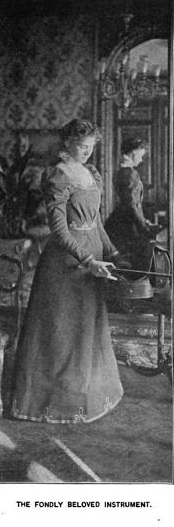
Here is a charming, very well-illustrated article on American violinist Leonora Jackson (1879-1969). It is by Katherine Graham and is from the Metropolitan Magazine of March 1900.

***

A slender girl, holding herself very straight after the manner of those who are students of the violin; in manners somewhat shrinking and diffident; a little defiant, perhaps, the better to conceal a natural timorousness at the sudden transition from the routine of study to the fierce light of publicity and unexpected fame – that is the picture.

The long arms and large, powerful hands are curiously awkward, like those of an overgrown schoolboy; they seem lost and meaningless until they grasp the violin, when they become beautiful, womanly, and alert with nervous force. The face is replete with promise and interesting to a high degree. The eyes are long and narrow, with wide spacing; in contrast to the olive, colorless skin they look pale-blue, but in certain moods they deepen and glow and impress one as being black. The forehead and head are almost massive, giving a suggestion of delicacy and supersensitiveness to the mouth and chin – an impression altogether erroneous, for the lips are full, and the chin, if short, is broad and square. Such is the first impression of Leonora Jackson, the young American violinist, who in a career of only two years has scored triumph after triumph with every orchestral organization of importance in Europe, and of whom Dr. Richter has said: “A genius! – one not found in a thousand.” And the critics indorse him.

“It is not what I say of myself, it is what I accomplish that counts,” she remarks sagaciously; and then she adds: “What have I to say after these last two years of public life? It is this: I am an American girl. I have been educated through the beneficence of the American people. Whatever triumphs I have achieved, I rejoice, since through them I have held up the Stars and the Stripes.”

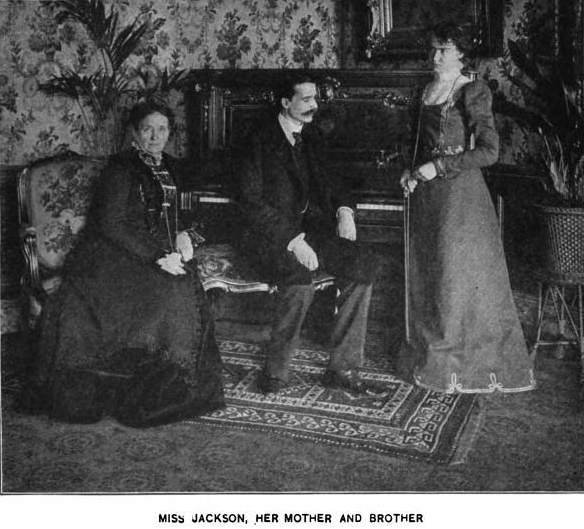
Although Mr. and Mrs. Jackson were married in California and are identified with the pioneer colony of that State, Leonora and Ernest, their two children, were born in Boston. The parents removed to Chicago while the children were still in their infancy, and it ws in the latter city that Leonora passed her childhood and early girlhood, and received her first violin lessons.

“I am proud to think,” remarks Miss Jackson’s loving and devoted mother, “that my daughter inherits her musical temperament from our side of the family. There was a family of twelve boys and girls, all musically inclined, in my father’s home. He was passionately devoted to music, and had a big organ built in the parlor, around which we gathered, night after night, singing the great choruses of the classics. I was sent to Italy to have my voice cultivated, and upon my return, after my marriage, I formed and conducted large singing classes. After Leonora came I resolved that she should be a singer or a pianist, like her brother Ernest, but even as a baby the sound a violin would send her into ecstasies of joy. ‘Buy the child a violin,’ said her grandfather. So we bought her a little violin, and I gave her her first lessons in the nursery, making believe that the notes were little girls and boys, whose homes were on the lines and spaces, and who each spoke with a different voice.”

At six years of age the child began to study seriously under the best masters the city afforded – Albert Ruff, Carl Becker, and Professor Jacobson. She made astonishing progress, and a brilliant future was predicted for her if she were sent abroad to pursue her studies. The child was taken to Paris and place under Professor Desjardins, of the Paris Conservatory. It was while in Paris, after her second year of study, that the shock came that changed Leonora Jackson from a merry, thoughtless child into a serious girl. News came that the entire fortune of the father was lost. Not a dollar remained. The son was taken from Harvard, and the mother and daughter, through the assistance of friends, returned home.

“It was a great blow,” remarked Miss Jackson. “Child as I was, I was suddenly confronted by poverty and the utter impossibility of continuing my studies. I knew I had the power to succeed, but how continue to pay for lessons and teachers? Mother knew that the position was desperate. At any price I must be sent to Europe to finish my education. We then devised the plan of giving little concerts, Brother Ernest as pianist and I as violinist, at the different seaside resorts during the summer, and with the proceeds sending me to Europe to study in the winter.”

For two years the girl struggled in this way to complete her education, notwithstanding the heavy strain on her body and mind. But her extraordinary talent forced recognition. When two wealthy women offered to pay her expenses abroad for four years, it was discovered that numbers of others insisted upon the privilege of sharing the expense. A subscription paper was started with twenty signatures representing six of the principal cities in the United States: New York, Chicago, Cincinnati, Philadelphia, Boston, and Washington.

The fund arranged for four years’ study in Berlin under Joachim, and the purchase of a beautiful Storioni violin. In January, 1894, Mrs. Jackson, accompanied by her son and daughter Leonora, sailed for Europe.

The outcome is well known. Miss Jackson made her début at the Berlin Philharmonic in the Brahms Concerto, Joachim himself leading the orchestra. She was commanded to appear before the empress, and then followed a series of engagements under the distinguished orchestra leaders of Germany. That same year she won the coveted Mendelssohn prize of fifteen hundred marks. Her triumphs since then at the Colonne concert in Paris, at the Hallé orchestra in London, at Windsor before the queen, in Scotland, Belgium, and Geneva, followed by twenty orchestral engagements in America, have been repetitions of her great successes in Germany.

“What is my aim in playing?” repeats the young virtuoso in reply to the question. “First a solid technique, then the message of some great immortal to be received and conveyed to others through the medium of my own individuality.”

2 Comments

Filed under Not My Writing, Women Violinists

Article: Violin Playing For Women, 1913

Sometimes while studying the history of violin performance in the early twentieth century, it is tempting to focus our attention on more “glamorous” soloist figures rather than more common “run-of-the-mill” teachers or chamber musicians. But of course, then as now, only a tiny percentage of professional musicians were actually traveling virtuosos. Sadly, women who wanted to pursue a career in music, who couldn’t or didn’t want to become soloists, found few doors open to them. Just like women in many other fields, women violinists had to deal with widespread and irrational prejudice; it was taken for granted that they would be less effective orchestral players than men, and until the advent of blind auditions in the mid-twentieth century, it was rare that they were given the chance to prove otherwise. Consequently their professional options were rather limited compared to their male colleagues’. This 1913 article, from The World’s Best Music: The Musician’s Guide, sheds some light on the subject of what professional options musical women actually had.

Note: The currency exchanges are only meant to be approximate.  They’re taken from MeasuringWorth.com.

***

Violin Playing for Women

By Alice Putnam

Musicians frequently receive letters from girl violinists, asking whether it would be advisable for them to go to college and prepare for school teaching, or to take up music as a profession. It is obviously impossible to answer such a question without knowing the individual girl, but in order to help girls to decide this question for themselves it is proposed to discuss the life of a professional violinist, and see of what its advantages and disadvantages consist.

There are four ways of earning a living with the violin – teaching, solo playing, trio or quartet work, and playing in an orchestra.

A girl’s success as a violin teacher depends entirely on her ability to make friends and to play the violin well, for unfortunately there is as yet no demand on the part of parents for pedagogical training for music teachers. A girl’s pupils will be mainly children, as grown persons usually prefer to study with men who have achieved international fame.

In large cities a girl generally goes to her pupils instead of having her pupils come to her. Many teachers prefer to do this, as studio rents, especially to musicians, are high. Also, one may charge for a lesson when one goes to the house, whether the lesson is given or not, whereas parents rarely take it pleasantly if one charges for the lesson after receiving word to the effect that “daughter has a cold and cannot go out to-day.” Private pupils are an uncertain quantity and studio rents come due inexorably once a month. Nevertheless, a good many young women prefer to pay from $30 to $60 [in modern currency, approximately $680 to $1360] a month for a studio rather than to spend the time and strength going to pupils’ houses.

From talking with many young women who are teaching, I gather that but few earn more than $3 [in modern currency, approximately $70] an hour, and very few indeed have their time all filled. And yet quite a fair living can be made by private teaching, and it has the advantage of bringing one into close and friendly relations with the pupil and often with the pupil’s family. Being one’s own master means hard work in building up the business, but it brings greater rewards in the end and is unquestionably far more interesting from day to day than bending to the wishes of the principal of any school.

It is more difficult to keep up a high standard of work with private teaching than in the classroom. There is not the same stimulus of rivalry and enthusiasm, nor is there a standard whereby one can measure the progress of a pupil. And it general happens that by the time a conscientious teacher begins to reap the rewards of her labor with a certain pupil and brings him to a point where his work begins to be really artistic, that pupil is whisked off to study with some famous European violinist, as though being famous as a player guaranteed his being a good teacher for that particular pupil.

Positions as violin teacher in boarding schools are not lucrative, the salary averaging from $400 to $600 [in modern currency, approximately $9,900 to $13,600] a year and board, and there are often the most ridiculous demands made of the teacher. She must not only teach the violin but she must be able to do forty other things as well, such as assisting in the piano department, teaching the banjo, guitar, theory of music, or assisting with the English work, or even riding horseback, as one school demanded. The violin teacher must also be ready at all times to chaperon or entertain the pupils. As if any one who could do all these things could amount to anything as a violinist!

In the state universities the salaries are a little larger, but few universities will employ a woman as violin teacher, as the young men students naturally prefer to study with a man. The violin teacher is usually expected to conduct the college orchestra also, and but few women have had an opportunity to learn conducting, or make good conductors even when they know how. However, if such a position can be secured, the woman who is fond of study and the university atmosphere will find herself in as nearly an ideal position as can be imagined.

The earnings of a music teacher are often largely increased by solo playing, which brings us to the next topic of discussion.

The opportunities for solo playing are various. There are the solos in private houses which are to be had even by young players – if they dress well and are pretty. A girl must play very well indeed to obtain engagements if she is plain and awkward.

Sometimes there are solo engagements to be had in connection with men’s choral society concerts, as a woman instrumentalist is supposed to add a pleasing variety to the program. There are also the large clubs, like the Union League Club of Chicago, and the woman’s clubs of all large cities, which give entertainments several times a year. The Masonic entertainments often pay well, while church entertainments rarely pay at all, but many a girl has received $5 for a solo at the Sunday services.

Another way of earning a living as a soloist is to travel with a concert company, but this is indeed hard work. The indifferent hotels of small towns, poor food, tedious train trips, and often undesirable company, make the life very unpleasant. One is often asked to play the same program over and over, as there is no opportunity for rehearsals. The only advantage to be gained in this work is in becoming accustomed to playing under all sorts of conditions and before all sorts of people. One must needs be gifted with a strong sense of humor to find fun in it after the first few days.

In order to secure engagements with a great orchestra a violinist must be already known as an artistic, sure player. No conductor will risk trying out a stranger before his public, for even the experienced are sometimes attacked by stage fright. So many players would give a good deal of money for an opportunity to appear with an orchestra, that occasions for the average young woman to earn money in this way are very rare indeed unless she has great talent. In this case the work will seek her instead of her seeking the work. In fact, to the girl with talent and perseverance all things are possible, but it takes a great deal of both before one arrives at playing with the grand orchestra.

Another and perhaps the most delightful way of earning a living with the violin is in the playing of chamber music. In this field one finds not only the most beautiful music to play, but also the most intelligent of audiences.

Engagements, like solo engagements, are to be found in clubs and private homes among friends. Also many young women find engagements for their trios or quartets in summer hotels, where they play one or two programmes a day and are free the rest of the time to amuse themselves with summer sports. Such engagements are often pleasant, especially if the other members of the trio are congenial. The amount paid for work of this kind varies, with the size of the hotel, but usually runs from $10 to $15 [in modern currency, approximately $230 to $340] a week and expenses, for each player.

Women’s orchestras are as variable and uncertain as the stock market. Women do not yet seem to be capable of regular, sustained organization, and good conductors will rarely bother long with them. This work, even under favorable conditions, does not pay very well for women. Many rehearsals are needed and the pay, if any, for rehearsals is not nearly so good as that for teaching during the same length of time.

When all is said and done, a woman’s success in earning a living with the violin, like any other business, depends largely on her power to make the right kind of friends and to inspire them with confidence in her. Women who are willing to put their profession first in their thoughts and lives, and make everything else, even home, secondary, usually succeed. But as a rule a girl only takes up a profession as a temporary thing, to fill up time until she marries. There are hundreds and hundreds of girls who, though they learn to play quite well, are never heard from professionally. But if a woman is willing to be thorough, to work hard, and if she is gifted with a good ear, a good memory, a naturally flexible hand, and an artistic temperament, she will find no more pleasant or profitable way to earn a living than with the violin.

Leave a comment

Filed under Not My Writing, Women Violinists

Article: The Effect of Music On The Growth of the Hair, 1896

I have just found what is possibly my favorite article on Victorian music ever. It is from the Boston Medical and Surgical Journal of 6 February 1896.

***

THE EFFECT OF MUSIC ON THE GROWTH OF THE HAIR.

The London correspondent of Le Temps writes that an English statistician has just demonstrated by figures the effect of music on the growth of the hair. The remarkable facts which he has discovered relate less to composers than to players. Among composers baldness is as frequent as among other professions, namely, twelve per cent., a proportion surpassed only by physicians, thirty per cent. of whom are said to be bald. The instrumental performer, however, almost always retained his hair up to an advanced period of life; performers on certain instruments retain their hair longer than others.

The piano and the violin, the piano in particular, prevent or arrest the loss of the hair. We are compelled to admit this on examining the portraits of Paderewski, Frederick Dawson, Vladimir di Pachmann, Léonard Borwich, Sapelloikoff, Henry Richard, Bird, and Emile Sauer, without including the prodigy, Joseff Hoffman, whose luxuriant growth of hair might be accounted for by his youth, even if he were not a pianist, and the aged Charles Hallé who died recently at an advanced age in possession of all his hair.

The same preservation of hair must be acknowledged to the violin, but in the players of this instrument the hair grows a little less luxuriantly, and there are a few cases of partial baldness. Eugéne Ysaye, Willy Hess, Sarasate, Tividar Nachez, Joachim, Betteman, Willy Burmseter, Fernandez Arboz, Johannes Wolf, Victor Wilhelms, all possess luxuriant heads of hair, but Louis Ries is compelled to use hair restorer, and John Tiplady Canodus could easily count the hairs which remain.

Similar observations have been made in the case of female violinists. The Swedish violinist Freda Scotta has an admirable head of black hair, and the yellow hair of the Austrian, Gabrielle Wietrowetz, falls to her feet.

Players on other instruments approach the mean of the learned professions, namely, about eleven per cent., of baldness. The ‘cello, the contra-bass, the alto and the harp preserve the hair fairly well, but one is not justified in placing much confidence in the hautboy, clarionette or flute, which do not guarantee the preservation of the hair much beyond the fiftieth year. On the other hand, brass instruments have a fatal influence on the growth of the hair, notably the cornet, the French horn, and the trombone, which apparently will depilate a player’s scalp in less than five years.

Our statistician simply states the facts, and leaves to scientific investigators the task of search for the causes which underlie them. It would certainly be interesting to find out why the slide trombone makes the hair fall out, while the piano preserves it. The statistician does not tell us, but his observations are well grounded, and will be easily confirmed by studying the musicians in the orchestras at concerts and theatres. The baldness which prevails among members of regimental bands has been given the name of “trumpet baldness,” calvitié des fanfares.

It would be interesting to know whether the predominance of brass instrument which the music of Wagner has introduced, has brought with it an increase of baldness among orchestras which are in the habit of rendering the music of that composer. It is also just possible that the baldness which is said to prevail among the habitués of the front rows at the theatre may be due to the proximity of the brass instruments, or may be caught by some contagion from the players themselves.

3 Comments

Filed under Not My Writing

Article: Addendum on Female Violinists by George Dubourg, 1852

Here is a fascinating chapter on female violinists from the book (take a deep breath!) The Violin: Some Account of That Leading Instrument, And Its Most Eminent Professors, From Its Earliest Date to the Present Time; With Hints to Amateurs, Anecdotes, Etc., by music writer George Dubourg (1799-1882). It was published in London in 1852 and, considering the era in which it was written, is a surprisingly liberal text. Dubourg had a prophetic viewpoint that women were just as capable of becoming great violinists as men were, and his spunky, spirited defense of his opinion makes for a highly enjoyable read. Wilma Norman-Neruda and Camilla Urso were both about twelve years old when this edition of The Violin was published, and they were just on the verge of proving Dubourg’s thesis right. No doubt in his later years he regarded their careers with satisfaction.

***

ADDENDUM

FEMALE VIOLINISTS.

“Place aux dames!”

[This section of the Work, which should have formed Chapter VIII, having been accidentally omitted in the printing [(Emily: *eyebrow raise*)], there remained no other course than, either to insert it here (as is actually done), or, by a dismissal utterly at variance with the laws of gallantry and of justice, to exclude it altogether, and so to debar the fairer portion of the community from all participation in the honours connected with the “King of Instruments” – an idea not to be for a moment entertained. If, in this volume, as in a campaigning army, the ladies find themselves placed altogether in the rear – let them attribute the position, in this case as in that, to any-thing but disrespect.]

Instead of a bow-arm, must ladies be allowed only the arm of a beau? Why should not a lady play on the Violin? The common objection is, that it is ungraceful. The ladies in Boccaccio’s Decameron, however – and who shall charge them with want of grace? – played on the viol, a bowed instrument requiring from the performer a similar position and handling to those exacted by the violin. If this latter instrument, considered in relation to a lady, should be admitted to be somewhat deficient in grace, – has not the lady, out of the overflowing abundance of this quality, which is her sex’s characteristic, some of it to spare for communication to the instrument? Can she not impart some of it to whatsoever object she chooses to associate with herself? Surely, she who can transform the rudest of beings from a bear to a man, and from a man to a gentleman, can lend a few spare charms to so grateful a receiver as the fiddle, which is found to repay in so eloquent a manner the attentions bestowed on it. But if the doubters continue to shake their heads at this, I would ask them whether, after all, we are to expect grace in every act and habit of a lady’s life, and call on her to reject every thing that may be thought inconsistent with it? Our modern respected fair one may, like Eve, have “heaven in her eye;” but really, looking at some of the offices which we are content to thrust upon her, it seems rather too much to insist that she shall also, like our original mother, have “grace in all her movements.” Is there grace in making a pie, or cutting bread and butter, or darning a stocking? If we have grace in the effect, shall we be rigid to require it in the means also? Now, the grace which belongs to violin-playing is audible rather than visible, residing in the effect more than in the means: nor ought we to be such cormorants of pleasure, as to demand that the person who is filling our ears with rapture, shall, at the same time, be enchanting to the utmost our eyes. If, then, a lady, full of soul and intelligence, is capable of expressing these through the fine medium which this instrument offers, should she be debarred from it, and restricted perhaps to the harp, because, forsooth, the grace that is merely external is found most in association with the latter? Let us only be reasonable enough to be satisfied, on principle, with the delicious effect that visits us through the ears, and we shall then give no hyper-critical heed to the rapid action of a lady’s arm in a presto movement, or to the depression of her head in holding the instrument; nor shall we continue to demand, with a pertinacity more nice than wise, that a feminine fiddler be

“Graceful as Dian when she draws her bow.”

That exquisite sensibility which is one distinguishing charm of the female character, has its fittest musical exponent in the powers of the violin, which, therefore, in this particular sense, might even be styled the women’s own instrument: but, without going so far as this, there seems no sufficient reason why it should not, occasionally, be honored by figuring in the hands of the fair. Should these defensive remarks, however, be found unsatisfactory by your anti-women’s-playing-the-violin-at-all sort of people, I have nothing farther to say to them, but leave them to quote, undisturbed, their “quae sunt virorum, mascula dicas,” &c. For my own part, I think so highly both of the ladies and the violin, that I rejoice at every opportunity of their being introduced to each other, and am delighted to know that, from time to time, certain clever and spirited women have been found ready to overcome the prejudices that have so long kept them asunder. Let us by all means enquire who these are.

A very high name meets us at the outset of our investigation – no less a one than that of QUEEN ELIZABETH. This exalted personage, who is recorded to have been musical “so far forth as might become a princess,” appears to have amused herself not only with the lute, the virginals, and her own voice, but with the violin. An instrument of this denomination, of the old and imperfect fashion, but splendidly “got up,” has been traced to her possession. If any particulars of Her Majesty’s style of performance could now be obtained, it would doubtless be found that she displayed, in no common degree, what is called “a powerful bow-arm”, but that she neglected the “sweet little touches” that give delicacy to execution.

To arrive at instances nearer to our own time, let us go at once from the Queen of England to Madame MARA, the Queen of Song. Her first musical studies were directed to the violin. When yet an infant, the little Gertrude Elizabeth Smaling (such was her name) discovered so strong an inclination for the violin, that her father was induced to give her a few lessons on that instrument. Her progress was so rapid, that, as early as her tenth year, she excited the public surprise. It is certain that the development of her vocal powers was not a little aided by this cultivation of an instrument that may be called the friendly rival of the human voice. She herself was known to declare, that, if she had a daughter, she should learn the fiddle before she sang a note; for (as she remarked) how can you convey a just notion of minute variations in the pitch of a note? By a fixed instrument? No! By the voice? No! but, by sliding the fingers upon a string, you instantly make the slightest variations visibly, as well as audibly, perceptible. It was by her early practice of the violin, that this celebrated woman had acquired her wonderful facility of dashing at all musical intervals, however unusual and difficult. She married a violoncellist, of no great capacity, except for drinking.

MADDALENA LOMBARDINI SIRMEN, who united to high accomplishment as a singer such an eminence in violin-playing, as enabled her, in some degree, to rival Nardini, had an almost European reputation towards the end of the last century. She received her first musical instructions at the Conservatory of the Mendicanti at Venice, and then took lessons on the violin from Tartini. About the year 1780, she visited France and England. This feminine artist composed a considerable quantity of violin music, a great part of which was published at Amsterdam. A curious document is extant as a relic of the correspondence between this lady and Tartini. It consists of a preceptive letter from the great master, the original of which, along with a translation by Dr. Burney, was published in London in 1771. From this pamphlet, which is now among the rarities of musical literature, I shall here give the Doctor’s English version of the letter:

“My very much esteemed

“SIGNORA MADDALENA,

“Finding myself at length disengaged from the weighty business which has so long prevented me from performing my promise to you, I shall begin the instructions you wish from me, by letter; and if I should not explain myself with sufficient clearness, I entreat you to tell me your doubts and difficulties, in writing, which I shall not fail to remove in a future letter.

“Your principal practice and study should, at present, be confined to the use and power of the bow, in order to make yourself entirely mistress in the execution and expression of whatever can be played or sung, within the compass and ability of your instrument. Your first study, therefore, should be the true manner of holding, balancing, and pressing the bow lightly, but steadily, upon the strings, in such manner as that it shall seem to breathe the first tone it gives, which must proceed from the friction of the string, and not from percussion, as by a blow given with a hammer upon it. This depends on laying the bow lightly upon the strings, at the first contact, and on gently pressing it afterwards; which, if done gradually, can scarce have too much force given to it – because, if the tone is begun with delicacy, there is little danger of rendering it afterwards either coarse or harsh.

“Of this first contact, and delicate manner of beginning a tone, you should make yourself a perfect mistress, in every situation and part of the bow, as well in the middle as at the extremities; and in moving it up, as well as in drawing it down. To unite all these laborious particulars into one lesson, my advice is, that you first exercise yourself in a swell upon an open string – for example, upon the second, or la: that you begin pianissimo, and increase the tone by slow degrees to its fortissimo; and this study should be equally made, with the motion of the bow up, and down; in which exercise you should spend at least an hour every day, though at different times, a little in the morning, and a little in the evening; having constantly in mind that this practice is, of all others, the most difficult, and the most essential to playing well on the Violin. When you are a perfect mistress of this part of a good performer, a swell will be very easy to you – beginning with the most minute softness, increasing the tone to its loudest degree, and diminishing it to the same point of softness with which you began; and all this in the same stroke of the bow. Every degree of pressure upon the string, which the expression of a note or passage shall require, will, by this means, be easy and certain; and you will be able to execute with your bow whatever you please. After this, in order to acquire that light pulsation and play of the wrist from whence velocity in bowing arises, it will be best for you to practise, every day, one of the allegros, of which there are three, Corelli’s solos, which entirely move in semiquavers. The first is in D, in playing which you should accelerate the motion a little each time, till you arrive at the greatest degree of swiftness possible. But two precautions are necessary in this exercise. The first is, that you play the notes staccato, that is, separate and detached, with a little space between every two, as if there was a rest after each note. The second precaution is, that you first play with the point of the bow and, when that becomes easy to you, that you use that part of it which is between the point and the middle and, when you are likewise mistress of this part of the bow, that you practise in the same manner with the middle of the bow. And, above all, you must remember in these studies, to begin the allegros or flights sometimes with an up-bow, and sometimes with a down-bow, carefully avoiding the habit of constantly practising one way.

“In order to acquire a greater facility of executing swift passages in a light and neat manner, it will be of great use if you accustom yourself to skip over a string between two quick notes in divisions. Of such divisions you may play extempore as many as you please, and in every key, which will be both useful and necessary.

“With regard to the finger-board, or carriage of the left hand, I have one thing strongly to recommend to you, which will suffice for all, and that is the taking a violin part – either the first or second of a concerto, sonata, or song (any thing will serve the purpose) – and playing it upon the half-shift; that is, with the first finger upon G on the first string, and constantly keeping upon this shift, playing the whole piece without moving the hand from this situation, unless A on the fourth string be wanted, or D upon the first; but, in that case, you should afterwards return again to the half-shift, without ever moving the hand down to the natural position. This practise should be continued till you can execute with facility upon the half-shift any violin part, not intended as a solo, at sight. After this, advance the hand on the finger-board to the whole-shift, with the first finger upon A on the first string, and accustom yourself to this position, till you can execute every thing upon the whole shift with as much ease as when the hand is in its natural situation; and when certain of this, advance to the double-shift, with the first finger upon B on the first string. When sure of that likewise, pass to the fourth position of the hand, making C with the first finger, upon the first string: and, indeed, this is a scale in which, when you are firm, you may be said to be mistress of the finger-board. This study is so necessary, that I most earnestly recommend it to your attention.

“I now pass to the third essential part of a good performer on the Violin, which is the making a good shake; and I would have you practise it slowly, moderately fast, and quickly; that is, with the two notes succeeding each other in these three degrees of adagio, andante, and presto; and, in practice, you have great occasion for these different kinds of shakes; for the same shake will not serve with equal propriety for a slow movement as for a quick one. To acquire both at once with the same trouble, begin with an open string – either the first or second, it will be equally useful: sustain the note in a swell, and begin the shake very slowly, increasing in quickness by insensible degrees, till it becomes rapid. You must not rigorously move immediately from semiquavers to demisemiquavers, or from these to the next in degree; that would be doubling the velocity of the shake all at once, which would be a skip, not a gradation; but you can imagine, between a semiquaver and demisemiquaver, intermediate degrees of rapidity, quicker than the one, and slower than the other of these characters. You are, therefore, to increase in velocity, by the same degrees, in practising the shake, as in loudness, when you make a swell.

“You must attentively and assiduously persevere in the practice of this embellishment, and begin at first with an open string, upon which, if you are once able to make a good shake with the first finger, you will, with the greater facility, acquire one with the second, the third, and the fourth or little finger, with which you must practise in a particular manner, as more feeble than the rest of its brethren.

“I shall at present propose no other studies to your application: what I have already said is more than sufficient, if your zeal is equal to my wishes for your improvement. I hope you will sincerely inform me whether I have explained clearly thus far; that you will accept of my respects, which I likewise beg of you to present to the Princess, to Signora Teresa, and to Signora Clara, for all whom I have a sincere regard and believe me to be, with great affection,

“Your obedient and most humble servant,

“GIUSEPPE TARTINI.”

REGINA SCHLICK, wife of a noted German Violoncellist and Composer, was celebrated under her maiden name of Sacchi, as well as afterwards, for her performance on the violin. She was born at Mantua in 1764, and received her musical education at the Conservatorio Pietà, at Venice. She afterwards passed some years at Paris. This lady was a particular friend of Mozart’s, and, being in Vienna, about the year 1786 solicited the great composer to write something for their joint performance at her concert. With his usual kindness, Mozart promised to comply with her request, and accordingly, composed and arranged in his mind the beautiful Sonata for the piano and violin, in B flat minor with its solemn adagio introduction. But it was necessary to go from mind to matter – that is, to put the combined ideas into visible form, in the usual way. The destined day appeared, and not a note was committed to paper! The anxiety of Madame Schlick became excessive, and at length the earnestness of her entreaties was such, that Mozart could no longer procrastinate. But his favorite and seductive game of billiards came in the way; and it was only the very evening before the concert, that he sent her the manuscript, in order that she might study it by the following afternoon. Happy to obtain the treasure, though so late, she scarcely quitted it for a moment’s repose. The concert commenced: the Court was present, and the rooms were crowded with the rank and fashion of Vienna. The sonata began; the composition was beautiful, and the execution of the two artists perfect in every respect. The audience was all rapture – the applause enthusiastic: but there was one distinguished personage in the room, whose enjoyment exceeded that of a ll the other auditors – the Emperor Joseph II, who, in his box, just over the heads of the performers, using his opera-glass to look at Mozart, perceived that there was nothing upon his music-desk but a sheet of white paper! At the conclusion of the concert, the Emperor beckoned Mozart to his box, and said to him, in a half-whisper, “So, Mozart, you have once again trusted to chance!” – “Yes, your Majesty,” replied the composer, with a smile that was half triumph and half confusion. Had Mozart – not studied – but merely played over, this music once with the lady, it would not have been so wonderful: but he had never even heard the Sonata with the violin*.

* Anecdotes of Mozart, by Frederic Rochlitz.

LOUISE GAUTHEROT, a Frenchwoman, was also distinguished on this instrument. In 1789 and 1790, she performed concertos at the London Oratorios, making great impression by the fine ability she manifested. In referring to this lady’s professional achievements, one of those who refuse to consider violin-playing as “an excellent thing in woman,” has indulged in the following remarks: “It is said, by fabulous writers, that Minerva, happening to look into a stream whilst playing her favorite instrument, the flute, and perceiving the distortion of countenance it occasioned, was so much disgusted, that she cast it away, and dashed it to pieces! Although I would not recommend, to any lady playing on a valuable Cremona fiddle, to follow the example of the goddess, yet it strikes me that, if she is desirous of enrapturing her audience, she should display her talent in a situation where there is only just light enough to make darkness visible.” – Shall we reply, ladies, to a detractor who is forced to seek support for his opinions in “fabulous writers,” and, even then, drags forward that which is no parallel case? Nay, nay, let him pass! Let him retire into the darkness which he so unwarrantably recommends to others!

LUIGIA GERBINI, who ranks among the pupils of Viotti, attained considerable credit as a performer. In 1799, her execution of some violin concertos, between the acts, at the Italian Theatre in Lisbon, was attended with marked success; as were afterwards her vocal exertions at the same Theatre. This lady visited Madrid in 1801; and, some years later, gave evidence of her instrumental talent at some public concerts in London.

SIGNORA PARAVICINI, another pupil of Viotti’s, earned a widely spread fame as a violinist. At Milan, where various fêtes were given in celebration of the battle of Lodi, the wife of Bonaparte was very favorably impressed, during one of these, by the taletns of Madame Paravicini. Josephine, a woman of generosity as well as taste, became the patroness of this lady, engaged her to instruct her son, Eugéne Beauharnois, and afterwards took her to Paris. However, for some reason not publicly known, Madame Paravicini was, after a time, neglected by Josephine; in consequence of which, and of other misfortunes, as to be compelled to live on the money produced by the sale of her wearing-apparel. Driven at last to the utmost exigence, she had no remaining resource, except that of applying to the benevolence of the Italisn then in Paris, who enabled her to redeem her clothes, and return to Milan. There, her abilities again procured her competence and credit. Her performance was much admired also at Vienna, where, in 1827, she

“Flourished her bow, and showed how fame was won.”

According to the report which travelled in her favour from thence, she evinced a full and pure tone – a touch posessing the solidity and decision of the excellent school in which were formed a Kreutzer and a Lafont – and a mode of bowing so graceful, as to triumph over all preconceived ideas of the awkwardness of the instrument in a female hand. Madame Paracivini, in the course of her professional migrations, was performing at Bologna in the year 1832.

CATARINA CALCAGNO, born at Genoa in 1797, received, as a child, some instructions from the potential Paganini; and, at the age of fifteen, astonished Italy by the fearless freedom of her play – but seems to have left no traces of her career, beyond the year 1816.

Madame KRAHMEN, in 1824, executed a violin concerto of Viotti’s, with great spirit and effect, at a concert in Vienna. At Prague, in the same year, a young lady named SCHULZ gave public delight as a violin performer. Mademoiselle ELEANORA NEUMANN, of Moscow, pupil of Professor Morandi, also astonished the public in like manner at Prague, and at Vienna, when she had scarcely reached her tenth year! She is said to have treated the instrument with great effect, and with a precision and purity of tone not always to be found in those “children of larger growth” who are content to substitute feats of skill, in place of these essential requisites.

Madame FILIPOWICZ, of Polish derivation, has given us evidence, in London, not many years since, of the success with which feminine sway may be exercised over the most difficult of instruments.

The instances I have thus brought forward will probably be deemed sufficient – else were it easy to go backward again in date, and to mention Horace Walpole’s visit to St. Cyr, in one of the apartments of which serious establishment, he behold the young ladies dancing minuets and country-dances, while a nun, albeit “not quite so able as St. Cecilia,” played on the violin! – Or, I might allude to the threefold musical genius of Mrs. Sarah Ottey, who, in 1721-22, frequently performed solos at concerts, on the harpsichord, violin, and base-viol! Enough, however, has been produced, to shew “quid femina possit” – what the fair sex can achieve, upon the first and most fascinating of instruments.

Leave a comment

Filed under Not My Writing, Women Violinists

Article: Female Violinists from The Contemporary Review, 1872

Here’s an article about female violinists from The Contemporary Review, dating from 1872. There were clearly some lazy writers in the Victorian era, because this is basically just a less-characterful compression of an article on the same subject by George Dubourg from 1852.

***

A great deal has lately been said about the propriety of ladies playing the violin. Some people seem to think it quite a novelty, but the practice in England at least is old enough.

On the painted roof of Peterborough Cathedral, said to be not later than 1194, is depicted a female figure seated and holding on her lap a sort of viol with four strings and four sound-holes: her left hand grasps the head, whilst she draws a bow across the strings with her right. Amongst the royal accounts, November 2, 1495, we  read, “To a woman who singeth with a fidell, 2s.; the queen’s male ‘fideler’ of the period, Feb. 17, 1497, was paid ‘in rewarde,’ £1 6s. 8d.”

Poor Anne of Cleves, after her divorce from Henry VIII, amused herself sometimes by playing on a sort of viol with six strings and frets, but no distinct finger-board. From a ballad in Charles I’s reign, we find that the art of viol playing was not uncommon amongst ladies; and amongst the accomplishments of a lady, we read that –

“She sings and she plays

And she knows all the keys

Of the viol de Gamba and lute.”

In more modern times ladies have excelled on the violin. Mozart wrote a sonata for Regina Schlick, born at Mantua, 1764. Louise Gautherot, a Frenchwoman, was also distinguished for her concertos played at the London Oratorio Concerts, 1789-90. Luiga Gerbini, a pupil of the celebrated Viotti, played solos at Lisbon in 1799, and afterwards visited London in 1801.

Signora Paravicini, another of Viotti’s pupils, was a favourite of Josephine, the wife of Buonaparte. She afterwards grew so poor as to be obliged to part with most of her wardrobe, but was charitably helped by some generous Italians at Milan. In 1827 she was much admired, and in the words of a poet –

“Flourished her bow and showed how fame was won.”

She played at Bologna as late as 1832.

The names of Mesdames Krahmen, Schultz, Eleonora Neumann, and Filipowicz, will be familiar to some of our readers, whilst few living musicians will need to be reminded of Mdlle. Sophie Humler, Mdlle. Vittoria de Bono, and Madame Norman-Neruda.

It may once have been maintained that the arm of a beau was more fit for a lady than a bow arm; but that prejudice has now happily vanished. Indeed nothing can be more appropriate in a lady’s hands than a violin properly held and properly played. If she have a good arm it is shown to the best advantage; if she have a pretty hand a tapering fingers, and a slender wrist, all these are thrown into the most graceful positions by the action of bowing and fingering.

Her arms, shoulders, and hands, her head and neck, and indeed her whole body have but to follow sympathetically the undulating and delicate curves of the violin itself. A beautiful woman holding a beautiful violin, is one of the most beautiful sights in the world. There are refinements of sentiment and of execution, which a woman’s sensitive hand is peculiarly fitted to render; in delicacy of touch and finely gradated effects she is unsurpassed, and although usually deficient in roundness of tone, yet both in rapidity of execution and melting pathos, have we not lately seen in the case of Madame Norman-Neruda “quid faemina possit!”‘

Leave a comment

Filed under Not My Writing, Women Violinists

Being Present

Late last month I went to visit some friends in Minneapolis. Before I left town I posted an innocent straightforward question about bowing variations on the violinist.com discussion board; when I came back, I logged in to see what my fellow fiddlers had to say. I was expecting an answer or two. As of this writing, there are twenty-seven. Granted, they contradict each other – but still, they were all thought-provoking. Surprisingly, the main thing I’ve taken away from the discussion is not how to practice bowing variations, but rather something deeper: I need to be more present when I practice. I need to pay more attention to what I’m doing. I have a feeling that if I am and if I do, those bowing variations will fall into place. Or at the very least be easier.

Earlier today I remembered that back in March 2009 Laurie Niles talked with James Ehnes about focusing during practicing. So this afternoon I clicked back for a much-needed reread. Ehnes was the guy who just about singlehandedly made me take this violin stuff seriously, and I remember reading this interview when it was first posted (actually more than once *cough*). The bit about focusing during practice really stuck out to me. I remember admiring the sentiment, and finding it to be very wise, and well worth listening to. But apparently my admiration is occurring on some far distant mental plane, because you know what? I’m not listening.

In modern Internet parlance: D:

I’ll describe a bit of my thoughts as I read. Bold is Ehnes. Italic is me.

Sometimes, when people learn a piece, they’re very focused.

*thinks back to the early days of learning Bruch a year ago* Mm-hmm. They have to be.

They have to be.

Exactly.

They have to be, they’re first getting it in the hands. Then when they are actually in the preparation-for-performance phase, they get into this sort of a trance-like run-through phase. They’ll run it through, every day. I gotta run it through, gotta run it through… The mind starts to get a little bit on autopilot.

Old news, Mr. Ehnes. I should be able to haul out a metaphorical fingernail file to use to while away the time as I read these words. I have, after all, played for twelve years, and this is kinda sorta one of those basic things that a person learns early on.

But…

I can’t help but think of all the times during my recent “practice sessions” where I’ve run through Bruch “for fun.” In the hallway at orchestra rehearsal. In the front hall in front of a mirror. In the bathroom in front of a mirror. In the bedroom in front of a mirror. In the bedroom not in front of a mirror. Anywhere in the house, for no reason whatsoever besides the fact that life is short and stressful and invariably depressing and sometimes a girl just needs to hammer through some gritty wangsty Germanic Romantic-era quadruple stopped chords, you know?, and does it really matter if they always sound muted and smothered?, because I mean, unlike some people, I really love the Bruch, and I respect it, I really do, and someday obviously I’ll get to those quadruple stops, and actually work on them, and do some bowing exercises, and fingering exercises, or whatever the heck kind of exercises one does to improve quadruple stops, and all of them will ring nice and clear someday, and I’m sure I’ll be able to play them on command flawlessly and they will be lovely and beautiful and – what were we talking about? Focusing? Right.

Laurie then asked Ehnes: “How do you make the focus happen?”

Yes, James. How do you make the focus happen? Tell us.

*takes a deep breath*

*prepares for massive life-changing earth-shattering revelation*

Just stop, start from where you last knew you had your focus, and really pay attention, really listen.

Sigh.

Is there anything in the world that sounds easier? Is there anything in the world that’s more difficult?

Maybe he has a shortcut…

*scrolls down to see if he mentions a shortcut*

People who practice well can get more done in an hour than people who practice poorly can get done in a lifetime.

Yes, I agree with this. But what you’ve just described is hard. And I’m not so keen on hard. You’re a frigging violin god. Can you spare a shortcut for a mortal?

The focus during practice sessions is so important.

*muttering* There is no shortcut, is there?

Too many young people get caught up in “time,” logging the hours.

FOR SHAME, young people. FOR SHAME. I’ve never been concerned about “time” or “logging the hours” or felt pride because I’ve played two or three hours in an afternoon without a goal or knowing if I’ve achieved it. Never ever ever done that. Especially recently. Never. *shifty eyes*

If people can have a particular goal in mind, and if reaching that goal can take on more important than just logging the hours, then I think real progress can start to happen. Of course, you want to make sure that the student is spending enough time to build up stamina, and build up that level of concentration. But when you are dealing with advanced students, if they’re saying, “Now I’m 16, now I’m getting serious about getting into the conservatory so now I need to practice X number of hours a day…” Well, maybe you should think of it in terms of, “I want to learn this piece and this piece, by this time,” that might be a more valuable way of looking at it.

*deep breath* Okay. This is familiar. Buri has said this before. Multiple times. He talks about this about as often as he discusses prunes. Maybe more often. And if Buri and Ehnes say it, then as far as I’m concerned, it’s Violinistic Gospel.

So…

You know…

Sigh…

I should work on this.

Now I’m looking back and cringing, thinking of all the times I’ve played through Bruch in a distracted totally half-*ssed manner, using it as a brainless emotional release valve way before it should have been used as such. Granted, 2011 has been Emily’s Year From The Deepest Innermost Pits of Hell (TM), and everything and everybody in my life is shifting and evolving and changing, and I’ve never been so distracted in my life, and oh, did I mention that I’ve had a crappy craptastic year of crappiness? And so I acknowledge that a little distraction is warranted. But…still. It’s a little dispiriting I didn’t even have a clue this was happening. It’s terrifying, really. What else have I been doing on auto-pilot? What else am I doing without realizing? Will I catch myself in time?

I need to shift my perspective. Recalibrate. I do this with my violin-playing every year or so, and it always helps. I need to go through my practice routine and see what stays and what goes. Scales: I need to figure out what I’m doing with them. They need a purpose; they deserve more than to be my precursory warm-up exercise. Kreutzer: I don’t need to learn how to play Kreutzer, I need to learn why I’m playing Kreutzer. What is each etude helping with? If I don’t know, then why the hell am I playing them? Bruch: if I choose to keep working on this (and I may ultimately decide to set it aside for a while), I’ll need to print out new music and really start afresh, isolating the tricky sections and working diligently with the metronome. In short: less what, more why. Less what, more why. Less what, more why.

In other words, I need to Be Present.

Who needs therapy when you play the violin?

(Or should that be, if you play the violin, then you really should be in therapy?)

2 Comments

Filed under My Writing

Article: A Quick Chat With the Eissler Sisters

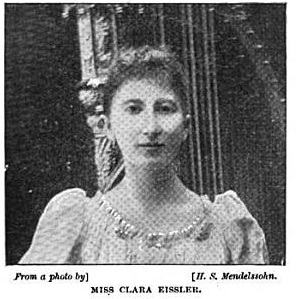
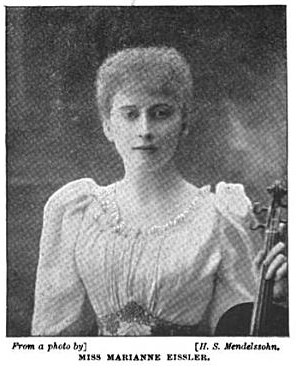
For whatever reason, musical talent often runs in families. Look at Lady Hallè, who was born into a family of prodigies – or the sisters Teresa and Maria Milanollo – or, nowadays, siblings Scott and Lara St. John. The Eissler sisters were two prominent Victorian sibling musicians. Clara was a harpist and Marianne a violinist. Here is a short excerpt from an article entitled “Moments with Modern Musicians” by F. Klickmann that appeared in early 1896 in The Windsor Magazine.

***

…Our final moments are to be spent with those two clever musicians the Misses Eissler. Like Herr Stavenhagen they are not natives of our foggy land, but unlike him they have made a permanent home with us. This is the more singular seeing that both the sisters hold official appointments at a foreign Court, Miss Clara Eissler being Court Harpist and Miss Marianne Eissler Court Violinist to the Duke of Saxe-Coburg Gotha. When State functions require their attendance, the sisters take a journey abroad to fulfil their engagements, after which they return to their home in Redcliffe Square.

It was in Miss Clara Eissler’s boudoir that I first heard the story of their earlier years. I had been wandering around the room looking at the innumerable portraits of the ever youthful Madame Adelina Patti. To no one are they more attached than to the prima donna, and, there is no lack of evidence – if one may judge by the inscriptions on the photographs – that the affection is mutual. Another photo that also attracted my attention was of a bright-faced happy-looking boy in a sailor suit. It bore an inscription, written in a round schoolboy hand – “Alfred, 1887.” When I commented upon this I was shown a diamond and sapphire ring that had been presented to Miss Marianne Eissler by the royal parents of the little sailor boy. Inside the ring is engraved, “From the Duke and Duchess of Edinburgh.”

This Misses Eissler are natives of Brünn, Moravia – a town already famous in the annals of violinists. Ernst was born there, also Wilhelmina Neruda (now Lady Hallé) and her brother Franz Neruda, the ‘cellist.

Herr Eissler was a professor of science at the Brünn University. On his death however Madame Eissler removed to Vienna, in order that her daughters might have greater musical advantages than was possible in Brünn.

“How was it that you made the harp your specialty?” I inquired of Miss Clara Eissler, after examining the exquisite instrument that had been made for her by Messrs. Erard.

“When I was ever so small I used to be taken to the concerts at the Vienna Conservatoire, where my sisters were studying, and the harp always fascinated me greatly. I made up my mind that if ever I played anything it must be the harp. At last they agreed that I should at any rate try what I could do with it, and when I was seven years old I likewise became a student at the Conservatoire and was placed under Zamara. Later on I studied under Hasselmans in Paris.”

“Seven years old seems very young to enter a Conservatoire,” I remarked.

“No, I think not. My sister Marianne began her studies at Vienna when she was the same age. By the way, it was rather curious that her first master at the Conservatoire was Professor Heissler.”

Our conversation was interrupted by the appearance of the young violinist herself, who had just returned from fulfilling an engagement at an afternoon concert. At my request she exhibited her beautiful “Carlo Bergonzi” violin, which bears the date 1732. This violin cost £400, and was presented to her by her friends in London. Violin collecting is a pardonable weakness in which Miss Marianne Eissler indulges; her partiality for autographs is a less expensive pursuit, however.

Miss Clara Eissler – who has a most artistic eye for such matters – finds her chief delight in arranging furniture and generally beautifying the home, while her favourite pastime is playing billiards.

The sisters have the highest regard for the musical ability of our royal family.

“I have heard that her Majesty takes a great interest in the music that is performed before her,” I said.

“Yes, and not only the Queen but likewise the princes and princesses,” Miss Clara Eissler replied. “On one occasion when my sister was playing at a concert in Portsmouth the Duke of Edinburgh came into the artists’ room and shook hands with her, and said how much he had enjoyed her playing, adding, ‘I have heard you play that solo before,’ and he mentioned the occasion on which she had previously played it. It is surprising how they can possibly remember trivial things like that, and yet they do.”

“You have often played before the Queen?”

“Yes we have played before her Majesty on several occasions. Once she honoured us so far as to command an encore.”

Our musical chat was finally broken up by Tristan – a terrier belonging to the harpist – who noisily demanded to be admitted to his mistress’s domain without further delay. The rest of our time we employed in trying to induce that quadruped to perform certain tricks in view of a prospective piece of sugar. But he was a superior dog and declined to sell his genius to so base an end – though he ultimately ate the sugar with little compunction.

Leave a comment

Filed under Not My Writing, Women Violinists

Writing About Music Is Like Dancing About Architecture, As The Saying Goes…

I love every part of the Haydn. It is a quartet that I can hear in any mood and can play in any mood. The headlong happiness of the allegro, the lovely adagio where my small figures are like a counter-lyric to Piers’s song; the contrasting minuet and trio, each a mini-cosmos, yet each contriving to sound unfinished; and the melodious, ungrandiose, various fugue – everything delights me. But the part I like best is where I do not play at all. The trio really is a trio. Piers, Helen and Billy slide and stop away on their lowest strings, while I rest – intensely, intently. My Tononi is stilled. My bow lies across my lap. My eyes close. I am here and not here. A waking nap? A flight to the end of the galaxy and perhaps a couple of billion light-years beyond? A vacation, however short, from the presence of my too-present colleagues? Soberly, deeply, the melody grinds away, and now the minuet begins again. But I should be playing this, I think anxiously. It is the minuet. I should have rejoined the others, I should be playing again. And, oddly enough, I can hear myself playing. And yes, the fiddle is under my chin, and the bow is in my hand, and I am.

That passage is from Vikram Seth’s 1999  novel An Equal Music, which delves into the lives of a circle of professional classical musicians. There are a lot of striking elements in the book, but for me the highlight is how beautifully Seth describes his characters’ performances.

I’m currently writing a short story about a string-playing protagonist. I ended up plotting it in such a way that it’s more about his debilitating obsession with his career and his fractured relationships with other people than it is about his actually playing any music. An important audition takes place smack-dab in the middle of it that I’m not even going to attempt to dramatize. I could sit here and come up with some convoluted reason why this is so (I made a deliberate artistic decision to focus on his life around his performances, because um, the lack of actual performances symbolizes the lack of fulfillment his career and, um, the music world in general has brought him – yes! yes, that’s it exactly), but to be honest, I think subconsciously I’ve shied away from describing performance simply because doing so is just so – damned – difficult.

If the Detritus Review is any indicator, plenty of other writers struggle mightily, too. The Detritus is a blog clogged full of the most egregiously awful classical music reviews contemporary journalism has to offer, where a team of snarky musical know-it-alls deconstruct the work of hapless writers on deadline. I always feel conflicted reading their entries. Many times I find myself choking with derisive laughter at nonsensical reviews which all too often sound like the result of some tequila-fueled musical Mad Libs game gone horribly, horribly wrong…but there’s always a nagging voice in the back of my head – if you had a deadline and a word count and an unsympathetic editor, could you do much better?

Heh.

Why is music so difficult to write about with beauty, grace, and clarity? Is it really any more difficult to write about than other subjects? (It certainly seems so to me, but maybe that’s because I care more for music than I do for anything else, and have a lower tolerance for bad or lazy writing about it.) How can people who want to write better about music? I suppose the standard rules of good writing apply (clever word choice, correct sentence structure and grammar, specific evocative imagery, etc., etc., etc.), but I think there other elements at play, as well. Actually, when you actually stop to think about it, it’s overwhelming how many well-honed skills a truly great music writer has to be able to bring to the table…many of them only peripherally related to writing ability. In an ideal world, he or she should have a long experience of concert-going – a familiarity with the repertoire – a knowledge of the history and the performance conventions of the repertoire – a familiarity with artists – some idea of the obsessive, often perfectionistic psychology of the people onstage – a quick observational talent – a truly intense focus – an ability to convert vague impressions to concrete ideas – maybe even experience actually performing the pieces in question him or herself… I could go on, but will spare you.

What, in your opinion, makes or breaks music writing, in either fiction or non-fiction? Who are the greatest practitioners of the art out there? And maybe most importantly: what can we do to become better writers and communicators away from our instruments?

Just some idle thoughts I had while procrastinating about finishing up that story…

3 Comments

Filed under My Writing

Great Female Violinists: A List

The following is a list of professional women violinists who were born before 1920. It is by no means exhaustive, but as I get more and more information, expect more and more biographies. Let me know if your favorite isn’t on the list!

Remember, you can hear many of these women on my Youtube channel.

This list was last updated on 23 August 2011.

***

Grażyna Bacewicz (1909-1969). Bacewicz was born in Poland and studied violin, piano, and composition at the Warsaw Conservatory. She studied under Carl Flesch in the 1930s. Later in life she shifted her professional focus away from performing and onto composition, a field in which she found great success. Her output includes seven violin concertos.

Grazyna Bacewicz

Ethel Barns (1874-1948). Barns was a British violinist, pianist, and composer. She and her husband, baritone Charles Phillips, established a concert series called (appropriately enough) the Barns-Phillips Chamber Concerts. She was passionate about furthering the cause of women in music, and she wrote at least two violin concertos.

Ethel Barns

Lady Ann Blunt (1837-1917). A granddaughter of Lord Byron, Lady Blunt was a polyglot, artist (she studied with John Ruskin), equestrian, and violinist. She and her husband, the adulterous Wilfrid Scawen Blunt, shared a mutual passion for Arabian horses. (In fact, according to Wikipedia, “the vast majority of purebred Arabian horses trace their lineage” to their stock.) She studied under violinist Leopold Jansa, who also taught Wilma Norman-Neruda. Her Stradivari, the 1721 Lady Blunt, was sold in 2011 for $15.9 million.

Lady Ann Blunt

Guila Bustabo (1916-2002). Bustabo was born in Manitowac, Wisconsin, and began to play the violin at the tender age of two. As a child she studied in Chicago and at the Juilliard School in New York. While living in Europe in the forties, Guila played under William Mengelberg, a conductor who came under criticism after the war for not doing more to resist the Nazis. General Patton actually arrested Guilia after hearing that she had worked with Mengelberg, although all charges against her were later dropped. According to Wikipedia, this incident limited her career opportunities in the United States; however, there are also indications that her bipolar disorder may also have contributed to her professional decline. Her recordings of the Sibelius, Bruch, and Wolf-Ferrari concertos (the latter of which was written for her) are landmarks in the discography. She later taught at the Innsbruck Conservatory and played in the Alabama Symphony.

Guila Bustabo

Lillian Shattuck (1857-1940). Shattuck studied under Julius Eichberg in Boston and around 1878 formed the first all-female string quartet in America, called, appropriately enough, the Eichberg Quartet. The members of the group traveled to Berlin to study under Joachim; reportedly he was so astonished to see an all-female group from America that he permitted them all entry to the Conservatory. Shattuck later became an important pedagogue in the Boston area.

Vivien Chartres (1893-1941). Chartres, the daughter of renowned author Annie Vivanti, was one of the foremost British prodigies of the late Victorian era. She was often compared in the press to Mischa Elman and Bronislaw Huberman, and she toured throughout Europe to great acclaim. Her mother wrote a fascinating novel loosely based on her life called The Devourers in 1910. In her later childhood, Chartres gave up touring, although she kept a violin for the rest of her life.

Vivien Chartres

Renée Chemet (c 1888-?). Chemet is somewhat of an enigma. She left us several lovely recordings, including one of the Japanese song Haru no umi (Sea in Springtime), but our knowledge of her career post-1930 is fuzzy. Some refer to her as “the French Kreisler.”

Renee Chemet

Jelly d’Aranyi (1893-1956). D’Aranyi was born in Budapest into a musical family (her great-uncle was Joseph Joachim, and her sister Adila was a famous violinist in her own right). She had fruitful creative relationships with many of the most important composers of the early twentieth century, including Ravel, Bartók, and Vaughan Williams. She was also a sensitive, and along with her sister Adila, she “uncovered” the Schumann violin concerto in a séance. (This is a rather long and interesting story.)

Jelly d'Aranyi

Santa della Pietà (early to mid-1700s). Santa della Pietà was a violinist, singer, and composer at the Ospedale della Pietà, a Venetian music school for female orphans. (Vivaldi famously taught at the Ospedale and wrote large amounts of repertoire for his female pupils.) She was only one of many talented women musicians (including women violinists) who worked at the Ospedale. See the documentary “Vivaldi’s Women” for more information.

Adila Fachiri (1886-1962). Fachiri was born in Budapest into a musical family (her great-uncle was Joseph Joachim and her sister Jelly d’Aranyi). She began to study violin when she was ten, but despite her relatively late start, she advanced extremely quickly. She married Alexander Fachiri in 1915. Several important composers dedicated works to her.

Adila Fachiri

Stefi Geyer (1888-1956). Geyer was born in Budapest, began playing the violin at the age of three, and proved to be a prodigy. She studied with Jenő Hubay in Budapest and toured throughout Europe as a child. When she was a teenager she met Béla Bartók, who promptly fell in love with her and wrote his first violin concerto for her. She never played the work…and never returned Bartók’s affections. Later in her life another composer Othmar Schoeck fell in love with her, and also wrote her a violin concerto. Geyer had a long successful career teaching and performing.

Stefi Geyer

Marie Hall (1884-1956). Hall was born to a poor family in northern England. She was a prodigy, but her family could not afford to send her to a prestigious institution to study. However, in 1901, upon the advice of Jan Kubelík, she made it into Ševčík’s studio in Prague. She had a fantastic debut in 1902 in that city and later became a sensation in London. Vaughan Williams wrote The Lark Ascending for her, and they consulted over revisions to the piece.

Marie Hall

May Harrison (1890-1959). May was one of four musical sisters (Beatrice was a cellist, Monica a singer, and Margaret a violinist). At eleven, May won a scholarship to attend the Royal College of Music. Later she studied in St. Petersburg with pedagogue Leopold Auer. She championed the Brahms double concerto (with Beatrice on cello) and the music of her fellow countryman Frederick Delius. Her quick-study skills were legendary: she learned the massively demanding Elgar concerto in two weeks.

May Harrison and her sister Beatrice

Leonora Jackson (1879-1969). Jackson was born in Boston and studied in Chicago, Paris, and Berlin. In Berlin she was a pupil of Joachim. Frances Cleveland, the former First Lady, provided Jackson with financial support for her studies. Jackson toured throughout the world, playing on a Stradivari from 1714. She retired upon her marriage at the age of 36.

Leonora Jackson

Hélène Jourdan-Morhange (1892-1961). Jourdan-Morhange was a close friend of Maurice Ravel’s (in fact, there is a rumor that he once proposed marriage to her). She met him after a performance in which she played his piano trio. Ravel dedicated his sonata for violin and piano to her, but arthritis kept her from ever performing it. He mused about writing a violin concerto for her, but unfortunately this project never materialized. She later wrote a book about her friendship entitled Ravel et nous.

Helene Jourdan-Morhange

Daisy Kennedy (1893-1981). Kennedy was born in south Australia. She began learning the piano at four and the violin at seven. When Jan Kubelík came to visit Australia, she secured a meeting with him, as well as a letter of recommendation to Kubelík’s teacher, Sevcik. She was a great musical success in both Europe and the United States. She is distantly related to violinist Nigel Kennedy.

Daisy Kennedy

Teresa Milanollo (1827-1904). Milanollo was one of the first great female violinists. Despite her being a girl, her father encouraged her studies and even relocated from Italy to Paris so that she might learn from the best teachers. She and her violinist sister Maria made an extraordinary impact on the European music scene in the 1840s, creating sensations akin to those that greeted Paganini and Liszt. One of her great passions was charity work. She largely retired from the concert stage after her marriage at the age of thirty. Despite her relatively short career, she opened many doors for the multitudes of female violinists who would follow in her footsteps.

Teresa Milanollo

Alma Moodie (1898-1943). Moodie was born in Australia. When she was nine, she won a scholarship to study at the Brussels Conservatory. As a teenager, she befriended famous composer Max Reger, who conducted and accompanied her at many of her concerts, and dedicated his Praludium und Fuge for solo violin to her. For a variety of reasons, she did not play much during World War I, and after the War, she studied under Carl Flesch to rehabilitate her playing (Flesch said that of all his students, she was the one he liked best). She had a brief affair with Gustav Mahler’s daughter’s ex, but eventually married a German lawyer named Alexander Spengler, who was not particularly supportive of her career. Details of her tragically young death, at the age of forty-five, are hazy. She never made a single recording.

Wilhelmina Norman-Neruda, later Lady Hallé (c 1838-1911). Wilhelmina was born into a musical family of prodigies. During her childhood, the violin was not considered to be an appropriate instrument for a lady, so her father encouraged her to play the piano instead. But when he discovered playing her brother’s violin in secret, he relented. She made her first public appearance at seven. Her first marriage was to Swedish composer Ludwig Norman; after his death, she married pianist and conductor Charles Hallé. She was considered to be one of the great violinists of the age, especially in her adopted country of Britain. For a longer biography, click here.

Wilma Neruda

Ginette Neveu (1919-1949). Neveu was born in Paris into a musical family. (Her brother Jean-Paul became a professional pianist who often accompanied her.) She made her orchestral debut at the age of seven. When she was fifteen, she was the winner of the Henryk Wieniawski Violin Competition, beating out a 29-year-old David Oistrakh. Neveu died in a plane crash at the age of thirty; her death is one of the great musical tragedies of the twentieth century.

Ginette Neveu

Kathleen Parlow (1890-1963). Parlow was born in Alberta and was one of the first great instrumentalists to come out of Canada. She and her mother moved to San Francisco in 1894, where she began to take violin lessons. She made astonishingly quick progress and by 1906 she had secured a coveted place in the legendary St. Petersburg studio of Leopold Auer. According to Wikipedia, “Kathleen Parlow…[was] the first foreigner to attend the St. Petersburg Conservatory. In her class of forty-five students, Parlow was the only female.” She had an international career as both a soloist and a quartet player, and later became a teacher at Juilliard and University of Western Ontario.

Kathleen Parlow

Maud Powell (1867-1920). Powell was born into a progressive family in Peru, Illinois. She studied in Chicago as a child, then later in Europe with Schradieck, Dancla, and Joachim. As a teenager, she secured her New York Philharmonic debut by walking into the hall and demanding the conductor listen to her play. She was hired on the spot. She was one of the most important American instrumentalists of her day, male or female, and was the first great American violinist who could stand comparison with the best of the European-born virtuosi. She premiered the Dvorak, Tchaikovsky, and Sibelius concertos in America; she was the first white musician to include the works of black composers in her programs; and she was one of the very first recording stars. She is one of the bright shining lights of American music history.

Maud Powell

Emily Shinner (1862-1901). We don’t know a tremendous amount about Shinner, but we do know that she was one of the first female students to study under Joachim in Berlin. Later in her career she became a specialist in chamber music, and the Shinner Quartet, which was made up of women, became internationally renowned. She died at the age of 39 after giving birth to a still-born son.

Maddelena Lombardini Sirmen (1745-1818). Sirmen was born in Venice and studied at one of the many music schools there. She studied under the legendary virtuoso Giuseppe Tartini, and he once wrote a letter to her about violin technique that has since become famous. When she was 22, she married a violinist named Ludovico Sirmen, and the two toured and composed together. Later in her career she began to perform as a singer, although she was not as successful a singer as she was a violinist.

Maddelena Lombardini Sirmen

Marie Soldat Roeger (1863-1955). Soldat was born in Graz, Austria, and began to study the violin in 1871. She was also a gifted pianist and vocalist, and it wasn’t until 1879 that she decided to focus on the violin. That same year she came to the attention of both Brahms and Joachim, both of whom aided her in her musical studies. She became closely associated with the Brahms violin concerto, and she – not Joachim – was the one who introduced it to many European cities. Rachel Barton Pine now plays her 1742 del Gesu, which Brahms arranged for Soldat to acquire.

Marie Soldat

Leonora von Stosch, later Lady Speyer (1872-1956). Von Stosch was born in Washington, D.C., the daughter of a professional writer mother and a Civil War veteran father. She studied in Brussels, Paris, and Leipzig. She first married Louis Meredith Howland, but that marriage ended in divorce; later, she married Sir Edgar Speyer. She was well-known in Edwardian music circles in Britain, and she was the one who premiered portions of the Elgar violin concerto in private performance. She suffered an injury that kept her from playing the violin professionally, and so she began to explore her interest in writing. Her book Fiddler’s Farewell won the 1927 Pulitzer Prize.

Leonora von Stosch

Regina Strinasacchi Schlick (c 1761-1839). Strinasacchi was born near Mantua, Italy, and studied at the Ospedale della Pietà in Venice. She toured Europe as a young woman, and while in Vienna in 1784, she met none other than Wolfgang Mozart. He was impressed by her talent, and composed a violin and piano sonata for the two of them to play together (K454). Mozart waited to compose the piece until the last minute. Strinsacchi had to learn the new piece very quickly, and Mozart himself played without sheet music. The next year she married a cellist named Johann Conrad Schlick. She also played guitar and composed.

Arma Senkrah (1864-1900). Senkrah’s real name was Anna Harkness; she arrived at her pseudonym by writing her real name backward. (Once, in sly homage, conductor Hans von Bülow signed an autograph to her as “Snah nov Wolub.”) She was an American, but came to study in Europe in 1873, and in 1881 she won the first prize at the Paris Conservatoire. Eventually came to the attention of none other than Franz Liszt, who worked with her a great deal and praised her talents highly. At her husband’s insistence, she gave up her career after her marriage. She committed suicide in 1900, supposedly after he fell in love with another woman.

Arma Senkrah

Teresina Tua (1866-1956). Tua was born in Turin, Italy, to a musical family. She began playing the violin when she was six, and it wasn’t long before she was touring through Europe. She studied with Joseph Lambert Massart (Kreisler’s teacher), but in 1880, she won a major prize at the Paris Conservatoire and left the school. As a beautiful young woman, she bewitched European audiences throughout the 1880s, although much to her disappointment she received lukewarm reviews in America. In 1890 she married, went into semi-retirement, and gave birth to a pair of twins (who later died young). She eventually returned to the concert platform, touring with no less a pianist than Rachmaninoff. Later in life she became a teacher. In 1940 she sold all of her possessions, gave the money to the poor, and entered a convent.

Teresina Tua

Camilla Urso (1842-1902). Urso was born in Nantes, France, the daughter of a flautist and a singer. As a six-year-old, she insisted upon learning to play the violin, despite the fact it was considered to be a masculine instrument. Thankfully, her father recognized talent when he saw it, and he championed his talented daughter, persuading the officials at the Paris Conservatoire to accept her. She had a professional career that spanned half a century and four continents, but she was especially beloved in her adopted homeland of America.

Camilla Urso

9 Comments

Filed under Lists, Women Violinists

Article: Short Leonora von Stosch biography

Here is a short article on Leonora von Stosch (later Lady Speyer) from The Illustrated American, 13 February 1892. This dates from early in her career, when she was 20 years old. In a field full of fascinating women, Leonora is one of the most interesting: she was not only an internationally renowned violinist, but also a Pulitzer-Prize winning poet.

***

Miss Leonora von Stosch. – The admired young artist whose portrait is here presented is a native of those country, and was born in Washington in 1872. Her mother is a New Englander, a successful contributor to various magazines, and a natural musician whose vocal and instrumental talents were sacrificed to the advancement of a literary career.

The father of the young violinist, Count von Stosch, a German gentleman of noble birth, came to America some twenty-five years ago, and was naturalized soon after his marriage. He died, and his wife became Mrs. Schayer, the name she now bears.

When not more than eleven years old, little Miss Von Stosch attracted attention by her skill in playing the violin. At a much earlier age she had given evidence of her ability both as pianist and composer. As a sort of youthful prodigy she appeared in concerts at Washington and Baltimore, studying all the while under Prof. Jos. Kaspar, of Washington, who strongly advised her going abroad for the advantage to be gained in foreign schools.

Following his advice, Miss Von Stosch and her mother went to Brussels when the former was in her sixteenth year. She was a diligent student at the Conservatory of Music in that city for twenty-four months. At the end of the first half of the course she was awarded second prize, with distinction, and the next year she carried off first honors.

It was shortly after her graduation that the young American played before Joachim in Berlin, also appearing in a great concert at the Monnaie Theatre, in which many distinguished professionals took part.

January, 1891, found Miss Von Stosch in Paris, ardent as ever in pursuing her course, and studying under Marsick. Circumstances at this time interfered, necessitating a trip home, where success and honor awaited the pretty, gifted girl. She realized, in spite of these triumphs, that her student’s life had not been fully rounded out, and feels it is only a question of time when she returns to the French capital, and enters again in earnest pursuit of the high mark her ambition has sent for attainment.

Her first professional appearance in this country was made with the Seidel’s Orchestra in New York, since when, she has, with profit and honor, assisted at many fashionable muscales in the drawing-rooms of the Four Hundred.

Tall and symmetrical, having a charming face lit by vivacious intelligence, of graceful presence, and with manners a happy mixture of dignity and warmth, few young women have been so graciously endowed by nature as this youthful artist, of whom New York audiences heartily approve.

Leave a comment

Filed under Not My Writing, Women Violinists