Category Archives: Reviews

Microreview: Minnesota Orchestra, Richard Strauss, Don Quixote

I need a coat nowadays when I go outside, and we all know what that means:

The Minnesota Orchestra subscription series has begun.

Therefore: it’s Microreview Time!

For those of you who are new (and quite a lot of you are, so hey!), a Microreview is a type of entry I write on Saturday morning after listening to the MPR broadcast of the previous night’s Minnesota Orchestra’s subscription concert, with a word count equal to or lesser than that week’s newspaper review. Microreviews are meant to hone my short writing skills, provide an alternative perspective to the official critics, promote the official critics, and frankly to provide filler when I’m too busy to write my traditionally novel-length articles on other topics. *thumbs up* Readers are welcome to contribute their own thoughts or Microreviews.

This week’s program was the opening to the Strauss Oktoberfest. Tony Ross the Boss starred in Don Quixote, with the Dance of the Seven Veils and the Suite from Der Rosenkavalier after intermission; the only review in the metro this week came from Rob Hubbard over at the Pioneer Press, and clocked in at 355 words.

***

The beating heart of the Minnesota Orchestra’s program this week was Don Quixote, the story of the original tilt-er-at-windmills. This orchestra excels at conveying narrative, and that strength was put to fabulous use here. DQ felt less like a tone poem and more like a one-act instrumental opera. At the Adventure of the Windmills, you could practically see Don Quixote lunging about with his lance. “The victorious struggle against the army of the great emperor Alifanfaron) [actually a flock of sheep]” variation cracked me up with its juxtaposition of heroic theme with rambling brass bleating. Tom Turner portrayed to perfection the earnest squire Sancho Panza, especially in his recurring and-that’s-that up-and-down arpeggio. The Ride in the Air was fricking airborne. The death scene was genuinely haunting, even after all the comedy that preceded it. And through it all, Tony navigated the multitude of mood changes with honesty and aplomb. Given that this is less a cello concerto than an orchestral showpiece, I wonder if the best performances might come not from traveling soloists, but rather from principals who know their band. This performance bore out the hypothesis; it was certainly one of the best I’ve ever heard.

Tom and Tony

Tom and Tony

After the heart of Don Quixote, the delicious corny schmaltz of Dance of the Seven Veils and Der Rosenkavalier felt…odd. I might have tweaked the program order. Salome’s dance was masterfully done. There was one marvelously performed skittering pianissimo string passage in particular that just made my violin-loving heart marvel. The Suite from Der Rosenkavalier started off with a few dance-heralding blasts in a tempo brisker than I’ve heard before; I loved it. Since the Mahler performance, I’ve been thinking about sarcasm in performance. I heard a bit of it here. Not in the slow tender heartbreaking moments, but in the more…decadent portions. The snarky vibe might have come partly from the fabulously flexible tempos; Andrew Litton and his players milked those for all they were worth, and to glorious effect.

In conclusion, I hadn’t realized how badly my life needed Erin Keefe playing vaguely snarky waltz solos.

***

347 words!

There’s still one more performance left tonight at eight, and I recommend you take advantage of it. As always, tickets at minnesotaorchestra.org.

Edit at 3:30pm: And if you’re interested, here’s the Strib review, which was published after mine.

***

2 Comments

Filed under Minnesota Orchestra, Reviews

Review: Minnesota Orchestra, Alisa Weilerstein in Barber, Mahler

As the house lights dimmed in Orchestra Hall on Sunday afternoon, I relaxed into the thought: when I write my next entry, I can focus on the musicI won’t need to write about barn-burning musician speeches, a defiant audience Euro-clapping and waving Finnish flags, or recurring flashbacks about being on the wrong side of the shrubbery. Instead, I’ll be able to write about how our Minnesota Orchestra performed Mahler and Barber.

That is as it should be. That feels good.

And so it is that Minneapolis is gradually acclimating to life post-lockout. We’re like a man who has been in a terrible car crash, gingerly testing out each arm and leg, finding that each limb is still (somehow) in working order. We’re a little bruised and battered. But still whole. And blessed with a whole new appreciation for life, and a whole new sense of purpose, direction, and focus.

The Minnesota Orchestra’s 2014-2015 season opening concert was marketed as a celebration of resurrection, but it was also a paean to ambition. A mere Mahler 2 wasn’t enough for Osmo and his musicians, so they also programmed the Barber cello concerto, one of the most difficult pieces ever written for that instrument. After our long musical drought, this two-and-a-half-hour concert felt like Thanksgiving dinner after a long fast. Trust me, our ears gorged on this music.

Superstar Alisa Weilerstein was the soloist. After he was commissioned to write a concerto for cellist Raya Garbousova, Samuel Barber told her to play her repertoire for him. He was obviously impressed with what he heard. Garbousova and Barber were in close contact during the concerto’s composition, exchanging ideas and inspiration. In a canon that skews so heavily male (Fun Factoid!: the works of Beethoven are performed more often than the works of all women composers combined), I cherish these stories of strong women who shaped our repertoire.

Alisa Weilerstein is the archetype of a strong woman. She is a force of nature – a pagan high priestess – a warrior cello Athena. She tore into the ferocious solo part with equal parts fire and grace, the white hot intensity of her concentration blinding. One moment she was crouching over her cello, listening intently with her ear tilted down. The next she was rolling her head back to watch Erin’s bow, Osmo’s hand – then abruptly lurching forward again to attack another triple stop, another sky-high broken arpeggio. There were a few brief scattered moments where I felt orchestra and soloist weren’t completely synched – Weilerstein’s approach to rhythm might be a bit…impulsive? – but she can carry it off, and if anything, her freedom just added drama to the performance. The third movement in particular was wildly virtuosic, completely impossible, breathtakingly death-defying, a fast unicycle ride on a high wire. It the classiest, brainiest, most exhilarating curtain-raiser imaginable. Next time she comes to town, you simply must go.

Then after intermission came Mahler 2. (Like I said, we were gorging.)

There is a famous old story of Mahler and Sibelius discussing the role of the symphony. Sibelius appreciated the genre’s “profound logic and inner connection.” Mahler disagreed: he said that “A symphony must be like the world. It must embrace everything.”

As we all know, Osmo’s calling card is Sibelius. (Rightly so.) And yet – somehow – his interpretive gifts serve both Sibelius and Mahler brilliantly. Osmo excels at immediately grasping the geography of a piece, no matter how complicated. He’s a perfectionist, but he somehow never gets caught in the weeds. He coaxes the most extraordinary superhuman dynamics from his players. He is honest; he is plainspoken; he abhors artifice. All of those strengths are what make his Sibelius so special.

And here’s the interesting thing: they’re also the strengths that make his Mahler so special, too. And by special, I mean “really really special.” And by really really special, I mean “holy crap, I think we have a Mahler conductor and orchestra on our hands.”

From the very first tremolo, it was clear that Osmo and his band were going to twist the Intensity Knob up to “Batshit Crazy.” And so accordingly, on the very first page, while attacking the growling cello part, principal Tony Ross had a Tony Ross String Incident (TM). Wasting no time whatsoever, he whipped his cello around like it was his dance partner, suddenly had a new C-string in his hand, silently re-tuned, then jumped back in with both feet, no fear, no timidity whatsoever. I mention it because the incident encapsulated the attitude of the whole performance: Let’s just go for it.

Tony’s passion set the bar for intensity. And it was a bar every exhausted musician met again, and again, and again. (Remember, this was their third performance in as many days.) The first movement chromatic death motif was haunting – it turned my stomach – and whenever it found its way into the bass registers, it shook our very seats. The fierce col legno clattering of bow wood on strings brought to mind dancing skeletons. Now and then ethereal moments of hope or even heroism peaked through the texture – rising chords in the brass, the pluck of harp strings, wistful lines in the winds – but they were invariably submerged or absorbed by shifting keys or orchestration. Osmo looked like a traffic cop up there, directing the various piano, mezzoforte, forte lines crossing and intersecting, rising, falling, all the while sculpting, molding, the results, revealing details previously buried away in the labyrinthine tangle of a score.

After the movement seemed to have exhausted itself, a wary peace seemed to descend…

And then, with a jab of Osmo’s hand, an anguished trumpet wail smeared a half-tone down. The following mechanical staccato triplets in the strings made it feel as if the very ground had fallen out from beneath us – and the nearly silent pizzicatos after that thudded like handfuls of dirt thrown onto a coffin.

Devastating.

The simple second movement is a Ländler, an elegant country dance. I’d always thought of it as a rather slow and gentle piece of music, ostensibly meant to contrast with all the death and destruction that has preceded it. Wikipedia says it’s an evocation of happy times in the life of the deceased. But this ländler felt like something different. Yes, it was slow and gentle, but it also had a sinister edge to it, intensified by dynamics one had to strain to hear, as well as rocking phrasing that hit on the rhythms just a tad too hard for a traditional ländler. Melody lines that sound merely lovely in other interpretations came across here as (subtly) sassy double entendres, as bitter muttered inside jokes. And this slightly surly attitude just served to intensify the more outright sarcasm of the third movement. Rolling themes whirled from section to section, showcasing each, constantly changing form, reinventing themselves, unfurling from corner to corner of the stage. It really is an experience to hear a Mahler symphony done live by a major orchestra; Sunday afternoon I realized yet again how recordings are the equivalent of pencil sketches of oil paintings. Anyone who thinks they can truly absorb music solely through recordings is delusional.

Then. After an hour of stunning instrumental color, came the contrast of a single female voice, singing a simple melody. The soloists were sitting behind the orchestra, and at least from my seat, the ascent of this anonymous human voice came a surprise. I didn’t see her stand or open her mouth; there was just, suddenly…sound. Effortless sound. Hugely moving sound. Human sound. Once that voice arrived, all the performance’s snark and sarcasm collapsed, and the energy came instead from a clear-eyed earnestness.

And so as the afternoon went on, the plot of the symphony slowly began to shed its outer layers of despair, cynicism, and world-weariness. We saw and heard fresh glimpses – suggestions, promises of a mighty world to come – obscured now by aural clouds, by sinister orchestration – then re-announced by bold choruses of horns and strings. The sounds came in waves, pounding then receding, almost like the ocean in La Mer.

The moments in which Osmo cued the offstage horns were particularly breathless: his eloquent hand suspended, just barely trembling. That simple gesture from the podium triggered muted faraway calls in another room, another world.

It took me a long while to figure out how to interpret that wide-ranging sprawl of a last movement. The closest I got to a narrative was imagining it as some kind of secular religious service in which the orchestra, chorus, and audience communally worships Art, or maybe the Art in God. I’m Episcopalian, and our Book of Common Prayer contains services for baptism, marriage, last rites, funerals…ceremonies for birth, love, sickness, and death. Paging through our slim little book, you go from the height of human joy, to the depths of human grief, then back again, all in the course of a few minutes. The symphony’s closing half hour reminded me of that idea – in fact, only made sense to me within the context of that idea: symphony as a form of worship. And so listening, there was more than one moment when I wanted to kneel and bow my head, cross myself, murmur ancient prayers, giving thanks at this sacred altar for blessings received. That impulse of spiritual reverence only strengthened when the hushed tones of the Minnesota Chorale entered. Whenever their voices fell silent, I suddenly realized I hadn’t been breathing, that I had no idea how long they’d been singing. Had it been two minutes? Ten? Sixty? They were transporting.

At the epic ending, voices rose, brass soared, bells clanged. They sounded like a church’s pealing after a war. As the final chords sounded, more than one face sparkled wet with tears of awe and gratitude at the magnificence arrayed before us. Here in a blaze of sonic glory was a fiery world created anew.

Rise again, yes, you will rise again,
My heart, in the twinkling of an eye!
What you have conquered
Will bear you to God!

“It’s so obvious,” a musician told me afterward. “But it doesn’t matter.”

***

17 Comments

Filed under Minnesota Orchestra, Reviews

Review: Minnesota Orchestra and Renee Fleming, September 2014

Last year I and a couple hundred others showed up outside a glitzy event at Orchestra Hall in Minneapolis: the famous Symphony-less Symphony Ball. The Musicians of the Minnesota Orchestra had been locked out for nearly a year, but the leadership wanted to throw a gala fundraiser anyway. The musicians weren’t invited. Nor was the music director. So a group of us got together to point out that this was, y’know, kind of insane.

I chose to wear evening dress (albeit with leg warmers, two layers of socks, and long underwear). After I got dressed, a friend brought me to the hall, and my mom and I walked around the block, taking in the scene. A large crowd had already gathered around Peavey Plaza, which looked like a combination circus, prison, and ShopKo garden center. There were tents, guards, and shrubberies… – 24 September 2013

Slide forward fifty-odd weeks. Mom and I were dropped off by the same friend in front of the same hall. It was the same time of year. I wore the same glamorous dress, albeit without the bulky layers underneath. But this time, we were invited, the guards had disappeared, and the shrubbery now existed only in our memories. September 2013: musicians locked out, music director uninvited, guards posted outside the lobby glowering at patrons, a band of women shaking their fringed costumes the only musical attraction within. September 2014: the Starry Starry Night gala fundraiser, musicians back onstage, Osmo directing and schmoozing in the lobby, no less than superstar Renee Fleming commanding the stage in a haze of golden tulle.

It was surreal. Two vastly differently realities in the same place, less than a year apart. All night I felt like I was slipping back and forth between the two realities, the present and the past.

*

First on the program to this gala concert was the Overture from Maskerade by Nielsen. Osmo strode onstage, turned his back on the hollering audience and raised his arms, simply unable to contain his eagerness to embrace the music. And just like that, we were off. Their tempo was just a hair too fast, a hair too dangerous, and it was glorious. Pianissimo string crossings in the violins were backed by little upward blips from the woodwinds, sounding like a group of happy, and slightly tipsy, revelers. When the whole orchestra came whirling back in, triumph in giddy full voice, it was impossible not to grin in wonder.

The Strand Settings for soprano and orchestra by Anders Hillborg were being played Friday night for the first time outside of New York. They were cloudy, misty, ethereal – strange and dreamy – celestial. Fleming’s voice floated through the hall above the cushion of sounds, weightless, piercing silver through all the instrumental shimmer. Some portions brought to mind the feelings of awe one might feel alone in the dark of the night in the countryside, endless black sky-scape spread above, distant stars twinkling. Other portions were much earthier, recalling a memory of jazz, or maybe a Bernstein musical: bass thumping as the commanding female voice soared above it all. My thoughts lately have gravitated toward death and rebirth, toward angels. Friday night Renee Fleming was one.

*

After Osmo’s resignation, when it seemed likely if not certain that the Minnesota Orchestra as we knew it was dead, in desperate hope I wrote an entry where I copy/pasted the story of the Firebird:

The Firebird is known to many as the Phoenix. It is a mythical bird that lives in five hundred year cycles, which is able to regenerate from injury and is therefore, immortal. With plumage of red and gold that illuminates its flight, the Phoenix is as much a symbol of divinity as it is of fire and many legendary tales have evolved around its existence. Its most spoken about quality, that has inspired stories of encouragement or been compared to adversities that have been overcome, is that the Phoenix, nearing the end of its life cycle, builds a nest where he sets himself and the nest on fire. From the ashes left behind, a young Phoenix rises, to take the place of the older…

The glow from the Firebird’s feather was powerful enough to light up an entire room. It is also believed to bring hope and relief to the suffering and in need, and one story in particular tells of pearls falling from the Firebird’s beak to the peasants below, for them to trade for food…

Over the ages, the Phoenix, or Firebird, has inspired many artists, such as Igor Stravinsky, who in 1910 immortalized the legend of the Firebird, in his ballet score of the same name. From being a symbol of doom to hope, the Firebird’s rise from its ashes has given many the inspirations to rebuild their lives and to believe that there is light in even their darkest moments. The Firebird holds a sacred place in the folklore of Russia, as a creature that is in itself as much of a mystery as the legendary tales. – 6 October 2013

*

The Intermezzo from Cavalleria Rusticana always risks sinking into shlock. But Osmo doesn’t do shlock. Instead, he crafts long lines to make warhorses feel suddenly, miraculously, new. Their performance was so tender and intimate I almost felt uncomfortable: it was a private love note between maestro and musicians, and an acknowledgement of all they have endured together.

But before the mood of tenderness had entirely evaporated, came the determined roil of the Overture to La forza del destino, and suddenly the tenderness was a mere memory. Now came muscular brass and flashy Italian spunk, and violins chattering repeated phrases high in their register, like gossipy Italian divas.

This orchestra can cover the full gamut of human emotion with a panache no other ensemble can muster.

*

Renee Fleming came out for her second act sporting a massive blue gown. In front of the podium sprawled a white bouquet. Surely this was planned: a not-so-subtle shout-out to the Minnesota Orchestra’s new colors, blue and white, shades of Osmo’s Finnish flag, the colors of the Minnesota audience rebellion. The beauty of “O mio babbino caro” garnered murmuring appreciative applause; the flirty sauce of “Ier della fabbrica a Triana,” from Conchita laughs and happy clapping.

After lovingly sung accounts of Somewhere and I Feel Pretty came a surprise encore. We all knew there would be an encore – we’re talking about Renee Fleming, after all! – but those of us expecting a classic opera aria were surprised.

“I want to honor you for taking care of this brilliant orchestra, treasuring this orchestra,” Renee said, to wild applause. She then went on to explain that her encore would come from Bernstein’s (legendary flop) 1600 Pennsylvania Avenue, and that in its original setting, the song was about taking care of the White House. But in this context, in this night, she meant for it to be about taking care of “this incredible institution and treasuring it in the future and always.”

Oooooooookay, I think most of us thought, but we applauded enthusiastically nonetheless.

Then she sang, and her and Osmo’s intent became crystal clear:

Take care of this house / Keep it from harm / If bandits break in, sound the alarm – be always on call / for this house is the home of us all.

My jaw dropped at the ballsiness of it. From now on, every piece played in Minnesota will have double meanings for those who seek to find them.

*

The evening’s great showpiece was The Pines of Rome by Respighi. In another context its triumphant bombast might sound insincere: not here, not tonight, oh no. You would never guess this was an orchestra that stared death in the face and walked away. Every player worked together to create a whole even greater than the sum of its fabulous parts; sixteen months apart in 2012-14 had done nothing to mute their chemistry. Greg Williams knocked it out of the park with his earthy – yet otherworldly – clarinet solos. Kathy Kienzle sparkled on the harp. Erin Keefe and Tony Ross enthusiastically shared gorgeous lines together; they strike me as being musical siblings, both embracing grit and passion in equal measure in their music-making. Respighi meant the famous final movement to be a portrait of the ancient Roman army advancing, but I couldn’t help but think of the city of Minneapolis taking up their symbolic arms to fight against the destruction of their beloved orchestra. First the musicians had spoken: a clear, firm, but quiet voice. Then their listeners spread the message to their friends and family. Then a slow but steady crescendo of people from all around the world raised their voices in all manner of ways, drawing a firm line in the sand: here is Minnesota. Managements can approach the line without going over it, a la the Met. Or they can even approach the line and go over it, a la Atlanta. But the line is there. And in future, managements will cross it at their peril.

*

After the concert, suddenly a dear beautiful face from the past appeared. Screams from each of us, then a hug and tears of joy and triumph, spinning round and round. I had not seen her for two years; she has been in California. But she came back home for this concert, The lockout made us sisters.

Before the show, I met up with a brand new friend I’d met online. (Making connections with dozens of wonderful people has been one of the few silver linings in a very cloudy sky.) Within the blink of an eye, we were chatting as if we’d known each other all our lives. Such connections don’t happen very often in a lifetime… Together we earnestly discussed the wonderful ensemble and the terrible situation that had brought us together. “This isn’t just an attack on this orchestra,” she said. “This is an attack on beauty! And I will not stand for it!” – 22 October 2012

Together we all celebrated very late into the night, well aware we’re living as close to a happy ending as real life can provide. Let us put this lockout nonsense behind us, embracing the lessons it taught us, embracing the connections it fostered between us, and work toward an even brighter day.

***

4 Comments

Filed under Minnesota Orchestra, Reviews

Microreview: Minnesota Orchestra and Chorale, Heitzeg, Stravinsky, Orff

Time for the last Microreview of the season! *gets weepy*

Catch this fabulous program tonight at 8pm and tomorrow at 2pm at Orchestra Hall; tickets at minnesotaorchestra.org. SOTL Microreviews will return this fall as we all embark on the Best Season Evar! Feel free to contribute a Microreview of your own, too.

My word count comes from this week’s enjoyable Rob Hubbard Pi-Press review: 429. I think it’s best for everyone if we forget the Strib’s review of weirdness ever existed, so 429 words it is. Here goes!

***

This week the sacred and the sexual mix unabashedly in a program of Stravinsky, Orff, and Minnesota composer Steve Heitzeg.

I’m not so familiar with Heitzeg, although I love his soundtrack for Death of the Dream, the TPT documentary about abandoned Midwestern farmsteads. It was sparse and devastatingly effective. So it was interesting to hear his voice in this new context. “Now We Start The Great Round” has the flavor of movie music written for a Copland biopic, and it serves as a sweeping curtain raiser. But it finished before it started, especially when the stage change took half as long as the piece itself.

After the Stage Change of Interminability came Stravinsky’s Symphony of Psalms. Way too late I realized: maybe it’s irresponsible to write about a performance of this piece, especially when

  1. I’ve never heard it before,
  2. I don’t know anything about choirs, and
  3. my two instruments have left the stage (violins! violas! come back!).

So I put the critiquing ears away and just soaked in the ambiance. From that perspective, the Symphony was all melancholy angularity, lit by the glow of the sound of the Chorale. It sounded like candlelight flickering in an Escher cathedral. Lush, sacred…and very odd. Last night I didn’t grasp the narrative. It was all very lovely, but meh. Then again, I don’t find much Stravinsky seductive, so…

Oh, you're the bad boy of music alright.

Oh, you’re the bad boy of music alright

The narrative for Carmina Burana, on the other hand, hit like an anvil to the head. From the first notes it felt like straight-line winds were blowing over the radio. O FOR-TUN-A, indeed. I think the Minnesota Chorale put every single emotion of being locked out of Orchestra Hall for sixteen months into that opening phrase. The bitter sneer of those consonants! My takeaway? Do not get on the wrong side of the Minnesota Chorale. Damn.

It was immediately clear that members of the Chorale could not only sing Carmina in their sleep, but under general anesthetic. That familiarity could easily lead to a bored performance, but of course they’re above that. Their effervescent joy at being back on that stage was contagious, and so deeply satisfying to hear. The Orchestra supported them all the way, but – dare I say it? – it was the Chorale’s show last night. And deservedly so.

As for the baritone in Ego Sum Abbas, I wish I sang that well drunk.

To sum up the 2014 season:

Away with sadness!
summer returns,
and now departs
cruel winter…

wretched is the person
who neither lives,
nor lusts
under summer’s spell.

***

Addendum: An earlier version of this review misspelled composer Steve Heitzeg’s name. Awkward, and my apologies.

10 Comments

Filed under Minnesota Orchestra, Reviews

Microreview: Minnesota Orchestra, Mozart

This week’s Microreview is of the Minnesota’s Orchestra Mozart 39 – 40 – 41 concerts. Apparently the Strib was too exhausted from kissing Richard Davis’s tap shoes to send a critic to this week’s Minnesota Orchestra concert, so my word count standard for this week will come from Rob Hubbard’s Pioneer Press review, which clocked in at 359 words. As per usual for Microreviews, I wasn’t in the hall: I was on my couch listening to MPR. So the suspected disclaimers apply.

***

I like Mozart. I respect him. I don’t love him.

But if more people played Mozart like the Minnesota Orchestra did last night, my heart would reassess.

Every section shined, but to me, this was the strings’ night. Rob Hubbard mused in his review that the string complement might have been too large, and I can understand the concern, because the string sound was certainly big. But strings are my things, so I didn’t mind one whit.

Endless tiny moments to savor, all night long. The ringing of the open strings at the end of descending scales in 39. The unfussy phrasing of the opening of 40. The batsh*t crazy tempo of the finale of 41 (how did the back of the firsts and back of the seconds stay in synch at this tempo from across the stage?).

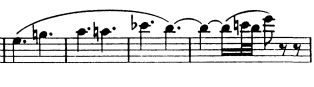
And this ascending line in 40. What the hell kind of magic is this? It’s a simple ascending line, for God’s sake. It shouldn’t make me want to squeal in bliss like some kind of Mozart-loving pig.

ascending line

And the breathlessly gorgeous phrases just kept coming. One phrase would end, and an equally luscious one would spin in to take its place.

This is a strange analogy, but I’ll make it anyway. The Minnesota Orchestra sounds like a splendid grande dame. She has the wisdom of decades combined with all the mischief of youth. She may be impeccably dressed, but fashion is only important to her within the context of self-expression: her motivations are pure, always. She knows when to be bold and brassy and when she can underplay her hand. Her sense of humor is sharp and biting and more than a little black and snarky. She can stay out later and party as hard as any twentysomething. She has been through more triumph and tragedy than anybody, and accordingly, she won’t stand for bull. She is an amazing 111-year-old lady.

And I love her.

There’s no doubt in my mind: this was the best played concert since the lockout ended.

***

341 words. Ha. I’ll cure you yet, wordiness.

If you don’t have your tickets for tonight, go! Buy them at minnesotaorchestra.org.

***

9 Comments

Filed under Minnesota Orchestra, Reviews

Microreview: Minnesota Orchestra, Mendelssohn, Wagner

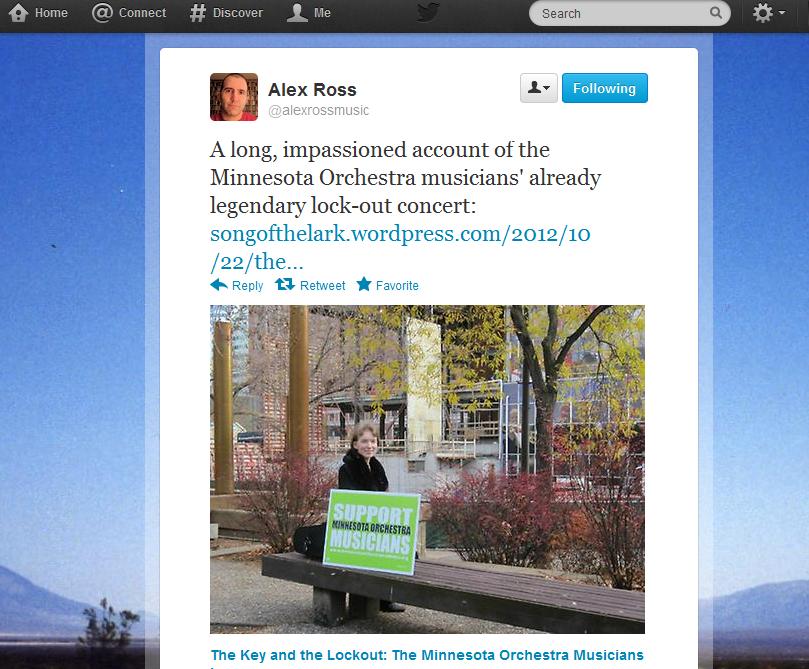
We all know I can write long. Even Alex Ross knows this.

rosstweet

I remember when this happened… *dreamy sigh*

But can I write short? Uh… Not really.

So to practice, I’m going to take the Strib’s review word count and work within that limit. This week’s Minnesota Orchestra Strib review belonged to Michael Anthony and clocked in at 456 words, so I’ll try to stay under 450. I do like to go long when I’m actually in the hall – in-person, I always see and hear a lot I want to write about – but when I’m just listening over the radio, I don’t see any harm in going short. I’m calling these micro-reviews. For lack of a better term.

If anyone wants to join in on the micro-review fun, do. The more the merrier when it comes to discussing concerts.

***

You know the best way to listen to a Minnesota Orchestra concert?

Livestreaming on a laptop!

/sarcasm

Well, it’s better than nothing. After a fashion report from Brian Newhouse (apparently Erin Keefe was wearing a “beautiful dark blue sleeveless gown”), Friday’s concert began with the Mendelssohn violin concerto. It was disorienting to jump into a concerto without an overture, but there was a 70-minute ~WAGNER EXTRAVAGANZA~ after intermission to consider.

The orchestra played with fine, elegant understatement. And I’m not sure I cared for that. I usually like my Mendelssohn with icy aristocratic soloists and wild-eyed accompaniment. It was the opposite dynamic here: Erin was providing all the fire, and the orchestra the cool restraint. Maestro Wigglesworth was completely justified musically, historically, and philosophically in taking this approach, but I need more time to decide if I liked it or not.

Lest you think I’m bitching, I thought the orchestra played beautifully, and the wind section in particular made some of the most stunning contributions I’ve heard in any Mendelssohn, ever. The single bassoon note linking the first and second movements startled me with its character.

And need I say that Erin Keefe played flawlessly? Silver tone, searing vibrato, character to burn… She’s perfection.

Next came the Wagner adaptation and its attendant harps and horns. Also, horns.

I admit that when it comes to opera, I’m a philistine. I find it hard to take this music seriously. Any story that goes remotely like this…

…has me skeptical before a single note is played.

But of course the performance was first-rate. The wild, Romantic, edge-of-your-seat quality I was missing in the Mendelssohn was here in spades. (Possibly because there were a lot of players literally on the edges of their seats. Don’t think I haven’t seen those string parts. What kind of sadist writes four nights of that?)

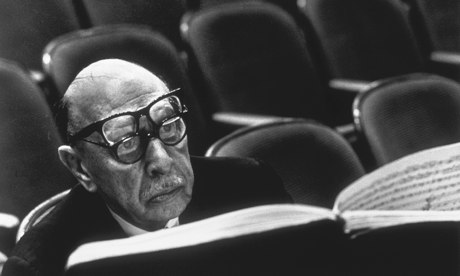
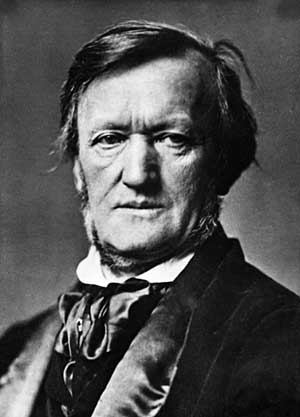
This guy

This guy

There were times when the arrangement was successful. The Ride of the Valkyries, for instance, took on a whole new meaning inserted into a larger narrative. Here the character of the strings almost stole the show from the brass. (Almost.)

But after a while, it all turned into a bit of a…blur. Albeit a heavy, horn-y, supremely well-played blur. I had two antithetical impressions: certain ideas seemed truncated, yet everything was so long. Call this the “Paradox of the Orchestral Adventure.”

Hey, did I mention there was brass? There was, and they played gorgeously, majestically, with a rich, plummy sound.

But one detail made it tough for me to truly enjoy this piece: namely, it was by Wagner. Apparently the Minnesota Orchestra has played this extravaganza every ten years since 1994. Maybe in 2024 I’ll go see the next performance.

Or….maybe not.

***

453 words. *dusts off hands*

Just because I’m wary of Wagner doesn’t mean you should be. You can still buy tickets for tonight at minnesotaorchestra.org. Erin’s Mendelssohn is worth more than the price of admission. If I was in Minnesota this weekend, I’d be going in a heartbeat. Enjoy yourself!

***

9 Comments

Filed under Minnesota Orchestra, Reviews

We Finnished It

The last time I was in Orchestra Hall in Minneapolis was in March 2012 to see the premiere of Judd Greenstein’s Acadia. This is a work for full and fabulous symphony orchestra, and it explores a narrative of change, loss, and redemption.

I left the hall that night happy – and completely oblivious to the fact that I’d be living those themes for the next two years.

Eight weeks after that concert, the Minnesota Orchestral Association (MOA) quietly fired the first shot in its aggressive PR battle, months before the work stoppage they were planning for even began. This shot at audiences and donors was completely unprovoked and completely indefensible. Presumably assuming that the wider world would never discover their dirty underhanded trick, somebody at the MOA authorized the purchase of a variety of domain names based on variations of the phrase saveourminnesotaorchestra.com. Why? During the Detroit Symphony strike, audience advocates there had created headaches for the board and management by creating an organization named Save Our Symphony to protest the direction the DSO was going. And consequently, the power players at the MOA wanted to make it harder for any Minnesota-based upstarts to start a similar group. This paranoid purchase proves that they were afraid that Minnesota audiences might try to derail the plans they had to choke the organization and remake it in their own image.

I can confirm that their fears were well-founded.

***

But there was no time to reflect on any of that as I stepped for the very first time into the Rorschach test of a new lobby. (Do you see a brand new $50 million boondoggle symptomatic of a dysfunctional organizational culture that values bricks and mortar over world-class orchestral music-making, or a badly needed remodel that will strengthen the Orchestral Association in a myriad of ways and foster community engagement and goodwill? Your answer will remain confidential between you and your therapist!) I immediately was in the arms of a musician friend, tearing up on a tux shoulder. Screw reflection; we’ve been to hell and back and we survived, so let’s celebrate. His words came out in a rushed tumble. We’re playing well, he said. Each week we’re sounding better. We need him back.

Of course, “him” is Osmo Vänskä: the beloved Finnish music director who brought the already great Minnesota Orchestra to even greater heights during his ten year tenure. He’d resigned during the sixteen-month-long lockout, and it is obvious he won’t bother to return unless and until the MOA board of directors demonstrates a renewed commitment to world-class orchestral music-making…a goal they, to be blunt, didn’t show any commitment to in 2012 or 2013. (Thankfully, 2014 is going a little better. So far.) What exactly that commitment might consist of, and what their terms might be, I don’t know, and of course it’s none of my business to know. But now that the lockout is over, there are at least some board members who want Osmo back. They’ve taken the first step to getting him back by overseeing the…completely voluntary resignation of the orchestra’s controversial CEO, Michael Henson. Osmo and the Orchestral Association are now in negotiations to see if they share enough of the same goals to make his return worthwhile. If the stars align, part two of our beloved Osmo’s tenure could be on its way. Plus, so many audience members are relieved to see the architect of the lockout packing his bags. Hence the electric buzz in the lobby.

Speaking of the audience…

Continue reading

13 Comments

Filed under Labor Disputes, Minnesota Orchestra, Reviews

Review: Minnesota Orchestra Musicians in Wagner, Mozart, Brahms

The thing that strikes me: by all rights, we should be despondent. And yet – I don’t think I’ve ever been to a more joyful concert.

The Minnesota Orchestra should be playing in its newly renovated hall in downtown Minneapolis. And yet – thanks to a fifteen-month-long musician lockout, they aren’t. Ted Mann Concert Hall on the University of Minnesota campus has been rented for musician-produced concerts instead, and it works just fine.

Stanislaw Skrowaczewski, the former music director of the Minnesota Orchestra, is ninety. Most men his age are crippled or dead. He shouldn’t be physically able to lead magisterial performances of Brahms and Wagner. And yet – here he is tonight, graciously accepting our wild applause, magically drawing forth music, gladly flouting his former employer in the classiest possible way.

The musicians should be performing on a newly renovated stage, fresh from triumph at Carnegie Hall. And yet – their Carnegie concerts are canceled and their music director is gone. Instead, they’re learning the fine art of PR, renting halls, serving on fundraising committees, debating repertoire, coordinating educational activities, and selling out concerts.

My volunteer audience activist friends should be occasional concertgoers and amateur musicians who go to concerts, enjoy them, and then go home to their families. And yet – now they’re devoting endless hours to poring over various orchestras’ financial records, while befriending influential politicians and studying the principles of non-profit management.

I should be curled up at home, a woman in her mid-twenties happy in her anonymity, writing essays about Victorian violinists that nobody reads. And yet – thanks to the lockout, I recently went on a WQXR podcast talking about the impact of social media on the arts with the former head of social media with the Dean campaign.

The last fifteen months have been one long story of “x should be, but y is.” Unintended consequences abound. People have tried to control them, but those who try, inevitably fail.

“It would be easy to be bitter, but I am thankful,” horn player Ellen Dinwiddie Smith tells us before the Brahms symphony. She is thankful for the audience, she says. For her colleagues. But most importantly, she is thankful for music.

Yes, I think. Yes.

We’ll soon announce a star-studded self-produced season to begin in the New Year, Ellen then says, very coyly, and the audience murmurs with excitement.

Continue reading

17 Comments

Filed under Labor Disputes, Minnesota Orchestra, Reviews

Review: Minnesota Orchestra Musicians, Bruckner and Mozart

Once upon a time, Minneapolis had an orchestra, and it was recognized as one of the greatest in the world. On the strength of its artistry, $100 million were raised to support it in the depths of the Great Recession. Half of that money went to support new artistic initiatives and the endowment, now the fourth largest in America…larger than New York’s and Los Angeles’s. The rest went to a huge new lobby of glass and stone, currently nearing completion on the south end of Nicollet Mall. It will be finished by early July.

But there will be no orchestra to open Orchestra Hall. Last October, three men – two banking executives on the Minnesota Orchestral Association board of directors and one spectacularly inept orchestra manager from Bournemouth – slipped the Minnesota Orchestra a potent sleeping potion in the form of a lockout. The MOA has not presented an orchestral concert since late July, and they will not be presenting any this July, either. Even after seven months of not paying musicians’ salaries or benefits, they claim they don’t have the money to present concerts…and it’s simply too expensive to play and talk, CEO Michael Henson explains. Mr. Henson continues to receive around $400,000 a year in compensation, the orchestra manager who doesn’t actually manage an orchestra. He makes a perplexing bedraggled picture, pleading poverty while wearing a yellow vest and hard hat and showing off his fifty million dollar lobby. The state of Minnesota is currently investigating the MOA’s finances. Things in Minneapolis have gotten so bad that a quarter of the orchestra’s seats are empty, with more musicians departing every month. There is no end in sight.

Every eight weeks or so, the musicians of the Minnesota Orchestra cook up a short-lived antidote to the potion: they put on a concert of their own. With the help of two of their former music directors, as well as their current conductor, Osmo Vänskä, this season the musicians have put on extraordinary performances of Dvořák, Shostakovich, Bach, Beethoven, and Sibelius. A few weeks ago they announced a late April concert: a program of Mozart and Bruckner, to be conducted by their former music director, eighty-nine-year-old Stanislaw Skrowaczewski. The soloist in the Mozart clarinet concerto would be principal Burt Hara, one of the great orchestral musicians in the world. As always, the tickets sold fast.

A Minnesota Orchestra lockout concert is different from any other orchestra concert you’ve ever been to. They will be sold out, so they will be crowded. The audience will skew young. Everyone present will be an intense, intelligent lover of music. You will find yourself waving across the hall at people you’ve only met once before; they will eagerly wave back to you. You will feel like you’re at a family reunion that has a concert built into it, because the musicians have gotten to know patrons, and the patrons have gotten to know musicians, and the invisible wall at the edge of the stage has crumbled. Turns out we’re no longer just fighting for our musicians; now we’re fighting for our friends, too. You will hear the kind of roaring applause and hoarse screams usually reserved for the debuts of prodigies. You will meet and chat and sit with politicians, multi-millionaires, and occasionally local celebrities, all of whom are disgusted with the action of the board. These concerts will be, simultaneously, the most emotionally taxing and the most emotionally fulfilling experiences you will have as a listener. They will reaffirm your belief about the power and relevancy of orchestral music. And they will give you the strength and inspiration to fight for excellence in all aspects of your life. You will also cry into your pillow once you get home, overcome by the enormity of what you have just experienced.

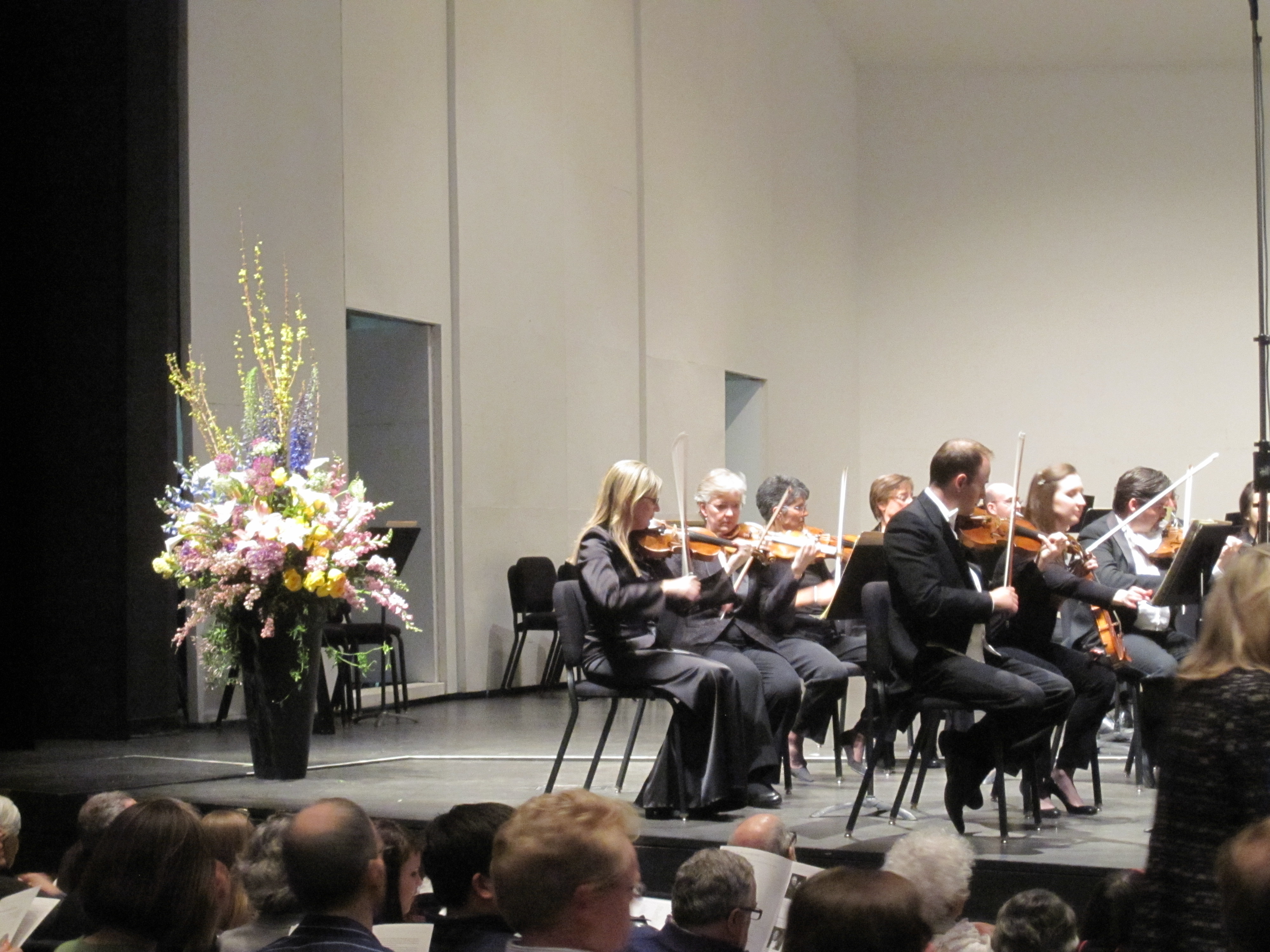
Of course lockout concerts would mean nothing without a passionately engaged audience, and I’m proud to say that the Minnesota Orchestra has the most devoted audience in America…maybe in the world. Behind the first violins stood a eight-foot-tall tower of flowers. I’ve never seen a more beautiful arrangement. Their color and fragrance were all the more beautiful after our long – both literal and metaphorical – winter. They’d been sent with love by a translator from Japan, who has loved the musicians of the Minnesota Orchestra for many years, but who could never bring herself to write to tell them so until the lockout began. Their recordings helped her pull through terrifying health scares and the devastating earthquake of two years ago. Eriko couldn’t be in Minnesota in person, but her pillar of flowers stood like an angel sentry on the corner of the stage. At the time of the concert, she was across the world in Japan, meditating.

IMG_3991

Eriko’s flowers

The musicians received two or three standing ovations before a single note sounded. Skrowaczewski came onstage, eyes sparkling. The Minnesota Orchestral Association will never invite him to conduct again, thanks to his unabashedly heretical pro-musician views, but it is clear he is enjoying playing the role of the rogue. Then out came Burt Hara, our magician of a clarinetist. He has worked at other orchestras over the years, but, thankfully, has always returned to Minnesota. He is the living personification of why we patrons are working so hard to pressure the board to back down from its proposals: Hara could easily get a job anywhere in the world, and whoever would win his seat here would simply never be able to fill his shoes. End of story. Michael Henson has gone on record saying every musician in the orchestra is easily replaceable. Michael Henson has no expletive-ing clue what he’s talking about.

Every phrase of orchestra and clarinetist was a new delight, blossoming like the flowers in Eriko’s arrangement. The variety of tones that Mr. Hara has at his command is nothing short of miraculous. Anyone who can’t tell the difference between a player the caliber of Burt Hara and his theoretical replacement not only has no business running an orchestra, but is ultimately destined for sad and pathetic failure in the field of orchestral management. In case this remark was too subtle for anyone, it’s directed squarely at Jon Campbell, the Wells Fargo vice president who is chair of the Minnesota Orchestra board of directors. Despite being one of the most powerful people on the Minnesota Orchestra board, Jon Campbell never actually goes to Minnesota Orchestra concerts. If you can’t appreciate Burt Hara – and there’s no way you can, if you never go to concerts – then have the simple human decency to step aside and hand your job over to someone who does.

I was still basking in the glow of the Mozart when, after intermission, as the lights were dimming, Mr. Hara came out into the hall. The audience began to applaud him. He grinned and shushed us. “Shh!! Not for me; for them!” he said, motioning toward the stage, and at that, my heart overflowed with admiration. He sat down in the empty seat next to me and smiled. Joyful, invincible energy radiated from his very pores.

After intermission, as has become tradition, violist Sam Bergman stepped up to the edge of the stage. By now the whole locked out audience knows what that means: a barnburner of a speech is at hand. And although all of Sam’s speeches have been extraordinary, this one was especially so…and the audience’s impassioned reactions said as much as Mr. Bergman.

He said, “It has now been almost seven months since the corporate managers of the Minnesota Orchestral Association decided that the best way to move this orchestra forward into a successful future was to lock out its musicians, set a non-negotiable annual budget that would be dwarfed by all of our peers, and demand an array of cuts the likes of which have never before been seen at any major American orchestra. Under their plan, the base salary of a Minnesota Orchestra musician would plummet, overnight, to a figure that, adjusted for inflation, equates to what our predecessors were making in 1983.”

The audience gasped.

“Under their plan, untold numbers of public orchestral concerts would be scrapped and replaced with musicians being farmed out to play private corporate rental events at Orchestra Hall.”

Cries: actual moans of shock and pain. It was as if someone had stabbed all two thousand audience members at once.

“Under their plan, the final authority on the hiring of new musicians for our orchestra would be stripped away from our Music Director, and given instead to the corporate management team.”

Another indignant communal cry. People actually began to weep in horror. I closed my eyes, tight. I knew this was the board’s plan, and I’ve known it for a long time, but to hear so many music lovers react to it so viscerally was nightmarish.

Although the news was grim, Sam’s speech ended on a note of desperate optimism. “Together,” he promised, “we will make our collective voice heard; together, we will reset the priorities of this sadly drifting organization; together, we will ensure that our audience will never again be marginalized and ignored; together, we will do away with the cynicism and ideology that has led us to this precipice; and together, we will move this orchestra forward into a truly artistically sustainable future.”

Together. Yes.

In this context, Bruckner suddenly meant something. (In this context, anything means something.) As fate would have it, almost a year ago to the day, I’d written a rather…controversial blog entry called “I Hate Bruckner, Part I.” Clearly Fate has a sense of irony that puts Stephen Colbert to shame. You say you hate Bruckner?, Fate says. Well, then, how about for your first live Bruckner experience, I snag you a legendary Bruckner conductor, sprinkle dozens of friends onstage and in the audience, and top it all off with the orchestra The New Yorker has labeled the greatest in the world. That’ll be a good introduction to Bruckner. Oh, and also, by the way, said orchestra is facing imminent dismemberment, if not outright dissolution. So enjoy!

It was a lot to swallow. But lucky for me, I wasn’t setting out on my first live Bruckner journey alone. I just happened to have beside me one of the world’s great orchestral musicians, who knew the piece inside and out, and who would teach me how to approach it. He swayed gently to the sounds, nodded before each woodwind entry, breathed in and out with every phrase. Through his body language, he showed me what to listen for. Big swaths of sound that had once been a meaningless brick wall took on a shape and direction: a narrative. He wasn’t doing this to teach me. He was moving with the music because he could no more stop the flow of music through him than I could stop breathing. I was just lucky enough to sit beside him to witness it.

At the first solemn horn call of Bruckner 4, my horizons began to broaden, and the appeal of the music slowly dawned. Time and space simply – disappeared. At every repetition of every phrase, the musicians clawed at every note as if their very careers depended on it…and maybe they did. The seats rumbled with each massive fanfare.

The graceful old man gestured on the podium, drawing out the magnificent sound from his mind’s ear.

The massive tower of flowers stood guard.

As time drifted on I was unsure if we had been in the hall an hour…or twenty-four hours…or twenty-four years. We fell into a collective trance. How long had the lockout gone on? Was there even a lockout? Surely not… All two thousand of us were swept away in the music and looking out over a cliff together – out at an ocean, perhaps. Or maybe we were on the top of a mountain, landscape spread far to the horizon. But as Sam had said, we were together…and surely, to be all together in our dark night in that dark hall…surely that means something? For as long as this lasts, we won’t be alone. Giant chords shifted beneath our feet and resolved in strange and glorious ways. A strange irrational peace descended upon me, the kind that comes when I recite well-worn phrases from my wrinkled Book of Common Prayer. Stan raised his arms, a prophet in the bright stage lights. Suddenly the past and future meant nothing; there was only the power of the present. This is transcendence.

The integrity of Stan – the generosity of Eriko – the eloquence of Sam – the passion of Burt – the courage of the Minnesota Orchestra musicians to sacrifice their very livelihoods in an attempt to preserve their beloved institution from decimation – the buzzing energy of the agitated Minneapolis music scene – and most of all, the untrammeled power of live orchestral music. You would be unwise to bet against.any of these things, let alone all of them at once. They may be under fierce assault, but I swear to God that Minnesota will not rest until all those things are celebrated as they deserve to be. Silence may win in the short term. But in the end, you will not deny the power of this music, nor the power and professionalism of these musicians. Our story is not over yet. This city will keep fighting until the very bitter end to find our musical happily ever after…no matter how many barriers the management of the Minnesota Orchestra sees fit to put in our way in the meantime.

There was a long silence after the earth-shattering final chords were struck. We all could read one another’s mind: this moment is too sacred to end. Then, gingerly, we began to applaud, gradually getting louder and louder, until the hall was a roiling sea of applause. The orchestra received such a long ovation that, in order to make it stop, the musicians had to leave the stage.

27 Comments

Filed under Labor Disputes, Minnesota Orchestra, Reviews

Review: Minnesota Orchestra in Bach and Beethoven, December 2012

“It’s our fricking orchestra, and they can’t take it away from us,” she said, except she didn’t use the word fricking.

“She” was a new friend, a Minnesota Orchestra patron and Minnesota Chorale member. My suitcase was upstairs; she’d invited me to stay with her overnight. We were in her parlor in her house in St. Paul, her adorable dogs scurrying around our feet. Old and new friends dropped in and out over the course of the afternoon. I knew some; she knew others; some, we’d both only met the day before. Everyone hugged. Together we brainstormed wild ideas. Vented. Laughed. (Swore.) There was chamber music, and pie. The recipe had come from another new friend from Oregon. We befriended her after she took an interest in the musicians’ plight. She sent three identical necklaces to Minnesota with our Christmas cards; a special charm hangs from each chain. I wear mine proudly, a talisman honoring the power of unlikely musical friendships.

The flurry of musical activism could only mean one thing: the locked out musicians of the Minnesota Orchestra were putting on another lockout concert.

***

I won’t go into the details of what’s happened since the Minnesota Orchestra lockout began on October first. If you want those, my blog is full of them, and there’s no shortage of information online. However, suffice it to say, both patrons and musicians are living a dramatic, tumultuous chapter of American orchestral history. Draconian wage cuts of thirty to fifty percent are still on the table, as well as over two hundred proposed changes to working conditions. There have been rallies, house concerts, lockout shows – Christmas cards, invitations, thank-you notes – hypotheses, inside jokes, fruitless readings of unreadable tea leaves – even a Grammy nomination, for the Orchestra’s recording of Sibelius 2 and 5. Blog entries and editorials have been passed back and forth feverishly, discussed and debated behind closed doors. Dozens of late-night emails have been exchanged, some triumphant, some despairing, some triumphant and despairing. Musicians are auditioning left and right, and when they aren’t auditioning, or preparing for auditions, they’re subbing – in New York, in Cleveland, in Detroit, in Atlanta, in Chicago. A bombshell article appeared in the Star Tribune on November 26, in which reporter Graydon Royce revealed that the Minnesota Orchestra management had deliberately planned its current deficits back in 2009 so they could be better positioned to get money from the state and massive salary cuts for musicians in 2012. All the while, construction of the luxurious $50 million lobby at Orchestra Hall in Minneapolis continues apace. I’ve contacted the Minnesota Orchestral Association again and again and again, asking dozens upon dozens of questions about what’s happening; nobody has ever answered me…or anyone else. Requests for interviews have been turned down flat – requests from me, from Matt Peiken, from Drew McManus. Thankfully, after countless pleas from patrons, the Minnesota State legislature is finally getting involved. No fewer than fourteen representatives have sent a pointed letter to Minnesota Orchestra CEO Michael Henson and Minnesota Orchestral Association board chair and Wells Fargo Vice President Jon Campbell, basically asking what the hell is going on. According to WCCO, representatives from the MOA have been asked to participate in a legislative hearing in the new year to discuss their finances and their treatment of musicians. Since the lockout began, my blog has evolved into one of the primary clearinghouses for information on the conflict, and it’s become semi-famous, to the point where when I go to Minnesota Orchestra concerts, audience members recognize me and stop me for hugs. I’ve written for Norman Lebrecht – appeared on the front page of the Pioneer Press – been cited by Alex Ross, the genius critic at the New Yorker, who has been my hero for years.

And in the hubbub, I’ve lost count of how often I’ve cried. The musicians of my beloved orchestra are slipping away. They’re leaving, one by one, to pursue brighter futures. The clock is ticking. Time is running out.

 ***

It was against this desperately frantic backdrop that we gathered at the Ted Mann Concert Hall in Minneapolis on December 15 and December 16 for two concerts put on by the Minnesota Orchestra musicians. The program was the Bach double violin concerto and Beethoven 9. Tickets were a hot commodity in the Twin Cities; the musicians sold out nearly 2400 seats within a few days. They could have sold out a third show, if they’d wanted.

Like the October lockout concert, the crowd consisted of all ages, all classes, all types. Our intentions were pure; our message clear: bring back our orchestra, dammit. We were there because we’re starved for great orchestral music, and we feel our souls shriveling without it. The silence makes us cranky. Every conversation I overheard had an undertone of grim resentment to it; we’re sick and tired of Michael Henson’s bull. A gentleman in front of me sighed, “I feel like an addict given a shot of crack.”

“Think of how they feel,” his row-mate answered, nodding toward the rows of empty chairs onstage.

“True.”

***

The musicians have begun a tradition of walking onstage together for their lockout performances, proud and unified. And the audience has begun a tradition of leaping to our feet and screaming ourselves hoarse. You’d be forgiven if you thought that Justin Bieber was in the house. We’re so desperately hungry for the spiritual and emotional and intellectual nourishment that these particular individuals give to us. So very, very hungry. It is such an overwhelming relief to see them in Minneapolis, where they belong.

It took a while for the giddy crowd to settle.

The first piece on the program was the Bach double concerto: a tasty appetizer before the meat of Beethoven nine. The soloists were former and present concertmasters, Jorja Fleezanis and Erin Keefe. When Ms. Fleezanis won her job in 1989, she was only the second woman to hold the title of concertmaster in a major American orchestra, and her friend and successor Ms. Keefe is proudly continuing our tradition of kick-ass female leadership. I like to think that somewhere Minneapolis Symphony violinist Jenny Cullen, who in 1923 became one of the first women to work in a major American orchestra, is smiling.

The Bach was delightful. The two women traded phrases back and forth, each concertmaster’s unique personality shining bright and brilliant. The second movement, the passionate heart of the concerto, was especially stunning, as the two shaped and exchanged their long, luxurious lines.

As a poignant reminder of what we’ve already lost, violinist Peter McGuire was sitting concertmaster. He’s accepted a job in Switzerland, and will be leaving for his position in the new year.

***

After intermission, Erin and Jorja returned to the stage as stand partners. (Erin’s former stand-partner, Sarah Kwak, has left Minneapolis to become the concertmaster of the Oregon Symphony. She left last year, along with her husband, also a Minnesota Orchestra violinist.)

After the chairs were rearranged and the full orchestra settled in, violist Sam Bergman came to the front of the stage to speak on behalf of his colleagues. He began with thanks: for us, for the volunteers, for the soloists, for the choir, for former Minnesota Orchestra music director Edo de Waart, who was conducting the concert. One of his shout-outs went to 89-year-old music director, Stanisław Skrowaczewski, who had just arrived from Germany to show his support for the cause. He stood, and the crowd whooped its appreciation.

Then it was down to business. A lot has happened since the last lockout concert in October, Mr. Bergman acknowledged. “For instance, we were nominated for a Grammy!” Applause. “We’re not actually a hundred percent clear on who’s scheduled to pick up the trophy if we win, but…” Murmurs of laughter. Black humor kills during lockouts.

He then continued to lay out a brief summary of the situation from the musicians’ point of view: clear, concise, and with conviction. “Our CEO and board leaders,” he said, “have been going around and telling anyone who will listen, that once these cuts are implemented, the Minnesota Orchestra will be exactly as it has always been – it will just be less expensive.”

And at those innocent words, the auditorium instantly transformed into a den of agitated pissed-off vipers. I’ve never heard anything like it. Entirely without provocation, an entire audience spontaneously, simultaneously, hissed. And not over a performance or a composer, like you read about in the history books, but an orchestra CEO. Don’t get me wrong – I agree with the sentiment – entirely – but I have to admit, a chill of fear shivered down my spine as I heard the sound. The rage of a crowd is a powerful thing, and Minnesotans are angry: very, very angry. I doubt Michael Henson realizes it yet, but the damage to his reputation is real, and it is lasting. His position is an extremely problematic one.

Mr. Bergman wrapped up his speech speaking of the Orchestra’s proud 110-year-old legacy. “We will continue to fight for it,” he said, voice rising, “and we will continue to sacrifice for it, for one day longer than our management continues to – ” He kept speaking, words ringing with authority, but he was rendered inaudible by the boisterous audience.

So. The lines in this battle are drawn. It appears that we are either going to have a world-class Minnesota Orchestra, or no Minnesota Orchestra at all.

***

From the very first notes, it was obvious the afternoon’s performance would be an overwhelming one. The sadness, rage, and fury, all held so politely in check over the months, came pouring out of strings and reeds and horns. The desperation sizzled. None of us will ever hear Beethoven like this again. Heck, we may not hear an orchestra like this again. We know it, too, and we ate it up. After all, we’re dealing with a rage and fury of our own. So performers and audience united, seeking meaning and catharsis in Beethoven: some kind of message to bring home, back to the senseless reality that lay outside the auditorium doors.

The scherzo bit and sassed and whirled, the intensity slowly rising and subsiding within phrases, like sea waves. The sense of movement that this Orchestra possesses is nothing short of extraordinary, and miraculously, the months of playing apart from one another have done absolutely nothing to blunt the musicians’ chemistry. Repeated chords beat against the walls of the hall like massive sonic hammers.

The fury of the first two movements drained away for the third. Instead, long-breathed phrases drifted past, glowing warm with sincerity and serenity. A blissful contentment blossomed within me. What is more beautiful than a well-played line of Beethoven, delicately, perfectly judged and shaped? Nothing. Nothing at all. If you take this perfection away from us, I swear: you will have hell to pay.

Then came that miraculous fourth movement, with its snippets of stolen moments from the preceding movements, finally materializing into the theme of the Ode. As various sections passed the tune around the stage, each treated it carefully, reverently. One by one, they endowed the melody with the nobility of their souls. And when they finally united to play it together, their conviction – and yes, joy – burst forth, and we all discovered the message of the music anew. Music is a miracle. Suddenly it was possible to remember nothing but beauty. To remember nothing but our strength in the face of adversity. To remember that no matter what the suits might say, we know it takes hard work to sustain a world-class orchestra, and we’re more than willing to put that hard work in. We are a community united by our love and appreciation of great music, and we deserve a world-class orchestra. And if the management of the Minnesota Orchestra insists on taking actions that every single reputable expert has said will decimate the quality of the ensemble and turn it into a second- or third-tier band…well, then we patrons are going to band together and make their work a living hell. Simple as that.

Because it’s our fucking orchestra, and they can’t take it away from us.

Within the context of Beethoven 9, everything good, no matter how unlikely, seems possible. The Ode to Joy was exactly what we needed in this moment: a reminder, an invitation, to hope. Even in our darkest hours, there are moments of brightness. As the music played, I clasped my necklace.

***

After the final chord, we all jumped to our feet. We would not let the musicians go; we could not let them go. But despite our never-ending applause, the musicians eventually left the stage, waving and beaming at us. I think they felt the love. Co-principal violist Richard Marshall gave us the thumbs up as he headed up the rear. We screamed our approval at him.

It is obvious: as long as these musicians want to fight, this city is behind them, a hundred percent.

It might seem strange, but I feel more confident now than I ever have about this city’s ability to preserve world-class culture. Don’t get me wrong: the Minnesota Orchestra is not out of the woods, not by any means. But we have proven our devotion to the cause. We have shown our willingness to take on a long-term full-time fight. We’ve garnered the attention of the entire music world. We are forging new friendships in the heat of battle, and they will not be broken. All who care are coming together in a rather spectacular way, and our passionate wholehearted activism is obviously getting things done.

So. Game on, Michael Henson and Jon Campbell. Answer our questions. Or else. In the meantime, we’ll see you at the State Capital.

***

After the show, old and new friends alike gathered to celebrate the communion of the concert in the Ted Mann lobby. It might not have cost $50 million, but it served our purposes just fine.


5 Comments

Filed under Labor Disputes, Minnesota Orchestra, Reviews