Category Archives: Not My Writing

Article: Concerning the Sexuality of Musical Instruments, 1921

I think human sexuality is one of the most interesting things in the world. Heterosexuality, homosexuality, bisexuality, asexuality, demisexuality, pansexuality – I find all of them fascinating. I’m also very interested in the ways that people’s ideas about sexuality seep into things as seemingly non-sexual as instrumental music. I have a theory that one of the many reasons the violin was considered to be inappropriate for women for such a long time was because a female playing on a violin (an instrument with a high range, a small size, and a womanly shape) was suggestive of lesbianism. This is a point that this alternately hilarious / creepy article vaguely touches on. I still haven’t studied gender or sexuality in any academic setting (actually, the one high school course that I took that even that mentioned sexuality assumed all of its readers were straight, and obviously there was never a word about anything like asexuality or pansexuality). So I don’t have the intellectual tools that I’d love to have to analyze all the implications that this article is making. But I found it fascinating anyway. Hopefully someday after I’m better educated I can come back and really understand the points this byline-less, source-less article is trying to make.

This is from The Common Opinion, June 1921.

Addendum, 11/23: For an immensely entertaining take-down of this article, head over here to Sam Bergman’s blog entry “How To Tell If Your Bassoon Is Gay.”

***

In quality of sound, as compared with the human voice, the violin is soprano, the cello is tenor, and the contrabass may be defined as baritone bass. For the same reason that the normal average man prefers the soprano to the tenor and the woman generally shows more appreciation for the tenor, the choice of musical instruments is governed, when there is liberty of choice and the individual is conscious of his or her leanings. The violin artist, as Konrad Berkovici goes on to say, in Bruno’s Review of Two Worlds, even physically is of a different type from that of the cellist, the first being generally full of masculine vigor and life, while the second is apt to be effeminate, showy, soft and silky. Among gypsies, we are told, one seldom finds a cellist and almost never an alto. Their women, who are proverbially jealous, seldom or never play the violin; and for the most part the players of the contrabass and the alto are elderly men in any human society. Not because these instruments are physically easier to play nor because they demand greater experience, but because the advanced age of the players decides their inclination.

Superstrenuous music of the Wagner and Beethoven kind has its explanation in Kraft-Ebling‘s analysis of their sex-psychology. Both men seldom used the violin or cello for the leading melody. Tschaikovsky’s music, to the writer in Bruno’s Review, suggests Oscar Wilde’s literature, there being a strong psycho-sexual resemblance between the writer and musician. Tschaikovsky gave the viola and the contrabass preeminence in his music, whereas the music of such as Berlioz or Verdi or Mascagni or Massenet is of the male of the species – tenor and violin.

Not only have string instruments sexual character, but, we are assured, the cornet, the oboe, the flute, also have such a character. Berkovici observes, in this connection, that the French and Italians are the best wind-instruments players and that Teuton women have a predilection for the oboe and the nondescript saxophone, tho these instruments are bulky and physically difficult to play. “As to the men, to every saxophone student in a conservatory you will see ten flutes and twenty clarinets. The violin classes are always full of fiery dark-eyed boys. Seldom, if at all, have blue-eyed violinists reached any artistic height, while the classes of cello are comparatively swamped with female students. The males studying cello are in a minority and of totally different type than their brothers of the violin; blue-eyed, soft, shy, retiring effeminates.”

Commercial reasons of supply and demand do not regulate these classes. There is said to be an oversupply of male violinists and an unsupplied demand of male cellists. A woman violinist is a comparative rarity. Normal sexual males do not like the contralto voice. Their choice between a Tetrazini and Schumann-Heink is made as quickly as Elma and Kushevitzky. And it is due to their sexual indirectness that the alto of the violin and the clarinet are in the background of orchestras.

We read further that in the harmonic blending of voices, where a mixture of string and wind instruments is necessary, the flute and clarinet cannot be used to complete the violins because “they are of the same sex.” Instruments representing opposite sexes are instinctively used by musicians for this effect, tho this analyst “has a feeling that Beethoven and Mozart knew more about it than other composers.” Primitive races, or races in process of ascendancy, are said to produce more male violinists than highly cultivated ones. Russia, Hungary and Bohemia have given us the latest great ones. Spain and Italy gave the best formerly. The Teutons and the French have not given a single great violinist in the last hundred years. Ysaye, Thibaud, Vieuxtemps, are Belgians. Almost all good violinists are composers, having creative minds, and their compositions, even when not for the violin, have a strong sexual element. The waltz, with its exact rhythm, is a favorite vehicle. There is love appeal in every bar, impetuous, lascivious and pretentious – in one word: male.

Konrad Berkovici, as the result of personal investigation in the quality of voices of violinists and cellists, male and female, reports that out of fifty male violinists, none older than thirty years, forty-one had deep baritone voices, of the other nine, six were tenors, and three non-descripts. Out of twenty male cellists, none older than thirty years, seven were altos and the other thirteen nondescript, and mostly effeminate voices. Out of ten female violinists, not over thirty years old, eight had alto voices, one a soprano, and one almost a baritone. This last one had also a masculine exterior. Out of fifteen female cellists, fourteen had soprano voices.

3 Comments

Filed under Not My Writing

Article: Miss Marie Hall, The Girl Violinist, A Romance of Real Life, June 1903

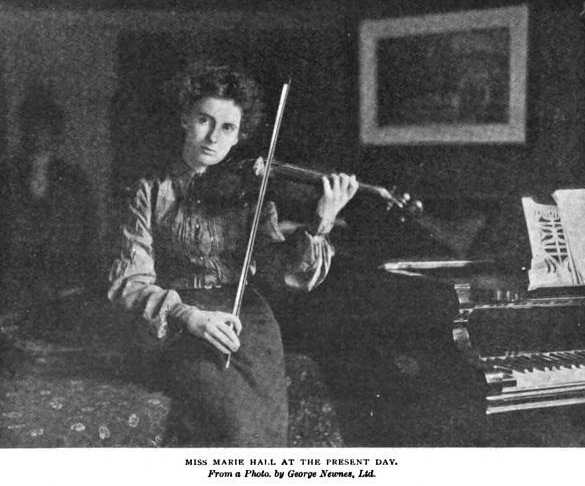
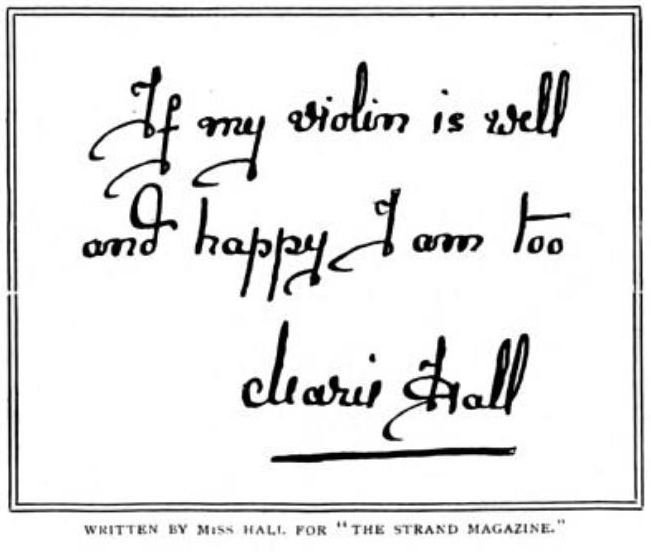
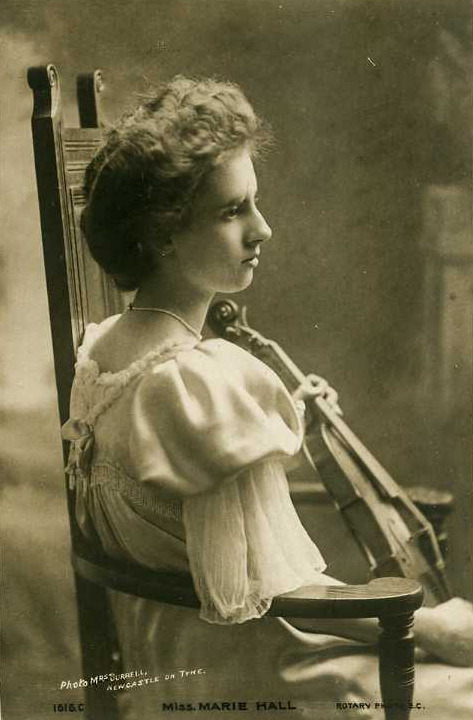
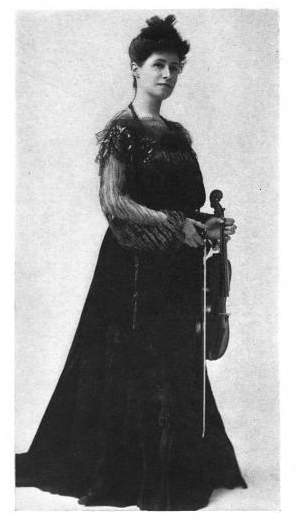
Forgive the Marie Hall kick, dear friends, but here’s another fantastic interview with her. As if Hall wasn’t spunky and amazing enough already, she says in this article that she wishes she could be a conductor! Even today, a hundred years later, it is relatively rare to see a woman taking on that job.

This piece is by M. Dinorben Griffith; it appeared in the Strand Magazine in June 1903.

***

“Marie is always, for ever and ever, plactising, plactising,” was the irate comment of two little boys when they failed to induce their but little older favourite sister to play with them.

It is this “always, for ever and ever, plactising,” or, in other words, that infinite capacity for taking pains which is the sign-manual of genius, that has brought Miss Marie Hall, the girl violinist, to the front of her profession before she has reached her nineteenth birthday.

Hers is no history of that forced and most miserable of spectacles – the child prodigy, often of ephemeral life and fame. A child prodigy she undoubtedly was, but of natural growth. Her talent was discovered and fostered by strangers, and it speaks well for her bodily and mental vitality that hard work, poverty, and even sorrow have only given strength to her personality and a finished maturity to her art.

She loves her fiddle, and even when idly handling it a beautiful tenderness comes into her face, which is generally sad and grave almost to sternness. With her bow she shows her inner self to the world, at least to as much of the world as can understand its language; her clever fingers not only interpret the masterpieces of the great composers, but the longings and aspirations of a young life striving for the perfection which alone can satisfy it; and for fame, not for fame’s sake, but because it will enable her to carry out a noble, unselfish purpose.

Like all highly-strung natures her personality is complex, oftenest grave, impulsive, yet sometimes as merry and gay as a little child.

To interview her is as difficult as to follow a will-o’-the-wisp.

“Where was I born? Oh, dear, must I go back as far as that? It was ages ago! In Newcastle, on April 8th, 1884, and I was called the ‘Opera Baby.'”
“Why?”

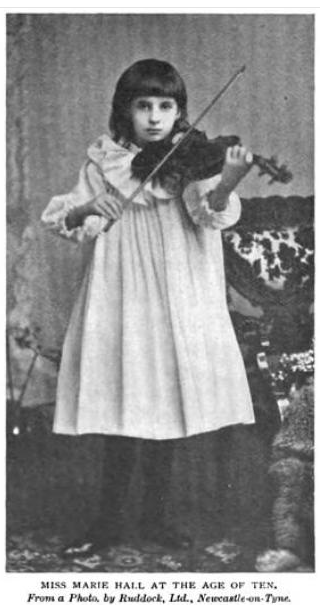
“Because my father, Mr. Edmund Felix Hall, was harpist in the Carl Rosa English Opera Company, which toured all over England. My mother always accompanied him, and while at Newcastle I was born; the company took a great interest in this important event, and called me the ‘Opera Baby.’ I may as well go a little farther back and tell you that my grandfather was a landscape painter and a harpist; my father, his brother, my mother, and sister are all harpists, and I ought to have been one too, I suppose. I did start; but I hated it, and used to hide when my father wanted to give me a lesson. I wanted to learn the fiddle. My father had his own ideas on the subject; I had mine, and I stuck to them.”

The little lady, I noted, had more than one side to her character. Into the grave face as she spoke came a mutinous, mischievous look reminiscent of an enfant terrible. It was also easy to infer that her early childhood held no pleasant memories for her. She was one of a family of four sisters (two of whom died) and two quite young brothers, one of whom – Teddy – is the stimulus to hard work and the making and saving of money on her part. He shares his sister’s love of the fiddle, and, although not yet nine, according to Miss Hall is “much cleverer” than she.

“Teddy is a genius,” she says, enthusiastically, “but, oh, so delicate. I want to have him with me always; to get him the best advice, to care for him, educate him, and love him. That is what I have been working for, that is what success means to me.”

She started learning the harp when only five, and the violin at the age of eight and a half, her father being her first teacher. Those lessons were not shirked, they were her only pleasure. More may be learned of Miss Hall’s early days from what she leaves unsaid than what she says, but there is no doubt that when Mr. Hall left the opera company, that meant to him a regular weekly income of twelve pounds, and more especially on the termination of a short engagement at the Empire Theatre, Newcastle, the family were in dire straits. From the orchestra Mr. Hall had to come down to playing in the streets, his wife and children in turns assisting him in earning a precarious livelihood.

The struggles of those days are written on Miss Hall’s face, but the fragile little figure is linked with an indomitable will. She is of the stuff that heroes are made of, withal a very girl, with a keen sense of humour and a pretty wit of her own.

The day of her first violin lesson was an era in her baby life, for the little maid had planted her foot firmly on the first rung of the ladder of fame. She had no thought of what was to follow; she had gained her point, and it behoved her to prove that the violin was her special métier.

“One day,” she said, “I played Raff’s ‘Cavatina’ to my father. I had been practising it hard as a surprise for him.” A surprise indeed it was, for it convinced him of her ability, and she was sent to Miss Hildegarde Werner, of Newcastle-on-Tyne, for lessons. She made remarkable progress, and her teacher was so proud of her precocious little pupil that she introduced her to M. Sauret, who predicted great things of her in the near future.

“After I had been learning the violin for a year I made my first appearance on the concert platform,” said Miss Hall. “I was then about nine and a half. After the concert was over I got several offers of engagements at music-halls.”

“Did you then play in the streets?”

“Yes, we all did; I hated it.”

“What were your usual takings?”

“Oh, a penny, and up to six-pence.”

“And is it indeed indiscreet to ask what you make now?”

“I will tell you with pleasure. My first concert in London, at the St. James’s Hall, brought me in five hundred pounds.”
Four hundred people were on that occasion – her second appearance in London – turned away from the doors. A guinea was cheerfully paid for standing room, and two guineas for a seat.

Before little Marie reached her eleventh year her parents moved to Malvern, when, she pathetically remarked, “times were very bad. My sister and I had to do all the housework, as we could not afford to keep a servant, and to help by playing in the streets and in the vestibules of hotels. I used sometimes to go inside the little gardens and begin playing, and was often then called into the houses.”

“Did you dislike it?”

“I hated collecting money,” was the reply, with a flash of her eyes. “Sometimes mother went out with father and she did the collecting, while my sister and I stayed at home.”

One can easily picture that untidy ménage, with the little drudges turning out in the evenings to play for money when tired out with the hopeless task of keeping things straight at home.

“Things might have been worse, you know,” she remarked, “for several people got to know me and were very kind. Fifteen pounds was subscribed among friends to buy me a violin, but my father thought the money would be more wisely spent in taking me to London, so that Wilhelmj could hear me.”

“With what results?”

“I stayed in his house for several months, he giving me free lessons as well as keeping me. I then returned to Malvern and took up my old life; not from choice, but from necessity. I played in the streets and in hotels until I was thirteen. Herr Max Mossel heard me play and offered me free lessons, so I went to Birmingham, living with some rich friends, who paid my parents a pound a week for letting me stay during the three years I worked under Mossel.”

Herr Mossel was charmed with his pupil; he recommended her so highly to the Birmingham School of Music Committee that she received a free studentship, which she held for two sessions.

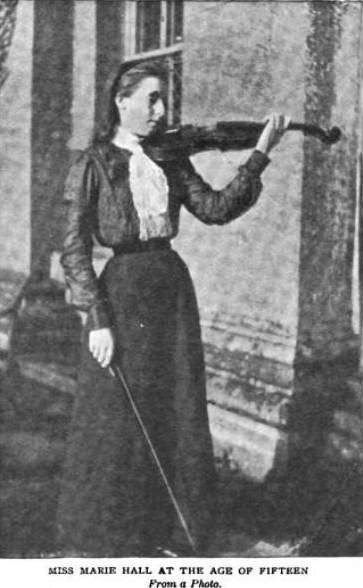
When fifteen years old she competed for the first Wessely Exhibition at the Royal Academy of Music and won it, but was unable to take it up, as she had no means to live on while in London.”

“It was such a disappointment,” said Miss Hall, “and things were worse than ever at home. We moved to Clifton, and there met with friends who were most kind to us all. They were Mr. and Mrs. Roeckel, of musical fame. We got to know them through a strange incident.

“As I told you, my uncle was a very clever harpist; he used to go about the country playing. Mr. and Mrs. Roeckel were spending a short holiday at Llandrindod Wells, in Wales. My uncle was there too, and they were delighted with his playing and spoke to him frequently, and learnt that his name was Hall.

“The Roeckels, on their return to their home at Clifton, heard one evening a harpist playing outside their door who reminded them, both in appearance and superior skill in playing, of the harpist they had met in Wales. It was his brother – my father.”

From this time their kindness was unceasing to the family, who owe much to their frequent and timely help. They took a practical interest in the clever girl violinist, and enlisted Canon Fellowes’s sympathy for their young protégée.
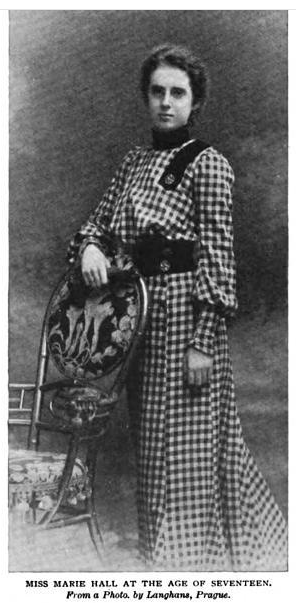
By Mr. Roeckel’s advice Marie got up a subscription concert, Canon Fellowes promising to bring Mr. Napier Miles, the Squire of Kings Weston, near Bristol, to hear her play. The concert was a grand success, the playing of the delicate, frail, little fifteen-year-old débutante astonishing all present.

“Wonderful! delightful!” said Mr. Napier Miles. He asked if she had ever played with an orchestra. “No,” was the reply. “Then you must come to Kings Weston for that purpose.” Her future tuition and expenses were practically assured from that day.

Mr. Miles and a few other friends combined in sending her to study under Johann Kruse, and she stayed with him a year, or until, in her own words, “I had got all he could give me.”

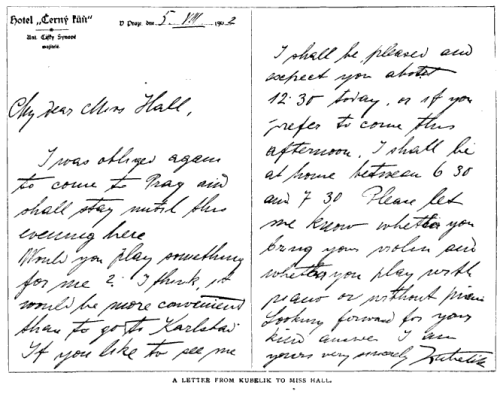
It was while she was in London with Kruse that she first heard Kubelik. He had shortly before been playing Bristol, and Marie had urged her father to see him and beg of him to hear her play.

“I saw,” said Miss Hall, “an announcement that he would give a recital in London on the 19th of June, 1900. I went. It was a red-letter day in my life. I went mad over his technique. As soon as the concert was over I went behind and waited outside his door, determined to see him if I had to wait until two o’ clock in the morning. After what seemed to me a long time he came out, followed by his accompanist. I rushed forward and said, ‘Oh, will you hear me play?’ He seemed very startled, drew back a little, and stammered, ‘I don’t know you, do I?’ Breathlessly I explained that my father had seen him at Bristol, and finally I left him with an appointment for ten o’ clock the next morning. I practised nearly all night, for to sleep was impossible.

“I found Kubelik and his accompanist at breakfast. I do not think they expected me; they seemed to think I was amusing, especially when I asked Kubelik to accompany me.”

With the sublime audacity of youth she had elected to play one of the very pieces she had heard Kubelik play the previous evening, the “D Minor Concerto” of Wieniawski, which was the success of the evening.

Kubelik was enthusiastic. “You must go at once,” he said, “to Prague to my old master, Sevcik.”
“But what do you think?” said Miss Hall, with a burst of merry laughter at the recollection. “Kubelik and the accompanist were so polite to me they both rushed to place a chair for me at the table, so that I could write my name and address, and I sat down – not on the chair, but on the floor,  with my feet in the air and my hat – well, I don’t know where it was. I felt so small and so humiliated, and they – I do not know how they managed it – never even smiled – at least, for me to see.”

It is difficult to get Miss Hall to talk about herself. She acknowledges being a “creature of moods,” very full of spirits one moment, correspondingly despondent the next; gave, sympathetic, sedate, or a real little hoyden, full of fun and laughter.

Asked if she had received any offers of marriage since she had come out, “Two only,” was the reply – “one from a Greek, a literary man, and one from a Bohemian musician.”

“Were they nice?”

“Well,” with comically raised eyebrows, “one was old and silly, the other very young and impressionable.”

“No millionaire offers?”

“Sorry to disappoint you – no, not one.

“When did I go to Prague? Oh, very soon after my interview with Kubelik. My kind friend, Mr. Napier Miles, made all necessary arrangements. I went first to Dresden to learn a little German, which I managed to pick up without a master – Sevcik does not speak a word of English – and also to practise for my entrance examination for the Conservatoire.”

She was the great Sevcik’s only English girl pupil, and he says, “She is the most gifted pupil I have ever had.” In addition to lessons at the Conservatoire, she had private lessons as well, working often fourteen hours a day and getting up at four in the morning.
“Had you no recreation at all?”

“Oh, yes; while I was at Prague I read all Dickens’s and Thackeray’s works – to broaden my mind,” she said, with a smile. “Do you know, I am very fond of shocking people?” she added. “In Prague it is considered very improper for girls to go out alone, especially to any public place. Several girl students lived together at a pensionnat, and we English ones used to love to dress up and go and dine sometimes at an hotel; people used to look at us, shrug their shoulders, and say, ‘Es sind Englanderinen.’ I was also very fond of dancing, and learned all the Bohemian national dances, which are very pretty.”

“How long were you in Bohemia?”

“Eighteen months. A concert is given at the Conservatoire every year, in which all the students that have won their diplomas take part, and I played and was recalled twenty-five times.”

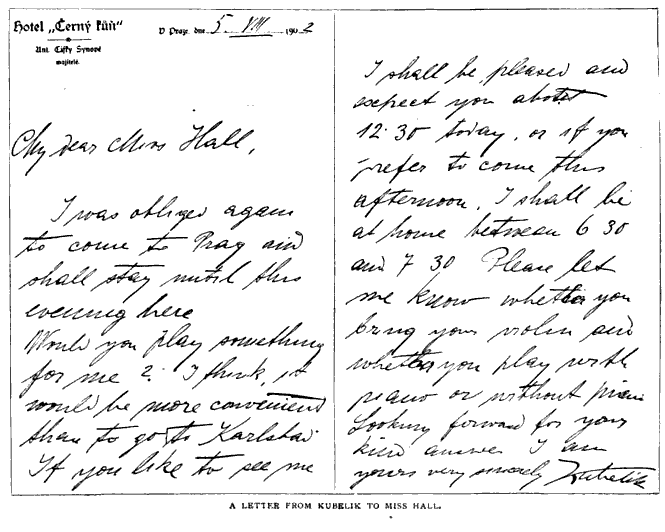
Miss Hall during her holidays once went to Marienbad, where Kubelik was also staying, and he gave her a few lessons. He has always taken a  great interest in her and considers her playing marvellous. She had a grand reception at Vienna, where she gave a recital before returning to England, being recalled no fewer than five times after each piece, a great compliment from so critical an audience.

“What is your fiddle?”

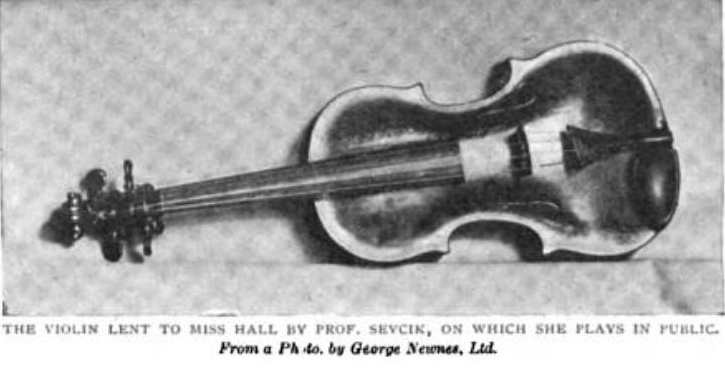
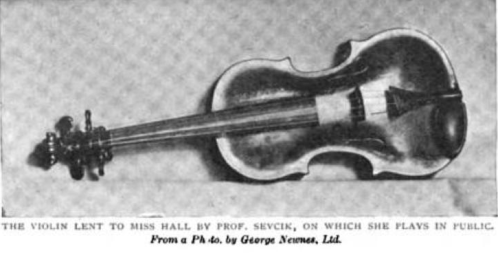
“An Amati. It was lent me by my master – Sevcik – and is the one used by Kubelik when he made his début. I have no violin of my own yet, but have three bows. I think I must learn to play on them.
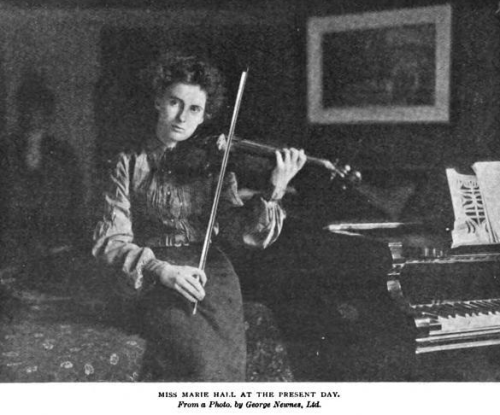
“A pretty incident,” Miss Hall went on to say, “occurred when I appeared for the first time after my return, at Newcastle-on-Tyne. A workman stood up and said, ‘Miss Hall ought to have a new violin. I have just made one and would like to give it to her.’ He evidently did not think much of this Amati, did he?”

“Is it not true that a violin worth two thousand guineas is being purchased by public subscription as a presentation to you?”

“Yes, it is so, but it will be some time yet before such a sum can be collected.”

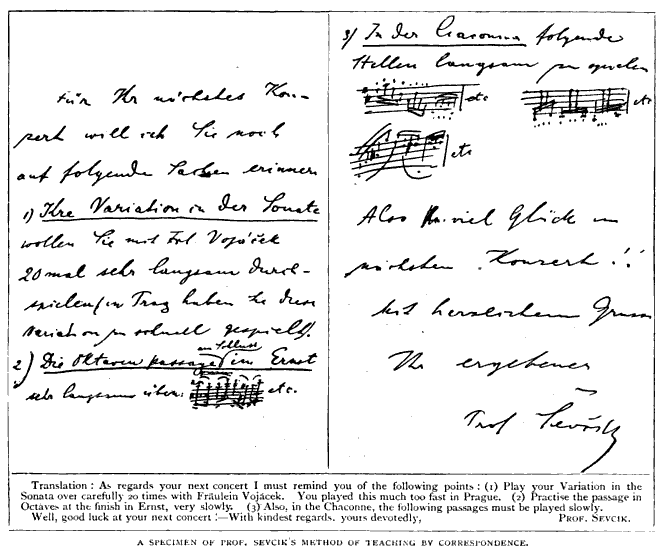
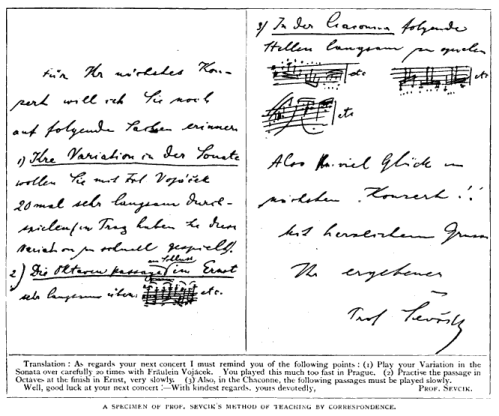
I was shown a letter from Sevcik; curious – as it showed his manner of giving his pupil violin lessons by post.

“He is coming back here with me in the autumn, and I hope he will settle in London.”

“What are your plans when the season is over?”

“After my two recitals here on the 30th of May and 23rd of June, I am going back to Bohemia. I shall take a little cottage in the country there where I can have perfect quietude and devote myself to practising, for I play with Richter in Manchester next season. I have a lot to do before I can rest, though. I am booked up for a tour in the provinces.”

In March last Miss Hall was made a ward in Chancery, which, on account of family differences, her friends considered a wise measure.
“You do not know,” she said, “how I want to help my family. I have offered my parents a regular income if they will only let me have my little brother Teddy.We are so fond of each other, and I want him to get strong and well. I have offered also to have my sister in London. She is fourteen, and her great wish is to have lessons with Mr. Thomas, the Welsh harpist.”

Miss Hall has very artistic tastes, is fond of pictures, and has the usual feminine love of pretty clothes. She always designs her own gowns. In a literary way her favourite books are the biographies of great musicians.

In reply to a query as to her favourite composers she said, “The three great B’s – “Bach, Brahms, Beethoven; and last, but not least, Paganini. I do not really care for anything but classical music, but the public taste must be studied too.”
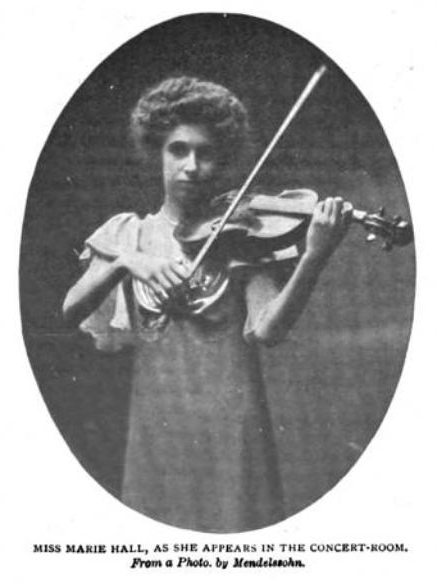
She recently played for the first time before the Prince and Princess of Wales, and met with great appreciation. She is in much demand at smart “At-homes.” I heard an amusing story about a very smart society function at which she was asked to play. Her first piece was Bach’s famous “Chaconne.” When she had finished, and received the usual applause, a lady came up to her and said, “You played it divinely. It is my favourite piece. Do you play his ‘Chaconne’ also?” Miss Hall, when she had recovered a little, simply answered “Yes.”

“I forgot to tell you one thing that is important,” said Miss Marie, with a laugh. “I am immoderately fond of oranges, and eat I do not know how many a day; they taste better if I am reading a novel at the same time; that is what I was doing when you came in,” pointed to “Temporal Power” and a plate of orange peel lying side by side.

“You are a second Kubelik, people say, I hear.”

“I am not a second anybody or anything,” she quickly retorted, with a proud little gesture. “I want to be myself, with a method and style of my own. If I were a man I should like to be the conductor of an orchestra. I should love it. That is not impossible, is it? although you are unfortunate enough to be a girl.”

“Perhaps not impossible, but it would be a startling innovation, would it not?”
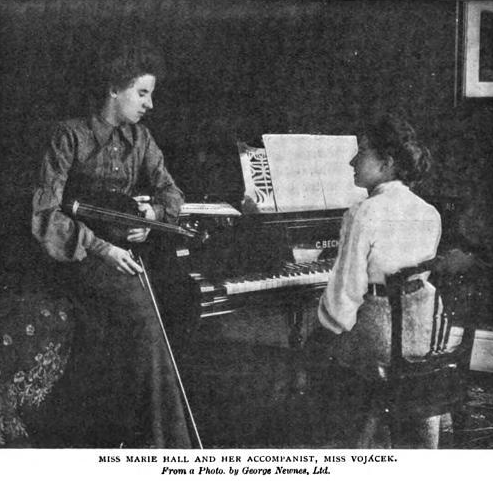
Miss Hall is fortunate in having as an accompanist a charming Bohemian lady, who was introduced to her by Sevcik himself. Miss Vojácek has travelled with, and accompanied, all the Sevcik girl pupils in England and on the Continent.

“Do not forget to mention,” said Miss Vojácek, smilingly, “that Marie always sits on the table when she is practising with me; it is so characteristic of her.”

There seems – if she does not overtax her delicate frame – to be no limit to the possibilities that the near future holds for this youthful and gifted violinist. Her short public life has been, and continues to be, a series of triumphs that might spoil a less modest and natural person.
13 Comments

Filed under Not My Writing, Women Violinists

Article: She Began As A Street Musician (Interview with Marie Hall, 1906)

Here is a surprisingly frank interview with violinist Marie Hall (1884-1956). She obviously had a dizzying drive and spunk to spare. She saw what she wanted and she went for it, other people’s opinions be damned. I wonder if all of these astonishing stories are true…

This article originally appeared in Success Magazine in March 1906.

***

She Began As A Street Musician:

Marie Hall, the Greatest Woman Violinist, Tells the Story of Her Hard Struggle to Win

by Ernest R. Holmes

“I was always determined to be at the top, and I’ve always had plenty of energy and perseverance.”

It was a very slight girl who said this, a girl with a thin, pale face, very serious brown eyes, and a mass of most rebellious dark hair, neither long nor short, just “coming in,” after an attack of typhoid fever. An utter stranger might well have questioned what it could be that such a frail person could lead the world in. Yet that girl of twenty-one can almost lay unquestioned claim to be the greatest woman violinist, and she is compared with Kubelik, her friend and benefactor, pupil of the same master.

But as I talked with Miss Marie Hall, the day after her second New York concert, her pale face grew animated, her eyes opened wide and flashed, and her words came with a decision that revealed a soul on fire with her art, and a determined will to great for her slight frame. One felt almost a pitying fear that her efforts would over-tax her strength.

As Miss Hall talks, one forgets her frailty, so sure of herself is she, and so full of her music. And the impression of an iron will and a dogged determination keeps recurring as she tells incident after incident of her rise from street and music-hall playing to a place among masters of the most human of instruments.

“Yes,” she said, “even when eight years old, I was determined to be a great violinist. My father was a harpist. He was with the orchestra of the Carl Rosa Opera Company and another, and he tried to teach me the harp. But I wanted the violin. He taught me a little on this, but still discouraged my continuing. I heard a lady play a concerto of Paganini, and I was bound I would play it too. With only a little help from my mother, I learned it in a few hours, and then played it for my father. He was astonished, and gave up to me. I had my beloved violin lessons.”

She had won by the weapon she has used ever since – winning prizes, tuition, instruction by the best masters, and now financial and artistic success.

“I have been lucky,” she went on. “I have always found friends to help me, I don’t know why. And if people won’t do what I want, I play for them, and generally then they do what I want,” and she gave a roguish smile as she thought of the magic power she keeps in little, slender, white fingers.

It was thus she won Kubelik, and through him his master, Sevcik, with an audacity that surprises when one thinks what she must have been at sixteen. Kubelik was taking London by storm.

“I went to hear him,” related Miss Hall. “I saw immediately that he had something I never had been taught, and I felt sure that it was from his teacher. I heard all his concerts, and I resolved that I, too, would learn that wonderful technique. I waylaid Kubelik – I was only sixteen, and my long hair was hanging loose. I told him I wanted him to hear me play. He smiled, and seemed amused, but consented. I went next day. His accompanist met me, and, seeing my violin, said, “But are you really going to play to him?” “Of course I am,” I answered, “that’s what I came for.” Kubelik came. He was very kind, but still seemed amused. I told him I wanted to know who his master was, who had taught him to play so, for I wanted to go and learn to do so too. He said, “I’ll hear you play first. I suppose you play from memory?” “Of course I do,” I replied with spirit, and then I played him two concertos that he had played the day before. He said it was wonderful, that I must go to his master, Sevcik, at Prague.

“I went to Professor Kruse, my teacher, and said, ‘I have found something that you can’t teach me. I must go to Sevcik to learn it.'”

The girl’s audacious proposal met with strong opposition from her master and her benefactors, who were supporting her in London. When there was no other way to gain her point, Miss Hall declared that if she could not go to Prague, she would quit studying and go home. She had her way, and it proved for the best, just as her decision for the violin and against the harp was for the best.

The ten years between her first public appearance at a little hall in her birthplace, Newcastle, and her triumphant debut at Prague, in 1903, were full of ups and downs, but that childish determination to be “at the top” shines through it all, and illumines seeming wilfulness that somehow always led to better things. One can gather, too, for Miss Hall is very frank, that her parents, musicians though they were, hindered rather than helped her high ambitions, though willing enough that she should help the family purse by playing in the way they always had. When enthusiastic Newcastle gentlemen wished to educate her, her nomad father took the family across England to Malvern, near Worcester. Her next benefactor, Max Mossel, violin professor at Birmingham, gave her a year’s instruction, and secured her a free scholarship at the Birmingham School of Music. Friends, won by her playing, aided her father to take her to London to Wilhelmj, who was so delighted that he wanted to adopt her, and he did keep her and teach her several months. But, as she told me, “I did not stay long. I was afraid of him, and of the bulldogs he kept in the room next to where I practiced.”

Then the ambitious girl tried for a Royal Academy scholarship, and won in the competition, only to find that it meant merely tuition, and there was no money to pay her board in London. She had to give it up, and go back to playing for her father in concert halls, and even on the street, for the family was then desperately poor. They wandered to Bristol, and there something in the little minstrel’s playing appealed to a musical clergyman, now Canon Fellowes, of Windsor. He asked her to his house, found out her poverty, her genius, and her ambition, and interested wealthy friends in her. Here again her unambitious father was an obstacle. He did not want to sign an agreement to give her to others’ care for a three years’ systemic course. When provision was made for the family, to compensate for the loss of her now valuable earning capacity, he consented, and the way was clear to accomplish all that the girl’s genius was capable of doing.

Then came Kubelik. When she had won consent to go to Prague, Kubelik aided her in every way, even to securing an apartment for her, and won over his old master, Sevcik, and Dvorák, director of the Conservatorium, to a lively interest in the little English girl.

“And there I worked,” said Miss Hall, reminiscently, “ten hours a day, but it was pleasure.”

When Miss Hall talks of Sevcik and his method, she grows enthusiastic. She says no one else on earth teaches such technique, and in such a systemic way. To that method she ascribes her sureness, and the confidence with which she attacks the most difficult concertos. On entering the Conservatorium, her attainments were recognized, so that she was admitted to the sixth year work, and in one year she had completed the whole course. Then for five months Sevcik gave her private lessons, – his “little concerts” he called them, so delighted was he with her playing.

When she gave her “coming out” concert  in Prague, to invited guests, they recalled her over a score of times after her rendering of Ernst’s concerto in F sharp minor. Two gold caskets and a laurel wreath were hers before she left Prague for other triumphs at Vienna, and then her appearance at St. James Hall, London, where the enthusiasm is said to have been unequaled since Rubinstein took London by storm. The long years of patience practicing (four thousand bowing exercises, she told me,) the alternate hope and despair, and the struggle with unappreciative parents and dire poverty had borne fruit – she was a great concert performer.

When I asked Miss Hall how much of a great artist’s success is from genius and how much from hard work, she looked puzzled for a moment, and then said: –

“Well, you must have the mind, the feeling to know what is right. You do feel, you don’t know how,” and she put her hand to her breast in an effort to express intuition. “You must be able to grasp the principles of art. If a person does not admire beauty in whatever form, if he is satisfied with the course and vulgar things, he can never become a great artist. Hard work will not make him one.”

“But in your struggles did you not get discouraged?”

“Yes, indeed I did, and I do yet. I just give up, and think I will not try any more. Then I conclude it is worth while, and I go at it again.”

1 Comment

Filed under Not My Writing, Women Violinists

Meeting Edith Lynwood Winn (And Her Opinions)

Meet Edith Lynwood Winn.

Winn (1868-1933) was a turn-of-the-century writer, violinist, and pedagogue. She had a lot of opinions, and she took great joy in sharing them. Her books include Violin Talks (1905), How To Prepare For Kreutzer (1910), How To Study Fiorillo (1910), and The Etudes of Life (1908). I just stumbled upon them yesterday by accident. Winn sidetracked me with her authoritative voice, and ever since I’ve been reading her highly entertaining work in my spare time. I know relatively little about her besides what she reveals in the books. She apparently studied in Europe (as almost all serious musicians did in those days) – once had a nervous breakdown after practicing too hard for too long – taught in public schools and colleges – lived in Boston – studied with Julius Eichberg, a Boston-based teacher who taught many great female violinists – and had “unfortunate fingers”, in particular an obnoxiously short fourth finger (just like me!). She sounds like a very interesting, strong-willed lady, and even when I oh-my-gosh totally absolutely 100% disagree with her, I still find I Can’t Stop Reading Her.

Here are some excerpts from Violin Talks.

Children’s work in America has been as yet an experiment and is not based on psychological and pedagogical training such as teachers in the public schools are obliged to receive before they are entrusted with the education of the young. The theory that “any teacher is good enough for a beginner” is fast becoming null and void. There must be teachers trained for children’s work. They most love this preparatory work. They must be willing to serve art from the beginning of child training. Such teachers are born and not made, and yet their preparation for teaching must be broad. They must know violin literature; they must love children and be able to meet the child on his own plane; they must be unselfish, consecrated, thorough. Above all, they must be able to produce a beautiful tone, – the first model which a child hears.

The teacher should possess a winning personality. The child should be obedient, respectful, prompt, and willing. The German child always comes to his teacher with a “good morning” and a hand-shake, but he stands somewhat in awe of his master. Teacher and pupil can be sympathetic without seriously interfering with the dignity of their relation. The nervous and high-strung child suffers under severe teaching.

In general, if a pupil has worked hard for eight or nine months without interruption, he should have a vacation during the summer, and he will begin with more freshness and vigor in the fall.

I believe that ear-training should go hand in hand with violin study. It is unfortunate, indeed, that the public schools of every town do not afford some musical training for children, but it is only in the average large town and city that there are trained teachers of music who direct and supervise the study of music through the various school grades. The consequence is that music teachers have to do more real drudgery than they should, and they are also compelled to teach ear-training, time values, and many other things which students ought to have learned long before.

Many people ask at what age a child should begin violin study. This depends upon the constitution and taste of the child, and upon his musical environment. It is better to begin at fifteen years of age with a competent teacher than to begin at seven with an inferior teacher. If there is no fine violinist in the town, let the child begin piano study with some good teacher, for piano teachers are more easily found. At the proper age let the child go to the city for violin lessons. Country and city standards differ. Country teachers, because of little competition, are prone to advance pupils too rapidly. The thoroughness with which the best city teachers work is an evidence of high standards. A faithful study of the first position requires two or three years for the average child.

Every violinist should play the viola to some extent. This aids one to produce a robust tone, and a knowledge of it is very helpful to the ensemble class.

It pays to be broadly educated. It makes us richer. It makes the world richer. It helps us to be happier. The man and woman who intend to devote life to the profession of violin teaching, or concertizing, cannot be too well educated.

Few pupils know how to practice, hence the prevailing fault of neglected rhythm. Said a well-known teacher: “Never let anything pass which is not up to the standard of true musicianship. It is better to play twelve Etudes in one year, and play them well, than to go over the whole range of Kreutzer and Fiorillo. You will have it all to do over again some day, and it will be hard indeed to undo what you have done unwisely or carelessly.”

Many piano pupils use a metronome for daily practice. Let the violinist use his brains.

“Rag-time” music is the very enemy of careful reading, attention to rhythm, and the cultivation of the highest in music. It develops inexcusable laziness in pupils, and the teacher has to undo a host of faults which could be avoided if parents only knew them to be positively the result of the “rag-time craze,” and would forbid it. This would save hard work on the teacher’s part, and much sorrow on the part of the pupil.

A certain pupil has an over-emotional temperament. She even plays unrhythmically. A year or two of ensemble work will aid her greatly. Another pupil suffers from the effects of overpractice. She also plays unrhythmically. Rest is her only cure.

If I were the mistress of a home I should teach every child to recite poetry. The child who cannot feel the rhythm of poetry will not feel it in music, but he can cultivate both. I should allow him to dance. From his earliest years he should sing child-songs. When he is older let him study the languages and learn to scan Latin. Our greatest musicians are fine linguists.

Few girls can practice over four hours daily. Common sense and physique forbid.

Naturally a girl has more supple fingers than a boy. She also has a fine command of her upper notes on the E string, for her fingers are small, delicate and agile, but she has no the endurance of boys. She can play, and play well, but she must keep her health and practice only as much as she can endure.

The effects of overwork are spasmodic movements of the body and face, nervous bowing, and unsteady tone, affectation, and absence of rhythm. This, added to a poor sense of pitch, which often accompanies nervous troubles, is a serious detriment to success. Life is too short and too full of meaning for us to cripple our energies by overwork. The violinist should keep his energies normal.

From the first the violin should be a good one. There is no inspiration in a bad violin. Not everyone can have a good, or, rather, a valuable violin. Everyone can have a violin correctly made.

The violin should go to the repairer at least once a year. The bow should be rehaired as often as necessary. Mine goes to the shop three times a year. Both violin and bow should be kept very clean and free from excess of rosin. Many students permit rosin to accumulate under the bridge. That is dangerous. Rosin injures the varnish, and dust-particles spoil the resonance of the violin. One can wash the bow with good soap and water and a little ammonia.

Two or three half-hour lessons a week are sufficient for the average intelligent boy or girl. It is well to have someone at home supervise the daily work of the child, but that person shuld attend the lessons with the child.

I don’t know why it is, but violinists are very often quite sensitively organized and delicate. One or two hours of daily practice is the most the beginner should undertake. I regret a year of hard work at six hours a day of practice. I paid for it by a nervous collapse.

I have often said that pupils should devote from fifteen to thirty minutes daily to scale practice; then they are not hampered by technic, as in Etude work, and, because the mind is concentrated one one thing, there is no excuse for faulty position. The prevailing “bad point” of new pupils is that the left elbow is not well under the right side of the violin, thus compelling the hand to tilt to the left, the thumb to cling too closely to the neck of the violin, and the whole arm to be changing its position constantly. There can be no progress with such a position, for intonation will never be correct, and technic, as well as a command of positions, is out of the question. Teachers who neglect these points do so at the risk of their own musical reputation.

Speaking of fingers, many violinists have most unfortunate fingers. I am one; my fourth finger does not reach to the last joint of my third finger, and in the higher positions, my thumb sometimes clings to the body of the violin, instead of to the neck. I have found, however, that persistent practice in the positions, with my fingers (on the E string) a little inclined toward the left, aids my thumb, while raising the hand and running the elbow very far under the violin permits the thumb to regain its proper position.

And now we must labor to obtain a normal position and as little extra movement with arm and hand, for all unnecessary movements cause great uncertainty and loss of security and time.

A prevailing fault is that of grasping the violin too tightly with the chin. The violin should be held by the left side of the jaw and not by the chin, which should rest upon the instrument at the left of the tail-piece.

There are many methods of holding the bow, but there is only one way of holding the violin – and that is the right way, – free and beautiful.

Now that I have spoken of the position of the body, it may be well to remark that young students should try not to move about much while playing. Paganini indulged in many contortions of features and of body, but his day is past. Many violinists sway the body to the rhythm of the music. It is, indeed, very hard to stand perfectly erect and motionless. The great artist is very full of moods, and he responds to the spirit of his music to such an extent that he is prone to move his body as he plays.

The violin is a difficult instrument indeed, but the drudgery of teaching lies in certain almost necessary repetitions. I find myself saying certain things daily. One is, “Do not allow the left elbow to remain far to the left of the violin.” Another is, “Keep the fingers down as long as possible.” Still another is, “Do not cling to the violin with the thumb.”

And these excerpts are only the first thirty-odd pages! She has much more to say throughout the rest of the book.

So what do you think? Anything in there that leaps out at you as being incredibly relevant? Incredibly irrelevant? Good advice, bad advice, advice you can’t make heads or tails of?

Winn’s books have made me wonder, what will teaching be like a hundred years from now? What conventions of today that we take for granted will tomorrow’s students laugh at? Which of Winn’s ideas are due for a come-back (personally, I love the ideas of mandatory ear-training and viola-playing)?

Isn’t it wonderful to read the work of a woman from a hundred years ago who is just as opinionated about the violin as we are today? What an honor to be part of this long continuum of passionate intelligent music-lovers…

4 Comments

Filed under Not My Writing, Women Violinists

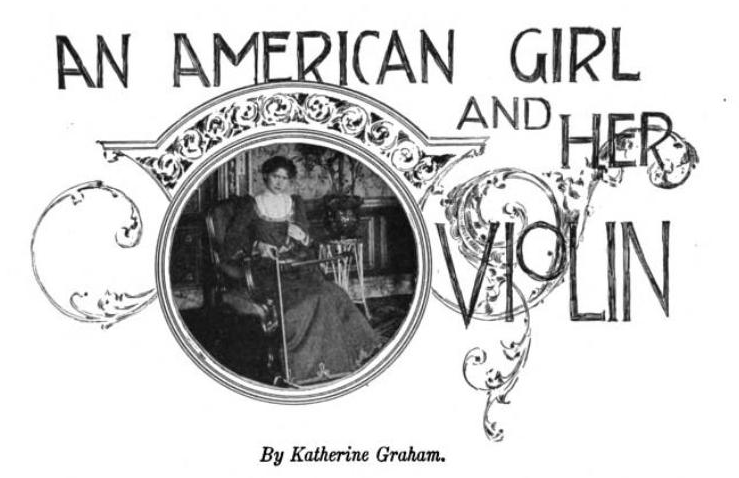
Article: An American Girl And Her Violin, March 1900

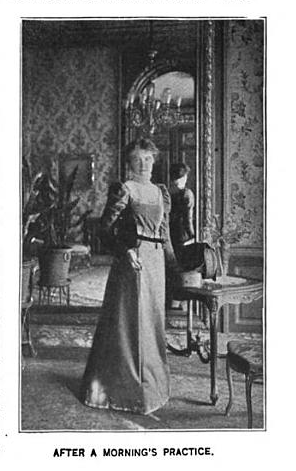
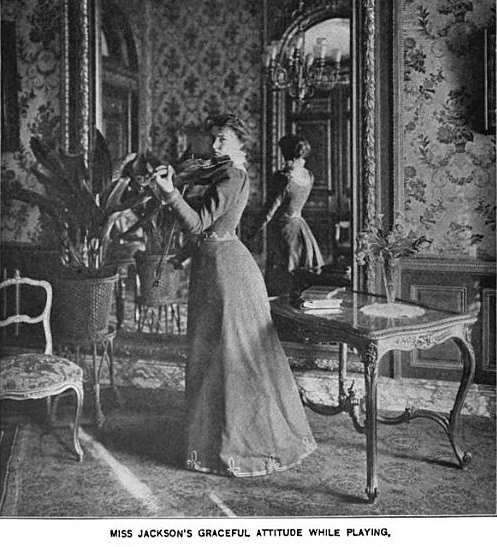
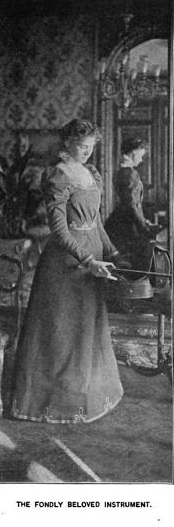
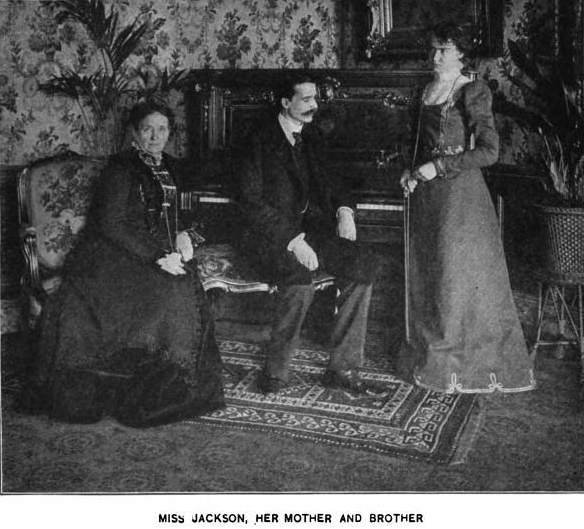
Here is a charming, very well-illustrated article on American violinist Leonora Jackson (1879-1969). It is by Katherine Graham and is from the Metropolitan Magazine of March 1900.

***

A slender girl, holding herself very straight after the manner of those who are students of the violin; in manners somewhat shrinking and diffident; a little defiant, perhaps, the better to conceal a natural timorousness at the sudden transition from the routine of study to the fierce light of publicity and unexpected fame – that is the picture.

The long arms and large, powerful hands are curiously awkward, like those of an overgrown schoolboy; they seem lost and meaningless until they grasp the violin, when they become beautiful, womanly, and alert with nervous force. The face is replete with promise and interesting to a high degree. The eyes are long and narrow, with wide spacing; in contrast to the olive, colorless skin they look pale-blue, but in certain moods they deepen and glow and impress one as being black. The forehead and head are almost massive, giving a suggestion of delicacy and supersensitiveness to the mouth and chin – an impression altogether erroneous, for the lips are full, and the chin, if short, is broad and square. Such is the first impression of Leonora Jackson, the young American violinist, who in a career of only two years has scored triumph after triumph with every orchestral organization of importance in Europe, and of whom Dr. Richter has said: “A genius! – one not found in a thousand.” And the critics indorse him.

“It is not what I say of myself, it is what I accomplish that counts,” she remarks sagaciously; and then she adds: “What have I to say after these last two years of public life? It is this: I am an American girl. I have been educated through the beneficence of the American people. Whatever triumphs I have achieved, I rejoice, since through them I have held up the Stars and the Stripes.”

Although Mr. and Mrs. Jackson were married in California and are identified with the pioneer colony of that State, Leonora and Ernest, their two children, were born in Boston. The parents removed to Chicago while the children were still in their infancy, and it ws in the latter city that Leonora passed her childhood and early girlhood, and received her first violin lessons.

“I am proud to think,” remarks Miss Jackson’s loving and devoted mother, “that my daughter inherits her musical temperament from our side of the family. There was a family of twelve boys and girls, all musically inclined, in my father’s home. He was passionately devoted to music, and had a big organ built in the parlor, around which we gathered, night after night, singing the great choruses of the classics. I was sent to Italy to have my voice cultivated, and upon my return, after my marriage, I formed and conducted large singing classes. After Leonora came I resolved that she should be a singer or a pianist, like her brother Ernest, but even as a baby the sound a violin would send her into ecstasies of joy. ‘Buy the child a violin,’ said her grandfather. So we bought her a little violin, and I gave her her first lessons in the nursery, making believe that the notes were little girls and boys, whose homes were on the lines and spaces, and who each spoke with a different voice.”

At six years of age the child began to study seriously under the best masters the city afforded – Albert Ruff, Carl Becker, and Professor Jacobson. She made astonishing progress, and a brilliant future was predicted for her if she were sent abroad to pursue her studies. The child was taken to Paris and place under Professor Desjardins, of the Paris Conservatory. It was while in Paris, after her second year of study, that the shock came that changed Leonora Jackson from a merry, thoughtless child into a serious girl. News came that the entire fortune of the father was lost. Not a dollar remained. The son was taken from Harvard, and the mother and daughter, through the assistance of friends, returned home.

“It was a great blow,” remarked Miss Jackson. “Child as I was, I was suddenly confronted by poverty and the utter impossibility of continuing my studies. I knew I had the power to succeed, but how continue to pay for lessons and teachers? Mother knew that the position was desperate. At any price I must be sent to Europe to finish my education. We then devised the plan of giving little concerts, Brother Ernest as pianist and I as violinist, at the different seaside resorts during the summer, and with the proceeds sending me to Europe to study in the winter.”

For two years the girl struggled in this way to complete her education, notwithstanding the heavy strain on her body and mind. But her extraordinary talent forced recognition. When two wealthy women offered to pay her expenses abroad for four years, it was discovered that numbers of others insisted upon the privilege of sharing the expense. A subscription paper was started with twenty signatures representing six of the principal cities in the United States: New York, Chicago, Cincinnati, Philadelphia, Boston, and Washington.

The fund arranged for four years’ study in Berlin under Joachim, and the purchase of a beautiful Storioni violin. In January, 1894, Mrs. Jackson, accompanied by her son and daughter Leonora, sailed for Europe.

The outcome is well known. Miss Jackson made her début at the Berlin Philharmonic in the Brahms Concerto, Joachim himself leading the orchestra. She was commanded to appear before the empress, and then followed a series of engagements under the distinguished orchestra leaders of Germany. That same year she won the coveted Mendelssohn prize of fifteen hundred marks. Her triumphs since then at the Colonne concert in Paris, at the Hallé orchestra in London, at Windsor before the queen, in Scotland, Belgium, and Geneva, followed by twenty orchestral engagements in America, have been repetitions of her great successes in Germany.

“What is my aim in playing?” repeats the young virtuoso in reply to the question. “First a solid technique, then the message of some great immortal to be received and conveyed to others through the medium of my own individuality.”

2 Comments

Filed under Not My Writing, Women Violinists

Article: Violin Playing For Women, 1913

Sometimes while studying the history of violin performance in the early twentieth century, it is tempting to focus our attention on more “glamorous” soloist figures rather than more common “run-of-the-mill” teachers or chamber musicians. But of course, then as now, only a tiny percentage of professional musicians were actually traveling virtuosos. Sadly, women who wanted to pursue a career in music, who couldn’t or didn’t want to become soloists, found few doors open to them. Just like women in many other fields, women violinists had to deal with widespread and irrational prejudice; it was taken for granted that they would be less effective orchestral players than men, and until the advent of blind auditions in the mid-twentieth century, it was rare that they were given the chance to prove otherwise. Consequently their professional options were rather limited compared to their male colleagues’. This 1913 article, from The World’s Best Music: The Musician’s Guide, sheds some light on the subject of what professional options musical women actually had.

Note: The currency exchanges are only meant to be approximate.  They’re taken from MeasuringWorth.com.

***

Violin Playing for Women

By Alice Putnam

Musicians frequently receive letters from girl violinists, asking whether it would be advisable for them to go to college and prepare for school teaching, or to take up music as a profession. It is obviously impossible to answer such a question without knowing the individual girl, but in order to help girls to decide this question for themselves it is proposed to discuss the life of a professional violinist, and see of what its advantages and disadvantages consist.

There are four ways of earning a living with the violin – teaching, solo playing, trio or quartet work, and playing in an orchestra.

A girl’s success as a violin teacher depends entirely on her ability to make friends and to play the violin well, for unfortunately there is as yet no demand on the part of parents for pedagogical training for music teachers. A girl’s pupils will be mainly children, as grown persons usually prefer to study with men who have achieved international fame.

In large cities a girl generally goes to her pupils instead of having her pupils come to her. Many teachers prefer to do this, as studio rents, especially to musicians, are high. Also, one may charge for a lesson when one goes to the house, whether the lesson is given or not, whereas parents rarely take it pleasantly if one charges for the lesson after receiving word to the effect that “daughter has a cold and cannot go out to-day.” Private pupils are an uncertain quantity and studio rents come due inexorably once a month. Nevertheless, a good many young women prefer to pay from $30 to $60 [in modern currency, approximately $680 to $1360] a month for a studio rather than to spend the time and strength going to pupils’ houses.

From talking with many young women who are teaching, I gather that but few earn more than $3 [in modern currency, approximately $70] an hour, and very few indeed have their time all filled. And yet quite a fair living can be made by private teaching, and it has the advantage of bringing one into close and friendly relations with the pupil and often with the pupil’s family. Being one’s own master means hard work in building up the business, but it brings greater rewards in the end and is unquestionably far more interesting from day to day than bending to the wishes of the principal of any school.

It is more difficult to keep up a high standard of work with private teaching than in the classroom. There is not the same stimulus of rivalry and enthusiasm, nor is there a standard whereby one can measure the progress of a pupil. And it general happens that by the time a conscientious teacher begins to reap the rewards of her labor with a certain pupil and brings him to a point where his work begins to be really artistic, that pupil is whisked off to study with some famous European violinist, as though being famous as a player guaranteed his being a good teacher for that particular pupil.

Positions as violin teacher in boarding schools are not lucrative, the salary averaging from $400 to $600 [in modern currency, approximately $9,900 to $13,600] a year and board, and there are often the most ridiculous demands made of the teacher. She must not only teach the violin but she must be able to do forty other things as well, such as assisting in the piano department, teaching the banjo, guitar, theory of music, or assisting with the English work, or even riding horseback, as one school demanded. The violin teacher must also be ready at all times to chaperon or entertain the pupils. As if any one who could do all these things could amount to anything as a violinist!

In the state universities the salaries are a little larger, but few universities will employ a woman as violin teacher, as the young men students naturally prefer to study with a man. The violin teacher is usually expected to conduct the college orchestra also, and but few women have had an opportunity to learn conducting, or make good conductors even when they know how. However, if such a position can be secured, the woman who is fond of study and the university atmosphere will find herself in as nearly an ideal position as can be imagined.

The earnings of a music teacher are often largely increased by solo playing, which brings us to the next topic of discussion.

The opportunities for solo playing are various. There are the solos in private houses which are to be had even by young players – if they dress well and are pretty. A girl must play very well indeed to obtain engagements if she is plain and awkward.

Sometimes there are solo engagements to be had in connection with men’s choral society concerts, as a woman instrumentalist is supposed to add a pleasing variety to the program. There are also the large clubs, like the Union League Club of Chicago, and the woman’s clubs of all large cities, which give entertainments several times a year. The Masonic entertainments often pay well, while church entertainments rarely pay at all, but many a girl has received $5 for a solo at the Sunday services.

Another way of earning a living as a soloist is to travel with a concert company, but this is indeed hard work. The indifferent hotels of small towns, poor food, tedious train trips, and often undesirable company, make the life very unpleasant. One is often asked to play the same program over and over, as there is no opportunity for rehearsals. The only advantage to be gained in this work is in becoming accustomed to playing under all sorts of conditions and before all sorts of people. One must needs be gifted with a strong sense of humor to find fun in it after the first few days.

In order to secure engagements with a great orchestra a violinist must be already known as an artistic, sure player. No conductor will risk trying out a stranger before his public, for even the experienced are sometimes attacked by stage fright. So many players would give a good deal of money for an opportunity to appear with an orchestra, that occasions for the average young woman to earn money in this way are very rare indeed unless she has great talent. In this case the work will seek her instead of her seeking the work. In fact, to the girl with talent and perseverance all things are possible, but it takes a great deal of both before one arrives at playing with the grand orchestra.

Another and perhaps the most delightful way of earning a living with the violin is in the playing of chamber music. In this field one finds not only the most beautiful music to play, but also the most intelligent of audiences.

Engagements, like solo engagements, are to be found in clubs and private homes among friends. Also many young women find engagements for their trios or quartets in summer hotels, where they play one or two programmes a day and are free the rest of the time to amuse themselves with summer sports. Such engagements are often pleasant, especially if the other members of the trio are congenial. The amount paid for work of this kind varies, with the size of the hotel, but usually runs from $10 to $15 [in modern currency, approximately $230 to $340] a week and expenses, for each player.

Women’s orchestras are as variable and uncertain as the stock market. Women do not yet seem to be capable of regular, sustained organization, and good conductors will rarely bother long with them. This work, even under favorable conditions, does not pay very well for women. Many rehearsals are needed and the pay, if any, for rehearsals is not nearly so good as that for teaching during the same length of time.

When all is said and done, a woman’s success in earning a living with the violin, like any other business, depends largely on her power to make the right kind of friends and to inspire them with confidence in her. Women who are willing to put their profession first in their thoughts and lives, and make everything else, even home, secondary, usually succeed. But as a rule a girl only takes up a profession as a temporary thing, to fill up time until she marries. There are hundreds and hundreds of girls who, though they learn to play quite well, are never heard from professionally. But if a woman is willing to be thorough, to work hard, and if she is gifted with a good ear, a good memory, a naturally flexible hand, and an artistic temperament, she will find no more pleasant or profitable way to earn a living than with the violin.

Leave a comment

Filed under Not My Writing, Women Violinists

Article: The Effect of Music On The Growth of the Hair, 1896

I have just found what is possibly my favorite article on Victorian music ever. It is from the Boston Medical and Surgical Journal of 6 February 1896.

***

THE EFFECT OF MUSIC ON THE GROWTH OF THE HAIR.

The London correspondent of Le Temps writes that an English statistician has just demonstrated by figures the effect of music on the growth of the hair. The remarkable facts which he has discovered relate less to composers than to players. Among composers baldness is as frequent as among other professions, namely, twelve per cent., a proportion surpassed only by physicians, thirty per cent. of whom are said to be bald. The instrumental performer, however, almost always retained his hair up to an advanced period of life; performers on certain instruments retain their hair longer than others.

The piano and the violin, the piano in particular, prevent or arrest the loss of the hair. We are compelled to admit this on examining the portraits of Paderewski, Frederick Dawson, Vladimir di Pachmann, Léonard Borwich, Sapelloikoff, Henry Richard, Bird, and Emile Sauer, without including the prodigy, Joseff Hoffman, whose luxuriant growth of hair might be accounted for by his youth, even if he were not a pianist, and the aged Charles Hallé who died recently at an advanced age in possession of all his hair.

The same preservation of hair must be acknowledged to the violin, but in the players of this instrument the hair grows a little less luxuriantly, and there are a few cases of partial baldness. Eugéne Ysaye, Willy Hess, Sarasate, Tividar Nachez, Joachim, Betteman, Willy Burmseter, Fernandez Arboz, Johannes Wolf, Victor Wilhelms, all possess luxuriant heads of hair, but Louis Ries is compelled to use hair restorer, and John Tiplady Canodus could easily count the hairs which remain.

Similar observations have been made in the case of female violinists. The Swedish violinist Freda Scotta has an admirable head of black hair, and the yellow hair of the Austrian, Gabrielle Wietrowetz, falls to her feet.

Players on other instruments approach the mean of the learned professions, namely, about eleven per cent., of baldness. The ‘cello, the contra-bass, the alto and the harp preserve the hair fairly well, but one is not justified in placing much confidence in the hautboy, clarionette or flute, which do not guarantee the preservation of the hair much beyond the fiftieth year. On the other hand, brass instruments have a fatal influence on the growth of the hair, notably the cornet, the French horn, and the trombone, which apparently will depilate a player’s scalp in less than five years.

Our statistician simply states the facts, and leaves to scientific investigators the task of search for the causes which underlie them. It would certainly be interesting to find out why the slide trombone makes the hair fall out, while the piano preserves it. The statistician does not tell us, but his observations are well grounded, and will be easily confirmed by studying the musicians in the orchestras at concerts and theatres. The baldness which prevails among members of regimental bands has been given the name of “trumpet baldness,” calvitié des fanfares.

It would be interesting to know whether the predominance of brass instrument which the music of Wagner has introduced, has brought with it an increase of baldness among orchestras which are in the habit of rendering the music of that composer. It is also just possible that the baldness which is said to prevail among the habitués of the front rows at the theatre may be due to the proximity of the brass instruments, or may be caught by some contagion from the players themselves.

3 Comments

Filed under Not My Writing

Article: Addendum on Female Violinists by George Dubourg, 1852

Here is a fascinating chapter on female violinists from the book (take a deep breath!) The Violin: Some Account of That Leading Instrument, And Its Most Eminent Professors, From Its Earliest Date to the Present Time; With Hints to Amateurs, Anecdotes, Etc., by music writer George Dubourg (1799-1882). It was published in London in 1852 and, considering the era in which it was written, is a surprisingly liberal text. Dubourg had a prophetic viewpoint that women were just as capable of becoming great violinists as men were, and his spunky, spirited defense of his opinion makes for a highly enjoyable read. Wilma Norman-Neruda and Camilla Urso were both about twelve years old when this edition of The Violin was published, and they were just on the verge of proving Dubourg’s thesis right. No doubt in his later years he regarded their careers with satisfaction.

***

ADDENDUM

FEMALE VIOLINISTS.

“Place aux dames!”

[This section of the Work, which should have formed Chapter VIII, having been accidentally omitted in the printing [(Emily: *eyebrow raise*)], there remained no other course than, either to insert it here (as is actually done), or, by a dismissal utterly at variance with the laws of gallantry and of justice, to exclude it altogether, and so to debar the fairer portion of the community from all participation in the honours connected with the “King of Instruments” – an idea not to be for a moment entertained. If, in this volume, as in a campaigning army, the ladies find themselves placed altogether in the rear – let them attribute the position, in this case as in that, to any-thing but disrespect.]

Instead of a bow-arm, must ladies be allowed only the arm of a beau? Why should not a lady play on the Violin? The common objection is, that it is ungraceful. The ladies in Boccaccio’s Decameron, however – and who shall charge them with want of grace? – played on the viol, a bowed instrument requiring from the performer a similar position and handling to those exacted by the violin. If this latter instrument, considered in relation to a lady, should be admitted to be somewhat deficient in grace, – has not the lady, out of the overflowing abundance of this quality, which is her sex’s characteristic, some of it to spare for communication to the instrument? Can she not impart some of it to whatsoever object she chooses to associate with herself? Surely, she who can transform the rudest of beings from a bear to a man, and from a man to a gentleman, can lend a few spare charms to so grateful a receiver as the fiddle, which is found to repay in so eloquent a manner the attentions bestowed on it. But if the doubters continue to shake their heads at this, I would ask them whether, after all, we are to expect grace in every act and habit of a lady’s life, and call on her to reject every thing that may be thought inconsistent with it? Our modern respected fair one may, like Eve, have “heaven in her eye;” but really, looking at some of the offices which we are content to thrust upon her, it seems rather too much to insist that she shall also, like our original mother, have “grace in all her movements.” Is there grace in making a pie, or cutting bread and butter, or darning a stocking? If we have grace in the effect, shall we be rigid to require it in the means also? Now, the grace which belongs to violin-playing is audible rather than visible, residing in the effect more than in the means: nor ought we to be such cormorants of pleasure, as to demand that the person who is filling our ears with rapture, shall, at the same time, be enchanting to the utmost our eyes. If, then, a lady, full of soul and intelligence, is capable of expressing these through the fine medium which this instrument offers, should she be debarred from it, and restricted perhaps to the harp, because, forsooth, the grace that is merely external is found most in association with the latter? Let us only be reasonable enough to be satisfied, on principle, with the delicious effect that visits us through the ears, and we shall then give no hyper-critical heed to the rapid action of a lady’s arm in a presto movement, or to the depression of her head in holding the instrument; nor shall we continue to demand, with a pertinacity more nice than wise, that a feminine fiddler be

“Graceful as Dian when she draws her bow.”

That exquisite sensibility which is one distinguishing charm of the female character, has its fittest musical exponent in the powers of the violin, which, therefore, in this particular sense, might even be styled the women’s own instrument: but, without going so far as this, there seems no sufficient reason why it should not, occasionally, be honored by figuring in the hands of the fair. Should these defensive remarks, however, be found unsatisfactory by your anti-women’s-playing-the-violin-at-all sort of people, I have nothing farther to say to them, but leave them to quote, undisturbed, their “quae sunt virorum, mascula dicas,” &c. For my own part, I think so highly both of the ladies and the violin, that I rejoice at every opportunity of their being introduced to each other, and am delighted to know that, from time to time, certain clever and spirited women have been found ready to overcome the prejudices that have so long kept them asunder. Let us by all means enquire who these are.

A very high name meets us at the outset of our investigation – no less a one than that of QUEEN ELIZABETH. This exalted personage, who is recorded to have been musical “so far forth as might become a princess,” appears to have amused herself not only with the lute, the virginals, and her own voice, but with the violin. An instrument of this denomination, of the old and imperfect fashion, but splendidly “got up,” has been traced to her possession. If any particulars of Her Majesty’s style of performance could now be obtained, it would doubtless be found that she displayed, in no common degree, what is called “a powerful bow-arm”, but that she neglected the “sweet little touches” that give delicacy to execution.

To arrive at instances nearer to our own time, let us go at once from the Queen of England to Madame MARA, the Queen of Song. Her first musical studies were directed to the violin. When yet an infant, the little Gertrude Elizabeth Smaling (such was her name) discovered so strong an inclination for the violin, that her father was induced to give her a few lessons on that instrument. Her progress was so rapid, that, as early as her tenth year, she excited the public surprise. It is certain that the development of her vocal powers was not a little aided by this cultivation of an instrument that may be called the friendly rival of the human voice. She herself was known to declare, that, if she had a daughter, she should learn the fiddle before she sang a note; for (as she remarked) how can you convey a just notion of minute variations in the pitch of a note? By a fixed instrument? No! By the voice? No! but, by sliding the fingers upon a string, you instantly make the slightest variations visibly, as well as audibly, perceptible. It was by her early practice of the violin, that this celebrated woman had acquired her wonderful facility of dashing at all musical intervals, however unusual and difficult. She married a violoncellist, of no great capacity, except for drinking.

MADDALENA LOMBARDINI SIRMEN, who united to high accomplishment as a singer such an eminence in violin-playing, as enabled her, in some degree, to rival Nardini, had an almost European reputation towards the end of the last century. She received her first musical instructions at the Conservatory of the Mendicanti at Venice, and then took lessons on the violin from Tartini. About the year 1780, she visited France and England. This feminine artist composed a considerable quantity of violin music, a great part of which was published at Amsterdam. A curious document is extant as a relic of the correspondence between this lady and Tartini. It consists of a preceptive letter from the great master, the original of which, along with a translation by Dr. Burney, was published in London in 1771. From this pamphlet, which is now among the rarities of musical literature, I shall here give the Doctor’s English version of the letter:

“My very much esteemed

“SIGNORA MADDALENA,

“Finding myself at length disengaged from the weighty business which has so long prevented me from performing my promise to you, I shall begin the instructions you wish from me, by letter; and if I should not explain myself with sufficient clearness, I entreat you to tell me your doubts and difficulties, in writing, which I shall not fail to remove in a future letter.

“Your principal practice and study should, at present, be confined to the use and power of the bow, in order to make yourself entirely mistress in the execution and expression of whatever can be played or sung, within the compass and ability of your instrument. Your first study, therefore, should be the true manner of holding, balancing, and pressing the bow lightly, but steadily, upon the strings, in such manner as that it shall seem to breathe the first tone it gives, which must proceed from the friction of the string, and not from percussion, as by a blow given with a hammer upon it. This depends on laying the bow lightly upon the strings, at the first contact, and on gently pressing it afterwards; which, if done gradually, can scarce have too much force given to it – because, if the tone is begun with delicacy, there is little danger of rendering it afterwards either coarse or harsh.

“Of this first contact, and delicate manner of beginning a tone, you should make yourself a perfect mistress, in every situation and part of the bow, as well in the middle as at the extremities; and in moving it up, as well as in drawing it down. To unite all these laborious particulars into one lesson, my advice is, that you first exercise yourself in a swell upon an open string – for example, upon the second, or la: that you begin pianissimo, and increase the tone by slow degrees to its fortissimo; and this study should be equally made, with the motion of the bow up, and down; in which exercise you should spend at least an hour every day, though at different times, a little in the morning, and a little in the evening; having constantly in mind that this practice is, of all others, the most difficult, and the most essential to playing well on the Violin. When you are a perfect mistress of this part of a good performer, a swell will be very easy to you – beginning with the most minute softness, increasing the tone to its loudest degree, and diminishing it to the same point of softness with which you began; and all this in the same stroke of the bow. Every degree of pressure upon the string, which the expression of a note or passage shall require, will, by this means, be easy and certain; and you will be able to execute with your bow whatever you please. After this, in order to acquire that light pulsation and play of the wrist from whence velocity in bowing arises, it will be best for you to practise, every day, one of the allegros, of which there are three, Corelli’s solos, which entirely move in semiquavers. The first is in D, in playing which you should accelerate the motion a little each time, till you arrive at the greatest degree of swiftness possible. But two precautions are necessary in this exercise. The first is, that you play the notes staccato, that is, separate and detached, with a little space between every two, as if there was a rest after each note. The second precaution is, that you first play with the point of the bow and, when that becomes easy to you, that you use that part of it which is between the point and the middle and, when you are likewise mistress of this part of the bow, that you practise in the same manner with the middle of the bow. And, above all, you must remember in these studies, to begin the allegros or flights sometimes with an up-bow, and sometimes with a down-bow, carefully avoiding the habit of constantly practising one way.

“In order to acquire a greater facility of executing swift passages in a light and neat manner, it will be of great use if you accustom yourself to skip over a string between two quick notes in divisions. Of such divisions you may play extempore as many as you please, and in every key, which will be both useful and necessary.

“With regard to the finger-board, or carriage of the left hand, I have one thing strongly to recommend to you, which will suffice for all, and that is the taking a violin part – either the first or second of a concerto, sonata, or song (any thing will serve the purpose) – and playing it upon the half-shift; that is, with the first finger upon G on the first string, and constantly keeping upon this shift, playing the whole piece without moving the hand from this situation, unless A on the fourth string be wanted, or D upon the first; but, in that case, you should afterwards return again to the half-shift, without ever moving the hand down to the natural position. This practise should be continued till you can execute with facility upon the half-shift any violin part, not intended as a solo, at sight. After this, advance the hand on the finger-board to the whole-shift, with the first finger upon A on the first string, and accustom yourself to this position, till you can execute every thing upon the whole shift with as much ease as when the hand is in its natural situation; and when certain of this, advance to the double-shift, with the first finger upon B on the first string. When sure of that likewise, pass to the fourth position of the hand, making C with the first finger, upon the first string: and, indeed, this is a scale in which, when you are firm, you may be said to be mistress of the finger-board. This study is so necessary, that I most earnestly recommend it to your attention.

“I now pass to the third essential part of a good performer on the Violin, which is the making a good shake; and I would have you practise it slowly, moderately fast, and quickly; that is, with the two notes succeeding each other in these three degrees of adagio, andante, and presto; and, in practice, you have great occasion for these different kinds of shakes; for the same shake will not serve with equal propriety for a slow movement as for a quick one. To acquire both at once with the same trouble, begin with an open string – either the first or second, it will be equally useful: sustain the note in a swell, and begin the shake very slowly, increasing in quickness by insensible degrees, till it becomes rapid. You must not rigorously move immediately from semiquavers to demisemiquavers, or from these to the next in degree; that would be doubling the velocity of the shake all at once, which would be a skip, not a gradation; but you can imagine, between a semiquaver and demisemiquaver, intermediate degrees of rapidity, quicker than the one, and slower than the other of these characters. You are, therefore, to increase in velocity, by the same degrees, in practising the shake, as in loudness, when you make a swell.

“You must attentively and assiduously persevere in the practice of this embellishment, and begin at first with an open string, upon which, if you are once able to make a good shake with the first finger, you will, with the greater facility, acquire one with the second, the third, and the fourth or little finger, with which you must practise in a particular manner, as more feeble than the rest of its brethren.

“I shall at present propose no other studies to your application: what I have already said is more than sufficient, if your zeal is equal to my wishes for your improvement. I hope you will sincerely inform me whether I have explained clearly thus far; that you will accept of my respects, which I likewise beg of you to present to the Princess, to Signora Teresa, and to Signora Clara, for all whom I have a sincere regard and believe me to be, with great affection,

“Your obedient and most humble servant,

“GIUSEPPE TARTINI.”

REGINA SCHLICK, wife of a noted German Violoncellist and Composer, was celebrated under her maiden name of Sacchi, as well as afterwards, for her performance on the violin. She was born at Mantua in 1764, and received her musical education at the Conservatorio Pietà, at Venice. She afterwards passed some years at Paris. This lady was a particular friend of Mozart’s, and, being in Vienna, about the year 1786 solicited the great composer to write something for their joint performance at her concert. With his usual kindness, Mozart promised to comply with her request, and accordingly, composed and arranged in his mind the beautiful Sonata for the piano and violin, in B flat minor with its solemn adagio introduction. But it was necessary to go from mind to matter – that is, to put the combined ideas into visible form, in the usual way. The destined day appeared, and not a note was committed to paper! The anxiety of Madame Schlick became excessive, and at length the earnestness of her entreaties was such, that Mozart could no longer procrastinate. But his favorite and seductive game of billiards came in the way; and it was only the very evening before the concert, that he sent her the manuscript, in order that she might study it by the following afternoon. Happy to obtain the treasure, though so late, she scarcely quitted it for a moment’s repose. The concert commenced: the Court was present, and the rooms were crowded with the rank and fashion of Vienna. The sonata began; the composition was beautiful, and the execution of the two artists perfect in every respect. The audience was all rapture – the applause enthusiastic: but there was one distinguished personage in the room, whose enjoyment exceeded that of a ll the other auditors – the Emperor Joseph II, who, in his box, just over the heads of the performers, using his opera-glass to look at Mozart, perceived that there was nothing upon his music-desk but a sheet of white paper! At the conclusion of the concert, the Emperor beckoned Mozart to his box, and said to him, in a half-whisper, “So, Mozart, you have once again trusted to chance!” – “Yes, your Majesty,” replied the composer, with a smile that was half triumph and half confusion. Had Mozart – not studied – but merely played over, this music once with the lady, it would not have been so wonderful: but he had never even heard the Sonata with the violin*.

* Anecdotes of Mozart, by Frederic Rochlitz.

LOUISE GAUTHEROT, a Frenchwoman, was also distinguished on this instrument. In 1789 and 1790, she performed concertos at the London Oratorios, making great impression by the fine ability she manifested. In referring to this lady’s professional achievements, one of those who refuse to consider violin-playing as “an excellent thing in woman,” has indulged in the following remarks: “It is said, by fabulous writers, that Minerva, happening to look into a stream whilst playing her favorite instrument, the flute, and perceiving the distortion of countenance it occasioned, was so much disgusted, that she cast it away, and dashed it to pieces! Although I would not recommend, to any lady playing on a valuable Cremona fiddle, to follow the example of the goddess, yet it strikes me that, if she is desirous of enrapturing her audience, she should display her talent in a situation where there is only just light enough to make darkness visible.” – Shall we reply, ladies, to a detractor who is forced to seek support for his opinions in “fabulous writers,” and, even then, drags forward that which is no parallel case? Nay, nay, let him pass! Let him retire into the darkness which he so unwarrantably recommends to others!

LUIGIA GERBINI, who ranks among the pupils of Viotti, attained considerable credit as a performer. In 1799, her execution of some violin concertos, between the acts, at the Italian Theatre in Lisbon, was attended with marked success; as were afterwards her vocal exertions at the same Theatre. This lady visited Madrid in 1801; and, some years later, gave evidence of her instrumental talent at some public concerts in London.

SIGNORA PARAVICINI, another pupil of Viotti’s, earned a widely spread fame as a violinist. At Milan, where various fêtes were given in celebration of the battle of Lodi, the wife of Bonaparte was very favorably impressed, during one of these, by the taletns of Madame Paravicini. Josephine, a woman of generosity as well as taste, became the patroness of this lady, engaged her to instruct her son, Eugéne Beauharnois, and afterwards took her to Paris. However, for some reason not publicly known, Madame Paravicini was, after a time, neglected by Josephine; in consequence of which, and of other misfortunes, as to be compelled to live on the money produced by the sale of her wearing-apparel. Driven at last to the utmost exigence, she had no remaining resource, except that of applying to the benevolence of the Italisn then in Paris, who enabled her to redeem her clothes, and return to Milan. There, her abilities again procured her competence and credit. Her performance was much admired also at Vienna, where, in 1827, she

“Flourished her bow, and showed how fame was won.”

According to the report which travelled in her favour from thence, she evinced a full and pure tone – a touch posessing the solidity and decision of the excellent school in which were formed a Kreutzer and a Lafont – and a mode of bowing so graceful, as to triumph over all preconceived ideas of the awkwardness of the instrument in a female hand. Madame Paracivini, in the course of her professional migrations, was performing at Bologna in the year 1832.

CATARINA CALCAGNO, born at Genoa in 1797, received, as a child, some instructions from the potential Paganini; and, at the age of fifteen, astonished Italy by the fearless freedom of her play – but seems to have left no traces of her career, beyond the year 1816.

Madame KRAHMEN, in 1824, executed a violin concerto of Viotti’s, with great spirit and effect, at a concert in Vienna. At Prague, in the same year, a young lady named SCHULZ gave public delight as a violin performer. Mademoiselle ELEANORA NEUMANN, of Moscow, pupil of Professor Morandi, also astonished the public in like manner at Prague, and at Vienna, when she had scarcely reached her tenth year! She is said to have treated the instrument with great effect, and with a precision and purity of tone not always to be found in those “children of larger growth” who are content to substitute feats of skill, in place of these essential requisites.

Madame FILIPOWICZ, of Polish derivation, has given us evidence, in London, not many years since, of the success with which feminine sway may be exercised over the most difficult of instruments.

The instances I have thus brought forward will probably be deemed sufficient – else were it easy to go backward again in date, and to mention Horace Walpole’s visit to St. Cyr, in one of the apartments of which serious establishment, he behold the young ladies dancing minuets and country-dances, while a nun, albeit “not quite so able as St. Cecilia,” played on the violin! – Or, I might allude to the threefold musical genius of Mrs. Sarah Ottey, who, in 1721-22, frequently performed solos at concerts, on the harpsichord, violin, and base-viol! Enough, however, has been produced, to shew “quid femina possit” – what the fair sex can achieve, upon the first and most fascinating of instruments.

Leave a comment

Filed under Not My Writing, Women Violinists

Article: Female Violinists from The Contemporary Review, 1872

Here’s an article about female violinists from The Contemporary Review, dating from 1872. There were clearly some lazy writers in the Victorian era, because this is basically just a less-characterful compression of an article on the same subject by George Dubourg from 1852.

***

A great deal has lately been said about the propriety of ladies playing the violin. Some people seem to think it quite a novelty, but the practice in England at least is old enough.

On the painted roof of Peterborough Cathedral, said to be not later than 1194, is depicted a female figure seated and holding on her lap a sort of viol with four strings and four sound-holes: her left hand grasps the head, whilst she draws a bow across the strings with her right. Amongst the royal accounts, November 2, 1495, we  read, “To a woman who singeth with a fidell, 2s.; the queen’s male ‘fideler’ of the period, Feb. 17, 1497, was paid ‘in rewarde,’ £1 6s. 8d.”

Poor Anne of Cleves, after her divorce from Henry VIII, amused herself sometimes by playing on a sort of viol with six strings and frets, but no distinct finger-board. From a ballad in Charles I’s reign, we find that the art of viol playing was not uncommon amongst ladies; and amongst the accomplishments of a lady, we read that –

“She sings and she plays

And she knows all the keys

Of the viol de Gamba and lute.”

In more modern times ladies have excelled on the violin. Mozart wrote a sonata for Regina Schlick, born at Mantua, 1764. Louise Gautherot, a Frenchwoman, was also distinguished for her concertos played at the London Oratorio Concerts, 1789-90. Luiga Gerbini, a pupil of the celebrated Viotti, played solos at Lisbon in 1799, and afterwards visited London in 1801.

Signora Paravicini, another of Viotti’s pupils, was a favourite of Josephine, the wife of Buonaparte. She afterwards grew so poor as to be obliged to part with most of her wardrobe, but was charitably helped by some generous Italians at Milan. In 1827 she was much admired, and in the words of a poet –

“Flourished her bow and showed how fame was won.”

She played at Bologna as late as 1832.

The names of Mesdames Krahmen, Schultz, Eleonora Neumann, and Filipowicz, will be familiar to some of our readers, whilst few living musicians will need to be reminded of Mdlle. Sophie Humler, Mdlle. Vittoria de Bono, and Madame Norman-Neruda.

It may once have been maintained that the arm of a beau was more fit for a lady than a bow arm; but that prejudice has now happily vanished. Indeed nothing can be more appropriate in a lady’s hands than a violin properly held and properly played. If she have a good arm it is shown to the best advantage; if she have a pretty hand a tapering fingers, and a slender wrist, all these are thrown into the most graceful positions by the action of bowing and fingering.

Her arms, shoulders, and hands, her head and neck, and indeed her whole body have but to follow sympathetically the undulating and delicate curves of the violin itself. A beautiful woman holding a beautiful violin, is one of the most beautiful sights in the world. There are refinements of sentiment and of execution, which a woman’s sensitive hand is peculiarly fitted to render; in delicacy of touch and finely gradated effects she is unsurpassed, and although usually deficient in roundness of tone, yet both in rapidity of execution and melting pathos, have we not lately seen in the case of Madame Norman-Neruda “quid faemina possit!”‘

Leave a comment

Filed under Not My Writing, Women Violinists

Article: A Quick Chat With the Eissler Sisters

For whatever reason, musical talent often runs in families. Look at Lady Hallè, who was born into a family of prodigies – or the sisters Teresa and Maria Milanollo – or, nowadays, siblings Scott and Lara St. John. The Eissler sisters were two prominent Victorian sibling musicians. Clara was a harpist and Marianne a violinist. Here is a short excerpt from an article entitled “Moments with Modern Musicians” by F. Klickmann that appeared in early 1896 in The Windsor Magazine.

***

…Our final moments are to be spent with those two clever musicians the Misses Eissler. Like Herr Stavenhagen they are not natives of our foggy land, but unlike him they have made a permanent home with us. This is the more singular seeing that both the sisters hold official appointments at a foreign Court, Miss Clara Eissler being Court Harpist and Miss Marianne Eissler Court Violinist to the Duke of Saxe-Coburg Gotha. When State functions require their attendance, the sisters take a journey abroad to fulfil their engagements, after which they return to their home in Redcliffe Square.

It was in Miss Clara Eissler’s boudoir that I first heard the story of their earlier years. I had been wandering around the room looking at the innumerable portraits of the ever youthful Madame Adelina Patti. To no one are they more attached than to the prima donna, and, there is no lack of evidence – if one may judge by the inscriptions on the photographs – that the affection is mutual. Another photo that also attracted my attention was of a bright-faced happy-looking boy in a sailor suit. It bore an inscription, written in a round schoolboy hand – “Alfred, 1887.” When I commented upon this I was shown a diamond and sapphire ring that had been presented to Miss Marianne Eissler by the royal parents of the little sailor boy. Inside the ring is engraved, “From the Duke and Duchess of Edinburgh.”

This Misses Eissler are natives of Brünn, Moravia – a town already famous in the annals of violinists. Ernst was born there, also Wilhelmina Neruda (now Lady Hallé) and her brother Franz Neruda, the ‘cellist.

Herr Eissler was a professor of science at the Brünn University. On his death however Madame Eissler removed to Vienna, in order that her daughters might have greater musical advantages than was possible in Brünn.

“How was it that you made the harp your specialty?” I inquired of Miss Clara Eissler, after examining the exquisite instrument that had been made for her by Messrs. Erard.

“When I was ever so small I used to be taken to the concerts at the Vienna Conservatoire, where my sisters were studying, and the harp always fascinated me greatly. I made up my mind that if ever I played anything it must be the harp. At last they agreed that I should at any rate try what I could do with it, and when I was seven years old I likewise became a student at the Conservatoire and was placed under Zamara. Later on I studied under Hasselmans in Paris.”

“Seven years old seems very young to enter a Conservatoire,” I remarked.

“No, I think not. My sister Marianne began her studies at Vienna when she was the same age. By the way, it was rather curious that her first master at the Conservatoire was Professor Heissler.”

Our conversation was interrupted by the appearance of the young violinist herself, who had just returned from fulfilling an engagement at an afternoon concert. At my request she exhibited her beautiful “Carlo Bergonzi” violin, which bears the date 1732. This violin cost £400, and was presented to her by her friends in London. Violin collecting is a pardonable weakness in which Miss Marianne Eissler indulges; her partiality for autographs is a less expensive pursuit, however.

Miss Clara Eissler – who has a most artistic eye for such matters – finds her chief delight in arranging furniture and generally beautifying the home, while her favourite pastime is playing billiards.

The sisters have the highest regard for the musical ability of our royal family.

“I have heard that her Majesty takes a great interest in the music that is performed before her,” I said.

“Yes, and not only the Queen but likewise the princes and princesses,” Miss Clara Eissler replied. “On one occasion when my sister was playing at a concert in Portsmouth the Duke of Edinburgh came into the artists’ room and shook hands with her, and said how much he had enjoyed her playing, adding, ‘I have heard you play that solo before,’ and he mentioned the occasion on which she had previously played it. It is surprising how they can possibly remember trivial things like that, and yet they do.”

“You have often played before the Queen?”

“Yes we have played before her Majesty on several occasions. Once she honoured us so far as to command an encore.”

Our musical chat was finally broken up by Tristan – a terrier belonging to the harpist – who noisily demanded to be admitted to his mistress’s domain without further delay. The rest of our time we employed in trying to induce that quadruped to perform certain tricks in view of a prospective piece of sugar. But he was a superior dog and declined to sell his genius to so base an end – though he ultimately ate the sugar with little compunction.

Leave a comment

Filed under Not My Writing, Women Violinists