Category Archives: My Writing

I Hate Bruckner, Part I

I hate Anton Bruckner.

For the last two years, whenever I’ve had any spare time, I’ve been drifting through Grout’s History of Western Music and taking notes at the end of each chapter. I then listen to Youtube videos of the mentioned works and follow along with scores on IMSLP. Even though Grout succeeded in sucking nearly every human element out of his narrative, I’ve uncovered a lot of great pieces this way and put them into historical context. I’m a nerd and I’ve enjoyed the project. Always.

But this week…

Bruckner.

Bruckner. For some reason, I hate this guy.

I don’t remember when I first heard his music. But I do remember the impression it left: what the hell?

It’s entirely possible I read about him before I heard any of his music. He was an insecure country bumpkin. His heroes were Wagner, Beethoven, tremolo, this rhythmic pattern, and Christ. He came to a Beethoven exhumation without permission and cradled the skull. And he was obsessed with teenage girls, even when he was old enough to be the girls’ grandfather, going so far as to keep a list of who he found physically desirable. I can deal with one or two creepy traits in an artist…because let’s face it, most of the great composers were creeps in one way or another…but Bruckner. He just takes the creepiness to a whole new level. For some reason literally nothing endears him to me. He seems like the great composer version of the lonely old guy who hangs around gas stations, mumbling things to himself and asking female clerks easily answerable questions. You know he’s probably harmless – maybe he’s even nice – but you have no desire to get any closer to find out.

I listened through the eighth symphony the other day while reading through the IMSLP score. I was twitching throughout the entire thing. The music repelled me – repelled me in a way no other music ever had. And I couldn’t explain why, which made me even twitchier. I GUESS MAYBE BECAUSE EVERYTHING FELT AS IF IT WAS IN CAPITAL LETTERS! EVERYTHING WAS LIFE OR DEATH OR BRASS OR TREMOLO FOR SEVENTY-FIVE MINUTES STRAIGHT! AND JUST WHEN I THOUGHT IT WAS ALMOST OVER I LOOKED AT THE CLOCK AND SAW THERE WAS STILL AN HOUR LEFT TO GO OH MY GOD SOMEONE GET ME OUT OF HERE!

I guess it shouldn’t come as a surprise. Fauré is my favorite composer, and the two couldn’t be more different. Bruckner is sun, Fauré is moon. Fauré is the wistful urban sophisticate who sums up delicate, ephemeral emotions in emotionally ambiguous nocturnes. Bruckner is the one who apparently can’t say anything worthwhile without a hundred-piece brass section blowing away for over an hour.

A totally scientific comparison of what goes through my mind when I listen to Fauré versus what goes through my mind when I listen to Bruckner

But I’ve been thinking about it, and realizing I’m not giving Bruckner a fair shake. Since I learned his biography before I had a chance to really dig into his music, I know I was biased against it from the start. Should what a composer did in his life influence what we think of his work? I don’t know that it should – so why does it? Personal life aside, why is his work so repellent to me? (Because I’m pretty sure I’d still hate it even if I thought he was a super amazing guy…) What exactly about his work is repellent to me? Orchestration? Harmony? Tempo? Lack of contrast? Everything? How can one person cry at one passage’s strength and beauty while I start cackling at its absurdity? Will I someday hear a Bruckner interpretation that I enjoy? How much of my hatred is the fault of conductors and performers? How much of my hatred is my fault? What exactly causes certain people to love certain styles of music, and others to loathe others? Could I ever – gasp – love Bruckner, if I invested the time and energy and resisted the ever-present urge to make fun of him?

Stop making me think, Bruckner! It was so much easier when I could just point and laugh at you.

So. This might be masochistic but I’m putting myself through the wringer again, re-listening to Bruckner 8 and live-blogging it, trying to answer some of those questions. I may even – and this is blasphemy – cut out the parts I don’t like, thereby adding my own wrinkle to the Bruckner Problem. I’m perversely curious as to what such a symphony would sound like. If in the future I use this project as evidence that I knew nothing at the age of twenty-two, so be it.

Do you love Bruckner? Why? Please convince me I’m a mean sixth-grade girl bullying a naive nerd, because there’s a part of me that wants to love Bruckner. Really. Honestly.

Do you hate Bruckner? Why? Help me understand this strange reaction I’ve never had before. Because, in case you didn’t hear yet, I hate Bruckner.

Do you have no opinion about him? That seems to me to be the most shocking position of all. How can an hour of this possibly evoke a “meh”?

Next time…the live-blog.

12 Comments

Filed under My Writing

Review: Premiere of Judd Greenstein’s Acadia, Minnesota Orchestra

If I could go back in time a few years to talk to my twenty-year-old self, the first thing I’d say is, prepare for endings and beginnings. Prepare for rebellion, discombobulation, and a new ambition that will stun you with its ruthlessness. Prepare for a pivot; prepare for change.

It’s no coincidence that this new taste for new things has been reflected in my musical life. In the last year, I did my best hipster impression at my first indie rock concert – said “screw it” and learned some challenging new repertoire I’d been holding back on learning without a teacher – joined a semi-professional orchestra, and didn’t die – took up viola on a whim, and liked it – found myself cheering on an effort to commission a half-hour orchestral composition – and then, strangest of all, found myself attending the premiere of said half-hour orchestral composition. (Is this the same girl who as a teenager pretty much refused to listen to anything written less than a hundred years ago? Really?) I’d never been to a premiere before, so I didn’t know what to expect. But for a variety of reasons, I decided to dress up Friday night and give it a chance.

And I’m so glad I did.

The program, consisting of the premiere of Judd Greenstein’s new four-movement orchestral work Acadia, attracted quite the mix of patrons, ranging from well-dressed elderly couples to young families to enthused hipsters. Two college kids sat behind me, one of whom had never been to Orchestra Hall before. He burst out laughing when he read in the program that Greenstein is writing his doctoral dissertation on hip-hop. “Dude, that is just so cool. Can you imagine?”

The concert was part of the Minnesota Orchestra’s Inside the Classics series, so, as is customary, the first half of the show was devoted to discussing and dissecting the piece, the second to performing it in full. To start things off, series host and Orchestra violist Sam Bergman observed that music that exists on the page alone isn’t really finished; it requires both performers and an audience to bring it life. This inspiring thought made me applaud all the harder when Greenstein himself came onstage to take part in the discussion about his work. If he was remotely nervous at the thought of talking in front of hundreds of people about the piece he’s devoted the last year of his life to writing, he didn’t show it. He immediately won the crowd over with an air of relaxed, good-humored genius. Thanks in large part to his eloquence, the first half of the show was over in an enlightening flash. After intermission, conductor Sarah Hicks ascended the podium and cued the orchestra to begin.

At first listen, Acadia was astonishing. I’ve never heard anything like it. I got dizzy attempting to put various passages in context – oh, look, Pärt! Glass! minimalism! Copland? hip-hop! Romantic sweep and color! jazz! Ravel! Boulanger? movie music! … Bon Iver? These genres aren’t supposed to mix, but the mix not only worked; it felt inevitable. The themes came and went, bubbled to the surface then melted back into it, sometimes yearning, sometimes insistent, always full of character and rhythmic drive. Like a good lover, they were both attractive and interesting: attractive enough to catch your attention at first glance, interesting enough to spend time getting to know. The pace was unnervingly masterful – almost frighteningly so for a composer who has never attempted a work of this scale before. The narrative struck me as being one of journey, reflection, then finally acceptance, maybe even celebration. Change. Evolution. Growth. Happily, Greenstein was smart enough never to detail what exact events had inspired him, so instead of feeling as if we were merely listening to his experiences, we felt as if he were giving voice to ours. There’s a power in ambiguity.

Certain passages were so clever and so unexpectedly beautiful that I looked around to try to catch someone, anyone’s, eye. Can you believe this?, I wanted to ask them. Are you feeling what I am? What am I feeling? Because I don’t know – I’ve never felt anything like this before. What do you think?

But no one else met my glance; rows upon rows of people were totally absorbed, sitting absolutely quietly, concentrating. No coughs, no sneezes, no rustling of programs. It felt as if the very walls were listening.

As I sat there, I toyed with the thought of what it must have felt like to attend a premiere of a piece by Beethoven or Tchaikovsky or Bartók. Did premieres of the (for lack of a better word) classics feel different from others? Did they feel anything like this? The communal electricity here was a strange mix of thrilling and hot, happy and anxious. I watched the impassive back of Greenstein’s head twenty rows ahead of me. Did he know he’d created something really special, or was he merely hoping? For that matter – had he? Is this piece really as fantastic as I think it is, or am I just predisposed to like it after having followed its progress for so many months? I don’t know. Does it matter? I don’t know.

A little over half an hour after it began, Acadia’s satisfying (and surprising!) last note reverberated through the hall. The audience clung to the sound. It wasn’t long before a grateful Greenstein was taking bows before a very loud standing ovation.

Will Acadia have a life beyond the Minnesota Orchestra? I’d be comfortable placing a bet that it will, and I’m not a betting woman. But even if it doesn’t, it and the project around it accomplished things classical musicians always say we want to do, but rarely actually get around to: it brought a new audience into the hall, it took (some pretty crazy) risks, it gave a brilliant young composer a chance to test-drive a world-class orchestra. In an industry that spends an awful lot of time bemoaning its ever-approaching irrelevancy and demise, those are things to celebrate.

In January Greenstein wrote some words on the Minnesota Orchestra blog that have been stuck in my brain for months. The day I got back home, I went to reread them. After hearing the piece they described, they resonated more than ever.

“I first heard the term Acadia in the context of Acadia National Park, where I spent a few incredible days camping with a good friend, a long weekend that turned out to be a pivotal time – literally, in the sense of a pivot – in my life. If I were to break my life into two sections, the first part would end in that Acadian weekend, hiking in hills on the edge of open ocean, exploring the southern tip of that land that stretches along the coast, upward to the Arctic… And so, for a commission that means as much to me as any I’ve ever received, I wrote this piece with that word in mind, a pivotal word for a composition that may mark the end of something, or the beginning.”

Endings and beginnings. Who knows what kinds? The beginning of a young composer’s triumphant career writing for orchestra? – the end of the Minnesota Orchestra’s commitment to new music? – the beginning of a new way of paying for commissions? – the end of a time in my life when I only feel capable of engaging with the work of dead men? – the beginning of my personal musical maturity, and the end of its childhood? The beginning of the concert life of Acadia? – the end of it? I have guesses and gut instincts, but honestly, I don’t know. No one does. We may have brought Acadia to life, but now it has to live or die on its own merits. Nonetheless, no matter what happens in the future, what happened last weekend was special – unbelievably so – and I’ll always remember it.

A portion of Greenstein’s autograph, inscribed with an important theme from Acadia

***

And even if you weren’t there, maybe you’ll remember, too, because a free recording of Acadia is available here. You have to sign up for an account with the Minnesota Orchestra, but doing so is quick and easy. Both Twin Cities critics gave the piece a rave, and everyone I’ve heard talking about it loved it, so it just might be worth your while to check it out.

6 Comments

Filed under My Writing, Reviews

A Quick Little Protest To The Ending of A Recent Star Tribune Article

Not long ago I was able to pen an event into my schedule that for months had been merely penciled: the premiere of Judd Greenstein’s new orchestral work Acadia with the Minnesota Orchestra. I’m pretty excited about it, and I wrote a big long sprawling article about the project here.

Someone at the Minneapolis Star Tribune wrote about it, too. You can read that article here. If you read my long sprawl you’ll see why I find this project so interesting – it was paid for by many small donations; the team behind it has integrated a lot of audience-enrichment activities into the commission; it will not only be performed but also discussed and dissected in the first half of the show in what will no doubt be a fun and clever fashion. However, I’m not sure if the Star Tribune writer shares my enthusiasm because (and I am not making this up) this is how he chose to finish his article about this one-of-a-kind groundbreaking project.

 What’s the worst that can happen, though?

Greenstein, a supremely affable and articulate fellow, laughed at that thought, admitting that the stakes are low. If it all falls apart, no one is going to lose their life.”On the high side, you can change someone’s life,” he said. “The worst that can happen is they don’t like it.”

If so, he can walk away, learn something about himself and his work, and write again.

It was a pretty nice article up until that point. But wow, that bummer ending made me feel like it might be more worth my while to go catch a Friday night showing of John Carter.

So let me talk for a quick second to anyone who wasn’t excited by that article. Let me try to convince you that this is a show worth buying a ticket to. My thoughts are organized, as all serious thoughts are, in a flippant irreverent tongue-in-cheek top-ten late-night fashion.

10) I’ll be there Friday night. You do want to meet me, right? Seriously, at intermission we’ll discuss female Victorian violinists and gender in music, or debate the value of shoulder rests, or fangirl/fanboy over the Minnesota Orchestra. We will probably have to do this while waiting in line for the bathroom because there aren’t enough restrooms in Orchestra Hall, but we’ll do it.

9) Much more interestingly, the composer will be there. An actual living breathing composer. Who composes. Who composes cool smart stuff that’s been praised by a lot of cool smart people. And he’ll be part of the show; he won’t be in a balcony with a monocle. Depending on how things go down, you might even get to say hi to him.

8) Who knows the next time you’ll get to see a premiere of a major 30-minute orchestral work by a world-class orchestra? I doubt I’m the only one who has noticed that the vanilla 2012-13 Minneapolis season features only one subscription concert that includes the work of a living composer. And that one living composer is John Adams. And he’s performed so often I almost kind of wonder if he even counts.

7) There’s an outside possibility that Stravinsky-esque premiere riots could be involved. (Probably not; we’re in Minnesota, after all, but let’s dream big! We’ll have excellent riot weather – 60 degrees and mostly sunny.)

6) Speaking of which, what if this piece becomes the next Rite of Spring? It might not, but what if there’s a one percent chance it will? If your grandkids become music fans, and they hear you were in Minneapolis in March 2012, and they ask you, “Grandpa, Grandma, what was the premiere of Acadia like?” you don’t want to have to say, “well, actually, honey…………I wasn’t there.” That would very possibly make you the lamest grandparents ever. Don’t risk being a lame grandparent.

5) Drinks! Drinks in the lobby! And you’re in downtown Minneapolis, so if drinks in the lobby aren’t your thing, just step outside. Bars and restaurants galore. If the concert goes badly, oblivion is calling.

4) No one has crowdsourced the funding for a major orchestral commission like this. Ever. Ev-er. In all the years of orchestral commissions. Can you imagine this form of fundraising not being a major part of the music scene in the future? Wouldn’t it be awesome to be at the performance of the first major orchestral work paid for in this way? That’s totally apart from the question of whether the piece is any good or not.

3) You can trace the eighteen-month history of the project on the Minnesota Orchestra blog, from Greenstein mulling over whether he should call the piece a symphony, to orchestra musicians raising their eyebrows when they see their monstrously difficult parts, to the viola section trying to figure out how exactly they’re supposed to play this with a spiccato bowstroke.

2) The compositional language won’t be totally alien to you because Greenstein has a website full of some pretty kick-butt free recordings. I really love a lot of his work, but At the end of a really great day is my current favorite. What’s yours?

But of course the number one reason…

1) If it goes badly, no one will die. Tired of the high stakes of the Hunger Games? Come to this concert!

Look, I’m not a shill for the Minnesota Orchestra. Fangirl with a taste for snark, yeah; shill, no. I criticize them and their guest artists whenever I feel they deserve to be criticized. But I also recognize their greatness, and I appreciate when they go out on a ledge to do something unique. And I feel sad when Twin Cities arts journalists cover that unique thing by basically saying “meh.” Because this project clearly has the potential to be a really big deal, whether because of the piece itself, the composer’s future career, the method of the commission, the use of technology, or the slim (but always present!) possibility of an exciting Rite of Spring style riot. So leave those John Carter plans at the door. I really think this weekend is going to be a blast.

Leave a comment

Filed under My Writing

Jumping Off A Cliff

A couple weeks ago I got an email from a string-playing friend. There was a second violin emergency in her orchestra. Violinist needed. Stat. Please. Help. Beethoven 7 – third piano concerto – here are the rehearsal times – here’s what you’ll be paid – will you do it? Can you do it?

Please?

My first instinct was no. No, I can’t do it. When I agree to play a concert, I like to be prepared to the max, to have my parts half-memorized, to know who I need to listen to when…to know everything I possibly can, and then to guilt myself for not knowing more. This job, however, would consist of me getting a symphony and a concerto I’d never played into run-through shape for the first rehearsal in a few days. It would be my first chance to make a positive or negative impression on the members of a semi-professional orchestra I’ve watched since my teens, which I’ve toyed with joining for years, in some hypothetical far-flung future where I’ll be much better than I ever am. So far I’d spent the majority of 2012 alternating between lying on the couch sick with the flu and playing slow scales in alto clef. I can’t imagine a worse preparation.

Can you do it?, she asked.

Can you do it?, I asked.

***

When I was 14 and went to my first orchestra rehearsal, I had no idea what to expect, so I sought advice from an older violinist friend. She said, “When you don’t know what’s going on, fake it.” I faked it the entire rehearsal. But gradually, with work, I stopped having to fake. A few semesters later, I was in the first chair of the second violins, and the conductor shook my hand at the final performance.

When I was accepted into the summer camp I knew I wouldn’t be accepted into, I was struck with a heady mix of terror and excitement. I was the least advanced, worst-trained player there; graduate students and competition winners abounded. One of the faculty members there was a fantastic player and person who had played second violin in my favorite recording of the Bach double concerto. During one of our last concerts, she played in our chamber orchestra, and I was her stand-partner in Brandenburg 3.

When I was asked by a professional musician if I’d like to try some duets sometime, I blanched. It felt like a waste of his time, like a gesture of sympathy, but I couldn’t bear to say no. Nonetheless when we got together I stalled. And stalled some more.

“I’m scared,” I finally said. For some reason, no reason, no reason at all, I was scared.

“You don’t need to be scared,” he said. “It’s just playing.”

He was right.

***

There have been times when I fell on my face. I’ve bombed auditions. I’ve lost orchestra seats. I’ve mis-read a scale…that was one octave…in C-major…in front of an important teacher…numerous times. Once when I was recording my recital for summer camp, I wasn’t told until a few minutes before I set up the mic that the pianist was actually a trombonist and only played simple Suzuki accompaniments on the side…and I’d brought her a piano transcription of a Wieniawski concerto. So there have been disasters.

But the thing is…now that I think about it, I don’t remember the disasters nearly as clearly as I remember the exultation of the unexpected successes.

***

One semester my youth orchestra took on three movements of Beethoven 5. It was the biggest musical project I’d been a part of up until that point. At the concert, before we began, the conductor asked us, “Before this concert, how many of you had played a Beethoven symphony?”

A few kids who had been lucky (and let’s face it, wealthy) enough to go to summer camp raised their hands.

He smiled. “Now how many of you have played a Beethoven symphony?”

We all raised our hands.

Is it strange that I don’t really remember anything about how the performance went? But I do remember finishing it and being backstage, waiting for a ride home. The heavy door to outside was open. Kids were leaving and shouting. Everyone was giddy. I sat in front of a bank of lockers and tried very hard not to cry. All that work, and the moment in the hot spotlight, the exultation, all come to this…sitting backstage, the music turned in, the folder empty, everything over. Not knowing when it would happen again. If it would happen again. If it could happen again.

***

Can you do it?

***

After deliberating, I hit reply.

The cursor blinked.

“Yes,” I typed. “I’ll do it,” and I clicked send.

Sometimes I guess you just have to jump off the cliff, and have faith you’ll land on your feet, fiddle in hand.

3 Comments

Filed under My Writing, Uncategorized

Hey Diddle Diddle, the Flu and the Fiddle

This week I’ve had the flu.

Flus and fibromyalgia don’t mix. Consequently, I tend to hermetically seal myself from society as much as possible during the winter months, because I catch everything. Things have gotten better since the B and C and D supplements, but nevertheless germs still find me incredibly sexy. So here I am after a hazy week of coughing and dripping. If prior flus are any indication, I probably have another week or so of battle left. Appointments were postponed, rehearsals canceled. As the days slip past, indecipherable from one another, I fall further and further behind. I’ve been posting way too much on Facebook and nursing an insidious self-loathing.

Before I got the flu, I’d been doing really well in the practice department. Like two-hours-a-day well. Lots of Kreutzer, lots of second position, lots of Ševčík, lots of Schradieck, lots of alto clef. I was actually really proud of myself, and high-strung perfectionist that I am, I have to do a lot to be really proud of myself. But then I went to visit friends for a couple days – and I didn’t bring the fiddle along – then I got sick the day after my return – and then I didn’t want to risk draining various facial fluids onto my violin, so… (Yes, I did say various facial fluids. Forgot to mention I also have a case of recurring pinkeye.) It was only yesterday that I finally picked the violin and viola up again, and then only for a half hour. And I had to lay down afterward because the excitement of Schradieck made my fever spike. (Sign you’re an orch dork: Schradieck makes your fever spike.)

So today I’m lying on the couch, eyes closed, thinking. I’ve been doing way too much of this lately, and chasing my thoughts in circles. But I’m wondering… Maybe the best measure of a devoted musician is not only how consistently they practice, but also how consistently they jump back onto the wagon once they’ve slipped off. In other words, how unfazed they are by circumstances that conspire to keep them away from the instrument. I think I’m going to move forward on this assumption. It’s not fair to hate myself for something I have no control over. Our society encourages us to think that there’s always a cure out there somewhere for everything if we just look hard enough. Quick fixes, the media tells us, abound, just as long as you get off your lazy ass to look for them. Chronic illness and I have been roommates for twenty-two years now, and I still fall victim to this ridiculous mindset; whenever one of my friends isn’t feeling well, my first impulse is to give them advice and ideas to try to cure themselves. Have you been to the doctor? Have you taken this pill? Are you eating these foods? But you know what? Sometimes there isn’t a cure. Sometimes you’re just sick. Sometimes you just have to endure waiting it out, and sometimes you just can’t do anything about it. In short, sometimes life sucks.

This isn’t a particularly inspiring moral – actually, it’s kind of terrifying – but…whatever. It’s the truth.

Plus, the sickness hasn’t been all bad. Thanks to my altered state of mind, I was able to complete a short story I’d been in a rut about for months. I’ll have to wait until I feel better to know for sure, but…I think I might be proud of it. (I know I’ve gotten somewhere with it, though, because I’ve now moved from worrying about how to finish it to worrying about how the people I so obviously have used for inspiration will receive it, if they ever stumble upon a fictionalized version of themselves in print…) I’ve cleaned out my desktop and a bunch of spam in my inbox, so I can now successfully delude myself into thinking I’m organized. My Tumblr has a long queue full of gorgeous pictures and audio. I’ve been thinking some thoughts that I’d been pushing down before; lately I’ve been too busy to acknowledge them, let alone process them. It remains to be seen whether I’ve over-thought everything. Maybe I have. (I probably have.)

But I’m happy to think that by the time I can decide, I’ll be feeling better. It might take a while, but eventually I’ll be feeling better.

And back to playing the violin.

***

(Oh, and I also heard that a little band named Bonny Bear headed by a pedophile accountant won something called “Best New Artist” at some awards show or something…? Congratulations to Justin Vernon and his band Bon Iver. I’m proud to share your hometown.)

1 Comment

Filed under My Writing

Emily Visits Violaland, Part 3/?

This week marks my fourth as a wayfaring stranger in Violaland. I thought that now might be a good time to take stock and figure out where to go from here.

I’ve been playing an hour of viola a day, as well as an hour of violin. When I first asked for advice for a violinist taking on viola, someone mentioned not to slack on the violin. I remember thinking, “Thanks, Captain Obvious,” but here’s the weird thing: once you start, it’s not obvious. It’s so easy to focus on one or the other, and to start gravitating toward either the sonic thrill of a new instrument or the familiar comfort of an old one. But you must not allow yourself to backslide on the fiddle, and that in turn means committing to the viola wholeheartedly. The viola is not a side-project. So far I’ve combatted favoritism by telling myself that for every half hour spent at the viola, I have to guarantee a half hour will be spent at the violin, and vice versa. I also mix up my practice sessions; every day I alternate which instrument I start with. So far it seems to be working.

Technically, all sorts of things have been changing…for the better, I think. (I hope.)

Most of the changes have been in the right arm. Right now, I’m focusing on relaxing the shoulder and elevating the elbow. I had a brief discussion with Professional Violist Friend (PVF) about this at the lesson. With the relatively low elbow I’d been employing before, he wondered if I’d ever had any pain or discomfort in my right arm. I was so tempted to cackle bitterly before launching into a detailed description of my battle with right arm nerve pain, in the kind of overwrought explanation that an old lady would give at a family reunion when an unsuspecting relative asks about her bum hip. (Thankfully, I resisted the temptation to go into all the awful details.) But the truth is I’ve struggled with bouts of unbearable nerve pain for a decade now. It comes from the pinky and the ring finger and goes all the way past the elbow, into the neck, and down to the toes. (For those who don’t know, I have health problems that exacerbate nerve pain. I’m aware that’s an extreme physical response.) Anyway, after some experimentation, I’m wondering if the low right elbow made those two fingers stiff. Over time, stiffness led to pain. Add in tension from a lowered chin and high shoulder and gritted teeth, and voilà. (Or should I say viola? … Maybe not.) I’m wondering if, with the higher elbow, maybe the code to nerve-pain-free playing has been cracked. I say “maybe” because it seems too wonderful to actually be true, and I don’t want to jinx it. And also because it’s humiliating to think I’ve sobbed in pain because of two stiff fingers. Anyway, this month my bow arm has felt much more relaxed and efficient, both on the violin and the viola. I’ve also taken on the no-doubt creepy-looking habit of closing my eyes halfway to three-quarters of the way. It might make me look high, but as long as nobody’s watching… It’s an expression that helps release facial tension.

The left arm has not been without its adjustments, either. I’ve decided that if I can’t see my elbow through the c-bout, it’s not tucked under enough. I need all the help I can get to stop those strings. Obviously this might be too extreme of a position for other players with different body types, and at times it’s almost too extreme for me (especially when I’m playing on the A-string). But I’ve still found it’s a good goal to shoot for, since I usually fall a little short of it, anyway. This change in position also necessitates some changes with the left wrist, since it’s tempting to arc it away from the neck. I’m having to bring the wrist in more so that it’s more in line with the arm.

Clef-reading has been coming along surprisingly well. I keep waiting for a massive roadblock, but it hasn’t come. The progress is slow but steady. To give a general idea of where I’m at, I can sight-read maybe three-quarters of the first Bach cello suite (not up to tempo, but the notes are largely there). Schradieck has been my savior; it’s just worked so well, especially since I know the exercises from violin. The exercises on one string (the D string in the transcription I’ve been using) really really really hammer the notes home. In fact, it works so well that I’m planning on transcribing it for the other strings. Ševčík , surprisingly, has not been nearly as helpful, although it too has been worth doing, if only to practice the elusive art of shifting on the viola. (Perhaps it will become more relevant once I get alto-clef in first position mastered.) One area I’m still very weak in is naming the notes. I know where to put my fingers, but I can’t tell you what note that is without taking a second or two to think about it. I suppose this will come in time. I guess when I think about it, twenty-five or so hours of playing is not a lot of time to totally learn a new clef. And I’m not a prodigy by any stretch of the imagination. So I’ll cut myself some slack on that one.

The thing that has helped the most by far in note-reading is the idea of intervals. Consequently, certain passages with notes a third or fourth or fifth apart come relatively easily. Things with wider jumps are still a little slower, especially when string-crossings are involved. And don’t ask me to read anything in a key with more than a couple sharps or flats…

I make a point to sight-read something every day. Right now I’m working on the viola part to the Mozart G-major violin-viola duo. It’s slow, but… I’m hoping that once I get my orchestra music for the semester I will start picking up sight-reading skills faster. Maybe eventually – gasp – I will be able to play in positions without my brain splattering all over the music stand. That would be a cool and welcome development.

Another awesome unexpected benefit has been mastery of second position…on violin. Yeah, I’m not sure how that happened, either. But something about learning first position in alto clef made second position in treble totally click. (???) This is something I’ve been struggling on and off with for five years; I would do all the exercises, but it just never stuck. So as you can imagine, I’ve been pretty chuffed, and using my newfound second position chops whenever I get a chance.

At the risk of publicly humiliating myself, here I am playing the Courante and Sarabande from the first cello suite. I’ve been working on the Courante a little bit every day for the last month. On the other hand, I’m sight-reading the Sarabande. (I wanted to prove to people that even if you are not particularly talented, it is possible to become comfortable enough with alto clef in a few weeks to sight-read a slow movement of a Bach suite without getting into a total trainwreck!)

Some observations…

– My voice recorder does not pick up the range of the viola nearly as well as it picks up the range of the violin. The sound seems much thinner and less complicated than in real life. Or maybe I’m not projecting well? Hmm. What I need is a set of portable human ears that I can move across the room and then connect to my brain. Does Shar sell those?

– Especially in the Courante, I’m sounding weirdly like a 90-pound violinist playing a violin with a C-string while using a crappy student violin bow. Which makes no sense, since I’m a 90-pound violinist playing a 14-inch viola while using a crappy student violin bow. At this stage in the game, should I be focusing on just hitting the notes? Or should I be adding “strive for a viola-like tone” on top of changing my right and left arms and reading the clef? How does one get a viola-like tone on a 14-inch instrument anyway? Especially when you’re forced to use a crap violin bow? (Sadly, upgrading won’t be an option for a very long time, and the viola bow that came with the rental is so awful I’m tempted to see if carbon-fiber bows are really as indestructible as their makers claim. I’m thinking a ritual massacre by steak knife…) Anyway, one possible solution I came up with was to slow the tempo down, because the viola clearly needs more time to speak and resonate than I’m used to giving the violin. What do you think? Would this help at all?

– It would be nice to have a full-time teacher. Never going to happen, but it would be So. Frigging. Nice. For any violinists wanting to add on viola, keep in mind that you can teach yourself a lot, but you’re going to get a lot farther a lot quicker with the help of a good teacher.

So, the inevitable question… Will I keep going with the viola?

Hell, yeah!!

Then the next inevitable question… Where do I want to go from here?

I’ve been thinking about it. It would be nice to feel familiar enough with alto clef to be able to read faster pieces at-tempo, so I guess more sight-reading and Schradieck is in order. I’ll need to work on rhythm, especially in ensembles (my rhythm’s atrocious without a metronome). Repertoire… I’ll continue my traversal of the Bach first cello suite, but I also have a viola transcription of Fauré’s Élégie for cello. Fauré is my favorite composer, and IMHO the Élégie doesn’t sound very good in the violin transcription, so… Even if the Élégie proves to be too challenging, I’ve got to try Après un Rêve at least. A Fauré fix is in order. Maybe from there I can take on the Bruch Romance, or something by Rebecca Clarke. Any repertoire suggestions?

To close… In my last entry, I pondered briefly as to what makes a violinist feel like a violist. Since writing that entry, I came up with one of the definitive signs: when you play the violin immediately after the viola, the violin sounds completely unsatisfying in comparison. It feels like a toy – a scratchy, unresponsive, uptight, whiny toy. You finally understand the gospel truth that it is always going to be easier to switch from violin to viola. You’ve heard many other people say this over the years, and you’ve always wondered how it could possibly be true, but then suddenly you experience it yourself and you think to yourself, oh. They’re right.

I still don’t love the viola more than the violin, though. They’re like my two kids. It would feel criminal to choose between them.

***

In future installments of Emily Visits Violaland…

– Emily curses fate that she has to learn all this crap without a teacher. Why God, why?? It’s so much to keep straight! Whine moan whine moan complain moan. She will then melodramatically wave a fist with calloused fingertips toward the sky.

– She tries to learn to sustain the viola sound. This will involve… Um… I don’t know. Experimenting with bow changes? Something like that. I’m not sure.

– She plays viola in an orchestra for the very first time. Will she be an asset to the section, or will her poor sight-reading skills make rehearsal grind to a halt like a New York Philharmonic concert interrupted by a marimba ringtone? Stay tuned.

Leave a comment

Filed under My Writing

Brahmspalooza ‘012!: Part 3

On Thursday 12 January and Saturday 14 January, violinist James Ehnes took the Orchestra Hall stage to play the Brahms concerto with the Minnesota Orchestra. I was at both performances, but unfortunately I can’t review either.

Well, I could, theoretically. But you’d have no reason to trust anything I say because my pro-Ehnes bias has a long history. A month after my thirteenth birthday, I heard a performance of his Tchaikovsky concerto broadcast live on public radio. I taped the concert (taped, as in taping using cassette tapes – do the kids nowadays even know what those are?), and thank God I did, because my life would have been a very different thing if I hadn’t. The first half of the concert consisted of a Shostakovich symphony that flew completely over my head. But the second half was Tchaikovsky. And it was unforgettable. It spoke to me in a way that nothing had before and nothing will again. I don’t know why; I wish I did. I’ve listened to it literally thousands of times over the last decade, and I can’t know any more if it really is as earth-shattering as I felt it to be when I was thirteen. It took on a life of its own.

I listened to that recording constantly as a teenager. I listened to it before and after school. I bought a Dover miniature score and read it during class. I listened to it before I announced to my teacher that, despite only knowing first position and a little bit of third, I wanted to be a professional violinist. (Let’s skim over how unrealistic that goal ultimately was, and just focus on the good intentions, okay?) I listened to it when I was lonely and crying and afraid. I listened to it when I was seventeen and convinced I was dying and my doctors told me nothing was wrong to me. I listened to it when I recovered. I listened to it when I injured my wrist and it seemed likely I’d never play violin again. I listened to it after my counselor suggested that maybe it would be a good idea if I gave up music. I listened to it when I was a student at the 2006 Green Lake Festival Chamber Music Workshop in Ripon, Wisconsin; I monopolized the listening room with it after everyone else had stopped practicing and gone back to the dorm for the night. I became obsessed with this recording and the violin, and I waited for the day when I would tire of them.

I’m still waiting.

At the risk of sounding over-dramatic, I honestly believe that without that recording, something awful would have happened to me. I would have continued on the drifting path of study I’d been on, only bringing out the violin every week or two, then month or two. Until finally one day it would have been a year or more since I’d played last, and I’d have opened the closet door and looked at the unused fiddle and told myself, “you know, I should sell that…”

The mere thought of this alternate universe brings on a panic attack. Because it was so close to materializing.

The classical music world is competitive and cutthroat. We’re the less crazy, less attractive versions of the characters in Black Swan. We lock ourselves into practice rooms for weeks at a time. We spend our lives preparing for careers that we almost certainly will never have. We’re constantly asking ourselves, are we good enough?, and casting paranoid glances over our shoulders and realizing we aren’t. And yet despite all the pressure and the politics, a weirdly high percentage of the artists I’ve met are incredibly kind and humble, and are people worthy of looking up to, not just musically, but personally. I don’t know why this is, but it’s true. I’ve had the amazing opportunity to meet Ehnes and chat with him a bit after various concerts over the last nine years. And despite his abilities and achievements, James Ehnes is among the kindest and humblest of them all.

So you know what? Ehnes didn’t even need to do a single thing besides walk onstage before I started misting up. On top of that, the performance was sentimental in another way, since his first appearance with a major American orchestra was actually with the Minnesota Orchestra in 1992 after winning the WAMSO competition. It was all a bit like the closing scene of a sappy Hallmark movie in which the boy-next-door protagonist, after decades of hard work, finally makes good and comes home.

I’ll try faking objectivity and try to pick out a highlight or two to describe, although this is difficult since everything he played was a highlight. For the Thursday morning performance, I was in the front row. Saturday night, I was in the first tier, third row from the back. That night I could tell it was taking a little bit longer for the sound to reach me – alas, even James Ehnes cannot defy laws of acoustical physics – but other than that, given the distance it was traveling, the sound on Saturday sounded remarkably similar to the sound on Thursday. That 1715 Strad was throwing its voice like nobody’s business. And there was such a range of dynamics, with every note, pianissimo or fortissimo, discernible from the very back of the hall. It was literally jaw-dropping. One violin is not supposed to be able to pierce through the texture of an entire symphony orchestra, especially not when playing pianissimo! But it did. Listeners who aren’t sure if it’s possible or not…rest assured, it is. It was so disorienting in such a wonderful way.

Another thing that I appreciated – especially after the puzzling Friday night Serkin performance – was the fact that Vänskä and Ehnes seemed to have relatively complementary views of the concerto. Either that, or Ehnes is capable of seamlessly blending in with an opposing approach without ever compromising his own artistic vision. Either option seems plausible.

The more restrained Thursday morning crowd didn’t applaud long enough to draw out an encore, but on Saturday night, the audience simply would not let him go. He came back onstage with Paganini 24 (“Brahms wrote nothing for solo violin,” he said from the stage, “but he did write a set of piano variations on this tune…”). He then proceeded to play Paganini 24 in a way no human being should be able to. This level of technical and musical achievement is supposed to only be attainable on disc, over the course of multiple sessions, with the help of state-of-the-art recording equipment and a crafty, cynical editor. But maybe with Ehnes it’s wise to expect the impossible. During the triple stops of the eighth variation I could have sworn there were two violinists, one suspended on the left side of the hall and the other on the right, their sounds colliding together onstage. I’ve never heard anything like it. I probably never will again.

The audience still wasn’t satiated. So he returned again with Paganini 16. (“This? Has nothing to do with Brahms,” he said by way of introduction.)

Words fail me.

You know, I’m sure Brahms third symphony afterward was fantastic, but for me, nothing was going to measure up to the electricity of seeing Brahms concerto followed by two Caprices performed by one of the great violinists of the age who singlehandedly inspired me to keep going with the violin at a time when I was dangerously close to quitting. Sorry, Minnesota Orchestra; you know I love you! I think you’ve got to start scheduling your super-duper drop-dead amazing soloists after intermission so I’m not listening to your no doubt lovely symphonic performances completely shell-shocked.

Anyway. I’m not quite sure what exactly this entry was. An Ehnes appreciation post? A glimpse into my wangsty Tchaikovsky-tinged teenhood? Me admitting I ended up having no objectivity whatsoever during Brahmspalooza? All of the above? Who knows!

There’s only one way I can think of to wrap this disjointed ramble up, and that’s by reiterating the fact that I’m so thankful not just for James Ehnes’s talent, but rather for the bigger fact that music has such a powerful ability to inspire. I’m just so damned grateful, for all of it. I think just about every musician hears a performance or two in their lives that stands out in their mind as life-changing. What were yours?

So Brahmspalooza ‘012 ended on an unbelievable high note…literally.

***

As a postscript, happy birthday to James Ehnes, who turns 36 today. It hardly suffices, but thank you.

3 Comments

Filed under My Writing, Reviews

Brahmspalooza ‘012!: Part 2

Brahmspalooza ‘012 has disappeared in the rearview mirror. I’ve taken such a long detour through Violaland that, despite good intentions, I haven’t had the time to write about my brush with Brahms. But I do want to set down my thoughts about the four (count ’em – four) concerts I attended before I forget so many details that I end up sounding like one of those critics who writes eighty percent of his review before stepping in the hall.

As it happened, Brahmspalooza was interrupted by a totally unexpected introduction to none other than Augustin Hadelich. A friend offered me a ticket to see him play the Ligeti violin concerto with the St. Paul Chamber Orchestra. It took approximately a tenth of a second to decide that this would be worth the cab fare from Minneapolis.

For those of you who think that Minnesotans are a bunch of laid-back Marge Gundersons, you might be surprised at the long history of fraternal dysfunction between the Twin Cities. In 1965 St. Paul decided to observe Daylight Saving Time with the rest of the nation, while Minneapolis opted to conform with Minnesota state law, leading – unbelivably – to a time when the two cities’ clocks were set an hour apart. And in an even creepier incident, in 1890 the New York Times reported that census workers were kidnapped so that there wouldn’t be a record of one city outgrowing the other. You can’t make this stuff up.

Thankfully, members of the Minnesota Orchestra (in Minneapolis) and St. Paul Chamber Orchestra (you can guess where they’re based) haven’t resorted to kidnapping each other. (Although this might be an interesting plot twist to the next Gerald Elias novel…) I haven’t spent enough time in the Minnesota music scene to know if there’s any kind of rivalry, or if one is generally considered to be superior to the other. All I can say is that I’m very happy that Minneapolis-St. Paul is able to support two world-class orchestras. We suffer an embarrassment of riches.

As beautifully performed as they were, the opening and closing pieces on the program – The Marriage of Figaro overture and El Amor Brujo by de Falla – were totally and completely eclipsed by Hadelich in the Ligeti. It was my first time hearing both the violinist and the piece, and I can’t imagine a more beguiling introduction to either. Hadelich is astonishing. When he plays you hear his soul, full of heart and character and warmth. He also clearly has an insatiable intellect, and his sheer commitment to Ligeti was inspiring. I’m still on the fence about the piece itself. On one hand, I loved its virtuosity and eerie beauty. Hearing certain acoustical effects resonate live through the auditorium was an unbelievable, unforgettable experience. But I don’t know how well those effects would translate to disc; for me it was one of those pieces that only makes real sense live. I hope someday I get to see it again. I know I’ll see Hadelich again; I imagine that after that performance someone from the SPCO ambushed him at the stage door with a new contract. His tossed-off encore – the twenty-fourth caprice, obviously! – gave the impression of being completely effortless. But we violinists know the truth.

So, the inevitable question… Who’s better, the SPCO or the Minnesota Orchestra? Please don’t make me choose, especially after the SPCO breezed through the incredibly virtuosic orchestral writing of the Ligeti. They’re both worth buying tickets to. Let’s leave it at that.

Brahmspalooza ‘012 resumed that evening with a performance by the Minnesota Orchestra back in Minneapolis. By supper-time I was getting awfully sore and tired (I was subsisting on a couple hours’ sleep, and I’d been sprinting around two downtowns attempting to catch cabs and escape the bite of the Arctic wind). No problem, I told myself, I’ll just pop a Tylenol. This was a huge mistake. For me Tylenol dulls not only the pain, but everything else: thoughts, impressions, emotions. When I’m doing nothing more than surfing the web and breathing, that’s fine. But when I’m trying to listen to one of the country’s, if not the world’s, greatest orchestras, I can’t afford to be cloudy. If I’m nearly falling asleep at a Minnesota Orchestra concert, that means either they’re in bad shape or I’m in bad shape. I’m going to assume that Friday night it was a case of the latter.

The program consisted of two pieces – Brahms first piano concerto starring Peter Serkin and Brahms first serenade for orchestra. Serkin made a surprise appearance before the concert started, wandering onstage and playing a few minutes before suddenly disappearing again. I’m not sure if I liked that he did this, and it’s bothering me why I’m not sure if I liked it. I don’t begrudge violinists a few moments to warm up; why should I object to a pianist doing the same thing? But it did take away a bit of the exciting pomp and circumstance of the great artist emerging with the conductor from the auditorium door, and I missed that. Maybe though the pomp and circumstance is overrated.

Sadly, Serkin’s performance fell largely flat for me. I hesitate to say the first movement was a mess, but…something very big and very integral was missing, and I can’t figure out what it was. Passion? Authenticity? An overarching conception? My sanity? Soloist and conductor struck me as often working at cross-purposes: I felt like Serkin wanted to explore the subtleties, the nooks and crannies, of every sumptuous phrase, while Vanska wanted to charge ahead and emphasize Brahms’s broad heroic lines. I can appreciate both approaches, but meshed together, they just didn’t work. On top of this, although I couldn’t tell for sure from my seat, it seemed that the visual lines of communication between the principles might have been broken by the piano. Whether because of this or other reasons, there was a general fuzziness to the first movement that set me on edge. But then came an utterly divine Adagio with hushed string whispers and a lovely pearly touch from Serkin. The sounds settled softly over the audience like a down blanket. It was a young man’s portrait of his beloved, and it was so beautiful. I spent the rest of the concerto trying to process the discrepancies between those two movements. After the applause ended, I turned to my companion and demanded, “What was that?” And then I moaned and said, “I am never drugging myself before a concert again.”

After intermission came the first serenade. Listening to it live, I decided it’s too long for its own good. It goes on and on and on. And on. And then on some more. Sometimes when I listen to it I have the temptation to snap oh shut up and just write your damned symphony already. But that being said, it’s still Brahms, you know? Even long-winded Brahms is Brahms. And that first movement in particular is so special. Does anyone do that sweet, elated, hesitant, joyful, buoyant, serious, lighthearted thing like Brahms? He takes these ridiculously complex, oftentimes contradictory, yet instantly recognizable emotions, and then he composes music that perfectly expresses them. It had been a very full day, and my thoughts were beginning to drift, but I felt a happiness, a contentment, of the very deepest kind as I heard the quiet ending of the first movement fade away. Any fuzziness or timidity I’d felt in the piano concerto had vanished; the Orchestra was back to being the crazy-wonderful beast it normally is.

But who knows what I would have thought or heard if I would have held off a few hours on the medication? I’m vowing here publicly never to listen under the influence again, no matter how bad the pain gets. It’s just not worth it. It makes me wonder how many performances we really like or don’t like we actually don’t know if we like or not…if that makes sense. What other non-musical influences do we bring into the concert hall with us, whether they be the side-effects of Tylenol, or a flattering review we just read about the soloist, or the bitter aftertaste of a fight with a loved one? And how do those influences affect our ability to process what we hear? The realization that the experience of live music might be even more subjective than I’ve thought…? That’s seriously unnerving.

The first and the last concerts I attended that weekend consisted of Ehnes in Brahms concerto. I’ll get to him sooner or later, but all I’ll say for now is:

Two Paganini encores.

6 Comments

Filed under My Writing, Reviews

Emily Visits Violaland, Part 2/?

In the thrilling first installment of Emily Visits Violaland, Emily decided to take up a second stringed instrument, gorged on viola jokes for the final time, and picked up a fourteen-inch rental that sounded surprisingly good for the size and price-point. Now comes…Part 2! Read on for the earthshattering musical secrets she discovered while taking her first lesson from a professional violist friend (known in this and other Violaland installments as PVF).

***

PVF began the lesson by giving an A on the piano. I drew my bow across the string and suddenly had the terrifying realization – (in dramatic cinematic slow motion) – that the string had unwound by an entire fifth while I was hauling the case through various bus and train stations, hotel lobbies, and pedestrian malls in subzero wind chills. I flushed, ashamed of this ominous start to my viola career, and started to raise my arm to turn the peg, when –

“Oh!” I said. “That’s not my A, is it?”

PVF smiled approvingly.

I took more time tuning than I usually do, worried that the cold weather had done a number on the instrument. Thankfully once I remembered, you know, where the strings were, I found that everything was mostly still in tune, but I winced nonetheless as I played the G and C together.

“What’s wrong?” PVF said.

“The C-string,” I said. I tried to explain that it didn’t feel right, but I couldn’t come up with the words. I guess my ears still aren’t used to the presence of this new pitch, and the C sounded, for lack of a better word, weird.

“Actually, most of us consider C-strings to be an advantage,” PVF said. Mmm. Touché.

Once the tuning was completed, I stood and awaited a deluge of violistic wisdom.

“So,” he said. “How long have you had the viola?”

“Um….two or three days.”

“How are you with the clef?”

“Um….I don’t know it.”

“Any of it?”

“Um….no.”

I suddenly had the fleeting thought that maybe it hadn’t been the greatest idea in the world to schedule a lesson with an extremely busy professional musician without even knowing the clef of the instrument he makes a living playing. I wondered if I was being A) really brave or B) really stupid.

But if my lack of knowledge worried him, he didn’t show it, because he proceeded to bring out an alarmingly thick clump of sheet music. “Okay. So,” he said. “Here are two things you are going to come to hate. Ševčík,” and he dropped a bundle on the stand, “and Schradieck,” and he dropped another one. They came down like bombs. Then at the back was a single sheet of paper. “Oh, and then some Bach, so you don’t want to kill yourself by the end of the hour.”

Yes, this was going to be fun.

I’m one of the few violinists in the world who has spent more time reading about Ševčík’s life and students than I have actually playing his exercises. (Fun factoid: Ševčík had his eye whacked out by an E-string that snapped in his face. When I told PVF this, he said, “Did he really? He sure took it out on the rest of us.” Truer words have never been spoken.) So the Ševčík was…I’m ashamed to admit it…new to me. I know. I’m a very bad violinist. But none of my teachers ever introduced me to him, and I never knew where to even start. Anyway, we started out with some measures from the Opus 8. I was getting lost intonation-wise, and not sure if what I was playing was the same thing that was on the music, and being my melodramatic and perfectionistic self, I began to despair and wonder if I maybe wasn’t cut out for the viola after all.

Then he said one sentence that cleared it all up. “You’re not used to the half and the whole steps.” Over the last twelve years I’ve unconsciously absorbed what marks on the clef consist of half and whole steps. On the violin, you see a note on the bottom line of the clef and then a note on the bottom space of the clef, and if you’re in C-major, you know it will be a half-step. You don’t need to consciously think “E to F, that’s a half-step, so fingers close together”; you just know. With alto clef, when you see the same thing, it’s a whole-step. So you actually have to stop and think “F to G, that’s a whole step, so fingers wider apart.” This relationship between notes is going to take just as much getting used to as the actual note names, and for some reason the thought had never occurred to me. To prove the intonation issues were mainly clef-related, we fast-forwarded to a portion where the music was written in treble, and of course things immediately became much easier. I let out a breath of relief.

I also learned that it’s important to be able to recognize larger intervals. It’s obviously much easier to identify intervals at sight than to think “okay, so if this note is on the second line from the top, I need to go down to think what string I’m on, and that’s D, so now I’m on the D-string, okay, so now I need to add my fingers in, so that would be E, so first finger down, okay, well, I think this is the right pitch…” I’m more familiar with interval-recognizing as it applies to piano-playing, but that will be changing. If I can glance at two notes and see they are a fifth apart, and I know where to put my finger on one of them, all I have to do is use that same finger a string up or down. Done, and done.

Another thing that helped immeasurably was PVF playing through each measure once before I began. That way I could have it in my head and focus more on the actual physical portion of playing the instrument rather than putting all the brain-power into deciphering the clef. I’m finding I can do better work by copying something tricky I’ve just heard than by trying to read it. I used to think this was a bad thing – that it was cheating or something – but I guess it’s not, as long as you don’t rely on copying by ear all the time.

When we moved onto the Schradieck, my prospects grew brighter. I knew the Schradieck; I’ve used those exercises for years on the violin. So I played through a few of those.

“See, look. You’re reading alto clef,” PVF said.

“Um, no. Not really. I’m remembering the violin exercises and then hearing them in my head and then playing them by ear.”

“But that’s how you learn alto clef,” he said.

Well. Maybe.

At one point I said, “I’m wondering if I should just give up reading in treble for a couple weeks.”

“No,” he said firmly. “No need to do that.”

I looked at him, dubious. “Are you sure?”

“Positive. It’s just a separate place in the brain. You have treble clef, bass clef, and now alto clef.” He spoke as if this was no big deal, as if picking up a new clef is as simple as picking up a third book from the library, or a third bag of groceries at the grocery store, but the idea boggled my poor brain. However, PVF clearly knows what he’s doing, so I’ll set aside my doubt (for now) and listen to him.

Especially during the Schradieck, PVF saw some tension in the left hand. Turns out I was overcompensating with pressure because I was playing a viola. It’s big, of course, but it’s not so big I need to press down on the strings like I’m white-knuckling a safety bar on a roller-coaster.

“What would your thumb do if I tried flicking it off the neck?” PVF asked. “Would it fall right off or stay glued?”

“Um.” I actually had to think about this one – to stop and focus, because I wasn’t paying attention to my left hand. “It would be sticky,” I decided. “It would come off, but it could be looser.”

“Try a scale lightly touching the strings, like you’re playing in harmonics.”

That helped a great deal. It seems that if the viola is going to teach me anything, it’s going to be efficiency. Because with the viola, it seems as if you’re either efficient, or in pain. There’s not much of a middle ground…at least for me. I can get away with certain bad habits on the violin that I can’t get away with on the viola.

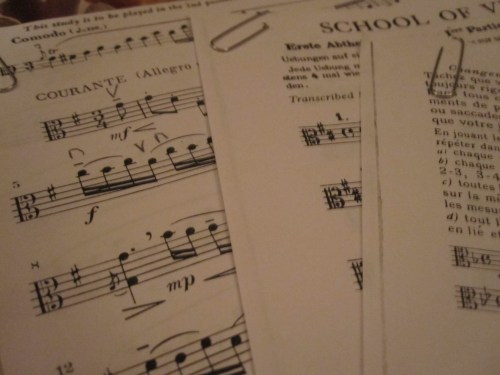
Although the Ševčík and the Schradieck didn’t engender thoughts of suicide, we finished up with Bach anyway. He’d brought along the Courante from the first cello suite. This was a bit of good luck, as it’s a piece I’ve played many times before on violin (albeit years ago), and of course I’ve heard the cello suite many times. PVF isolated the first line, and off I went.

The Courante was more of a Dirge the first couple of times through, but after a few times I found I honestly was remembering where certain notes were. There were some unnecessarily dramatic pregnant pauses as I calculated what note was where, but by the end of the session…I was reading a portion of a movement of a Bach cello suite in alto clef. Not particularly well, and not particularly quickly, but I was doing it. I thought I’d have to play something like scales or Ševčík or flashcards for weeks before I could even begin to look at something like Bach. But I was wrong; Bach turned out to be just as helpful at helping to lodge the clef into my skull as either scales or Ševčík.

There was obviously much more to the lesson, but a lot of it is stuff that’s difficult to explain in words and would be much better demonstrated in-person. But here are some random tidbits to keep in mind for any violinists who are thinking about taking up viola…

– The viola has a tendency to droop more than the violin because it’s bigger and heavier. (At least it did at my lesson.) Resist the temptation to let the scroll drop; it will affect your ability draw a straight bow.

– Actually, full straight bows in general become even more important than they are on a violin, if that’s even possible.

– Despite the instrument’s larger size, keep the left elbow tucked under; the fingers always need to be right there on top of the string ready to fall on the fingerboard.

– Breathe while you play. Exhale fully. This will help keep your right shoulder low and loose and help your tone. (Who knew exhaling would help your tone on a string instrument? I for one had never made the connection…)

– I was having difficulties getting into and finding higher positions on the viola and I couldn’t understand why. It turns out it’s because I’ve always used the old violinistic trick of knowing you’re in third position by feeling the rib of the instrument lightly on the side of your hand. But not all violas’ third positions are located there. And mine isn’t; if I feel for the ribs, I end up about half a step sharp. Hence the feeling of being completely lost.

– Don’t ever, ever tell cellists you like the Bach suites on viola. They will come and kill you in your sleep. Probably brutally and with an endpin.

I ended the session fried but inspired. “This is going to help a lot of issues that I’ve just skimmed over on the violin,” I said, cheerfully nerdy.

We then got to talking briefly a little about the differences between the two instruments. I said that although I love it, the sound of the viola has a tendency to make me melancholy.

“Embrace the sadness,” PVF said, with a glint in his eye.

***

So what have we learned from this installment of Emily Visits Violaland?

Lesson Number 1: Alto clef is easier than it first appears.

Lesson Number 2: Transcriptions of and familiarity with the Bach cello suites are very helpful.

Lesson Number 3: To help avoid frustration and delusions of idiocy, it’s best for violinists who want to make the switch or the addition to take a lesson or two from a well-trained violist (emphasis on “well-trained”) (did I mention the violist should be well-trained?). Obviously the instruments look deceptively similar, but there are a lot of differences to keep in mind, and only someone who has done a lot of thinking and learning about the mechanics of the viola is going to do you any good. Don’t go to any old yahoo who just plays the viola on the side.

Clearly I have plenty to work on. We’ll see if I can make a dent in some of those etudes; maybe sometime in the spring I can visit PVF again. Actually I have to, because I never did remember to ask about the secret violist handshake. Maybe I can learn that after I get alto clef firmly into my fingers.
***

Coming up in future installments of Emily Visits Violaland…

– Emily wonders what it will take for her to think of herself as “a real violist.” Why does it feel like she’s not a real violist even though she’s obviously playing viola? Do she have to play a fifteen-inch instrument? Does she have to learn a viola sonata or concerto? Does she need to play viola in an orchestra? Where will that dividing line be?

Ševčík and Schradieck. Lots and lots of Ševčík and Schradieck…

– Thoughts of suicide.

– (No, just kidding.)

– But she may be murdered by her neighbors…

1 Comment

Filed under My Writing

Emily Visits Violaland, Part 1/?

What do you call someone who hangs around musicians a lot?

A violist.

Haha!

Why don’t violists play hide and seek?

Because no one will look for them.

Hahaha!

What’s the longest viola joke?

Harold in Italy.

HahahaHAHAHAhaha!

Did you hear the one about the violinist who got frustrated arranging music for string orchestra because she didn’t read alto clef, who had some weaknesses in her violin playing that she thought viola playing might solve, and who had a viola-playing friend who she thought might help her navigate the subtleties of switching between instruments?

She took up viola.

HAHAHAHAHAHA –

No. She did.

(laughter fades)

Seriously. I’m not joking. This actually happened.

(awkward silence)

***

A month or two ago I arranged a piano piece by Amy Beach for my little string orchestra. The two violin parts were a piece of cake, obviously. The cello parts didn’t come quite as effortlessly, but they were still relatively easy; I did play for a year or two in my teens, and although I’m a terrible pianist, I’m fluent in bass clef.

But those violas. And that alto clef.

I know that technically it’s not possible for clefs to leer, but I swear this one did. It taunted my cluelessness. I might as well be a cipher to you, it said. For all these years, you’ve sat next to violists; learned chamber music featuring violas; heck, worshiped Lillian Fuchs and had the wildly unpopular heretical thought that there are times in her hands that the Bach cello suites sound just as good, if not better, on the viola…and you haven’t even bothered to glance at me, let alone take the time to learn my pitches. You have to go to Wikipedia to figure out what you’re doing when you’re writing notes on me. Wikipedia! You don’t know when you’re asking violists to make inconvenient shifts, do you? – you don’t know how to finger beginner players’ parts, do you? – in fact, you don’t know anything about violas period, do you? You like to think of yourself as a well-rounded musician, but you don’t know a thing about me. Haha. The joke’s on you now, isn’t it, Miss Violinist? Isn’t it? Isn’t it??

I kept hearing Edith Lynwood Winn’s opinionated turn-of-the-century voice in my head: Every violinist should play the viola to some extent. This aids one to produce a robust tone, and a knowledge of it is very helpful to the ensemble class.

Every violinist should play the viola to some extent…

Every violinist should play the viola to some extent…

***

In one of those common real-life coincidences that editors view as contrived in novels, the guy who sits next to me in orchestra is my luthier, and he has a shop and rents out stringed instruments. In early December my portable stand broke during one of our gigs (FYI, cold Wisconsin winters + plastic stands + forgetting plastic stands in cars in cold Wisconsin winters = problem), so I emailed him asking if he could bring along a spare stand to our next gig and I’d pay him there.

Then, suddenly and on impulse, I tacked on a quick paragraph asking about viola rentals. I asked if he had any available, and if so in what sizes, because with my small frame and chronic pain problems, I’d prefer a smaller one. Weirdly, I didn’t tell anyone what I was doing. I was treating the request like a covert mission. A drug deal. Looking back, I’m not sure if I was keeping it a secret to cushion against disappointment in case it didn’t work out, or whether if deep down all the jokes over the years actually have engendered some anti-viola prejudice in me.

I needn’t have feared disappointment. Sure, he wrote back. I’ve got a 14-inch in stock; if you can handle your violin, you almost certainly can handle this viola. $20 a month.

Yes, it turns out that for pennies a day, you too can give a home to a lonely viola in desperate need of love and attention.

After I heard from him, I started a thread on violinist.com about adding on viola to my musical workload and got some helpful advice (thanks guys!), the most urgent of which seemed to be, take a lesson from a violist.

As it turns out, I’m lucky enough to have an obliging professional violist friend (to be referred in this and future installments of Violaland as “PVF”). He was kind enough to agree to take some time away from his busy schedule of doing the mysterious violay things professional violists do to let me in on some trade secrets. My lesson is this weekend, so by Sunday I should be fluent in the secret violist handshake. (There is a secret handshake, right?)

***

Yesterday I went to pick the instrument up, half nervous, half giddy. My luthier came in the room with a Hoffman Concert from Shar – a really nice sturdy little thing whose value I would have assumed to be at least four or five times what it actually is. It’s not so bad to look at, either. I wonder if this is just a particularly nice shop and a particularly nice rental, or if cheap stringed instruments have drastically improved in quality since I began playing twelve years ago.

He left the room so I could be alone for my big viola debut. I took a breath, raised the bow, and started a scale on the C-string, making sure to relax as much of my weight into the bow that I could.

The weeks of waiting were worth it. The tone resonated through my chest, like someone humming very loudly right next to my heart. I remember the feeling of a soothing vibration from my cello days, but this was so much better because it was right beneath the ear, and the tone didn’t take nearly so much effort to draw out. The G and D strings had large, wide, wise sounds. (How can sounds be wise? But they are. I felt like I was listening to a philosopher.) And the A-string! It should basically be the same thing as my violin’s, right? But it’s not, at all; it’s a totally different creature. It’s mellow, mournful, melancholy. Shifts on the A-string just tug at the heart. It’s the stringed instrument equivalent of walking through an animal shelter and seeing dozens of sad eyes follow you around. And there’s no bright silvery quick-vibrating E-string afterward to cheer you up. The mellow, mournful, melancholy A-string is the high point of the viola. It’s the happy part. I’m melancholy by nature, so I loved it.

While I was at the shop, my luthier kindly offered a fifteen inch for me to try. Its sound was even bigger and broader, and more (for lack of a better word) viola-ish. But my intonation was dodgier, and it was harder to get a good tone out. Verdict: if I didn’t have chronic pain issues and could have weekly lessons with a well-trained teacher, I would have assumed I’d get used to it and brought the fifteen inch home. It wasn’t unmanageable by any means; it just felt inconvenient. It was heartening to know that a woman who’s ninety pounds and five feet five inches can almost handle a fifteen-inch viola. Something to keep in mind for the future.

But for today leastways it would be the fourteen-inch. I signed the papers and away I went.

***

I got home and compared my violin and the viola, both aesthetically and aurally. I spent the whole time playing various excerpts of solo Bach. I marveled at how the same passages could sound so entirely different on the two instruments…and how brilliantly Bach wrote for each range. I ended the session with my violin (I have to let her know she’s still my baby) with a quiet double-stop from the g-minor adagio – D on the A string and open D. I gently raised the bow from the string and let the pitch ring in the air. This was a day well-spent, I decided.

Suddenly I heard a strange sound behind me that I’d never heard before, as if there was another player in the room. I turned around just in time to see the D-string on the viola vibrating in resonance. My violin was talking to the viola…and the viola was answering. For a brief moment I got weirdly emotional (it was a long day, okay?). It was touching, and all the confirmation I needed that the two instruments can live happily in harmony.

***

This video includes, in order, 1) the allemande from the first Bach cello suite, transcribed for violin, excerpt, 2) the allemande from the first Bach cello suite, transcribed for viola, excerpt, 3) the adagio from first Bach sonata for solo violin, excerpt, and 4) the adagio from first Bach sonata for solo violin, transcribed for viola, excerpt. I thought it only fair to give each instrument a piece from their “native” rep. Also, I’m familiar with the whackload of mistakes in these clips, but forgive me; I always regress in front of an audience or a microphone. Plus, I used my laptop mic, which is made obvious by the mysterious crystally sounds scattered throughout. But hopefully, crap quality aside, the clips give a general idea of where I am at the moment in my viola journey.)

***

So what have we learned in this installment of Emily Visits Violaland?

Lesson Number 1: You don’t need an excuse to try the viola. A simple curiosity is reason enough.

Lesson Number 2: Don’t let your size hold you back from at least trying a viola.

Lesson Number 3A: The viola is amazing. The melancholy of the A-string may lead to dysthymia, but it’s amazing.

Lesson Number 3B: Refuse to listen to Edith Lynwood Winn at your peril.

***

Coming up in future installments of Emily Visits Violaland…

  • Emily experiences how frustrating it is when people have no idea what your instrument is, and learns how to strategically deploy the phrase “um, it’s between a violin and a cello…”
  • PVF makes his first appearance and offers wisdom from the rarefied world of professional viola-players.
  • Emily prints out a transcription of the first cello suite by Bach and learns that the pitch of the bottom line of alto clef can be remembered by thinking “F this!”

Until next time…

6 Comments

Filed under My Writing