Category Archives: My Writing

More Misrepresentation, More Realities…..More Misrepresentations of Reality

Today is the Minnesota Orchestra’s annual meeting – a “sober, closed-door affair“, according to Graydon Royce: “the most downbeat meeting in the orchestra’s 110-year history.” Part-y! I’ve been wondering for a while if they’re going to discuss canceling concerts through February or March (or heck, maybe even June, while they’re at it). You know, since they’ve got the whole gang in one place. Here’s some evidence to back that depressing idea up: there are some new Misrepresentations vs. Realities on the MOA’s website. (You’ll remember that the “Misrepresentations vs. Realities” chart initially appeared on the Orchestra website right before they announced the last batch of cancellations.) And bizarrely, new Misrepresentations and Realities are sprinkled among the old Misrepresentations and Realities. Not sure why they didn’t just add them to the end of the chart, or the beginning, but…whatever.

If you’re just joining us, I debunked the old “Realities” here a month ago. So let’s take a peek at the new ones!

Misrepresentation: The Board has presented its final offer and refuses to negotiate further.

Reality: While the Board has been clear that it seeks savings of $5 million annually, the approach we use to achieve these savings can be adjusted through the course of good faith negotiations. We need our musicians to participate for this to happen.

I have a story to share with you…

Pretend you’re in a car. An MD is driving, and recklessly. You get into a terrible car accident. You’re thrown from the vehicle, and are badly injured. The MD – whose specialty is obviously not surgery – investigates your wounds and determines that in order to save your life, he must remove a limb with a chainsaw he keeps in the trunk.

“Which one?” you moan.

“I’m open to negotiation,” he says.

“What? How about a second opinion?” you gasp.

“Not necessary,” he says, revving the chainsaw.

“An outside analysis?”

“Why don’t you trust me? I’m an excellent MD, not to mention driver.”

A surgeon rushes up to the scene. (Let’s say his name is, oh, I don’t know, Dr. McManus.) He says that the cure has “a high degree of probability of killing” you.

However, despite this dire warning, the MD not only ignores Dr. McManus, but pretends he does not exist. “The approach we use to decide which limb to cut off can be adjusted through the course of good faith negotiations,” he says. “But you need to tell me which limb.”

You then bleed out onto the pavement, get a Grammy nomination, and die. The end.

I humbly submit: this is not negotiation. It’s insanity. (Or a deleted scene from Misery. Either/or.)

Misrepresentation: The Board has “cooked the books” to mislead musicians and the public.

Reality: Absolutely not. The Board has appropriately fulfilled its fiduciary responsibility to the Orchestra during extraordinary times.

Hear that? They are absolutely not cooking the books! At all! Ever! Such an accusation is shocking and uncouth and uncalled for! Robert Levine? I think someone’s taking a jab at you… (Mr. Levine, of course, posted a blog entry not too long ago about the Minnesota Orchestra expressly titled “Cooking the books.”)

In fact, the MOA went so far in its effort to not mislead the public that in mid-October 2012 they removed a misleading article from 2010 that had been on their website, which celebrated the Minnesota Orchestra’s sound fiscal health, even though they knew at the time that they were in desperate trouble. They reached backward in time to set the record straight. That’s how committed to the truth they are. Pretty impressive stuff.

The Board signed a contract with musicians in 2007 that called for a 25 percent pay increase.

The Board’s decision to rely on the MOA endowment to help cover these costs through the recession was appropriate and responsible.

At the same time, Board and management were creating a strategic plan that would eliminate the organization’s structural deficit once and for all.

We began talking publicly about our structural deficit as soon as the board had ratified that plan.

Our financial position has always been clearly outlined in public documents that include our annual audited financial statements and our 990 tax returns.

“We began talking publicly about our structural deficit as soon as the board had ratified that plan.” Well, gee whiz, thanks for including patrons in the planning process, guys!

Seriously, though. This aspect of the story never fails to amaze me, and no matter what perspective I come to this question with, I just can’t conceive of an explanation for it. Why would you not include the community in your Strategic Planning? Businesses don’t go radically altering established product lines without going out to speak to actual customers. This is akin to Coca-Cola taking Coke off the shelves and replacing it with a drastically different brand new drink, without ever once talking to a single actual consumer about what they actually want in a soft drink. It just strikes me as being ridiculously reckless and irresponsible. If the MOA would like to explain their strategy, go ahead. Comment section’s open.

Also, note how neatly they sidestep the fact that they knew there was a problem back in 2009 and 2010, when they were saying things were so great and were seeking state money (and your money). FYI, you don’t need to formulate a formal plan to address a problem before you talk about it. (Same way you don’t need to formulate an entire counterproposal before you talk about it. But I digress…) If people had to come up with solutions to problems before we even discuss our problems, then we’d be as dysfunctional as the Senate. It would not be pretty.

Misrepresentation: Musicians had no idea what the true financial picture of the Orchestra was or how steep the current fiscal cliff would be.

Reality: Dating back to 2009, the Board has very thoroughly shared the full financial picture of the Orchestra with our musicians in a series of comprehensive meetings.

In 2010, the Board asked musicians for a 22 percent wage reduction—a clear indication of how steep our challenges were. We said those reductions alone wouldn’t solve our problems but it would make the financial cliff we face in 2012 less steep.

The players chose not to take that reduction, as was their legal right, and so instead we are now grappling with these compounded problems.

First of all, I addressed this point in my last major blog entry, basically deciding that we didn’t have enough information to be able to assess the truth of these statements.

Second… Why is every single person from the MOA saying the exact same thing? It’s creepy. Here’s an example. I bolded the repeating phrases.

Campbell and Davis’s editorial

Mr. Zavadil, and all his colleagues in the orchestra, participated in three meetings — on May 28, 2010, March 18, 2011 and Nov. 21, 2011 — in which we plainly articulated a $5 million gap that would only grow each year. In 2010, we asked our musicians to help alleviate growing deficits by taking a 22 percent wage reduction. We told them that even this sizable reduction would not resolve our financial problems. It would, however, make the cliff less steep in 2012. The musicians chose not to participate in those reductions. That was their legal right, and so we must grapple with even bigger financial issues today.

Mr. Eisele’s MinnPost editorial

The best we can do is request that our players consider midterm contract modifications, and this is exactly what we did in both 2009 and 2010. The musicians agreed to a one-year wage freeze in 2009, but they turned down our request for a 22 percent salary reduction in 2010. It was the musicians’ legal right to do so, but it has made the cliff we face today all the steeper.

And then now again in this chart…

In 2010, the Board asked musicians for a 22 percent wage reduction—a clear indication of how steep our challenges were. We said those reductions alone wouldn’t solve our problems but it would make the financial cliff we face in 2012 less steep.

The players chose not to take that reduction, as was their legal right, and so instead we are now grappling with these compounded problems.

We – are – all – robots. We – are – all – saying – the – exact – same – thing – in -exactly – the – same – way. We – are – apparently – incapable – of – expressing – original – thought.

Greet – ings – Minn – e – ap – o – lis – mus – ic – lov – ers.

Okay, yes, I’m a politics and media geek; I’ll admit it any day. I know what talking points are; I know their purpose; and I know that they are specifically designed to be repeated ad nauseum, ad infinitum. And the musicians certainly have their talking points, too. But the extent to which the MOA is repeating itself (and this “cliff” metaphor is only one example of this) is seriously unnerving. Their repeating the same soulless phrases over and over and over again – simplistic phrases that never seriously grapple with our complicated questions – only plays to the stereotype: that they are all inflexible, robotic, disconnected big businessmen, more concerned about the bottom line than the experience and concerns of their patrons, unsure if their ideas can withstand public scrutiny if they vary one syllable from the pre-written focus-grouped script. The MOA has even coordinated words about how they feel: the meme de jour is “heavy hearts” and “perplexion.” (Seriously. Keep an eye out for those two phrases in MOA literature. You’ll find them. Frequently.) These guys need to put the talking points in the shredder, come down from the tower, and engage with the patrons one-on-one, or in multiple in-depth interviews. They need to talk to us from their hearts.

Misrepresentation: The musicians simply do not have enough information to have a clear picture of the Orchestra’s finances.

Reality: Our Board negotiating committee trusted musicians with exhaustive amounts of information in the current negotiations in order to be transparent. This information includes our most recent independently audited financials; three years of monthly Finance Committee, Board and Executive Committee minutes; detailed reports on all our fundraising activity; quarterly investment reports dating back three years; our investment policies and objectives; and a comprehensive actuarial report on our defined benefit plan.

Aww, come on, MOA. Make this at least a little difficult for me. Here’s all I need to say to debunk this: they never actually answer the misrepresentation here.

Misrepresentation: An independent third party analysis is required to assure musicians that the Board has properly managed its finances.

Reality: The Minnesota Orchestra board is comprised of top business and philanthropic leaders in the Twin Cities, who volunteer their time and money to support the Orchestra. Why would the Board want to do anything but protect the Minnesota Orchestra for the long-term?

Question: do the top business and philanthropic leaders in the Twin Cities commonly put the future of their businesses and philanthropic organizations into the hands of volunteers who know little about how those organizations work? Are you willing to go on record saying that these volunteers, no matter how golden-hearted or well-intentioned, know better about orchestras than Drew McManus, Robert Levine, the past music directors of the Minnesota Orchestra, and others? I’d love to know.

Any financial examination would begin and end with a rigorous analysis of the Orchestra’s income and expenses—in other words, with an independent audit, which is the highest level of objective assurance regarding the state of the Orchestra’s finances. The MOA opens its books annually to an independent auditor and shares these certified results with musicians. The musicians could conduct their own analysis based on the audited financials, the MOA’s annual tax return, its forward-looking strategic plan and the 1200 additional pages of information the Board has shared in negotiations.

But they’re not asking for just a financial examination; they’re asking for something larger and more comprehensive, something that looks ahead as well as backward…just like what Mary Schaefle suggested before she knew the scope of what the musicians were requesting. We’re talking about two completely different things here. And you’re businessmen, and so you know it. So now you’re just trying to mislead us. Or, in other words, you’re frolicking and detouring. Not cool, guys.

Misrepresentation: President Michael Henson is an “obstacle” to achieving a contract resolution with musicians.

Reality: The obstacle standing between Board/management and musicians in achieving a contract resolution is the musicians’ perplexing refusal to put forward a single contract proposal of any kind in any form. How can negotiations possibly succeed if one side refuses to participate?

Perplexion!!! Told you! I’d suggest that we’d start a drinking game every time the MOA mentions the words “perplexing” or “perplexion”, but we’d all die of alcohol poisoning. (Also, this sentiment is lifted from Campbell/Davis’s editorial, in which they write, poetically: “We are perplexed by this standoff. What purpose can it possibly serve?” Just add in some line breaks and you’ve got yourself a haiku.)

Look, I’ve already extensively documented Michael Henson’s extensive failures of leadership during his time at the MOA, so I’ll just leave this “reality” unrebutted here. Check the apocalypse archives if you want more details about how terrible Michael Henson is at his job.

Misrepresentation: The Minnesota Orchestra is unique among orchestras across the country in the financial issues it is facing.

Reality: The recession severely impacted the orchestral industry, as it did most nonprofits that rely on charitable donations and investment returns. Musicians in many other major orchestras across the nation have helped their Boards to address these issues by making significant contract concessions. These include the major orchestras of Atlanta, Baltimore, Dallas, Detroit, Philadelphia and Pittsburgh. Other orchestras, such as Cleveland, have not sought wage concessions but have announced major structural deficits. Every community must find its own solution to the challenges that its orchestra faces, based on what its community can afford.

This brings up a good question… What can our community afford? Robert Levine has that same question in a thought-provoking blog entry… The whole thing is worth reading, but here’s a taste.

A close look at recent Minnesota Orchestra contracts begs a different question, which is: how did the orchestra manage to run balanced budgets for so many years?…

Essentially the board is claiming that they’re unable to pay, not only tor the orchestra they have now, but for the orchestra that they had for a long time before the most recent settlement. No wonder the musicians want an independent analysis of the orchestra’s financial situation. How does an orchestra go from running balanced budgets year after year, well into the deepest recession in our industry’s history, and then start running massive deficits – far above any increase in overall orchestra compensation – when the economy is coming out of that recession? And all this while raising major sums for hall renovation?

I don’t know, Mr. Levine. It certainly is…what’s the word for it?…perplexing.

On a closing note, the Industry News page has been updated. And I can’t help but notice the “curious incident of the dog in the night-time”: Graydon Royce’s bombshell article of 11/26 is not among the articles cited there. I don’t understand, guys. It’s almost as if the MOA isn’t happy about the revelations contained therein…

2 Comments

Filed under My Writing

On Cheap Publicity Stunts

Eons ago (as in, a week ago), there were two editorials published in the Strib, one from musicians, one from management. Sorry I haven’t gotten to analyzing management’s yet. Been busy assembling board member addresses and writing for Norman Lebrecht, among other things. And too I have a thing known as a “real life” that I occasionally indulge in.

Anyway, as the saying goes, better late than never. So let’s settle down, pop some corn, and analyze!

On Oct. 11, our commentary on the Minnesota Orchestra’s financial position appeared in the Star Tribune (“Orchestra makes a stand: Even in the arts, we can spend only what we earn”).

We were then six months into contract negotiations. The orchestra’s musicians had not offered a single counterproposal.

NO, THEY HAVEN’T. AND YOU WANT TO KNOW ONE REASON WHY??? BECAUSE. THE NUMBERS. YOU’VE GIVEN. CONTRADICT. THEMSELVES. How many times have I said that here? How many times have the musicians said that? And yet we’ve heard no explanation or clarification…not even a denial that the numbers contradict themselves. It’s like being at a family dinner, and asking your uncle if he could please pass the chicken, and your uncle not only refuses to pass the chicken, but starts talking pointedly about the salad, and you say, yes, I understand that the salad is delicious, but I’d like some chicken now please, but your uncle keeps yammering about how fresh and crisp the lettuce is. Stop – it! We’re not talking about salad! For Pete’s sake! Could you at least acknowledge there’s chicken on the table?

But they never do, so… I advise the Minnesota business community to take note. Either A) Jon Campbell and Richard Davis would happily approve of millions upon millions of dollars of investments even if the numbers within the deals contradict themselves, or B) Jon Campbell and Richard Davis are shameless hypocrites. Until they explain themselves, there’s not much middle ground there. This information may prove useful to you as you’re deciding whether or not you want to do business with them.

The orchestra board had planned for the possibility of a lockout in case the musicians decided to run out the clock on their contract.

Yes, just in case the musicians decided they didn’t want pesky things like salaries, health insurance, or jobs weighing them down…

At midnight on Oct. 1, we were obligated to make the decision to hold musicians accountable for a counterproposal rather than continuing to “pay and play” — an option that would incur losses to the orchestra of at least $500,000 per month.

Or “play and talk”, as it’s known on Earth. (And by the way, technically speaking, the MOA never “played and talked.” That practice is typically – if not always – done after the contract expires. Before September 30, the musicians were contractually obligated to play. We’ve discussed this before, but clearly they need a little reminder.)

Since then, the musicians have been busy with publicity stunts and attempts to discredit their greatest supporters and most generous donors.

So. For those of you keeping track at home…

Holding a vote of no confidence in a CEO after information comes to light that he misled the state legislature about the state of his organization’s finances = publicity stunt.

Releasing the entirety of a draconian proposed contract without letting the musicians know =/= publicity stunt.

Got that?

Also, as a corollary to that equation, if you donate a lot of money to an organization (even if this is a relatively small percentage of your overall income), you are above approach. This is what Campbell and Davis are saying: having a lot of money = automatic competence in all fields of endeavor, always, no exceptions, ever.

Here’s a little news flash for the MOA: the musicians aren’t the only ones who have been…”stunting.” (Or whatever.) What about we devoted patrons who have been following every twist and turn of this crazy saga? Who have been reading and parsing their press releases and editorials? Who have been combing through Strib articles dating back years? Who are at this moment analyzing their 990s from the past decade? Who had to figure out what percentage draw rates they were taking from their endowment because they wouldn’t tell us? Who have been begging the MOA, pleading with the MOA, to engage with us for months? What about us? Are we stunting? If so, why??? What the hell are we getting out of this, besides bad cases of carpal tunnel?

What if I would start a petition asking Michael Henson to resign? What if thousands sign it (as certainly seems possible, judging from the musicians’ Facebook page, which is nearing 6000 fans)? Would that be a publicity stunt? Listen to us! This isn’t just about the musicians. The musicians are secondary now. This is about a much larger group of people: your patrons – and, more importantly, the taxpaying citizens of Minnesota.

You’re having a meeting with your board on Thursday. How about a meeting with us?

Consider the motives of the volunteer members of this board. Why would we link our personal reputations to an institution that we didn’t care for greatly? Why would we seek harm for any member of this iconic organization? Why would we have any goal but to protect the future of this great orchestra?

Why would they link their personal reputations to an institution that they don’t care for greatly? Because it’s good PR! Especially in an era when a large percentage of the population, rightly or wrongly, believes that the ultra-wealthy frequently avoid their moral obligations to society. Exhibit A: Jim Ulland’s editorial, Enough with the big-bank bashing, from November 2011, where he uses Jon Campbell and Richard Davis’s seats on the Minnesota Orchestra board as evidence of their fundamental respectability and decency and goodness, and as a reason to not criticize the business practices of Wells Fargo and US Bancorp.

Mr. Campbell and Mr. Davis shouldn’t pretend that being on a board with other wealthy people isn’t a powerful networking tool. There’s absolutely no shame in admitting that. Wealthy individuals and institutions have always used music and musicians as tools to express their power and social status. That’s Music History 101 for you. Am I saying that none of you care for orchestral music? Of course not. Am I saying that there are other reasons besides love of the orchestra that might lead a powerful individual to want to be on the Minnesota Orchestra’s board of directors? Yes. So don’t even try to play such an easily refuted card. Your doing so suggests you have no case, and know it.

Another question… If you don’t seek harm, then why are you not following – or even acknowledging – the dire pronouncements of orchestra experts, who are tossing about the following phrases: “the Minnesota Orchestra’s reputation has been wrecked for years amongst musicians by recent events”, “The cure stands a high degree of probability for killing the patient”, and “An orchestra does not recover easily, from such drastic cuts, if ever”? Are you saying you know more about how orchestras work than Drew McManus, Robert Levine, Edo de Waart, Stanislaw Skrowaczewski, and Neville Marriner combined? If you are, then I have one thing to say to you: ha ha ha. It would be better for the Minnesota Orchestra to be dissolved completely than to be led by the likes of you.

Good intentions mean nothing; knowledge, competence, and experience in the field are everything. I could become chair of a major bank, have the best intentions in the world, and still be completely capable of turning the international financial system upside down. (If the bankers in power haven’t done so already…)

Recently, orchestra musicians shared board meeting minutes with the Star Tribune in an effort to criticize financial decisions made by our board — decisions that had been made expressly to protect the Minnesota Orchestra.

Their sharing this knowledge is “an effort to criticize financial decisions”? Uh, I don’t think so. It was more like an attempt to drag some accountability out of Orchestra leadership after they manipulated numbers so they could get a better crack at $14 million in tax dollars.

We shared those board minutes, amid 1,200 pages of documents, with musicians in our negotiations last summer as part of the orchestra’s longstanding commitment to transparency with our players.

Yes, a longstanding commitment to transparency that includes not giving players important documents and analyses they request. That longstanding commitment to transparency also extends to members of the public, who have asked for a longer version of the Strategic Plan, a fuller explanation of where endowment draws are going, answers to literally hundreds of questions, extended interviews with leadership, etc., etc., etc…none of which have ever been acknowledged or granted. Transparent transparent transparent. Totally transparent.

Transparent

That musicians chose to give these documents to a reporter is not our issue;

Mmm, Dontcha love the smell of passive-aggressive non-accusations in the morning?

rather, it is that they feigned surprise at the revelation of our financial situation. Contrary to a quote from musician Tim Zavadil (“I’m not sure we were ever told how big this cliff was going to be”), the musicians were fully aware that we could no longer manage our deficit with precarious endowment draws. Mr. Zavadil, and all his colleagues in the orchestra, participated in three meetings — on May 28, 2010, March 18, 2011 and Nov. 21, 2011 — in which we plainly articulated a $5 million gap that would only grow each year.

Oh! So you’re climbing aboard the “We Were Facing A Fiscal Apocalypse At The Same Time We Were Asking For $14 Million In State Money And Telling Our Patrons And The Legislature We Were In A Golden Period” train? Sure, hop right on! I’m sure Mr. Henson would be glad to welcome you! The public will wave a fond good-bye to you at the station.

So long, farewell, auf Wiedersehen, good-bye...

So long, farewell, auf Wiedersehen, good-bye…

Question: why would 90 musicians want to deplete the organization’s endowment by 2018? Are you really suggesting that ninety of the best-educated people in the country are too stupid to do basic math? Really?

In 2010, we asked our musicians to help alleviate growing deficits by taking a 22 percent wage reduction. We told them that even this sizable reduction would not resolve our financial problems. It would, however, make the cliff less steep in 2012. The musicians chose not to participate in those reductions. That was their legal right, and so we must grapple with even bigger financial issues today.

Haven’t heard this allegation yet, and consequently, I’m a little suspicious. I imagine there’s more to this story than what fits in a Strib editorial. (Also, there’s the little fact that in the past, just about everything provable that management has said was obfuscation and/or lie.) However, even if a new standard for transparency is being set here, and Mr. Campbell and Mr. Davis are being completely honest, as Robert Levine noted in his blog:

Notice what wasn’t mentioned: the contract re-opener of 2009. And yet the minutes demonstrated pretty clearly that the Board was planning on running deficits even in advance of that re-opener. What did they ask for in that negotiation? If they needed “a 22 percent wage reduction” in 2010, why not in 2009? And why not mention that the musicians had already given back  wage increases in 2009? It’s not even clear why a 22% giveback in 2010 would have changed management’s demands this year. If the issue is really “sustainability,” whatever deficits were run in previous years were not going to have a big impact on what sustainable fundraising goals and endowment draws would be going forward.

As I’ve said before, what we need here is more clarification… Which apparently nobody wants to give us! Ever! So we’re forced to assume the worst! Fun! Yay!

The musicians also knew that the rest of the organization had taken salary, benefit and staff cuts and that we had trimmed other expenses as much as we could without destroying this institution.

Question: What are you doing now, exactly? Have you heard what the experts are saying these proposals will do to this orchestra? Go to Google Blog Search. Type in “Minnesota Orchestra.” Press Enter. And read.

They knew of and were thrilled with our plans to secure the Minnesota Orchestra’s future through a capital campaign that began in 2005.

Yeah, I was thrilled, too… Until I heard what terrible shape the Orchestra’s finances were in. And then I wondered if fundraising for the building might be taking money away from donations for operating expenses. And then Mary Schaefle came along and said, “Unrestricted gifts decreased by close to $750,000 in three years, or almost 25%. I wondered whether focusing on the campaign would have a dampening effect on general, or annual, contributions. We can’t say for certain, but it’s tempting to think that the same effort for the Orchestra as a whole would have eased or erased the deficit.” And then I started worrying that something somewhere had gone terribly terribly wrong.

And why not? That $110 million (scaled back by nearly 50 percent postrecession) would provide for a badly needed renovation of Orchestra Hall and would help cover additional musician, touring and recording expenses in the future. The successful completion of that campaign is in sight, thanks to generous donors who believe in the Minnesota Orchestra’s future.

So now Campbell and Davis are claiming that the Building for the Future campaign was originally slated at nearly $220 million. That’s a new exciting number to add to our ever-lengthening list of Contradictory Numbers The MOA Has Provided. I’d heard that the hall renovation was possibly going to go up in cost to $90 million as late as 2010, but nothing about management seeking $110 million for musician, touring, and recording expenses in future, as is implied here. Gentlemen, would you mind pointing me to the news articles where this major campaign was announced? I’d love to read all the details.

We understand that peering into one of this region’s most venerable arts organizations through excerpted meeting minutes might make for scintillating news coverage. That’s often part of the job when leaders must make tough calls. The leaders of the Minnesota Orchestra have nothing to hide.

Yes…there’s nothing that people love more than…scintillating news coverage of…orchestral endowment draw percentages. You remember the autumn tabloids. I think it went something like LiLo stars in Liz and Dick, the fallout from the Robsten cheating scandal, and the Strib coverage of the Minnesota Orchestra’s minutes. Who can resist the sex appeal of a large endowment draw? Yes, Graydon Royce is our Mary Hart; the Strib is the National Enquirer. They do nothing but facilitate the public’s filthy, filthy, filthy habit of finding fault with brave leaders making tough calls. Shame on us for being shocked by that article, and wanting answers, and being taken in by flashy news coverage. For shame, Minnesota. (And entire music world.) For shame.

Now, bringing the sarcasm down a notch or two… Question: Does the MOA honestly believe that if we think they’re hiding something, their telling us they’re not is going to convince us?

Nixon: I have nothing to hide.

Public: OK! Glad that’s settled!

*presidency continues*

Yeah. From what I remember, Watergate didn’t go that way. People who have something to hide don’t tell people they’re hiding something. Otherwise it wouldn’t be called “hiding something.” Do I think the MOA is hiding something? I don’t know. Would they be telling us if they were? No.

Our minutes in their entirety reflect the deliberations of a board that takes its fiduciary responsibility very seriously.

Do you want to know how seriously the MOA takes their fiduciary responsibility? They misled (or lied to; take your pick) the State legislature to get $14 million. You’re taking something awfully seriously if you mislead the state legislature to get it.

They reveal a methodical coming-to-terms with the structural deficits that threaten the stability of orchestras around the country. They show a board wrestling with how to continue to offset a mounting deficit during the recession through expense reductions and precarious endowment draws in order to preserve the 25 percent pay raise contained in the 2007 contract with musicians. They show it carefully considering the impact of the 2008 recession on a fundraising campaign that began three years before the “new normal” of 2008 turned the orchestral world on its ear. And they reflect the board’s absolute commitment to ensure every musician was fully aware of the pending budget problem and the need for contract change in 2012.

And unfortunately, they never ever show a board who is open and accountable to the public about this process.

The musicians’ negotiating team appears to be avoiding at all costs our request to come back to the table with a substantive counterproposal. While we have been clear that we seek savings of $5 million annually, the approach we use to reduce these costs can be adjusted through the course of good-faith negotiations. But we need our musicians to participate for this to happen.

Sorry; I think you got that backward. We need you to participate for this to happen.

Maybe I’m unspeakably stupid, but…what would be the downside to an independent financial analysis? The cost? By your own admission, you’ve just raised $110 million. Surely it wouldn’t be too difficult to raise a few thousand more specifically for this purpose. The time it would take to analyze the books? The musicians asked for an analysis back in early September, so the time it would take should be on your dime, not theirs. The fact that you’re hiding something? Surely not; you just said you had nothing to hide, and of course those who are hiding something never lie to the public about it…

So. Once again, behold! Yet another useless major editorial from Mr. Campbell and Mr. Davis! (Once again, notice how Michael Henson is…totally, completely, and utterly absent. Let’s hear it for bold, engaged leadership, guys!) No answers to the dozens of questions we patrons have raised. No answers to the experts in the field who are warning about the dire results of the MOA’s proposals. No explanation of why a financial analysis is off-limits (an omission made even more perplexing by the musicians’ Strib editorial which ran the same day). No explanation of why they manipulated the numbers to get the balanced budgets when they thought it would be convenient for them. No explanation of why Mr. Royce’s article isn’t under Industry News. No explanation of the changed mission statement. I’m assuming they have no answers for these questions. I’m assuming they know their case is on life support.

In other words:

Good thing so many members of the Orchestra have perfect pitch. At least some people in this mess aren’t tone-deaf.

22 Comments

Filed under My Writing

Response to Jon Eisele’s MinnPost Editorial

Here’s a link to Jon Eisele’s piece in MinnPost: “MN Orchestra board member: We seek our musicians’ partnership to build a strong future.”

I’m not going to spend the time nitpicking every little thing in it that’s misleading or unsatisfactory, so I’ll just pick out a few highlights…

Here’s Mr. Eisele’s answer to why the mission statement was changed:

Our mission statement was changed in our new strategic plan to signify a new emphasis around serving our community. This language change is important, not because the “orchestra” isn’t part of it, but because it communicates a pivotal shift in what we see as the role of symphony orchestras in the 21st century. A shift to a more community-minded and responsive organization is a positive and needed repositioning for our orchestra.

For those of you who haven’t memorized the orchestra’s old and new mission statements… It went from

Our mission is to enrich and inspire our community as a symphony orchestra internationally recognized for its artistic excellence.

Our mission will be implemented by:

  • Enhancing the traditional core of concerts with innovative approaches to programming and format;
  • Providing the finest educational and outreach programs;
  • Representing and promoting the Minnesota Orchestra and the State of Minnesota to audiences across the state,  across the country and around the world through tours and electronic media;
  • Maintaining an acoustically superior hall with a welcoming environment.

To:

The Minnesota Orchestral Association inspires, educates and serves our community through internationally recognized performances of exceptional music delivered within a sustainable financial structure.

Seriously, now. Which mission statement sounds like it’s more interested in serving its community? If community service really was at the heart of the Minnesota Orchestra’s new mission, then why remove references to “the finest educational and outreach programs”, “representing and promoting the Minnesota Orchestra and the State of Minnesota to audiences across the state” and maintaining a hall with “a welcoming environment”? I think this is a fair question.

Also, I’m failing to understand how not addressing a community’s questions about its finances is in any way, shape, or form serving them…

Another point: I was disappointed that Mr. Eisele took words directly from the Minnesota Orchestra’s website and Mr. Campbell and Mr. Davis. I would have much preferred to hear from him in his own words.

The website:

These donations would not have been contributed to the Orchestra if there were not a building project to support.

Mr. Eisele:

The vast majority of donations we received for the hall campaign would not have been contributed to the orchestra if there were not a building project to support.

Mr. Campbell, Mr. Davis:

 In 2010, we asked our musicians to help alleviate growing deficits by taking a 22 percent wage reduction. We told them that even this sizable reduction would not resolve our financial problems. It would, however, make the cliff less steep in 2012. The musicians chose not to participate in those reductions. That was their legal right, and so we must grapple with even bigger financial issues today.

Mr. Eisele:

It was the musicians’ legal right to do so, but it has made the cliff we face today all the steeper.

Mr. Campbell and Davis:

Why would we seek harm for any member of this iconic organization?

Mr. Eisele:

Why would we want anything but the best for the organization?

And so on and so forth. It would have been lovely to hear more from Mr. Eisele, and fewer rearranged talking points. We’ve already read the talking points, thanks.

I couldn’t help but note that Mr. Eisele ignored the DeCosse’s question, “Has the community raised almost $47 million to renovate an Orchestra Hall that will not include a first-rate Minnesota Orchestra?” That’s troubling, especially when it’s probably the most pertinent question that the DeCosses raised.

On top of that, there are no answers in Mr. Eisele’s piece to questions like:

  • Why the orchestra trumpeted its financial health from 2008-2010
  • Why Mr. Henson misled the state legislature
  • Why an independent analysis would be harmful
  • Why orchestra experts like Drew McManus, Robert Levine, and Bill Eddins are so off-base in their assessments
  • Why we shouldn’t be listening to all the former music directors who claim these cuts will be catastrophic
  • Why there was a $6 million draw from the endowment in 2011 that did not go to operating expenses
  • How much revenue will come from the newly renovated hall, and how

Etc., etc., etc.

We believe the board and the community that supports the Minnesota Orchestra deserve that level of respect.

I look at it another way. I believe the community that supports the Minnesota Orchestra deserves the respect of the board. They are there to serve us and the musicians. Serving us would include submitting to a full independent financial analysis. This isn’t about the musicians anymore. It’s about the taxpayers who footed the $14 million bill for the Orchestra Hall renovation.

In short, this is a hugely unsatisfying piece. I doubt the DeCosses are satisfied. I know I’m not.

Leave a comment

Filed under My Writing

Guest-Blogging, MOA Annual Meetings, and Advent Reminder

I was asked by Mr. Norman Lebrecht over at the Slipped Disc blog to contribute a summary of the Minnesota situation. Here ’tis. As I say in the article, I welcome any clarification from the MOA. (Heck, even an acknowledgement of my existence would be nice… *waves* I know you know I’m here, MOA! It’s getting awkward never hearing from you! Trust me, there’s absolutely nothing to be afraid of! I’m only 90 pounds, and I’m disabled, to boot! So come on over and pull up a chair!) Anyway. The lesson I took away from writing the Lebrecht entry? It’s much more difficult to write something in 850 words than it is in 3000!

I also have an answer to a question I’ve been hearing a lot of lately: when is the MOA’s annual meeting? And that question is invariably followed up by, can we protest at it?

According to the Star Tribune, the annual meeting of the Minnesota Orchestral Association will take place on Thursday December 6. We don’t know when in the day or where, so unless information is leaked and publicized in time, sadly we cannot protest at it. (I’m guessing that the MOA is keeping the time and location under pretty tight wraps. I can’t imagine they’re very keen on the idea of a public demonstration outside their annual meeting.) We have no idea what will happen there. (Some tough questions for Mr. Henson, such as, why did you lie to the state legislature? Discussion of canceling more concerts? Discussion of hiring replacement musicians? A full vote of confidence in MOA leadership from the board? Musician bashing? Union bashing? Musicians’ union bashing? The mind boggles at the possibilities!) In years past, Graydon Royce has reported on the meeting, so keep an eye out on the Strib’s website for that.

To be a fly on the wall there. There would be so much material for this blog, I’d be busy until Christmas. Oh, well. I’ll have to make due with all the material that is public, and to be fair, there is a lot of material that is public. I’m working on a couple of essays at the moment, examining management’s latest Strib editorial and Doug Kelley’s string of non sequiturs on Almanac. And I know Mary is working on another installment of her financials series. And I know of at least a couple other people who are digging around in tax forms and Internet archives and the like. And I imagine Graydon Royce is researching stuff, as well. So take heart; this story isn’t over yet, by any stretch of the imagination. Despite any discouragement you may have, keep your chin up, and stay tuned. We’ve only just begun to fight.

Hope you’re having as enjoyable a holiday season as possible, given the circumstances. Have you checked out the Song of the Lark Advent Calendar? If you haven’t, you should! We’re – er, I’m – still accepting submissions for memories / encouragement for all those affected by the lockout(s), to be sent to songofthelarkchristmasproject [at] gmail.com. I’d really appreciate hearing from you! And if you want to send out some polite letters of protest along with your Christmas cards this year, I have just the entry to help you do just that.

6 Comments

Filed under My Writing

Drew McManus’s Latest, and Popcorn

There aren’t many blog entries that I devote blog entries to, but here’s one I will: Drew McManus’s “The Empire Strikes Back.” (This was also the title of Robert Levine’s latest.) (Combine those two entries with my recurring popcorn GIFs, and it appears the Minnesota Orchestra blogosphere is now on a movie kick.) (But who can blame us? With every passing day, the conflict gets more and more theatrical.)

Here’s Mr. McManus:

EXTERIOR PLAIN OF HOTH MINNEAPOLIS – HELICOPTER SHOT – DAY:

A white snowscape races toward camera … the MAIN TITLE quickly recedes, followed by a roll-up. Episode V: THE EMPIRE STRIKES BACK…

Although certainly not science fiction, the recent opinion piece co-authored by Minnesota Orchestra Association (MOA) board chair Jon Campbell and MOA negotiation chair Richard K. Davis and published in the 11/28/12 edition of the Minneapolis Star Tribune still managed to contain what some might consider a rather cinematic tone…

And it goes on, very entertainingly, from there.

Mr. McManus brings up an important point that I should have thought of earlier, but didn’t. If the musicians submit a counterproposal, they’re at risk of turning the conflict from a lockout into a strike, and losing unemployment benefits, thereby strengthening management’s position, all while guaranteeing the musicians (and the many patrons who support their cause) nothing. I actually knew all of those piece of information individually, and yet never connected the dots to think of how they might relate to one another. Sooooo, this is proof that you need to read as many media outlets as possible, because I’m not always going to make all the connections that need connecting. I’ll try to keep you as up to speed as possible, but I’m only one woman, going through her first orchestral labor dispute, and learning as I go along. So keep an eye on MNuet’s News & Reviews page. Be well-informed, folks!

Drew McManus is, as I’ve said before, the Nate Silver of the orchestra world. He’s calm, rational, level-headed, professional, uber-careful, always. So when he starts posting snark and parody………………….well. Crap is hitting the fan.

I think at this point the MOA should go on Stephen Colbert’s Absurd-U-Chart, which is reserved for things that are “offensively absurd, like rabbits with pancakes on their heads, and owls.” I think that’s about the level of crazy we’ve reached here. Let’s see how long it takes the MOA to figure that out and come back to earth.

I’d also like to repeat what Mr. McManus says, among other things, in the comment section:

I’ve also offered to travel to Minneapolis at my own expense to conduct a live interview with them which would subsequently be published here in audio format.

I hate to use more popcorn GIFs, but…

https://i0.wp.com/www.reactiongifs.com/wp-content/uploads/2011/05/popcorn_yes.gif

(Also, in case you were wondering, I have my own response to the Campbell/Davis editorial cooking. So stay tuned.)

Edit 1:30PM: Here Robert Levine discusses Drew McManus’s entry.

11 Comments

Filed under My Writing

Michael Henson’s Advent Calendar

Well, the two weeks of breathless anticipation have finally passed, and the First Annual (?) Song of the Lark Advent Calendar is now live on Tumblr!

Our primary theme this year is “Michael Henson’s Advent Calendar.” Our secondary theme is “a gaudy chintzy glitter-based aesthetic.” Our tertiary theme is “accountability to patrons and taxpayers.”

For more information on the project, visit

michaelhensonsadventcalendar.tumblr.com

You can get all the sparkly details there. Watch me! In a jerky Youtube video! Adorned in a silky red shirt and a glittery garland! Yammering into a webcam for twelve whole minutes! While giving dramatic readings of three of the Christmas cards I sent this year! And showing off my holiday crafting project! And explaining for the unenlightened what an Advent calendar is, and how generally awesome they are! (There also may or may not be some Alex Ross fangirling.) (Spoiler alert: there’s Alex Ross fangirling.)

As the MOA is fond of saying, we all have a part to play! Jon Campbell, Richard Davis, Michael Henson, every reader of this blog. Let’s all come together in this celebration of the holiday spirit. Bookmark the calendar. Follow michaelhensonsadventcalendar on Tumblr. Check back daily. Answer my questions. It’s a veritable cornucopia of accountability! Yay!

If you have a memory or encouragement to share, you can email me it at songofthelarkchristmasproject [at] gmail.com. We still need more.

Wishing you all a wonderful holiday season.

2 Comments

Filed under My Writing

Mr. Henson Goes to St. Paul, Part 2

Click here for part one of my “Mr. Henson Goes to St. Paul” series.

***

Well, after that marathon transcription session, I’m ready to dig into the meat of the matter. Please feel free to join me in the comment section.

Margaret Kellihan: …There’s a wonderful packet that they’ve put together for all of you, including the impact on your own districts of the Orchestra.

Some questions… What specifically did this packet say? Did it include anything about the Orchestra’s financial situation? If so, what? Can a person or organization face consequences for submitting false or misleading information in writing to the state legislature? I highly doubt that anything illegal occurred; I’m assuming the leaders of the MOA were extremely careful to check with their lawyers to make sure that everything was done within the bounds of the law. But just the fact that I have to say “I’m assuming the leaders of the MOA were extremely careful to check with their lawyers to make sure that everything was done within the bounds of the law” leaves a terribly rotten taste. I’d be very interested in seeing what claims were made in that packet, or to the state government in general. How closely did lawmakers look at the financial situation of the Orchestra while deciding whether to entertain the request? What information did they need? What answers were they given? I don’t know how this all works, and I’d be interested in finding out.

MK: Over 900 jobs will be created with this little bit of state money, partnered with a lot of private money.

MH:  Our private fundraising efforts are going very well, but public funding is critical if we are to reach our ultimate goal. Our private donors are keen to hear that the state is a partner in our project.

Of course we already knew about the synergy between public and private money within the Building for the Future campaign, but hearing it here again really underscores how desperately important this bonding request had become to the MOA and their vision of the organization’s future. I doubt the renovation could have even happened without it. So I completely understand what a temptation it must have been to manipulate numbers to, as Mr. Ebensteiner said in 2009, “support our state bonding aspirations.” I don’t agree with that tactic, at all, but I certainly understand it.

MK: The Orchestra has been winning terrific acclaim all around the globe, including the London Daily Telegraph, as well as the New York Times. And you can also know the reach of this Orchestra by the fact that it’s one of the only – it is the only American orchestra with a regular broadcast on the BBC. I think that’s pretty amazing, Madame Chair, and members.

It appears from the Speaker’s words that a major reason this request was entertained was because the Minnesota Orchestra is a world-class ensemble…or, in other words, a destination for world-class orchestral players. Implication: if they were to secure this money for the renovation of Orchestra Hall, Mr. Henson and the board had ethical (if not legal) obligations to do everything they could to maintain the status and the reputation of the Minnesota Orchestra. But I’ve yet to hear anyone in the orchestra business suggesting that the current leadership team is doing that. Indeed, Robert Levine has called for the entire board’s resignation, as well as Henson’s dismissal. We all remember the joint editorial that Marriner, de Waart, and Skrowaczewski published in the Strib in early October, in which they said, “An orchestra does not recover easily, from such drastic cuts, if ever.” And Drew McManus recently wrote in the comment section of his blog:

I would also add that provided everything in Royce’s article is accurate, the public trust is likely damaged beyond repair at this point as well. It’s difficult to separate the accounting decisions vis-a-vis the public bond funding and the corresponding decision to then reverse the policy for the purpose of artificially exacerbated negotiation leverage.

As the situation unfolds, it is depicting an increasingly sad state of affairs for an organization that once held one of the highest reputations in the field.

If we hear from dissenting respected voices from within the orchestra business praising management’s handling of the conflict, I’d be happy to feature them here. But I personally have found none.

On the financial front, we have announced balanced budgets over the last three consecutive years, and we are facing the current economic downturn with stability.

The slickness of that sentence just… It makes me queasy. It’s so terribly upsetting. As a commenter on violinist.com said, “Henson uses an interesting choice of words: ‘…we have announced balanced budgets…’ rather than saying they achieved, attained, or just plain had balanced budgets. I could ‘announce’ tomorrow that I am indeed the Queen of Sheba. Doesn’t make it so.” Well, exactly. He’s allowing himself wiggle room. And listen to the tone of his voice as he says it. He doesn’t stop; he doesn’t hesitate. He’s owning that obfuscation. It’s not troubling him at all, even though he’s clearly constructed the sentence to allow him to backpedal later if necessary.

We could debate whether the “we have announced balanced budgets” line is false or simply misleading, but personally, I consider the bit about “we are facing the current economic downturn with stability” to be a lie. A total fabrication. You might disagree with that assessment; “stability” is a subjective word, and it can mean a lot of things to lots of different people. But personally I can’t begin to conceive of a “stable” fiscal future that involves a 20-40%+ pay-cuts for musicians and endangers the quality of the core product. I wonder why Mr. Henson even included this phrase? He could easily have stopped after the slippery “we have announced” bit. Nobody would have noticed.

In general, the orchestra is musically enjoying a Golden Period with music director Osmo Vänskä.

Sigh.

This is obligatory now

Since I joined the Orchestra, we have tested and re-scaled the scope of the hall project in light of the very challenging economy.

This is a point I would love to hear more about. What did the testing and re-scaling consist of? Did anyone ever consider postponing the project for a few years? Did the public have any input into the decision-making process? If not, why not?

Our private fundraising efforts are going very well, but public funding is critical if we are to reach our ultimate goal.

Yes, fundraising was going so well that, a few weeks after testifying to the legislature, Mr. Henson said to the Strib…

“You recall that the project was downsized from $90 million,” Henson said, referring to a previous plan announced in 2007. “If we can generate more money through our fundraising, then it would make sense to grow the project, but it’s too early to say that, and we’ve made a priority to be fiscally responsible.”…

KPBM was expected to deliver sketches last December, but that likely was delayed to see whether fundraising might be robust enough to expand the project.  – Star Tribune, 15 March 2010

I know I mentioned that point a few days ago, but I think it deserves repetition, especially in light of Graydon Royce’s recent article. Because now we’ve got to wonder: did Mr. Henson really believe he could grow the project, or was he just saying that to manipulate the public? Your guess is as good as mine. This is incredibly disheartening. As Mary recently said in the comment section of Drew McManus’s blog: “A nonprofit’s most precious asset is trust of the community and donors that they are doing the right thing.” And right now we have a major trust deficit. Which will lead to exacerbated financial crisis. And so the downward spiral continues.

In other words:

We’re aiming to maintain the vast majority of that orchestral series, and the object has to be to actually retain that audience, so that when we close the hall and reopen it in a year’s time, we have retained as much of that audience as possible and retained that enthusiasm. So hopefully in the next couple of months we will be announcing that, and we are trying to minimize the amount of disruption.

Hmm. Yeah, about that…

(You know, now would be a fascinating time for minutes to surface in which MOA leaders discuss the possibility and likelihood of a work stoppage. Paper proof that Mr. Henson and his colleagues were anticipating a strike or lockout in January 2010 would add a whole new level of sleaziness to this entire affair.)

(Also, I’m eagerly anticipating the release of the Orchestra’s 2013-2014 schedule. Then we’ll have a much better idea of how many classical concerts the MOA really wants to put on relative to other non-renovation years.)

If I could also supplement that, we’re also aiming to increase our state touring for that year as well.  And we’ll be looking at between two to four weeks of activity. So I think we’re going to see a smaller main season, but we’re also going to take that in terms of increasing our presence across the whole state.

Great idea! Unfortunately, it never happened. Most (if not all; I’m not sure) of the Orchestra’s state touring is now done via the Common Chords project. In the 2011-2012 season, when the Orchestra was still in the hall, there were two Common Chords residencies, one in Grand Rapids and one in Willmar. In the 2012-2013 season, there was only one week scheduled, in April, in Bemidji…even though the Orchestra’s performance calendar was totally blank from September to mid-October. Is this an indication that the MOA was anticipating a work stoppage back when they were scheduling the season? Read the tea leaves as you will.

Well, those were the gist of my thoughts. I might have more as time goes by, and if I do, I’ll flesh those out in the comment section in conversation with you.

7 Comments

Filed under My Writing

Is Minnesota Orchestra Management Lying To Us, Part 3: Yes

Yesterday proved to be an important day. Graydon Royce penned and published the single most important article yet written about the orchestral apocalypse. So go read it. Now. Please.

Let’s all take a moment to acknowledge that Graydon Royce is the King of Minnesota Orchestra Investigative Reporting.

Your crown, dear sir.

The article begins:

For four years, the Minnesota Orchestra board has walked a tightrope between managing public perceptions about its financial health and making its case to cut musicians’ salaries.

I’m not writing in a newspaper, and I’m not speaking on behalf of anyone but myself, and I don’t need to be delicate, so please, allow me…

The Minnesota Orchestral Association lied to the public about its fiscal health in order to get what it wanted. Yes, I know that we’ve sidestepped the L-word in the past. I wrote “obfuscations” once; the MOA then wrote about “misrepresentations“. So I’m going to be the first to be blunt, and say lie. They lied. They lied, as in “they presented false information with the intention of deceiving.”

THEY LIED TO US.

Continue reading

23 Comments

Filed under My Writing

Richard Davis Debates Richard Davis

Hey, do you guys remember Richard Davis? Yeah, me neither. We haven’t heard much from him lately. But presumably he hasn’t fallen off the face of the earth, as he is still listed as immediate past chair of the Minnesota Orchestral Association board of directors, and is therefore a co-architect of the lockout.

While I was Googling aimlessly this morning, I came across this shocking interview with Richard Davis from June 2012. It’s explosive. Second Quarter Richard Davis (in other words, “2Q Richard Davis”) has some extremely pointed criticism for Fourth Quarter Richard Davis (or “4Q Richard Davis”). Let’s listen in on their heated debate about how they should be running the Minnesota Orchestra Corporation.

Richard Davis v. Richard Davis

Inside the Performance Chain: An interview with US Bank’s Richard Davis

Congratulations to Richard Davis for his induction into the Minnesota Business Hall of Fame — today!

US Bank: Minneapolis-based U.S. Bancorp (NYSE: USB), with $330 billion in assets, is the parent company of U.S. Bank National Association, the 5th largest commercial bank in the United States. The company operates 3,089 banking offices, 5,092 ATMs in 25 states, and provides a comprehensive line of banking, brokerage, insurance, investment, mortgage, trust and payment services products to consumers, businesses and institutions.

About Richard: “I could have been a pastor as easily as a banker.

“I started as a teller, working my way through school.  I became interested in ‘how does it all fit together?’  I’m one of those guys – ‘just tell me how it works.'”

Ouch. What a stinging rebuke by 2Q Richard Davis to 4Q Richard Davis, who has repeatedly shown a lack of interest in learning how orchestras work. Expert after expert has condemned the current contract proposal and the way the lockout has been conducted:

For decades, Minnesotans have taken pride in the accomplishments and extraordinary talents that make up the state’s most prominent cultural institution. In dramatic contrast, this management and board is out to destroy it, even though they may not quite realize that yet. – Frank Almond, Non Divisi, 2 October 2012

Traditionally, the diminution of artistic quality produces an equal decline in ticket buyer and donor interest, which in turn could initiate an unavoidable spiral of decline resulting in exacerbated financial crisis. The cure stands a high degree of probability for killing the patient. – Drew McManus, Adaptistration, 19 November 2012

He’s [Henson’s] wrong if he thinks that Minnesota Orchestra will “always have great appeal as a place to have an orchestral career.” I’m sure they’ll always get musicians to audition for positions. But everyone now knows that the Minnesota Orchestra is not a trustworthy employer, even in an industry full of employers who are having trouble making ends meet. It matters to musicians considering going there that their chosen course of action, in the face of supposed financial problems, was 1) complete lack of transparency; and 2) a refusal to bargain in good faith with its musicians. I think the Minnesota Orchestra’s reputation has been wrecked for years amongst musicians by recent events, especially amongst the musicians who they would most want to recruit – those at the top of their game. – Robert Levine, Polyphonic blog, 9 November 2012

An orchestra does not recover easily, from such drastic cuts, if ever. – Edo de Waart, Stanislaw Skrowaczewski, Neville Marriner, 6 October 2012, Star Tribune

And yet! Despite these incredibly dire assessments by outside experts, 4Q Richard Davis never alters his position, and shows a consistent refusal to learn from them. The insinuation may be unspoken, but it’s obvious: 2Q Richard Davis thinks that 4Q Richard Davis should start listening to experts who know how orchestras work, and modify his positions accordingly.

Richard is Chairman, President and Chief Executive Officer of U.S. Bancorp. He has served as Chairman since December 2007, as President since October 2004 and as Chief Executive Officer since December 2006.

“When I stepped into my role, we had disaffected employees. We are in a service business which means we need really, really engaged employees who serve and create happy customers, who in turn lead to results for the bank.

(As Jon Stewart would say… “Go on.”)

“When we held a large investor relations event about a year after I became CEO in 2007, I built my whole presentation about how employees were going to take the front seat.  One analyst who follows the bank publicly questioned the approach. She doubted that a focus on employees would have the needed impact.”

A year later, that analyst told Richard he was right – focusing on employees was paying off.

Aww, snap! Did you hear that, Richard Davis? Did you hear that? Richard Davis is mocking you! He’s clearly insinuating you’re being fiscally and morally irresponsible by not fostering a work environment within the Minnesota Orchestra that results in “really, really engaged employees who serve and create happy customers,” which will then “lead to results” for the Minnesota Orchestra! Are you listening, 4Q Richard Davis? Are you just going to let that shocking accusation stand?

Richard turns to CPR when he talks about the evolving needs of the constituents: Consistent, Predictable and Repeatable. For investors, predictability is the most important aspect, while customers appreciate all three, making sure there are no surprises in their experiences. CPR gives employees confidence, and they enjoy representing the organization.

“The key is not to do things out of character with who we are as an institution. It works.”…

OH! OH! And the brutal hits to 4Q Richard Davis just keep on coming! 2Q Richard Davis thinks it would be a good idea to have a Consistent orchestra – a Predictable orchestra – a Repeatable orchestra…but 4Q Richard Davis doesn’t want any of those things. 4Q Richard Davis actually said of musicians in September 2012 – “There’s a risk that they find their way to another place, and those who can leave will. It’s going to be a personal decision where they want to perform.” (Well, actually technically I guess that was 3Q Richard Davis, but apparently 3Q and 4Q Richard Davis share many of the same beliefs, so…) Rarely do we hear such wealthy powerful people criticizing each other so publicly. I wonder what will happen the next time Richard Davis meets Richard Davis at a cocktail party. Yikes.

What are the key attributes of your company’s performance chain that come to mind?

“People. Empowered people.”

Can you relate to how speed, flexibility, predictability and leverage play a role in the way your company operates? Let’s start with predictability.   

“Predictability goes with ‘CPR.’ No surprises – consistently good service.  Communications across all levels of employees is critical.  We have a quarterly leader meeting with 1,000 leaders.  We talk about the business and the environment. We talk up to them and empower them to do the same with their employees. Rather than controlling the flow of communication, they asked that we expand the information sharing, so we’re now having a similar conversation with the next 6,000. The idea is to build understanding and empowerment, leader to leader.

If we want consistent performance, we have to rely on each employee to act within their role with as much information as possible.

Ooo, that is a powerful indictment. He didn’t spell it out specifically, but of course all of us who have been following this story know exactly what 2Q Richard Davis is referring to: 4Q Richard Davis refuses to give musicians information they’ve requested multiple times, including the current 2012-13 budget, an audit report from FY 2011-2012, minutes from a meeting of the Trustees of the Oakleaf Trust, a joint independent financial analysis, and confirmation or denial that a reduction in “contributions and pledges…was related to these contract negotiations.”

You know, I can’t help but think that things would be different at the Minnesota Orchestra right now if 2Q Richard Davis was in charge. Perhaps the lockout would even be over by now. I wonder: is it too late to get 2Q Richard Davis on the Minnesota Orchestra board?

“In our business, leverage is all about people. Again – I fully believe if employees are happy, empowered and know what to do, they will drive happy customers. Happy customers drive results.”

Wow, 2Q Richard Davis isn’t even trying to hide his scorn for 4Q Richard Davis anymore! As the entire music world knows, 4Q Richard Davis’s actions have resulted in widespread customer anger. In fact, the following comments were all posted by customers on the Orchestra’s Facebook wall within the last couple of weeks:

Michael [Henson] can stop sending me letters trying to prove that he has a) an argument or b) any integrity…

I am standing here with money in my hand, to give to the Orchestra as soon as you fire management…

You are holding the citizens of Minnesota hostage by not negotiating. We will not attend sub standard part time concerts no matter how shiny a new hall you build. Settle this now. You are in the process of lowering the standards of our proud state which has a history of supporting and appreciating the arts. Shame on You Board of Directors. Shame on you…

Just read Maestro Vanska’s letter to you. Beautiful and heartfelt. Shame on MN Orchestra management for picking out one paragraph in their letter to patrons to make it sound like he unilaterally supports their ridiculous and unfair stance. Yet another classic example of Management’s deceitfulness. Lord help us all…

I just purchased my tickets for the December 16th concert by the musicians. This will be the second Minnesota Orchestra concert I have attended this year and neither will have been under the auspices of the MOA. Michael Henson, Jon Campbell, et al: What I care about is the music. I have not, and will never, buy tickets to attend a concert of administrators. Your only purpose, and the purpose of the MOA is to facilitate the delivery of music. You have failed to do so, yet the music plays on. I guess that means you are irrelevant…

Those are some awfully unhappy customers! You know, I hate to take sides in this smackdown argument, but it does appear that 2Q Richard Davis has a point here.

I look forward to documenting any further debate between Richard Davis and Richard Davis.

3 Comments

Filed under My Writing

A Michael Henson Retrospective

A few days ago, I took a trip through the 2010 Minnesota Orchestra e-tour site. That’s the place where I found the “winning” article from Gig Magazine, where the Minnesota Orchestra was described “as a beacon institution among the bad [economic] news.” Not long after I blogged about that article, it mysteriously vanished from the Orchestra’s website. Luckily, a reader had told me to take screenshots, and so I posted those. We’re going on seven weeks now, and management has yet to address the disappearance.

Anyway! During my recent return trip to the e-tour site, I found some more quotations that I feel compelled to share with you now. They’re from an interview that Minnesota Orchestra CEO Michael Henson gave to Classical Music Magazine in August 2010 called “Flying the flag.” I’m not even going to bother with the cache. Here’s a direct link. When that’s taken down, here are the screenshots. Click for bigger images.

Mr. Henson is speaking…

“We’re being fiscally prudent, looking at how we plan the short term at the same time as being mindful of the medium and long term.”

“The current Sommerfest series is being well attended and the orchestra came in on budget for the 2009/10 season.”

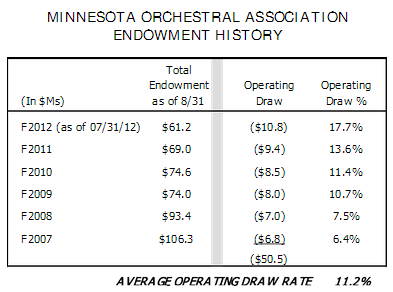
In the 2008-2009 fiscal year, the Minnesota Orchestral Association, or MOA, says their operating draw percentage was 10.7%; in 2009-2010, the orchestra says the operating draw percentage was 11.4%. (I say “says” because guest blogger and local nonprofit professional Mary Schaefle reports that the numbers released to the public don’t match the MOA’s tax returns, and so far, we have not received clarification from the MOA on this point.) As Jon Campbell, the chair of the MOA board of directors, and Richard Davis, the immediate past chair, put it, “In Minnesota, we were able to deliver balanced budgets through large, unsustainable endowment fund draws and ‘bridge-the-gap’ fundraising.” Which – and correct me if I’m wrong about this – is bad. But according to August 2010 Michael Henson, unsustainable endowment fund draws and “bridge-the-gap” fundraising are also….fiscally prudent, and being mindful of the short and medium and long term. Or something.

Although there has been a slight decline in recent audience numbers, it has not been enough for alarm bells to sound.

But… I thought national trends indicate a need for change…

So I guess there’s a need for change, but there hasn’t been enough change for alarm bells to sound? Or in other words, there’s no need for changes that require a significant departure from the traditions of the past?

Clarification would be very cool right about now.

“We’ve done a very good job in terms of maintaining audiences and indeed the audiences have really shown that even if we’re in a tough economy, people still want to come out and hear a great orchestra.”

In the fiscal year lasting from 2009-2010 (the year Mr. Henson had just finished as he gave this interview), overall attendance dropped by 7%, from 270,000 to 250,000. Is this “a very good job in terms of maintaining audiences”? I suppose if you get convoluted about it, and if most other American orchestras saw their attendances plummet by 10% or 15% that year (and I don’t know if they did), you could make that case. Otherwise…I dunno. Please forgive me if I’m not completely convinced. I’d love to hear more of the subtleties of the argument, and more figures to back the argument up. If Mr. Henson ever sits down with a reporter like Matt Peiken from MNuet, these remarks could form the basis of a fascinating and productive discussion. (Mr. Peiken has asked to interview Mr. Henson; Mr. Henson has not yet accepted the invitation. Maybe he will now.)

(And yes, I’m aware that a big chunk of that attendance drop can be ascribed to the fact there were 9% fewer concerts in the 2009-2010 season, as Mary has explained here. But Mr. Henson wasn’t talking about revenue here; he was just talking about audience maintenance.)

At the time Henson was appointed to the Minnesota Orchestra, he was quoted as saying he believed orchestras were in a golden period. That, he says, is still the case.

A visual representation of our era

Yes, apparently we are in a…golden period. Pretty fricking depressing Golden Period, if you ask me, but…OK.

 “At the moment we are getting some great artistic performances from major orchestras in America. The real challenge is looking at the long term future. It’s critical that the art remains central to our mission and critical that we continue to act in a fiscally prudent way. This orchestra’s been in existence for well over a hundred years and our job and duty is to make sure it’s thriving for the next hundred.”

What?

I agree with Michael Henson about something?

Yay!

This warrants a celebration.

OK, celebration over.

Now. Remember, at the exact same time that he was saying all of these things…”golden period”, “people still want to come out and hear a great orchestra”, “we’re being fiscally prudent, looking at how we plan the short term at the same time as being mindful of the medium and long term”…Mr. Henson was, behind closed doors, not only approving endowment draw rates of over ten percent, but Strategically Planning the Strategic Plan that would culminate in 20-40% pay cuts for musicians, prominently highlight how “stressed” orchestras are, and produce a drastically altered mission statement that can be interpreted as the MOA having no interest in supporting orchestral music at all. By management’s very own admission, the Strategic Planning began in the spring of 2010: months before these sentences were ever uttered to Classical Music Magazine (or, for that matter, Gig Magazine).

So, to sum, as he was giving these rosy interviews to the international press, behind closed doors, Mr. Henson was saying (formatting mine for emphasis):

  • “the status quo can no longer be preserved” (from the Open Letter)
  • “…this is a journey that began several years ago, when the Board of Directors of the Minnesota Orchestra recognized that the organization could no longer survive based on optimistic economic assumptions and the hope of limitless benefactor generosity” (from the Open Letter)
  • “…the reality is that over the past three years we met regularly with our musicians and others with a stake in our future to share the clarity of our financial challenges“… (from the Open Letter)
  • “Board and management have been communicating the financial position of the Orchestra with musicians for three years.” (from the Misrepresentation vs. Reality chart)
  • “As part of the strategic planning process, the board openly shared the Orchestra’s financial situation with musicians in a series of meetings spanning three years.” (from the Misrepresentation vs. Reality chart)
  • Would you like me to keep going? Because I could keep going. But alas, I have pity for this dead horse.

So.

What are you feeling right about now? Personally, I’m suffering from a bad case of confusion, and the only thing that has a chance to cure it is a long, long hours-long sit-down chat with Mr. Henson himself.

Here are some more quotes that struck me as odd as I was paging through old newspaper articles. Lots of interesting ones…although, awkwardly, none of them are as damaging as what is actually still on the Minnesota Orchestra’s own website.

Terms of his [Henson’s] contract were not disclosed. According to public documents, [Tony] Woodcock, his [Henson’s] predecessor, earned an annual salary of about $300,000. – Pioneer Press, 22 September 2007 [According to public documents, Mr. Henson’s salary in the 2010-2011 fiscal year was $360,283; total compensation was $389,861. We are currently waiting on numbers from the 2011-2012 fiscal year. Since I don’t have a paid account with Goldstar, I have no access to the 990s that would go into the details of Mr. Woodcock’s compensation.]


Henson believes the hall’s finest characteristics must be preserved. He has visited the new Guthrie Theater, MacPhail Center and the Walker Art Center and came away concluding that while all three make distinct visual statements, it is what happens inside the building that matters most.

“There is no point in having a great building without having great art inside it,” he said. – Star Tribune, 24 February 2008


The Minnesota Orchestra has raised $24 million toward its $40 million Hall renovation. Michael Henson, president and CEO, told the Orchestra’s annual meeting Wednesday that $10 million was raised in September alone. In other financial highlights, the Orchestra balanced its budget for the third consecutive year even as total attendance declined, and ticket revenue rose 4.4 percent…

“We must balance artistic initiative with fiscal responsibility,” Henson told the noon luncheon in downtown Minneapolis. “We’re quite pleased with these results in a challenging year.” – Star Tribune, 9 December 2009. [In the 2008-2009 fiscal year, the year Mr. Henson is referring to here, the MOA states the endowment draw rate was at 10.7%, over double what they now say is “sustainable” and responsible.]


Michael Henson, Minnesota Orchestra CEO and president, hinted Monday that the organization’s renovation of Orchestra Hall might be expanded. Henson’s optimism came after Gov. Tim Pawlenty included $14 million for the project in the state bonding bill. Coupled with private and corporate fundraising of $24 million, the orchestra has now raised $38 million toward a plan that was announced last summer at $40 million.

“You recall that the project was downsized from $90 million,” Henson said, referring to a previous plan announced in 2007. “If we can generate more money through our fundraising, then it would make sense to grow the project, but it’s too early to say that, and we’ve made a priority to be fiscally responsible.”…

It is no secret that the orchestra has been pleased with its fundraising. Last June, when Toronto architects Kuwabara Payne McKenna Blumberg Architects (KPMB) were chosen to spearhead the renovation, pledges for $14 million had been secured. That grew to $24 million by last December’s annual meeting. An organization’s ability to raise private capital helps its chances in the legislature. Henson said he was pleased that “the governor has shown confidence in this project. It’s a very good day for the orchestra.”

KPBM was expected to deliver sketches last December, but that likely was delayed to see whether fundraising might be robust enough to expand the project.  – Star Tribune, 15 March 2010


A gift of $5 million from Target has pushed the Minnesota Orchestra past a $40 million fundraising goal for its Orchestra Hall building project. With the Target donation, the orchestra has raised $43 million to expand and refurbish the 1974 hall’s lobby and surrounding terraces.

Target’s is the campaign’s largest corporate gift. The state of Minnesota contributed $14 million through state bonding, and one individual gave $5 million, according to Michael Henson, the orchestra’s president and CEO.

At the same time, the organization announced that the building project is part of an even larger fundraising effort it calls the Building for the Future Campaign. That initiative has raised $82 million toward a $100 million goal and has been talked about only within the orchestra and the philanthropic community. The campaign includes $40 million for the building project, $30 million for the orchestra’s endowment and $30 million to support artistic and education programs.

However, Henson said, within that framework it’s possible that more money could be dedicated to the renovation.

The $40 million was a “focused budget,” he said. “By passing that amount, we’re not going to increase the scope of the project, but we will increase the quality of finishes and other aspects that give us additional value.” – Star Tribune, 15 June 2010

????

So, um.

Wow.

But those weren’t the only articles I read. Over the course of a lazy afternoon, I carefully studied a couple dozen in which Mr. Henson discusses his work in Minnesota. In none of them was there any hint of an impending apocalypse, or even a “market reset.” True, there were articles about cutbacks in staff after the Great Recession began, and occasional mentions of a “difficult economic climate“, but just about everybody suffered staff cutbacks after the Great Recession began, and of course we all knew we were in a “difficult economic climate.”

Here. Don’t take my word for it; check out Highbeam or EBSCO yourself. The search term you want to use is “Michael Henson” orchestra. Leave any interesting links I may have overlooked in the comment section, especially if they prove me wrong. Because I’d love to be proven wrong. Go ahead. Make a fool of me.

I eagerly await Mr. Henson’s (and Mr. Campbell’s, and Mr. Davis’s) clarifications.

…………………..Because they’d better clarify.

Here’s a final observation from Mr. Henson from August 2010:

“These are much bigger organizations than British orchestras. That requires the right sort of skills and anybody contemplating coming here has got to have the right skill set. But there are some fantastic opportunities in America.”

Indeed.

So. What have we learned?

Assuming the MOA wants to support an orchestra (and at this point, I’m not convinced they do; they can get back to me on that one when they change their mission statement back to include the word “orchestra”), we’re going to keep circling round and round until we agree on the answer to one simple question:

Can you sustain – nay, heighten – the artistry of an orchestra while also cutting its budget by twenty percent over the course of one season? Can you pay twenty percent less for a product and still get a better product? (Especially when you can’t outsource the assembly of said product to China?) Do you believe that an orchestra that pays roughly half as much as the best orchestras in this country – that consists of demoralized dejected players seeking work elsewhere – that has no seniority pay – that has a management team reviled by musicians and music-lovers across the world (and I’m not exaggerating when I say that)…do you believe that such an orchestra will ever become a professional destination for world-class players? (Especially if – sigh; when – Osmo leaves in 2015?) I say no. (Robert Levine, a member of the Board of Directors of the League of American Orchestras, also says no.) (Arts consultant Drew McManus has also expressed doubts.) I maintain that no matter what Mr. Henson says, easily walkable geography does not a desirable location make.

If you don’t have the money to sustain an orchestra’s quality, should you level with your public and say they can’t support the quality of ensemble they’ve grown accustomed to unless they pony up tons more cash and quickly, or should you promise your patrons the moon in the cynical hope they won’t notice when your orchestra starts to decline? As a patron, what kind of management do you want to have in charge? People who are level with you about the challenges ahead, or people who consistently sidestep the truth over a period of years?

Hopefully we all agree: eventually we’ll reach a tipping point. Obviously we can’t buy a world-class orchestra for, say, $0 a year. So somewhere along that sliding scale between $32 million and $26 million and $0, we’ll lose our “world-class” quality. So where is the Minnesota Orchestra’s tipping point? Is it at $30 million? $28 million? $25 million? $10 million? If we’re going to cut twenty percent, then what keeps us from cutting, say, thirty percent? Forty percent? Fifty percent? After all, that would give us more money to invest in the endowment. It would protect us against another major recession and give us more money to use on educational programs. How about we cut ninety percent? Ninety-five? Ninety-nine? How about the musicians pay us to have the chance to play in a world-class orchestra? All right; now I’m being hyperbolic. But hopefully you understand the broader point I’m trying to drive home here. Where is that tipping point? How close to the bone can we shave without seeing a marked decrease in quality (and an accompanying decrease in financial support)? Do we know? If so, how do we know? And why was the community never given a chance to discuss this? Because we’re not dumb. We could have helped you solve the problem, you know. It’s our orchestra, and we deserve to have a say in its future.

The only way I can reconcile Mr. Henson’s words (without labeling him a self-serving cynic who specializes in painfully inept incompetence) is to assume he honestly believes that a world-class orchestra – (in a golden age of orchestras) – will thrive artistically – (and therefore, financially) – after he brutally gouges the salary and working conditions of his musicians, and misleads and then infuriates his devoted public. Personally, I find that idea to be roughly as realistic as the idea of an obese man flying around the world to deliver toys to every good boy and girl on the face of the earth, and so do many experts in the field. The idea may be comforting at first glance, but in practice, it’s unworkable. But for whatever reason, a lot of people on the board appear to agree with Mr. Henson.

So what do you think? What I think isn’t important. It’s what you, the patrons, think that really matters. (Or, at the least, what should really matter.)

As always, the comment section is open.

5 Comments

Filed under My Writing