
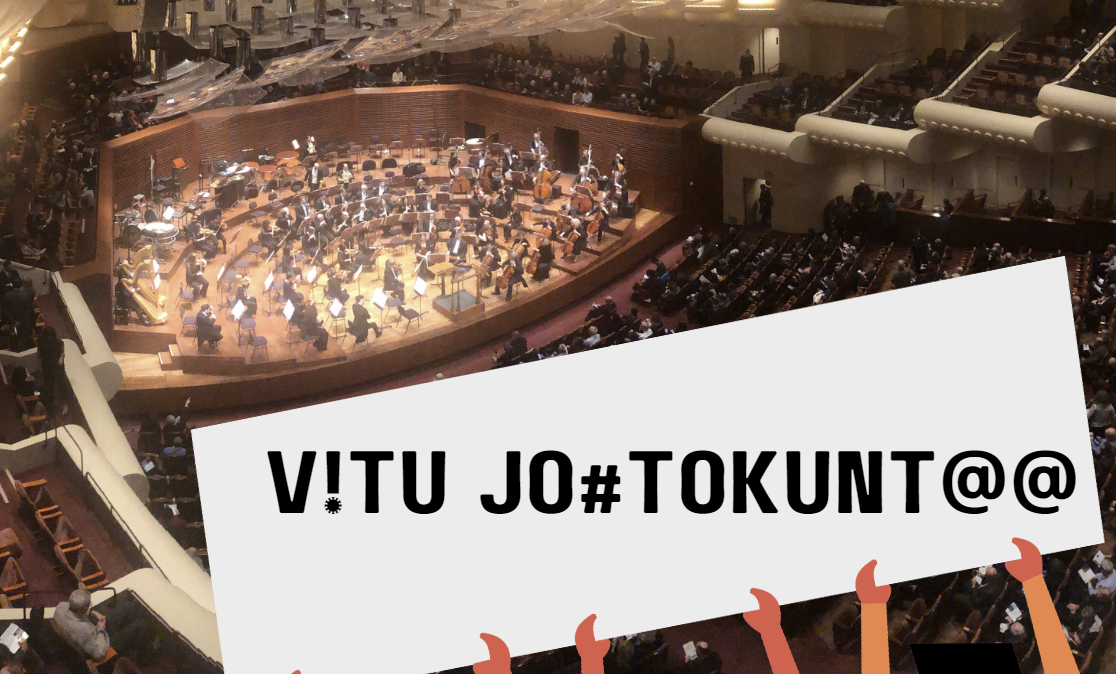
There has been a seismic development in the ongoing San Francisco Symphony saga. A patron named Laura Leibowitz went to a concert this June and held up a sign during an applause break.
The Chronicle shared the terrifying details:
Amid growing public outrage over the Board of Governors’ failure to retain the acclaimed Finnish conductor [Esa-Pekka Salonen] beyond his five-year contract ending after the 2024-25 season, audience member Laura Leibowitz displayed a sign during the June 21 performance that read “F— the board” in Salonen’s native language. An image of her with the sign went viral on social media, increasing scrutiny of the organization’s direction and finances, prompting the organization to threaten a ban of Leibowitz in Davies Symphony Hall.
Fortunately, the orchestra’s senior director of operations immediately leapt into action, writing in a letter to Leibowitz, “Should this conduct occur again, you will be subject to further disciplinary action, up to and including removal from Davies Symphony Hall and/or suspension of privileges to enter and attend activities of the San Francisco Symphony.”
Leibowitz told the Chronicle that “a ban would be devastating, as she considers the local classical music community like family. She has reached out to the ACLU to consult her rights and is considering her next move.”
Leibowitz has been a regular concertgoer at the orchestra since 1991.
Obviously, there are many lessons to take away from this violent attack on our social and symphonic mores. I thought I’d break a few of them down.
Signs are the number one threat to an orchestra’s financial sustainability. Signs are widely recognized as a gateway drug to banners, which in turn is a gateway drug to organized applause-break chants. When one angry audience member sees another angry audience member indulging in the immoral behavior, the contagion spreads. And what happens if these loud lost souls move on to even harder drugs, such as the alcohol available in the lobby? This is a slippery slope. Every time an obscene Finnish sign is raised, the San Francisco Symphony’s accumulated deficit climbs by another million dollars. We are lucky that someone intervened when they did.
Women who have been attending the symphony since 1991 are the best demographic to alienate and antagonize. The more loyal the customer, the more urgent a matter it is to ban them from your business’s premises. All for-profit corporations know this, and it’s time we start running our non-profits more like for-profits. There is an old saying in the world of business: “The customer is always wrong.” Only the stupidest businessmen do not understand this.
The timeline of this particular audience rebellion is working in management’s favor. This was not Esa-Pekka Salonen’s final bow. He still has a year left to serve as music director. And the musicians’ contract doesn’t expire until November. So even if a multi-month strike or lockout happens and knocks out the back half of Salonen’s final season, this board versus patron conflict is going to keep escalating for four more months. Fortunately, during that time, audiences definitely won’t start connecting with each other, planning additional direct actions, brandishing dozens of signs at once, or reading and writing editorials and inflammatory blog entries. There is no precedent for that in American orchestral history.
It is totally normal for orchestra patrons to contact the ACLU about interactions they’ve had with an orchestra’s management. In fact, all responsibly-governed orchestras have an entire subset of patrons and subscribers who are constantly in talks with the ACLU. Truly, a long-time patron invoking the ACLU is a (and I hate to use this word, but…) sign that the orchestra is doing everything right. People in the industry know that every world-class orchestra’s tour to Carnegie Hall kicks off with a minimum of ten patrons complaining to the press that their civil liberties have been violated.
The San Francisco Symphony needs to keep writing threatening letters to patrons who will then immediately take those letters to the press, thereby publicizing them even more, giving other patrons ideas, and cementing the public press narrative of PR-Challenged Out-of-Touch Upper Management vs. Pissed Off Patrons. This is productive! It is a wise use of staff time and resources, and speaks well about the priorities within the organization. It will not make San Francisco Symphony employees’ working lives even more miserable than they already must be.
It is long past time for orchestras to start keeping a database of concertgoers (with mugshots). Fortunately for the San Francisco Symphony, it is located in Silicon Valley. So I think there could be a productive partnership to be struck here between the orchestra board and a tech company to create some kind of facial recognition database that could better track the identities and whereabouts of these sick sign perverts. Perhaps that database could even be monetized in some way, or the information scraped to train AI with. This could be an exciting cutting-edge partnership that will lure in future donors, thereby engorging the Silicon Valley donation pipeline, since (as we all remember) Salonen couldn’t get that particular job done in four years, two of which happened during a pandemic.
Fellow audience members should warn the orchestra administration if they witness — or even hear rumors about — other audience members partaking in crafts. Perhaps a hotline could be set up to report the subversives. Public service announcements discussing the dangers of permanent markers and cardstock could be made. To underline the gravity of the situation, letters in blue envelopes with the San Francisco Symphony’s seal on them could be sent to these people to let them know that they’re under investigation. Perhaps lie detectors have a role to play here. There are no bad ideas when you’re brainstorming.
Three words: cameras in bathrooms. Extreme? Perhaps. Necessary? Yes. Hall restrooms are prime spaces in which deviant activities (such as sign assemblage) can happen. The higher-ups must monitor the goings-on. (An auxiliary benefit to monitored bathrooms would be that upper management could see who has been using too much toilet paper, which will help push the San Francisco Symphony to both financial- and eco- sustainability. We in the orchestra industry call that a win-win!)
Moving forward, every San Francisco Symphony patron must undergo a full body search before entering the concert hall. Now, this may sound extreme, but remember: we live in a post-Signgate world. Paper is more insidious than a firearm, because paper cannot be found by metal detectors. Paper is a flat substance, and, terrifyingly, can be folded. Music lovers must demand safety. If elderly volunteer ushers have to strip search us so that we can hear Mahler 3 live, then that’s the price we must pay. Great art requires great sacrifice.
Orchestras would benefit from maintaining their own paramilitary forces. Think about it. What happens if Laura Leibowitz fails to obey authority, even after being warned in a sternly worded letter that she faces a San Francisco Symphony ban? If she dares to enter and raise a second obscene Finnish sign, what is stopping her from attending a third time for, say, Bruckner’s seventh symphony (besides Bruckner’s seventh symphony)? No, she must face consequences. Of course, there’s a big problem here: the orchestra as it exists today does not have the manpower to make good on their warnings. Who is going to take Liebowitz into custody if she doesn’t comply? If I may borrow an apocryphal quote from Andrew Jackson, “The San Francisco Symphony has made its decision. Now let it enforce it.” What better way to solve this issue besides maintaining a standing army of mercenary fighters headquartered in the box office (this area could also serve as a detainment facility)? I live in hope: I believe that law enforcement can be trained so that Ms. Leibowitz can be removed from the premises without distracting other concertgoers. Her removal could be planned to coincide with brass fanfares.
In conclusion, I hope it’s clear to everyone now that these are the only paths forward to quell dissent and fulfill the orchestra’s mission statement “to inspire and serve audiences and communities throughout the Bay Area and the world through the power of musical performance.” And I know that all of my fellow orchestra lovers will agree with me.
Fortunately, there is absolutely nothing else going on right now at the San Francisco Symphony that requires management’s attention. By my count, the only problems are a music director abandoning ship, a stalled search for a new music director, an ongoing audience mutiny, an expiring musicians’ contract, a rapidly worsening PR crisis, and crippling amounts of debt. The orchestra is extremely lucky to have time to give this truly terrifying incident the attention it deserves.
I’ve been writing about orchestras for about fifteen years now, and people from Wisconsin are great writers, so I took the liberty of tossing together a few sentences that the SFS management is welcome to use or adapt when they announce the new regulations.
The executive order that the orchestra president will sign will expand security investigations to all levels of balconies, facilitating the coordination of the efforts among various departments, including the Ushers Unit, the Toilet Paper Usage Investigation Committee, and the SFS Sign Deviants Unit. Those accused and investigated will be judged based on their trustworthiness and whether they are able to commit donations that would leave them susceptible to coercion. These are people the rest of us consider sad, sick, even pathetic. Note that an investigation about concealed signage may be commenced based on the accusation of a fellow audience member, even if the fellow audience member prefers to remain anonymous. One of my friends said the other day, why worry about those individuals? You don’t claim they’re all pro-Salonen, do you? The answer is obviously no. Some of them are very energetic, very loyal patrons. Some of them have that unusual affliction through no fault of their own. We’re not disturbed about them because of their morals. We’re disturbed about them because they are dangerous to this concert hall. Thank you. God bless you. And may God bless the San Francisco Symphony.
*
Proposed orchestral soundtrack for the background music to the speech:


 Song of the Lark